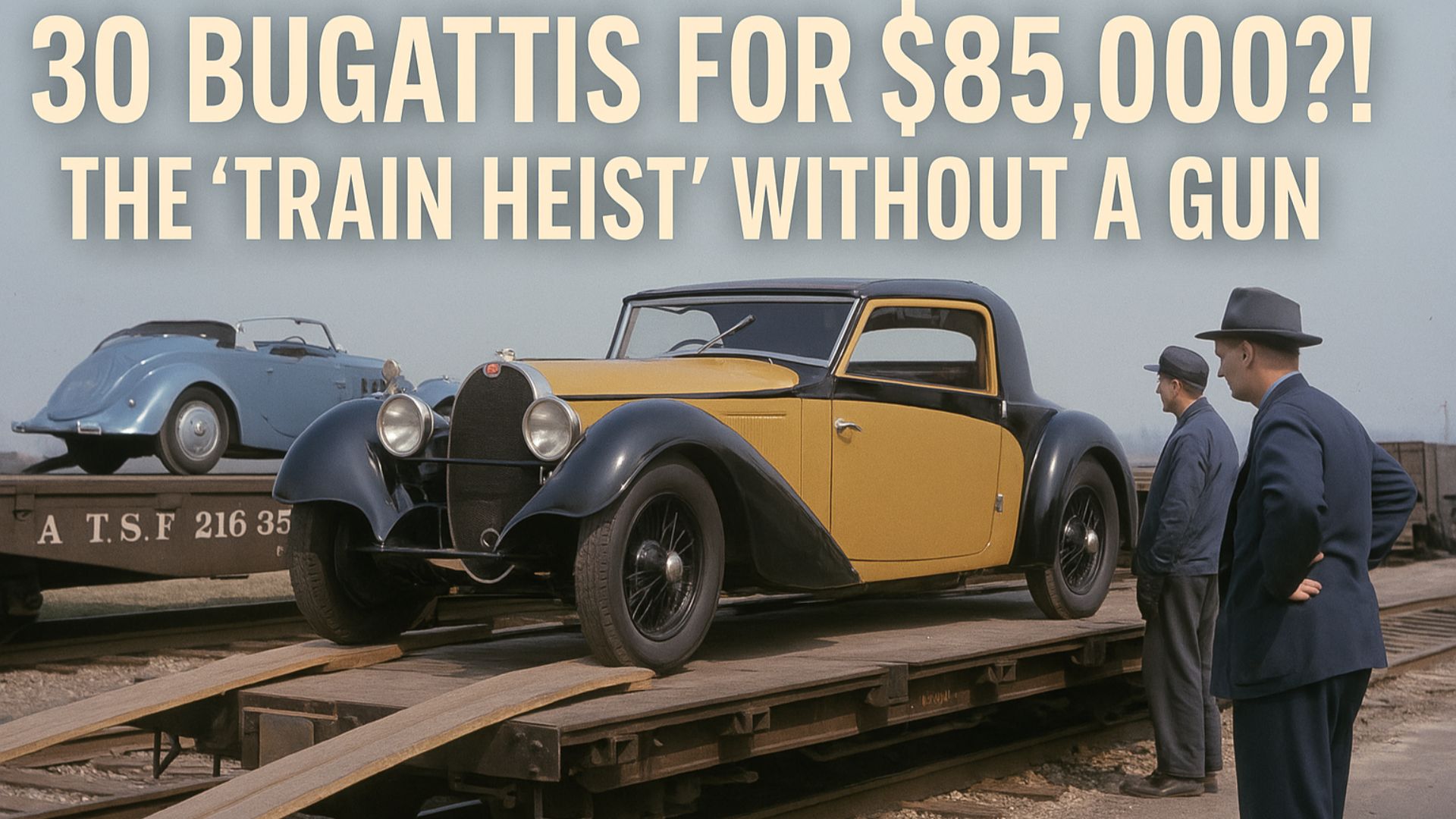
In 1964, one of the most remarkable transfers in collector car history took place—not at an auction block, but via a discreet negotiation and a train full of priceless machines. American collector John W. Shakespeare agreed to sell his 30-car Bugatti collection to French industrialist Fritz Schlumpf for just $85,000, a sum equivalent to about $720,000 today. The deal would later be dubbed a “train heist without a gun.”
Shakespeare, a wealthy enthusiast from Illinois, had amassed an extraordinary lineup of Bugattis, including a Type 41 Royale, a series of Type 57s, a rare Type 55, and even Ettore Bugatti’s eccentric Type 56 electric car. Yet despite the scope of the collection, Shakespeare grew disenchanted with the upkeep and sought to sell.
Best Labor Day Amazon Deals for Car Collectors (2025 Edition)
Enter Schlumpf, a Swiss-born textile magnate based in Mulhouse, France, whose obsession with Bugatti would ultimately define his legacy. Recognizing the opportunity, Schlumpf secured the entire collection through persistent correspondence and a shrewdly negotiated offer. The cars were loaded onto railcars in Illinois, shipped out of New Orleans, and eventually delivered to Le Havre, France.
Once on European soil, the cars became a cornerstone of what is now the Cité de l’Automobile in Mulhouse, home to more than 400 rare automobiles and the world’s largest Bugatti collection, with roughly 100 examples under one roof.
The Shakespeare sale has become legendary not only for the bargain price but also for its lasting cultural impact. What might have remained scattered across private garages instead became accessible to the public, preserved as part of one of the most important automotive museums in the world.
It was a transaction built not on force, but on letters, leverage, and timing—an $85,000 deal that forever altered the trajectory of car collecting.