
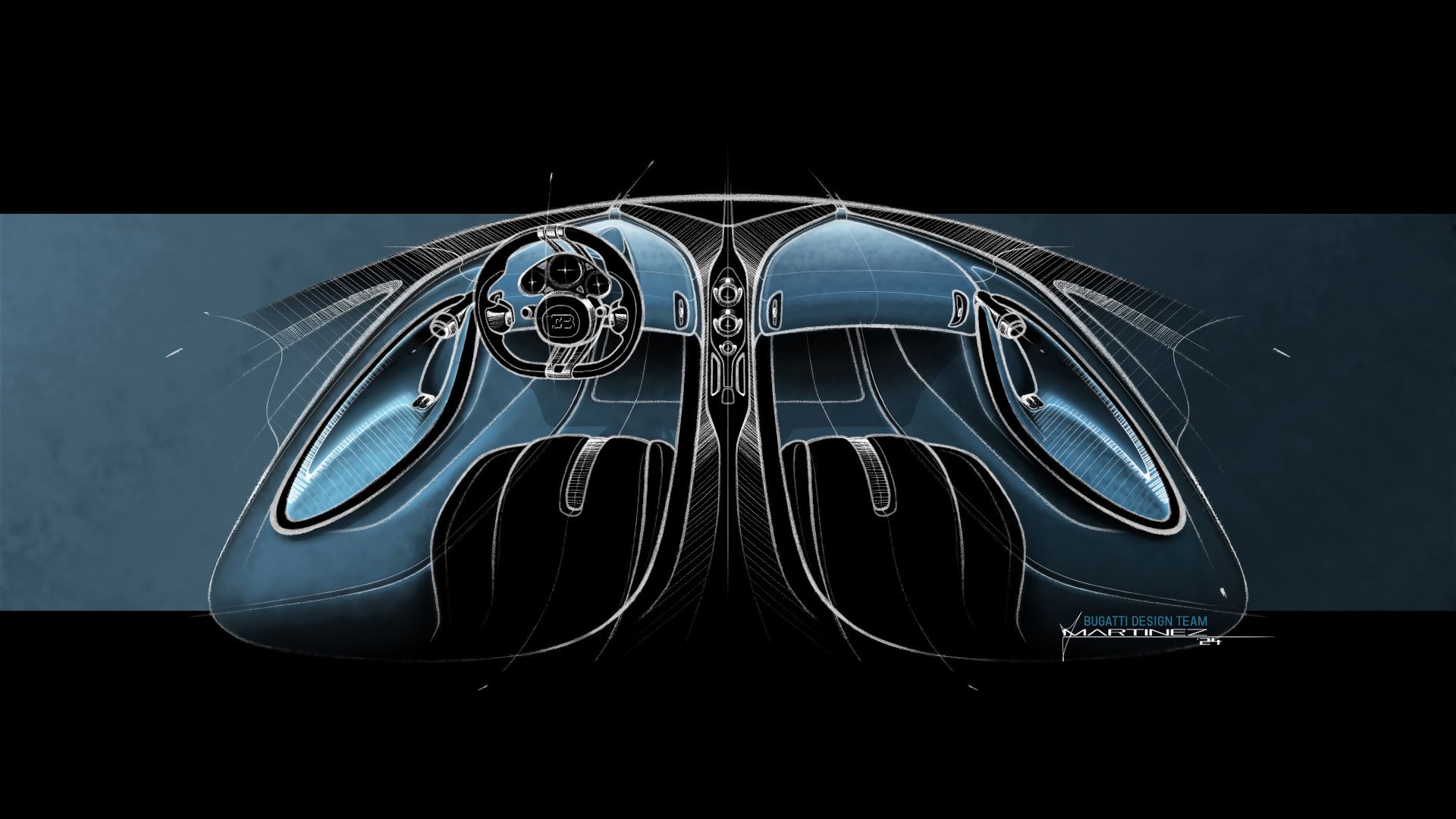
Bugatti’s newest hypercar, the Tourbillon, places interior design at the center of its vision for longevity, craftsmanship, and brand identity. As the marque enters a new era, the cabin of the Tourbillon reflects more than luxury alone, drawing deeply from Bugatti’s 116-year design lineage while responding to the practical demands of a modern road-going vehicle.
The interior concept builds on visual elements that have long defined Bugatti, including the signature center line and C-line. In the Tourbillon, these cues converge inside the cabin, creating a distinct division between driver and passenger. A central line runs through the interior in harmony with the exterior design, shaping a bespoke environment on each side of the cockpit. This architectural approach reinforces symmetry while maintaining an intimate and purposeful layout.
Material choice plays a critical role in defining the atmosphere. The Tourbillon expands beyond traditional leather applications, incorporating newly developed fabrics designed specifically for the seats and door panels. These elements are paired with supple leather to enhance texture, contrast, and sensory engagement. Bugatti refers to this approach as “car couture,” translating principles of Haute Couture into automotive design through tailored materials and craftsmanship.
While aesthetics and heritage guide the interior’s appearance, engineering considerations remain equally important. Designers worked within strict constraints related to safety, ergonomics, and real-world usability. Airbag placement, seat belt positioning, crash behavior, and occupant protection were integrated without compromising the original design intent, ensuring the cabin meets regulatory and performance requirements.
Timelessness stands at the core of the Tourbillon philosophy, echoing the watchmaking innovation from which the car takes its name. To preserve longevity and avoid short-lived trends, Bugatti deliberately minimized digital interfaces. The human-machine interaction relies primarily on physical controls designed for precise haptic feedback, while the central display remains concealed within the dashboard until needed.
The steering wheel and instrument cluster serve as the visual and functional centerpiece of the cabin. A fixed-hub steering wheel allows the rim to rotate independently around the central airbag, integrating controls and paddle shifters seamlessly. Beneath it sits a fully analog instrument cluster developed with Swiss master watchmakers, featuring mechanical components, skeletonized construction, and crystal-housed dials.
Together, these elements connect the Tourbillon’s interior to the traditions of both early Bugatti automobiles and fine horology, reinforcing a design philosophy meant to endure across generations.





 Shawn Henry