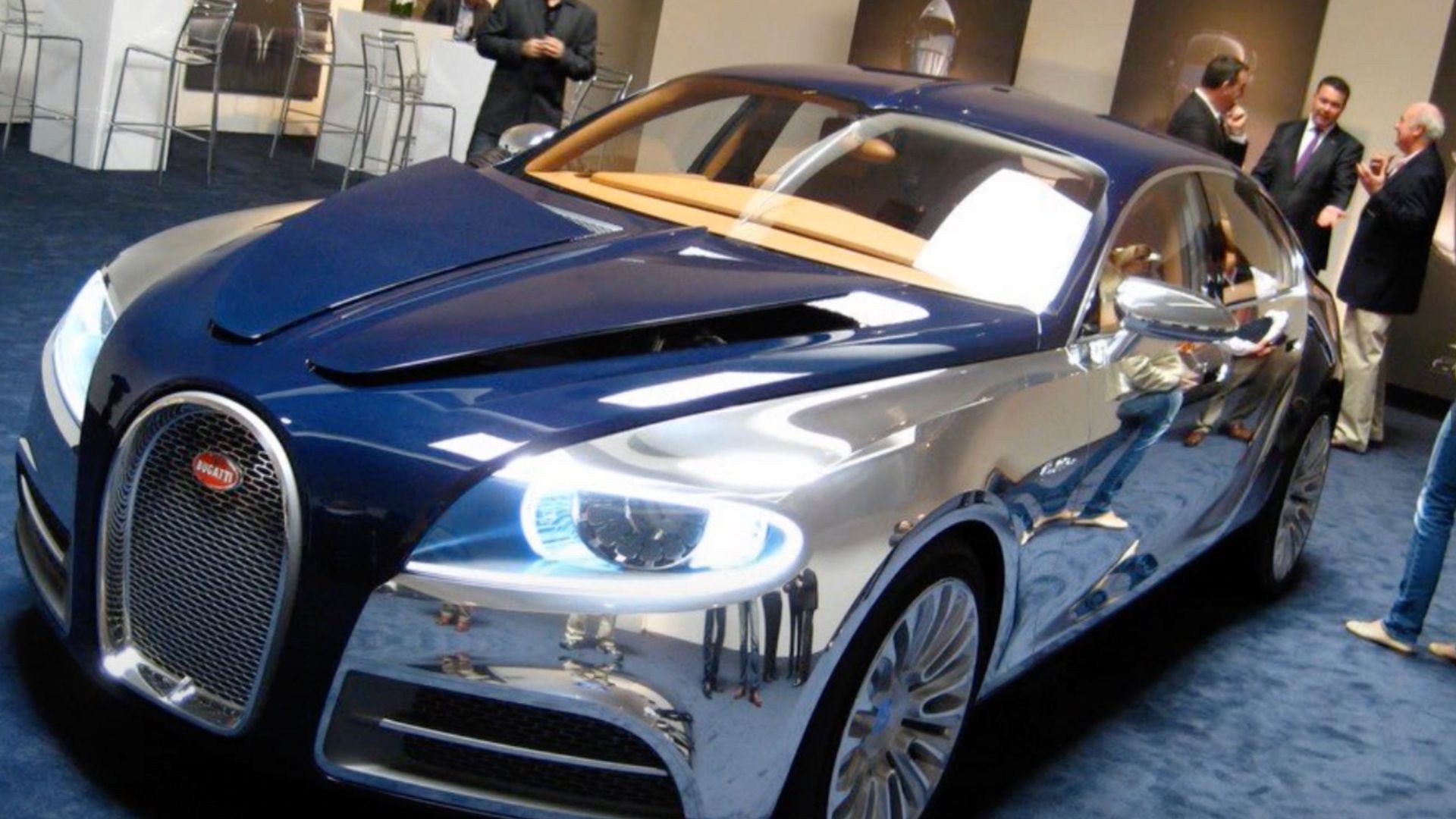
Over a decade ago, Bugatti stunned the automotive world with the unveiling of the 16C Galibier—an ultra-luxury four-door concept car with a price tag projected at over $2 million. But despite grand ambitions, the car never saw production, and only a single prototype was ever built.
Unveiled in 2009, the Galibier was envisioned as a hyper-luxurious sibling to the Veyron. Designed to blend Bugatti’s sporting heritage with executive-class comfort, the vehicle featured a hand-crafted body of dark blue carbon fiber, mirror-polished aluminum panels, and a unique interior anchored by a removable Swiss-made tourbillon timepiece that could be worn as a wristwatch.
At the heart of the Galibier was an 8.0-liter W16 engine—similar to the Veyron’s—but enhanced with twin superchargers and configured to run flex-fuel, including ethanol. Bugatti touted it as the “most exclusive, elegant, and powerful four-door automobile in the world.” It offered all-wheel drive, ceramic brakes, and a reengineered suspension system to deliver high-speed stability in a full-size luxury package.
The Galibier’s name was a nod to the legendary Col du Galibier, one of the most grueling ascents in the Tour de France, as well as to the original Type 57 Galibier—a high-performance four-door produced in the 1930s.
Yet despite strong buzz and critical praise, Bugatti ultimately shelved the project by 2013. Reports suggest that internal debates over brand direction and product positioning led to its quiet cancellation. The marque later pivoted to launch the Chiron, a two-door successor to the Veyron that stayed closer to Bugatti’s hypercar roots.
Today, the lone Galibier prototype remains a curiosity—an ambitious what-if from a brand known for defying boundaries. While it never made it to showrooms, the car remains a symbol of Bugatti’s willingness to imagine the extraordinary.
Related Posts:
- The Complete Guide to the Yenko Camaro
- Ultra-Rare Bugatti Veyron 16.4 Grand Sport “Soleil…
- The Meticulous Journey of a 2011 Bugatti Veyron's Resurgence
- Depreciation and Market Comparison of the Pontiac…
- Bugatti Unveils the Electrifying Tourbillon: A New…
- Bugatti Veyron Sang Noir Headlights Cost as Much as a Car