
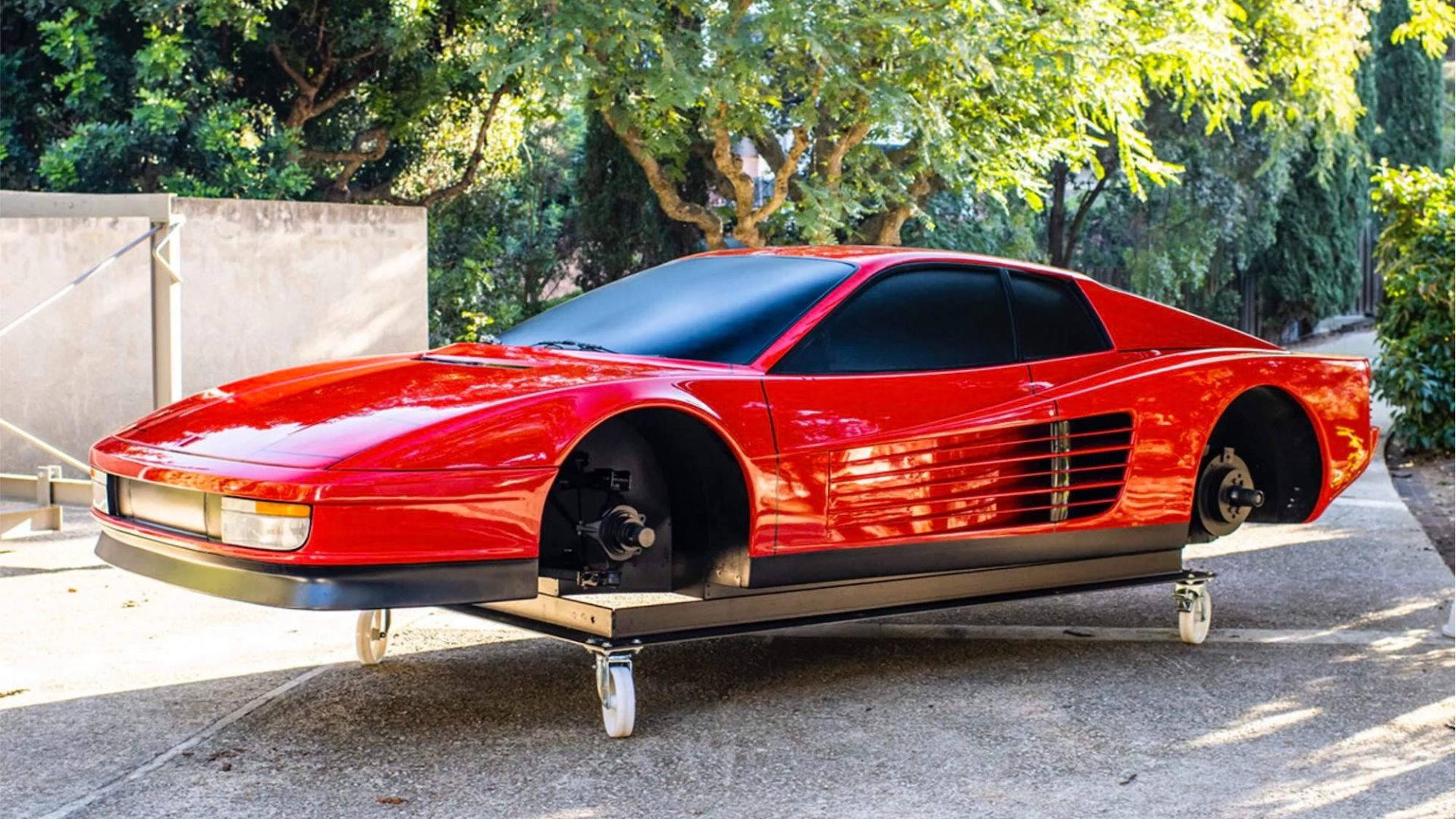
A rare full-scale design study created during the development of the Ferrari Testarossa is set to be offered for sale, giving collectors a glimpse into one of the most important styling moments of the 1980s supercar era. The 1:1 scale model represents a near-final iteration of the Testarossa’s production design and was built to showcase how the car would appear once it reached showroom floors.
Constructed from various types of resin over an internal steel frame, the model wears a red exterior with blacked-out windows, painted-on shut lines, and faux grilles and lighting elements. It rides on caster wheels for mobility and features wheel hubs designed to accept wheels, though none are currently fitted. There are no functional doors and no interior, underscoring its purpose as a visual and developmental tool rather than a display vehicle intended for public use.
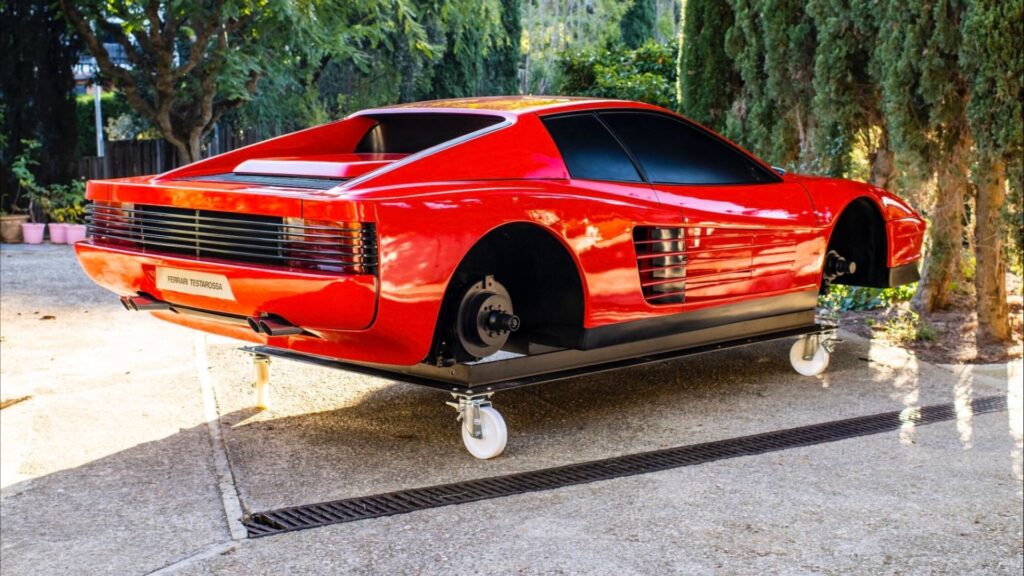
The Testarossa itself debuted at the 1984 Paris Auto Show with high expectations. Ferrari needed a successor capable of outperforming the outgoing 512 BB in sales while offering greater comfort, improved space, and stronger performance. It also needed to compete directly with the long-running Lamborghini Countach, which continued to dominate headlines at the time.
While the Testarossa is often associated with Leonardo Fioravanti, its design was the result of a broader effort at Pininfarina. Emanuele Nicosia laid out much of the original concept, with meaningful contributions from Ian Cameron, Guido Campoli, and Diego Ottina. The team focused heavily on aerodynamics and regulatory compliance, particularly for the United States, a key market previously missed by the 512 BB due to emissions and safety constraints.
Mechanically, the Testarossa evolved the flat-12 engine from the 512 BBi with double overhead camshafts per bank, four valves per cylinder, and Bosch K-Jetronic mechanical fuel injection. It was built on a tubular steel chassis with independent double wishbone suspension, anti-roll bars front and rear, and four-wheel disc brakes. Its larger footprint provided increased cabin and cargo space, appealing especially to American buyers.
Cultural exposure further fueled demand, with prominent appearances in Miami Vice and the Sega arcade game Out Run. Production ran from 1984 to 1996, including closely related variants, with nearly 10,000 examples built.
The Pininfarina Testarossa design study is scheduled to cross the auction block with Gooding Christie’s in late January, carrying an estimate of €25,000 to €50,000, or approximately $29,750 to $59,500.
 Shawn Henry