
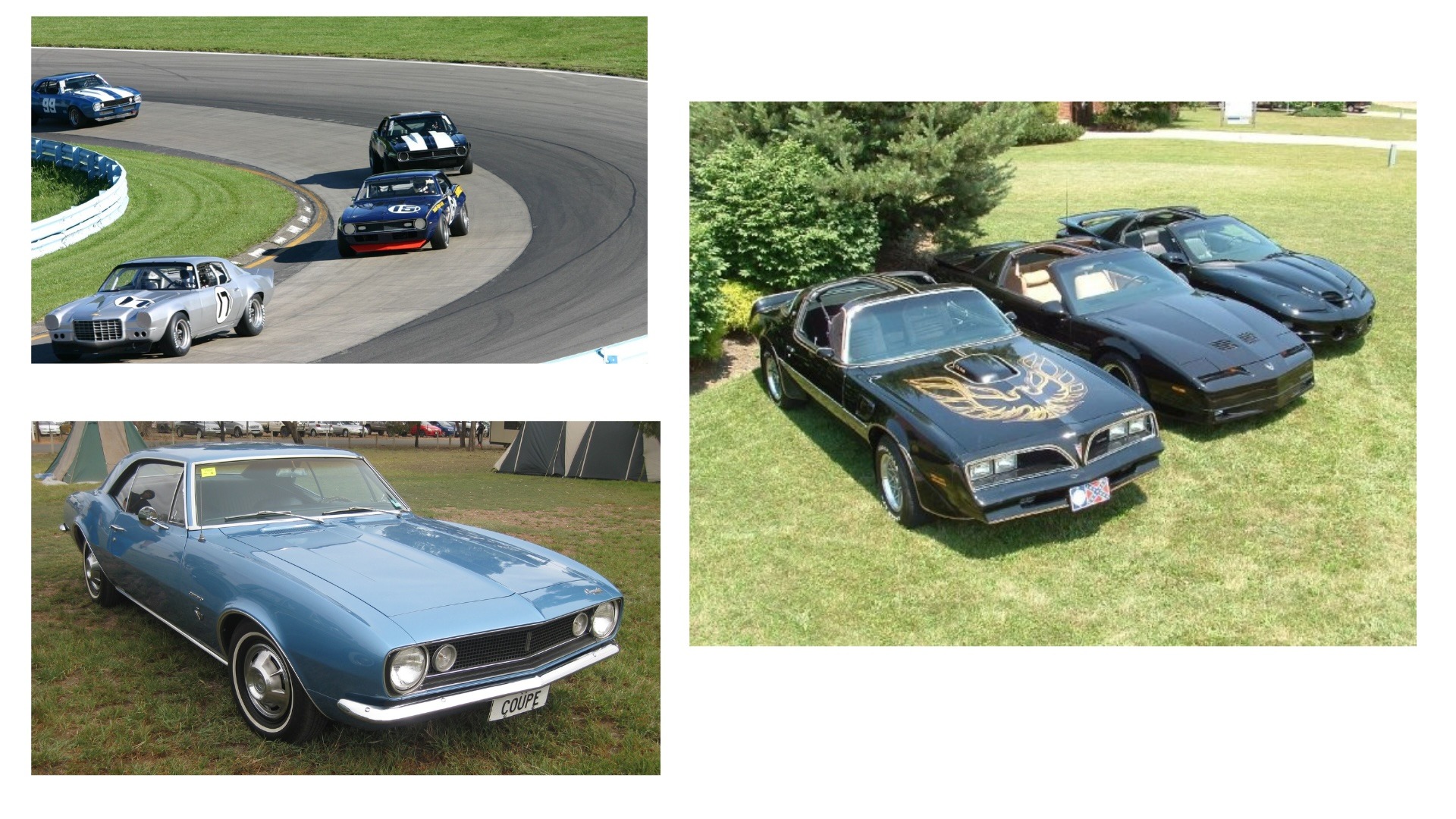
From 1967 through 2002, the Pontiac Firebird and Chevrolet Camaro were “twins” on GM’s rear-wheel-drive F-body platform, then diverged when the Firebird ended and the Camaro returned in 2010 on newer architectures (Zeta for Gen5; Alpha for Gen6). In depreciation terms, that split matters: the Firebird’s entire value story is now an all-used, all-collectible continuum (1967–2002), while the Camaro spans both collectible and modern used-car depreciation cycles (1967–2024).
Supply has always favored the Camaro. In the launch year (1967), Hagerty notes Firebird sales of 82,560 versus Camaro sales of 220,906—nearly 3:1, shaping survivorship, parts ecosystems, and market liquidity decades later. By 2026, that supply difference is visible in listings as well: Classic.com shows “for sale right now” inventory for a 1967–69 Firebird Gen1 at 44 cars versus a 1967–69 Camaro Gen1 at 352 cars.
“Base” versions typically do not deliver strong real (inflation-adjusted) returns over long horizons, even when nominal values rise. Using CPI-U data (referenced as BLS CPI-U on the CPI table) and representative Hagerty/KBB/JD Power reference values: a 1967 Firebird starting at $2,666 has a current good-condition reference of $18,600, which is still below its inflation-adjusted ~2025-dollar MSRP equivalent; the 1967 Camaro V8 coupe similarly lands near (but still under) inflation parity.
Performance trims and true rarity are where the market decisively separates winners from “drivers.” A genuine 1969 Firebird Trans Am (689 coupes + 8 convertibles, per Hagerty) is “blue-chip,” with Hagerty showing a good-condition value reference of $802,000—orders of magnitude above original pricing norms for the era. For the Camaro, Classic.com’s benchmark (“CMB”) highlights how first-gen rarity stacks (e.g., COPO and ZL-1 markets) far above mainstream Z/28 pricing.
Late F-body cars (1993–2002) generally show the steepest depreciation in both brands, particularly in base form, while top-option V8 cars (LS1/WS6/SS) retain better but still usually sit below inflation-adjusted MSRP in the mainstream retail guides. The modern Camaro (2010+) shows classic modern-car depreciation curves: large real declines over the first decade, with some stabilization signals as Gen6 (2016–24) ends.
Sources, definitions, and methodology
This report prioritizes four kinds of inputs:
- Production years, generation definitions, and qualitative vehicle history from Hagerty model histories and Classic.com market pages.
- Pricing/valuation guides: Hagerty Valuation Tools (publicly visible “#3 Good” values), J.D. Power (NADA) retail bands (Low/Average/High) for 2002 performance trims, Kelley Blue Book (KBB) for modern Camaros, and CollectorCarMarket’s Value Report (condition tiers #1–#4) to anchor condition spreads.
- Market-benchmark aggregation (Classic.com “CMB”) for iconic trims/markets (e.g., Trans Am submarkets; Camaro Z/28/COPO/ZL-1).
- Inflation adjustment: CPI-U annual averages from a CPI table explicitly describing CPI-U as provided by the U.S. Department of Labor BLS. (Because the analysis is being delivered in early 2026, the report uses 2025 CPI annual average as the latest full-year baseline.)
Key definitions used in this report
“Generation” follows common market practice for these cars: Firebird Gen1–Gen4 (1967–2002) and Camaro Gen1–Gen6 (1967–2024).
“Condition” is mapped to widely used collector tiers:
- Concours (#1), Excellent (#2), Good (#3), Fair (#4) are taken directly where available (CollectorCarMarket Value Reports).
- Where a source only exposes a “Good/#3” value publicly (common in Hagerty pages), this report treats that as a median-like driver-quality reference and uses the CollectorCarMarket spreads as an estimation scaffold when a full tier table is needed (clearly labeled as estimated).
“Modification/originality” uses Classic.com’s descriptive categories (e.g., “Original & Highly Original,” “Modified,” “Custom”), which are useful because value behavior often follows originality class more than odometer alone at the collector end of the market.
Inflation methodology and one explicit estimate
Inflation adjustments convert year-of-MSRP dollars to 2025 dollars using CPI-U annual averages. For 2010 CPI, the CPI table segment containing 2010 was not captured in the accessible excerpt during tool-limited browsing; therefore, the report estimates CPI(2010 avg) by linear interpolation between CPI annual averages for 2008 and 2013 (both visible in the CPI table). This is flagged low confidence and used only for illustrative “real” depreciation of 2010 Camaros; nominal depreciation remains directly sourced.
Timeline and platform context
Overlapping generations timeline
1970 1975 1980 1985 1990 1995 2000 2005 2010 2015 2020 2025Gen1 (F-body) Gen1 (F-body) Gen2 (F-body) Gen2 (F-body) Gen3 (F-body) Gen3 (F-body) Gen4 (F-body) Gen4 (F-body) Gen5 (Zeta) Gen6 (Alpha) Pontiac FirebirdChevrolet CamaroPontiac Firebird vs Chevrolet Camaro — production timeline by generation
Firebird and Camaro share the F-body platform from 1967 to 2002 (and are the only two vehicles commonly identified as F-body cars), after which the F-body ends. Later Camaros pivot to different architectures: Gen5 (2010–15) is noted as a Zeta-platform application and Gen6 (2016–24) as the Alpha-platform car—an architectural move frequently credited with making the sixth-gen notably lighter and more capable.
A key regional and supply nuance: the Sainte‑Thérèse, Quebec plant is documented as producing the Camaro and Firebird from 1993–2002, and Hagerty’s 1993 Camaro history explicitly states the new Camaros were built in Canada at a plant in Quebec. This matters for regional supply, export patterns, and (sometimes) buyer perceptions and documentation trails.
Comparative valuation and depreciation results
Price-retention visuals
The chart above demonstrates a consistent pattern: collector-era base trims (1960s–early 1970s) can land nearer inflation parity over multi-decade holds, while late F-bodies (especially early-1990s base cars) and modern Camaros (2010+) show steep real depreciation. The “verified points” here are built directly from the cited MSRP/value references and CPI baselines described in the methodology.
This scatter emphasizes the same conclusion another way: many cars that feel “expensive now” are still below their inflation-adjusted original price—especially in base trims after the early muscle era.
Side-by-side generation definitions and “new price” anchors
| Era | Firebird generation (years) | Camaro generation (years) | Platform anchor | Key redesign notes (very high level) | MSRP anchors used in this report |
|---|---|---|---|---|---|
| Early pony-car era | Gen1 (1967–69) | Gen1 (1967–69) | F-body | Firebird positioned as an “upmarket” pony car; Hagerty notes Firebird and Camaro differed in body and details and that Firebird sales trailed Camaro substantially. | Firebird starting price $2,666 (1967 hardtop). Camaro model pricing includes $2,572 for 1967 V8 coupe. |
| Second-gen muscle-to-malaise transition | Gen2 (1970–81) | Gen2 (1970–81) | F-body | 1970 launch timing disruptions are noted in both: Firebird’s 1970 run shortened by strike (Hagerty), Camaro Gen2 launch delayed to Feb 1970 (Hagerty). | Camaro 1970 V8 retail price $2,839. Firebird Gen2 “condition distribution” example uses 1979 Trans Am values; see below. |
| Aerodynamic/modernization era | Gen3 (1982–92) | Gen3 (1982–92) | F-body | Camaro and Firebird both shift to lighter, sharper “third gen” bodies; Hagerty highlights the 1982 Camaro’s major weight reduction and the 4-cylinder/V6 mix. | 1982 Firebird MSRP reference $8,120 (Hagerty field) and 1982 Camaro base price $8,029 (Hagerty narrative). |
| Fourth-gen F-body era | Gen4 (1993–2002) | Gen4 (1993–2002) | F-body; Canada production noted | 1993 redesign: Camaro retains floorpan/rear axle but uses radically different bodywork and materials per Hagerty. Firebird and Camaro both end 2002 (and many cars are modified, per Hagerty’s Firebird notes). | 1993 base prices: Firebird MSRP $13,995; Camaro base from $13,399 and Z28 from $16,799. 2002 performance retail bands: Firebird WS6 and Camaro SS (JD Power). |
| Post-Firebird era | — (Firebird ended 2002) | Gen5 (2010–15) | Zeta | Camaro returns after hiatus (post-2002) on a different architecture. | 2010 KBB MSRPs/values for LS and SS. |
| Modern era | — | Gen6 (2016–24) | Alpha | Hagerty describes Alpha as key to Gen6 performance capability. | 2016 and 2020 KBB MSRP/value anchors for LT/SS and LS/LT1. |
Depreciation and annualized rates using verified “base-trim” reference points
The table below reports nominal MSRP and inflation-adjusted (2025$) MSRP, compared to a current reference value (Hagerty #3 Good for classics where visible; KBB “pricing starts at” for modern used; model-year price for 1967 Camaro V8 from the Camaro options/price list PDF). CPI values shown for 1967/1970/1982/1993/2002 come directly from the CPI table excerpt.
| Model / representative trim | Rep. year | Orig. MSRP | Orig. MSRP (≈2025$) | Current reference value | Approx. age | Real value ratio (current ÷ 2025$ MSRP) | Real annualized rate |
|---|---|---|---|---|---|---|---|
| Firebird Gen1 base (starting price) | 1967 | $2,666 | ~$25,698 | $18,600 | 59 yrs | ~0.72 | ~-0.5%/yr |
| Firebird Gen3 base (Hagerty MSRP; #3 Good value visible) | 1982 | $8,120 | ~$27,090 | $5,300 | 44 yrs | ~0.20 | ~-3.6%/yr |
| Firebird Gen4 base (Hagerty MSRP; #3 Good value visible) | 1993 | $13,995 | ~$31,181 | $3,700 | 33 yrs | ~0.12 | ~-6.3%/yr |
| Camaro Gen1 V8 coupe (model price + #3 Good value) | 1967 | $2,572 | ~$24,792 | $21,900 | 59 yrs | ~0.88 | ~-0.2%/yr |
| Camaro Gen2 base V8 Sport Coupe | 1970 | $2,839 | ~$23,557 | $16,000 | 56 yrs | ~0.68 | ~-0.7%/yr |
| Camaro Gen3 base Sports Coupe | 1982 | $8,029 | ~$26,786 | $7,800 | 44 yrs | ~0.29 | ~-2.8%/yr |
| Camaro Gen4 base (1993) | 1993 | $13,399 | ~$29,853 | $4,200 | 33 yrs | ~0.14 | ~-5.8%/yr |
| Camaro Gen5 LS Coupe (KBB: MSRP vs current; real rate uses CPI estimate) | 2010 | $24,985 | ~$36,174 (est.) | $8,200 | 16 yrs | ~0.23 | ~-8.9%/yr (est.) |
| Camaro Gen6 LT Coupe (KBB) | 2016 | $29,685 | ~$39,819 | $15,700 | 10 yrs | ~0.39 | ~-8.9%/yr |
| Camaro Gen6 LS Coupe (KBB) | 2020 | $25,995 | ~$32,336 | $18,100 | 6 yrs | ~0.56 | ~-9.2%/yr |
Condition sensitivity example using an actual condition-tier value report
Because condition tiers materially drive collector pricing, the following chart uses CollectorCarMarket’s published values for a 1979 Firebird Trans Am (Concours/Excellent/Good/Fair).
This is a value-weighted visualization (how the dollars spread across tiers), not a count of how many cars exist in each condition.
Drivers of value differences
Condition, mileage, and documentation effects
Condition and mileage influence both price level and depreciation path. Hagerty’s own Q&A notes that lower mileage generally increases classic car value because it can imply greater originality and less wear, while also acknowledging that extremely low mileage can carry maintenance needs from lack of use. In mainstream used-car appraisal tools, a consistent benchmark assumption is often “12,000 miles driven per year,” which Edmunds explicitly uses for its value estimates—illustrating how mileage is normalized (and penalized) in modern depreciation modeling.
Documentation (build sheets, PHS-style records where relevant, matching-numbers drivetrains, correct-code engines for Z/28/WS6/SS cars, and ownership history) tends to matter most in the highest-value submarkets—because it reduces “authenticity risk,” which directly impacts liquidity at auction.
Modification and restoration: when it helps, when it hurts
At the collector end, originality is often a pricing “multiplier,” but not in a simplistic way. Classic.com distinguishes Original & Highly Original, Modified, and Custom vehicles, noting that modified/custom vehicles are typically not easily returned to factory specification—an important reason why modified cars can have a lower ceiling than equally clean originals in some buyer segments even when the build cost is high.
For late F-bodies, the modification dynamic is especially strong. Hagerty’s Firebird Gen4 discussion emphasizes that many examples “have therefore been modified, driven hard and racked up a lot of miles,” which increases dispersion: stock, documented cars can command premiums, while heavily modified/high-mile cars trade on a different curve.
A practical synthesis for valuation (collector-market oriented):
- Reversible, period-correct upgrades (e.g., correct wheels, correct-carb rebuilds, factory-option restorations) tend to be less value-destructive than irreversible changes.
- Restomods can command strong money but usually compete in a different buyer pool than “numbers-matching” cars; the market often prices them on execution quality and drivability rather than on original MSRP lineage.
- Drivetrain swaps (e.g., non-original engines in models where authenticity is core—Z/28, documented Trans Am packages) can materially reduce value relative to an equivalent-condition matching-numbers car.
Rarity, pop-culture influence, and racing pedigree
Rarity and story are the two compounding forces that most reliably overpower ordinary depreciation.
For the Firebird:
- Hagerty calls the 1967–69 Firebirds “relatively scarce” compared with same-vintage Camaros, and for the 1969 Trans Am it documents production at 689 coupes + 8 convertibles.
- Pop culture is explicitly part of the Firebird value narrative: Hagerty notes “Smokey and the Bandit”–era pull for Trans Ams and cites Knight Rider’s modified Firebird as a high-visibility cultural anchor (even as it jokes about “tachyon pulses”).
- Special editions can be numerous yet still demand-strong. For example, Hagerty highlights 1979 Trans Am production exceeding 100,000 cars and notes the 10th Anniversary package price point and order volume—useful context for why “Special Edition” doesn’t always mean “rare,” but can still be collectible if the story is big.
For the Camaro:
- Hagerty describes the 1967 Z/28’s original intent (SCCA Trans-Am series), and provides a concrete rarity anchor: 602 Z/28s built for 1967.
- The Camaro options/production/price list document provides additional grounding for 1967 model pricing (e.g., $2,466 6-cylinder coupe; $2,572 V8 coupe) and engine usage including the 302 count.
- Later historical events (e.g., Indy pace car themes) also appear as part of the Camaro story: Hagerty notes the 1982 Camaro Indy Edition Z28 and provides counts/prices and the model mix by engine—valuable for understanding how supply was distributed among I4/V6/V8 cars.
Finally, the “homologation halo” and racing brand equity (Z/28 and Trans Am naming itself) are durable demand-side forces: they keep top trims buoyant even when base trims behave like ordinary used cars.
Current market standings and regional differences
Snapshot of 2026 market positioning
By aggregated benchmarks (Classic.com CMB), the market shows a clear hierarchy:
- Firebird/Trans Am submarkets:
- Trans Am (1969 only) CMB $150,610;
- Trans Am “Super Duty” (1973–74) CMB $104,024;
- Trans Am Special Edition (1976–81) CMB $68,778;
- Trans Am (1982–92) CMB $25,414;
- Trans Am (1993–2002) CMB $25,763.
- Camaro Gen1 halo markets:
- Z/28 (Gen1) CMB $100,507;
- COPO (Gen1) CMB $187,271;
- ZL-1 (Gen1) CMB $563,719.
These benchmarks align with the broader depreciation story: the biggest “winners” are the cars where rarity, provenance, and narrative are strongest.
At the late F-body end (2002 performance trims), J.D. Power’s retail bands provide an apples-to-apples mainstream guide comparison:
- 2002 Firebird Trans Am WS6 (coupe): Original MSRP $30,780; Low Retail $7,050; Average Retail $12,600; High Retail $21,400.
- 2002 Camaro SS (coupe): Original MSRP $27,620; Low Retail $10,000; Average Retail $17,200; High Retail $26,400.
Both show real depreciation versus inflation-adjusted MSRP (using CPI values for 2002 and 2025), but the Camaro SS’s retail curve appears less severe in the J.D. Power retail bands than the WS6.
Regional notes: US-first, but not US-only
The market is US-centered for both nameplates, but there are meaningful regional mechanics:
Canada: production location and supply channels matter. The Sainte‑Thérèse plant’s documented production of both Camaro and Firebird in 1993–2002 and Hagerty’s note that 1993 Camaros were built in Quebec are relevant for provenance and cross-border used supply.
Europe: Camaro availability widened in the Gen5 era. GM Authority reproduces a GM press release stating the “all-new Chevrolet Camaro” would arrive at European Chevrolet showrooms in spring 2011. This aligns with broader reporting that Chevrolet’s European strategy retained halo imports even as the mainstream Chevrolet brand withdrew from Europe.
Australia/New Zealand: late-model Camaros became available via right-hand-drive conversion programs. Street Machine reports Holden/HSV confirmation that from mid-2018 Camaros would be converted to RHD and distributed through HSV dealers in Australia and New Zealand. This conversion pathway can create region-specific premiums/discounts versus US pricing due to compliance cost, conversion quality variance, and LHD/RHD buyer preferences.
Sources consulted
Hagerty Valuation Tools and model histories for Pontiac Firebird and Chevrolet Camaro (multiple years and trims), including production/price history and publicly shown “#3 Good” values.
Classic.com market pages and submarket benchmark (“CMB”) summaries for Firebird/Trans Am and Camaro halo markets.
J.D. Power (NADA) used values pages for 2002 Firebird Trans Am WS6 and 2002 Camaro SS, including Original MSRP and Low/Average/High Retail bands.
Kelley Blue Book (KBB) MSRP and current pricing snapshots for modern Camaros (2010, 2016, 2020).
CollectorCarMarket Value Reports for condition-tier spreads (1979 Firebird Trans Am; 1969 Camaro Z/28).
CPI-U table (CPI described as CPI-U provided by BLS) used for inflation adjustment to a 2025-dollar basis, with specific year CPI references drawn from the table excerpts.
Regional production and distribution references for Canada (Sainte‑Thérèse) and export availability in Europe/Australia.

 Shawn Henry