

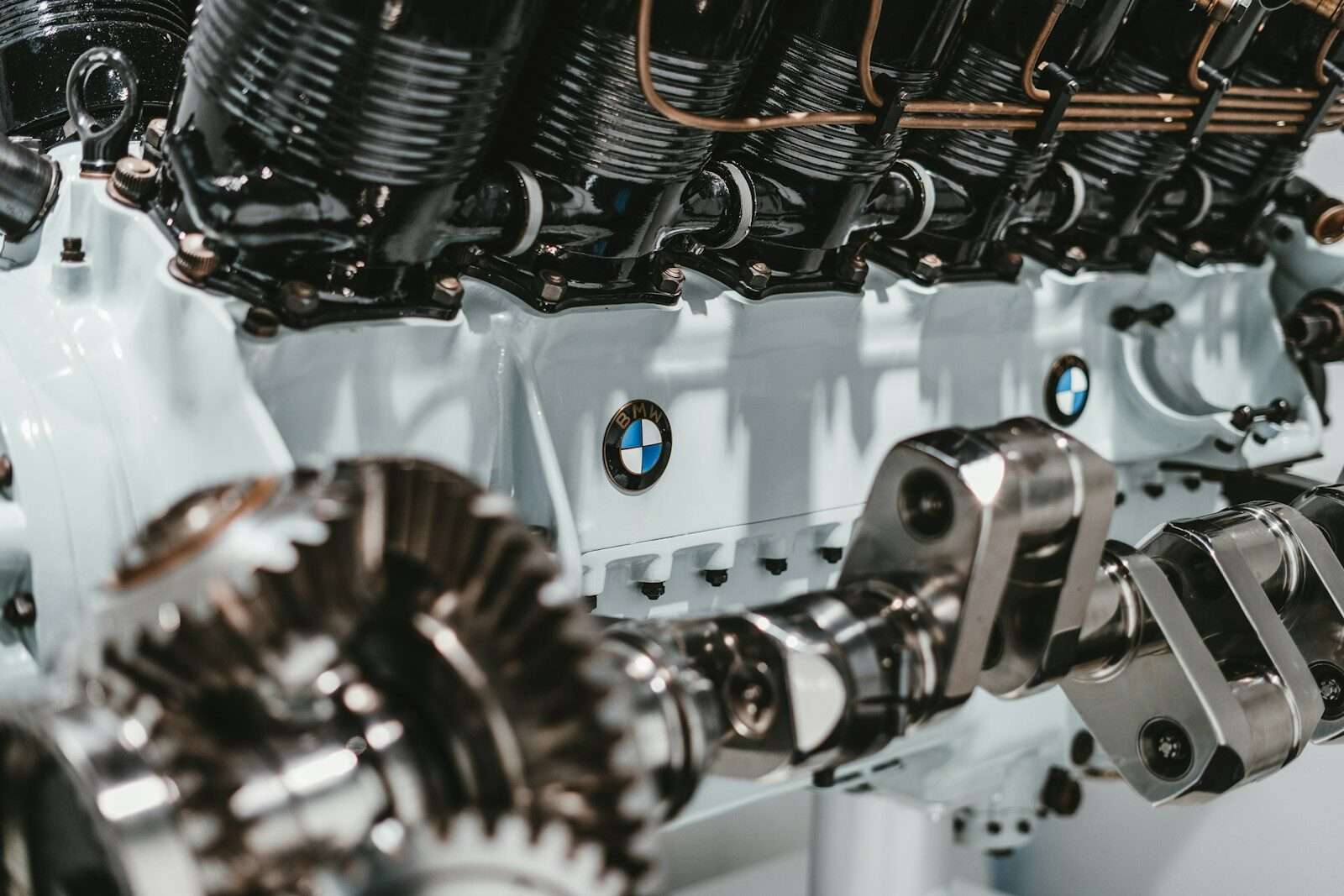
Every so often a listing surfaces that has nothing to do with a car at all, and everything to do with why cars matter. This week it’s a bare engine: a BMW M10 four-cylinder, rebuilt to 1.9 liters in 2022, paired with a Getrag 240 five-speed dogleg gearbox, offered at no reserve out of Phoenix with a current bid of $500. There’s no chassis attached, no VIN to research, no paint color to debate. Just an engine, a transmission, and a stack of invoices.
It’s also one of the more honest artifacts of vintage racing to cross the block this year, and it says something worth paying attention to about how serious collectors are learning to value documentation over drama.
The real story here isn’t the $500 current bid. It’s what the M10 represents, and why a stripped-down engine and gearbox can carry more legitimate history than plenty of complete cars do.
The M10 is BMW’s longest-serving engine architecture, introduced in the 1962 BMW 1500 and remaining in production, in various displacements, through the final 318i models built in 1988, a 26-year run spanning three generations of BMW’s compact sedan. It powered the 1600 and 2002, the E21 and E30-generation 318i, and later versions of the 5 Series. That alone makes it one of the more historically significant four-cylinder blocks in postwar engineering, but the M10’s road-car longevity is only half the story.
The other half happened in Formula One. BMW’s turbocharged M12/13/1 engine, which carried Nelson Piquet to the 1983 World Championship in the Brabham BT52 and remained on the grid through the mid-1980s with teams including Arrows and Benetton, was built around the same cast-iron M10 block found in ordinary family sedans. In qualifying trim, that same architecture was reportedly pushed well past 1,300 horsepower. Few production engine blocks in history have spanned that range, from commuter-car duty to Formula One grid, without a fundamental redesign. BMW’s motorsport commitment in this era wasn’t limited to four-cylinders, either. The factory’s 3.0 CSL program, which Modern Car Collector explored when a first M-prototype example surfaced for sale in the U.K., ran concurrently on inline-six power, underscoring how central touring car and endurance racing were to BMW’s identity throughout the M10’s working life.
The M10 block, fitted with a twin-cam 16-valve cylinder head, also became the basis for the S14 under the hood of the E30 M3, including the rare Evolution II variant Modern Car Collector featured when an example surfaced on Bring a Trailer. That’s the same car whose standing among BMW M’s most coveted performance icons we examined in our look at RM Sotheby’s Best of M Collection, and a lineage worth remembering any time an M10, in any form, changes hands.
None of that history is printed on the invoice for this particular engine. But it’s the reason a stripped four-cylinder and a gearbox are worth discussing at all.
What’s actually being sold is more modest, and more useful, than F1 trivia. This M10 was bored and built to 1.9 liters, a common move in production-based racing, where classes are frequently capped at 2.0 liters and builders extract every legal cubic centimeter before hitting the limit. Fitted with forged pistons, a reworked and honed intake manifold, enlarged intake and exhaust valves, RC Engineering fuel injection components, and an Ireland Engineering fuel pressure regulator, it was built specifically for endurance racing, not for a dyno queen or a show stand. The build backed up its specification with actual use: approximately ten races in a 1985 BMW 318i, with the work split between Top End Performance in Chatsworth, California, and Ultimate Auto Works in Scottsdale, Arizona, two shops, two states, and a documented trail that most vintage race engines never carry.
The Getrag 240 gearbox tells its own small story. It’s a dogleg five-speed, meaning first gear sits down and to the left, isolated from the standard shift pattern, so the four gears a driver actually uses on track, second through fifth, fall into a simple, fast H-pattern. It’s a layout borrowed from period rally and touring car practice, and it signals that whoever built this drivetrain understood exactly what they were building it for.
For most people, an engine and gearbox without a car around them isn’t a collectible. It’s a parts listing, which is exactly how Bring a Trailer classifies it, filing the lot under automobilia rather than automobiles. But for the growing population of owners campaigning 2002s, E21s, and early E30s in vintage and historic racing, this is precisely the kind of listing that solves the hardest problem in the hobby: finding a race engine whose history is actually known. Buy a running 2002 out of a barn and you inherit someone else’s guesses about what’s inside the block. Buy this, and you inherit dyno sheets, shop invoices, and a race log.
That distinction, a documented build versus an assumed one, is where real value lives in this corner of the market, and it’s a different kind of provenance than the ownership chains and matching-numbers debates that dominate coverage of six- and seven-figure cars. Nobody is going to authenticate this engine’s numbers against a factory build sheet. What buyers are authenticating instead is workmanship: which shops touched it, what parts went in, and how it performed before it came off the car. In parts and automobilia, that’s the entire game, and the same due-diligence instincts we’ve outlined in our guide to buying a car at auction still apply here: read the invoices, verify the shops, and never assume no reserve means underpriced.
The $500 current bid isn’t a market signal worth taking seriously. No-reserve parts listings routinely open low and finish according to how many people actually need what’s being sold, not according to any broader read on BMW values. What is worth taking seriously is that a listing like this exists at all, cataloged with the same rigor applied to seven-figure Ferraris. That’s a sign the market for correctly documented vintage race components has matured enough to support real due diligence, rather than trading purely on word of mouth in the paddock.
The M10 never needed to be rare to matter. It needed to be everywhere, under the hood of a million commuter sedans and, briefly, in the highest-strung engine bay in motorsport, before anyone thought to treat it as history. That’s a useful reminder for collectors chasing the next undervalued platform, a subject we’ve returned to often in our coverage of the market’s most undervalued collector cars: the components worth owning aren’t always the ones nobody built. Sometimes they’re the ones nobody stopped building, long after everyone assumed the story was over.
For whoever ends up owning this particular engine, the appeal isn’t nostalgia. It’s simpler than that: a documented, race-proven M10 and a correctly configured dogleg gearbox save months of guesswork for anyone bringing a vintage BMW back to the grid. That’s not a headline. It’s just the kind of detail serious collectors already know to look for.
The collector car market, every weekday morning.
Auction results, price moves and what’s crossing the block, read in four minutes. Free, from Modern Car Collector.
No spam, unsubscribe in one click. Or read more about the Brief.



 Kyle Matthews