

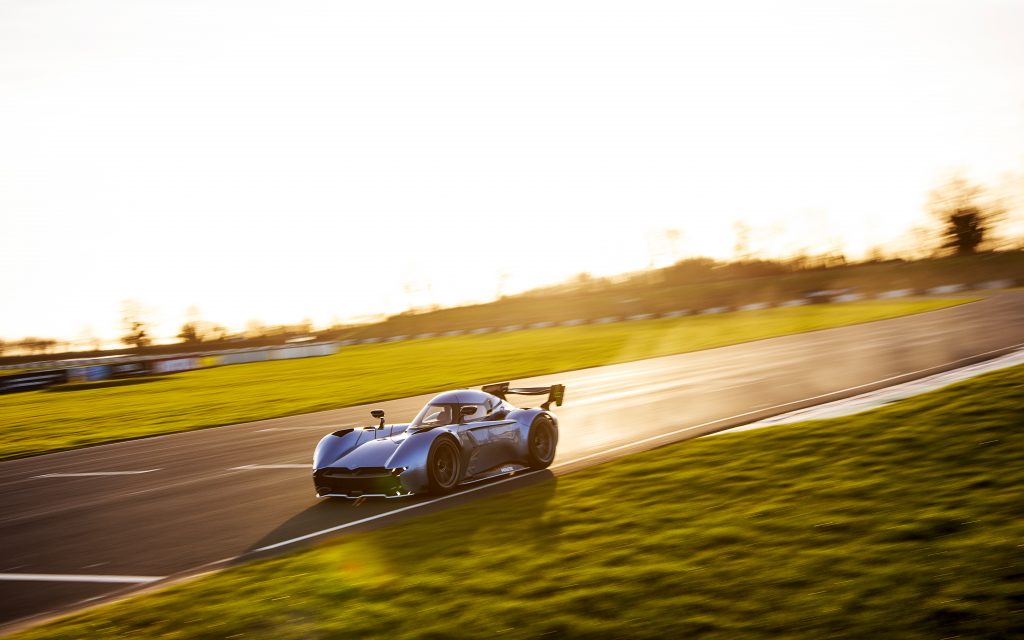
On August 4, McMurtry Automotive announced that its Spéirling PURE will make its first public appearance in full production form at The Quail during Monterey Car Week, followed by a static display at Laguna Seca. It’s a milestone worth noting, but not for the reason most coverage will lead with. The headline number will be the roughly $1.3 million price. The real story is what the Spéirling PURE brings back from motorsport’s history of technology that was once effective enough to be outlawed.
Fan-generated downforce is not a new idea. In 1970, Jim Hall’s Chaparral 2J used an auxiliary engine to drive a rear-mounted fan that sucked the car onto the track, and it was banned from Can-Am competition before the season was out. In 1978, Gordon Murray’s Brabham BT46B won the only Grand Prix it ever entered, then was withdrawn under pressure from rival teams before it could race again. Readers who followed our recent look at a Dan Gurney-modified Lola T70 already know how seriously today’s market treats Can-Am-era provenance; the Chaparral came out of that same paddock, one season before it was shut down. For almost fifty years, “fan car” has been paddock shorthand for an idea too effective to allow.
McMurtry Automotive spent roughly a decade turning that outlawed idea into a customer product. The company was co-founded by Sir David McMurtry, the engineer who invented the touch-trigger probe and built Renishaw into a global metrology supplier employing more than 5,000 people before his death in 2024. His engineering partner and the company’s managing director, Thomas Yates, came from Mercedes-AMG’s Formula 1 powertrain division. That pairing, precision-measurement instincts alongside top-level motorsport engineering, has more bearing on the Spéirling PURE’s credibility than any single spec on its data sheet.
Conventional aerodynamics only work as fast as the air moving over them; a wing produces nothing at a standstill. McMurtry’s Downforce-on-Demand system, a pair of electric fans mounted beneath the carbon monocoque, generates up to 2,000kg, roughly 4,400 pounds, of downforce independent of road speed, available from a dead stop. That single detail is why the car has been able to demonstrate holding itself to a ceiling, and why nearly every record it has set has come with a caveat that the car was barely being asked to try.
Those records aren’t a marketing footnote, either. At the 2022 Goodwood Festival of Speed, the Spéirling prototype posted an outright hillclimb time that beat the unofficial benchmark set years earlier by a McLaren MP4/13 Formula 1 car, making it the first fan car to compete in sanctioned motorsport since the Brabham ban. It has since taken the closed-wheel record at Hockenheim, a hillclimb record on Laguna Seca’s Corkscrew, and beaten a 2004 Renault Formula 1 car’s long-standing mark around Top Gear’s test track by more than three seconds.
What arrives at The Quail is not the record-setting prototype but a substantially re-engineered production car, hand-built at a new factory in the Cotswolds with, McMurtry says, 95 percent new components. Battery capacity rises to 100kWh from the 60kWh used in testing, the wheelbase grows to accommodate it, and the finished car is quoted at 1,000 horsepower, a 190mph top speed, and a 0-60mph time of 1.55 seconds. We covered the prototype’s most viral moment, a demonstration that its downforce could theoretically hold the car to a ceiling, back in February. The production version is the more consequential follow-up, because it’s the one customers will actually take home.
For collectors, the more revealing detail isn’t the price. It’s who has been shaping the finished specification. McMurtry says feedback from its earliest deposit holders directly influenced the production car, an unusually direct customer role that echoes how coachbuilders once worked with individual clients rather than a product-planning department. Because every Spéirling PURE is track-only, single-seat, and hand-built in low volume, the provenance questions that will eventually matter, which chassis set which record, which car carries which driver’s data, sit closer to those asked of a period race car than a typical limited-run road hypercar. That’s a different kind of collectibility than horsepower or a badge, and it’s one the market has historically rewarded in machines like the Chaparral and the Brabham, both of which now sit in museums rather than trade as tradeable stock.
It also arrives alongside a small wave of low-volume, single-seat track hypercars, including New Zealand’s Rodin FZero, suggesting the format itself, not just McMurtry’s version of it, is becoming a genuine category rather than a one-off curiosity.
Collectors have spent decades discussing the Chaparral 2J and the Brabham BT46B as ideas that were shut down before they could be fully realized. The Spéirling PURE is the first time that idea has shipped with a delivery date instead of a rulebook citation. Whether it becomes a footnote or a milestone in electric performance will depend less on its lap times than on what McMurtry does with the next hundred cars, and on whether the deposit holders who helped shape it are remembered as its first true owners, or its first test pilots.
The collector car market, every weekday morning.
Auction results, price moves and what’s crossing the block, read in four minutes. Free, from Modern Car Collector.
No spam, unsubscribe in one click. Or read more about the Brief.

 Shawn Henry
  Kyle Matthews
  Eve Nowell