

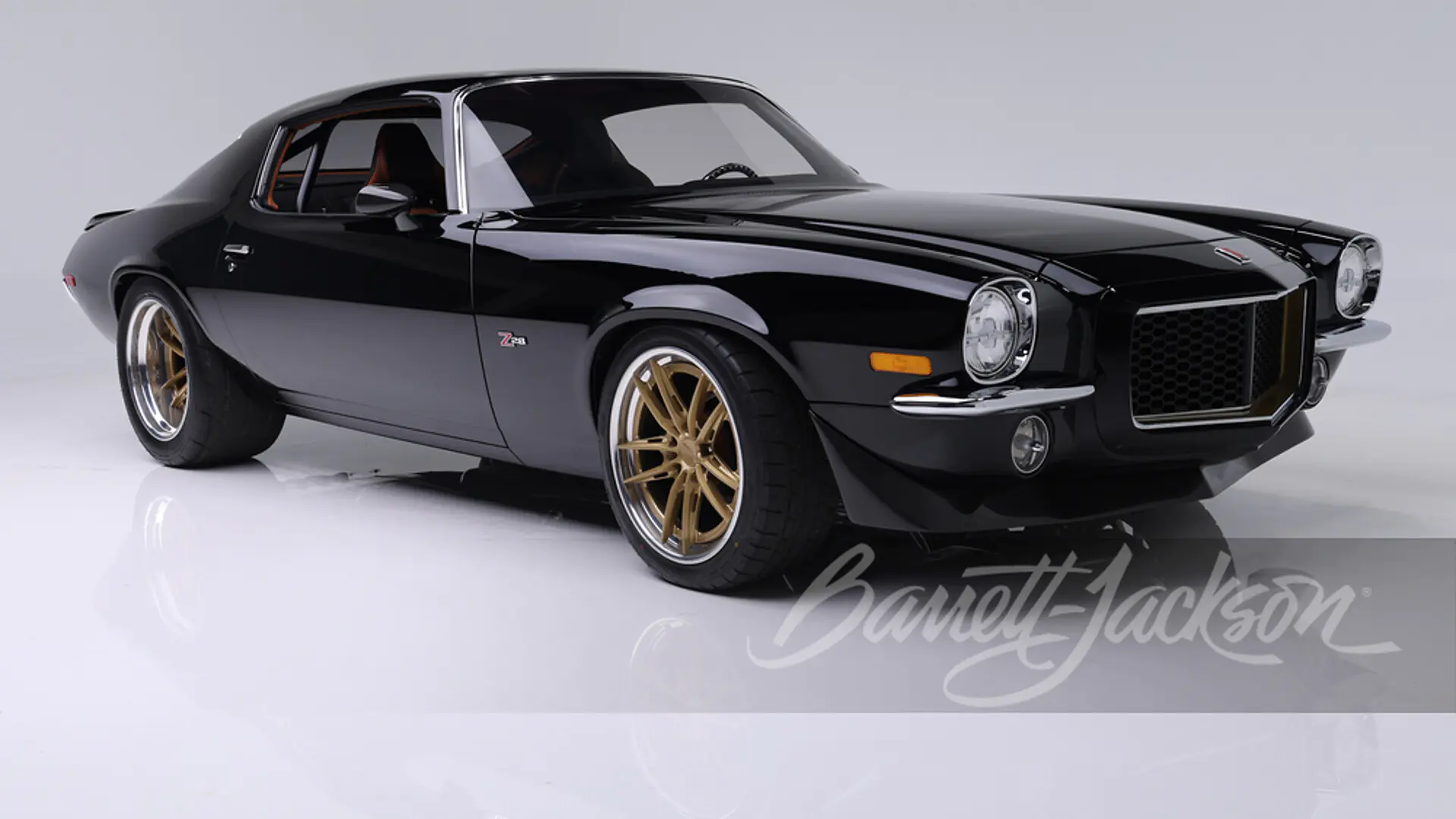
Barrett-Jackson’s Scottsdale block has long been the proving ground for cars that are built rather than found, a market we examined when we asked what an “official” Eleanor Mustang is worth. The 2027 docket includes a cleaner test of the idea than most: a 1972 Chevrolet Camaro known as “Slammer,” offered at no reserve, powered by a 650-horsepower Chevrolet Performance LT4 crate engine and finished by Garret’s Rod Shop.
The argument worth making is that the car underneath is the least important thing about it. In this corner of the market, the builder’s name is the provenance.
A Modest Donor, by Design
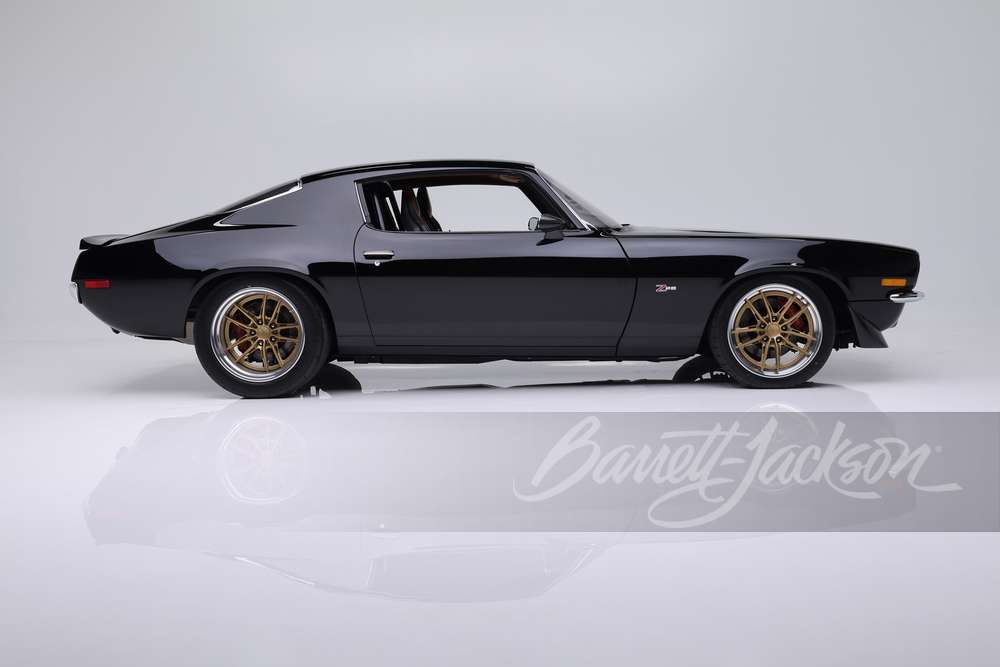
The 1972 Camaro is not a car collectors dream of finding in a barn. It sits in the second generation, after the 1967–69 cars that command the headlines, and its model year was disrupted by a long strike at General Motors’ Norwood, Ohio, assembly plant, which held production to roughly 68,000 cars. The plant code in this car’s VIN points to Norwood. Low volume, in this case, did not translate into a premium, because the cars that carry the value in this generation are the Z/28 and the documented, well-optioned survivors. A base coupe is the opposite: an inexpensive, honest foundation with a handsome chrome-bumper shape, and one a builder can strip without destroying anything a purist would grieve.
That is the first thing a serious buyer should register. Nobody bidding on “Slammer” is paying for matching numbers, a build sheet or a Protect-O-Plate. They are paying for what was done to the car, and for the confidence that it was done properly.
The Tech Sheet Is the Documentation
Barrett-Jackson’s listing reads like a bill of materials, and for this kind of car that is exactly the right document. The 6.2-liter supercharged LT4, the same engine family Chevrolet fitted to the Corvette Z06 and Camaro ZL1, is paired with a Bowler Performance 4L80E automatic, a 12-bolt rear with Moser axles and an Eaton Truetrac differential, and a General Motors ECU tuned with HP Tuners. The chassis retains a General Motors frame, now carrying Ridetech control arms and spindles, Fox coilovers and Borgeson steering. Stopping duty falls to Wilwood six-piston front and four-piston rear calipers over 14-inch rotors.
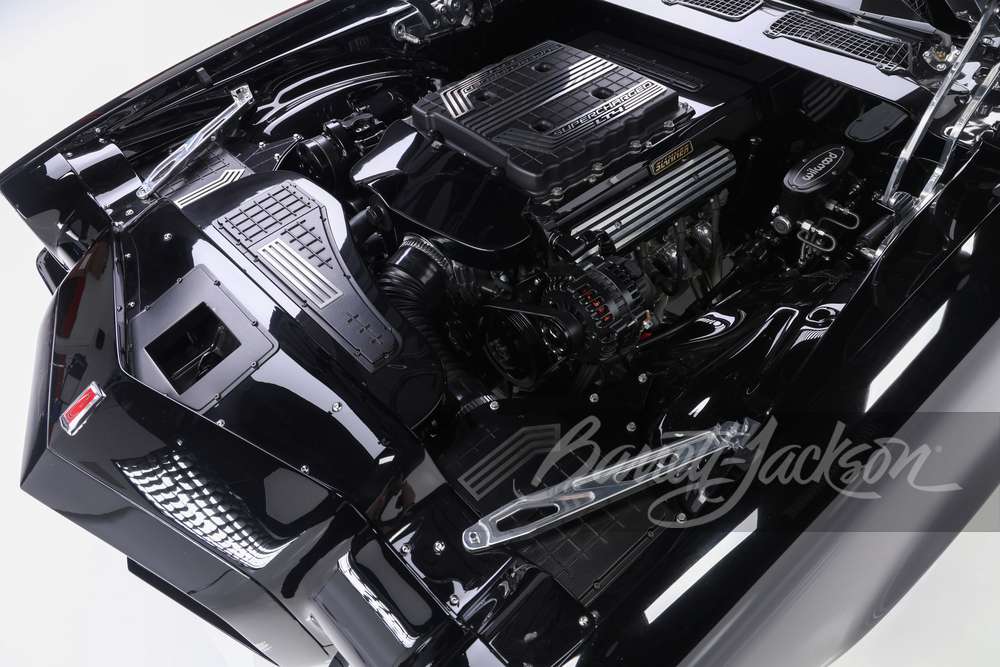
Two details deserve more attention than the horsepower figure. The body uses AMD reproduction panels, which means the car carries new metal and no corrosion history to investigate, a genuine advantage over a restored original. And the build was managed from a single shop. Garret’s Rod Shop is credited with project management, engine dyno work, exhaust fabrication, fiberglass, custom machining, paint, bodywork and sheet metal. One accountable builder is a far better position than a car assembled from a dozen vendors, because the person who can explain the wiring, the cooling and the tune is still reachable.

What the Trophies Do and Do Not Prove
The résumé is real. “Slammer” was named Best GM Car in the Kicker booth at the 2024 SEMA Show, Best Camaro at Chevy in the Smokies in 2025, a featured build at the 2025 Corvette Expo, and a Top 12 Builder’s Choice at the Goodguys Columbus Nationals. It has also been licensed as a digital feature car in the CSR2 Racing mobile game.
Those awards are credible evidence of fit, finish and fabrication quality, judged by people who look at hundreds of builds. What they cannot supply is liquidity. A trophy shelf does not make a buyer appear, and the restomod market has a habit of rewarding the car that is driven, serviced and understood over the car that is merely admired. Technology also ages in this category in a way it does not for original cars: an LT4 is a current-generation engine today and a known quantity tomorrow, while a numbers-matching 1969 Z/28 is a fixed point. That is why the two should not be compared on price alone. We drew a similar line when we looked at what “re-bodied” means for a COPO Nova, where identity is the whole story, and in the case of the one-off 1968 Camaro Z28 convertible built for Pete Estes, where documentation is the value. “Slammer” sits at the far end of that spectrum, where craftsmanship is.

Why No Reserve Matters Here
Barrett-Jackson has extended its 2027 Scottsdale auction to nine days, running January 23 through 31 at WestWorld of Scottsdale, citing consignment demand. A larger docket means more built cars competing for the same bidders, and a no-reserve lot is the consignor accepting whatever that room decides. For a custom build, that is a more informative signal than a reserve price, because there is no comparable sale to anchor it. The result will describe what a documented, show-proven, single-builder 1972 Camaro is worth to a live audience on a given afternoon.
What Serious Buyers Should Ask
Ask for the Garret’s invoices and the dyno sheet. Ask how the cooling system and the charge-air heat management were validated in a car with 650 horsepower and a vintage engine bay. Ask how much of the car has been driven, and how serviceable the custom fabrication is outside the shop that made it. Confirm that the VIN and title remain those of a 1972 Camaro, which keeps the car clear of the identity questions that complicate re-bodied cars.
If the price disappeared from this story, the lesson would remain. Collectors rarely pay a premium for horsepower alone; they pay for evidence that the work was done by someone who will stand behind it. In a restomod, the donor car is a rounding error, and the builder is the history.
Sources: Barrett-Jackson, 1972 Chevrolet Camaro Custom Coupe lot listing; Barrett-Jackson Auction Company; Forgeline Motorsports vehicle gallery.
The collector car market, every weekday morning.
Auction results, price moves and what’s crossing the block, read in four minutes. Free, from Modern Car Collector.
No spam, unsubscribe in one click. Or read more about the Brief.





 EL Puckett