

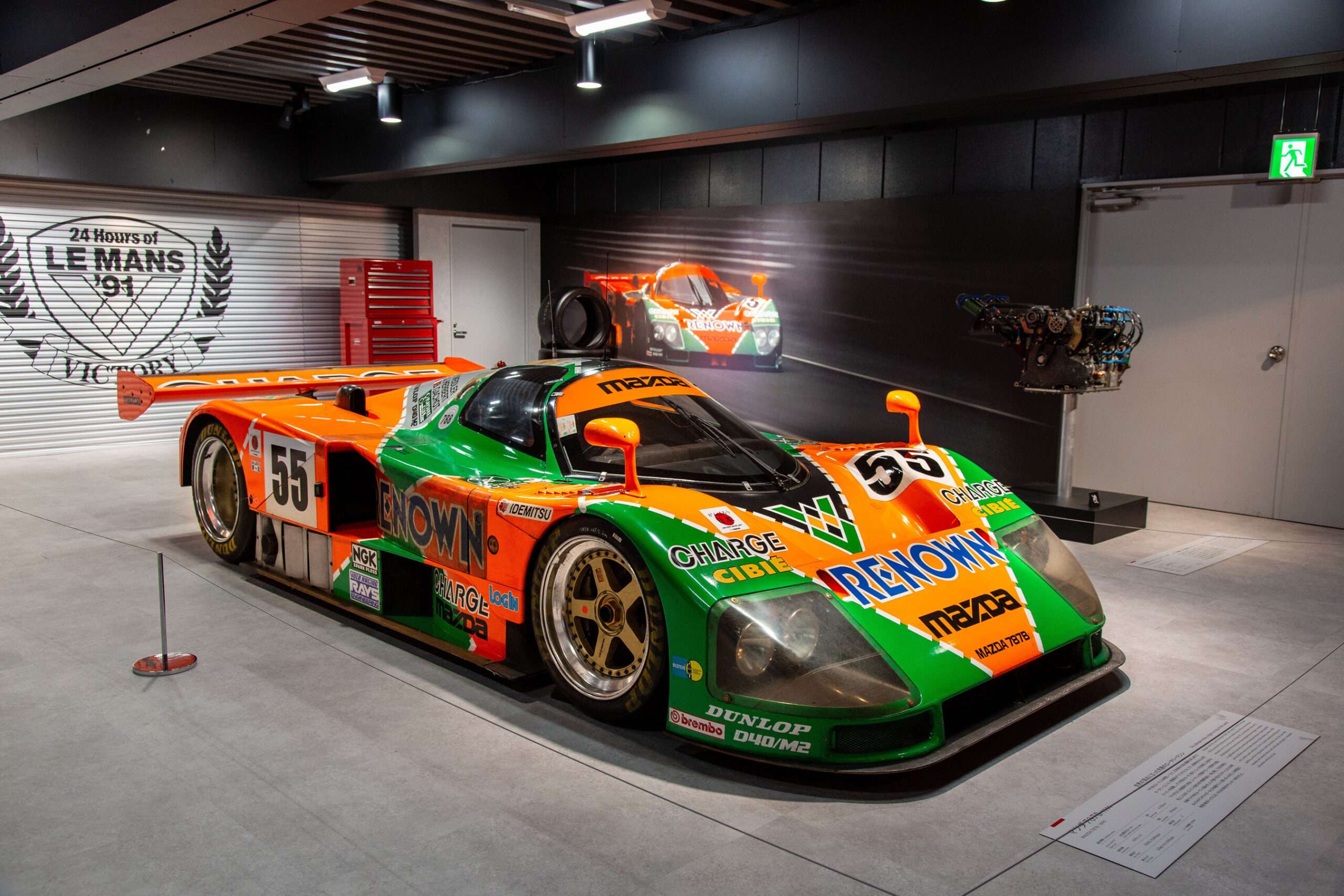
On the Sunday before Monterey Car Week’s on-track programming even opened, a four-rotor Mazda prototype caught fire in the Laguna Seca paddock. Flames poured from the left side of the engine cover as onlookers preparing for the week’s marquee event, the Rolex Monterey Motorsports Reunion, captured the moment on their phones. Track crews extinguished the blaze quickly. No one was hurt. And within hours, social media had done what social media does: assumed the most historically important rotary-powered race car ever built had very nearly been lost.
It hadn’t. The car burning in that paddock was not the 787B that won the 1991 24 Hours of Le Mans outright, the only rotary-powered car ever to do so, and arguably the single most significant Japanese competition car in history. That chassis, 787B-002, is being flown in from Mazda’s collection in Japan for its own appearance at Laguna Seca this week, a trip Mazda announced back in June. The car that caught fire was its older sibling: a 767B, chassis 767B-002, part of Mazda’s own Heritage Collection and a fixture of historic racing since a two-year restoration returned it to competition in 2016.
That distinction matters, and understanding why tells you more about Mazda’s collector-car philosophy than the fire itself ever could.
The Car Nobody Was Talking About Is the One That Made the Winner Possible
Mazda’s four-rotor works prototypes trace back to the 767 that arrived at Le Mans in 1988. The evolved 767B followed for the 1989 season, powered by a naturally aspirated 13J engine producing roughly 630 horsepower, a car that ran the Mulsanne Straight at genuinely alarming speed but had no real chance outright against the turbocharged Porsche 962s, Jaguar XJR-9s, and Sauber-Mercedes C9s that dominated Group C that year. That was never really the point. Mazda wasn’t chasing outright victory in 1989. It was banking the reliability data, the aerodynamic lessons, and the institutional confidence in rotary technology that would let the R26B-powered 787B win at La Sarthe two years later, becoming the first Japanese manufacturer, and to date the only rotary-powered entrant, to win Le Mans outright.
Only a handful of chassis were built across the entire 767 and 787 program, and almost none were ever sold to privateers, unlike the Porsche 962s that scattered across dozens of independent teams throughout the 1980s. That matters for provenance in a way collectors will recognize immediately: a car like 767B-002 has never left factory supervision. There is no chain of private owners, no gap in documentation, no restoration performed by a shop without direct access to factory records. It is about as close to unimpeachable provenance as competition history offers.
But that same concentration cuts both ways. When a privately owned 962 needs parts or expertise, there are dozens of surviving sisters and an entire cottage industry of specialists to draw on. When a Mazda four-rotor prototype needs serious repair, the pool of people who truly understand it starts and ends with Mazda itself.
Why Mazda Races Cars Most Manufacturers Would Simply Display
Most manufacturers with comparably important heritage cars keep them still. Surviving works Jaguars and Porsches make the occasional parade lap at low speed, wheeled out for photographs more often than they are driven in anger. Mazda has taken a different approach with its four-rotor prototypes for nearly a decade now: it enters them in real historic competition, at real speed, repeatedly. That is the actual headline buried inside Sunday’s incident. Mazda treats these cars less like sealed artifacts and more like instruments that exist to be heard, felt, and raced, not simply preserved behind glass.
That philosophy is a large part of why Mazda’s rotary prototypes remain the most beloved sound in vintage racing, and it is also why one of them occasionally comes home with damage. A 787B maintained in showroom-perfect condition but never run is, in the end, a very expensive sculpture. A 767B turning hot laps at Laguna Seca, apex seals doing their job, engine note doing exactly what it was built to do, is still a race car in the fullest sense. Collectors tend to understand that difference instinctively, even when they can’t quite articulate it: originality and function compound each other much like interest compounds in finance. A car that still does what it was built to do carries an authenticity no static display can replicate.
A Useful Lesson for Anyone Who Vintage Races Something Important
Sunday’s fire is also a useful case study for collectors weighing whether to actually campaign a significant competition car rather than trailer it between concours lawns. Insurance for this category of asset is rarely straightforward. Agreed-value policies for historically significant race cars typically demand detailed, current condition reports, and many carry separate, tighter terms for damage sustained in competition versus transport or storage. Owners face a real philosophical choice, too: preserve a car in its most original, as-raced state and accept the wear that comes with actually driving it, or maintain it to a standard so pristine that using it becomes psychologically, if not financially, difficult. Mazda has clearly chosen to keep using its most important prototypes. Sunday was the visible cost of that choice.
The Weekend Isn’t Ruined. That’s Rather the Point.
For collectors headed to Monterey Car Week and this week’s Rolex Monterey Motorsports Reunion, the arrival of 787B-002, the actual Le Mans winner, remains the story that matters, and it will proceed regardless of what happened to its older sibling. Mazda is not alone this week in using Car Week to tell a heritage story rather than simply sell a new model; BMW’s own three-pedal concept program makes a similar bet that enthusiasts will reward manufacturers who show up with something more interesting than a press release. Mazda’s four-rotor legacy is getting attention from more than one direction this month, too: a pair of Mazda-powered Lola T616 Le Mans prototypes crossing the block at Mecum Monterey shows how the same rotary program that produced the 787B also produced cars collectors can actually buy, a reminder that significant and for sale are two very different categories in Mazda’s world. It is the same lesson, in a different form, that the McMurtry Speirling PURE has been teaching this year: a car’s importance is rarely just about what a stopwatch says.
Every important race car carries two histories: the one it eventually made, and the one that made it possible. Collectors, understandably, tend to pay for the first. Sunday’s fire in the Laguna Seca paddock is a reminder that the second history is just as real, just as fragile, and, for anyone who understands what Mazda accomplished in 1991, arguably just as worth protecting.
The collector car market, every weekday morning.
Auction results, price moves and what’s crossing the block, read in four minutes. Free, from Modern Car Collector.
No spam, unsubscribe in one click. Or read more about the Brief.

 John Lloyd
  Eve Nowell