

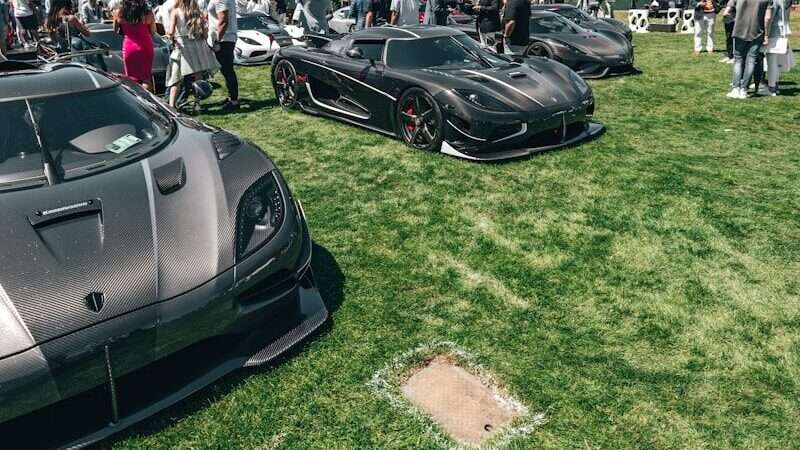
Every August, the Monterey Peninsula becomes the epicenter of the global collector car world. For one dense stretch of days, five major auction houses — Bonhams, Broad Arrow, Gooding Christie’s, Mecum, and RM Sotheby’s — set up within a few miles of one another and roll out some of the rarest, most valuable automobiles ever built. This year’s edition, culminating in the Pebble Beach Concours d’Elegance, arrives with a genuinely startling number attached to it: industry forecasts suggest total auction sales could cross half a billion dollars for the first time in the event’s history.
That figure alone is enough to generate headlines, and casual observers will likely treat it as some kind of referendum on the broader economy. If buyers are willing to pay eight figures for a Ferrari, doesn’t that mean the economy is thriving? The honest answer is more complicated, and understanding why requires looking at what is actually driving this year’s projections alongside how Monterey’s results have swung over the past decade and a half.
The Case for a Record Year
Heading into the week, analysts at Hagerty placed the midpoint of their sales forecast at roughly $470 million, just behind the existing record, with an optimistic scenario reaching around $496 million. Importantly, that projected growth isn’t being attributed to a broadly healthier market or a larger number of cars crossing the block. Total lot counts are expected to stay roughly flat, and the share of reserve lots is only ticking up slightly. What has changed is the mix: more seven- and eight-figure automobiles have reportedly been consigned this year than at any prior Monterey. Headline consignments include a Ferrari 250 P and a McLaren F1 GTR, alongside multiple Ferrari Enzos and, notably for domestic collectors, a Chevrolet Corvette Grand Sport and a Shelby Cobra Daytona Coupe, neither of which had crossed the auction block since 2009. Another headline consignment we’re watching this week is Jerry Seinfeld’s Porsche 907 Langheck, a rare factory racer making its own trip to the auction block.
Analysts also expect a record 177 lots to sell for $1 million or more, surpassing the previous high of 158 set in 2022. Modern supercars, generally cars built from the mid-1980s onward, are projected to account for roughly 60 percent of total sales this year, continuing a multi-year shift away from the vintage, Enzo-era Ferraris and prewar classics that once defined Monterey’s top sales. The average model year of cars on offer has crept from 1967 just three years ago to 1974 today, a small but telling sign of how quickly collector tastes and collector demographics are changing. That shift was already on display earlier this year when Gordon Murray’s Le Mans GTR finally turned a wheel in public, more than a year after collectors had already committed to buying one.
Beyond the Auction Block: Turnout and Scale
Auction totals only capture part of the picture. Monterey Car Week itself, which traces its roots back to 1950, has grown into a sprawling calendar of concours, rallies, and club gatherings that drew an estimated 100,000-plus attendees in 2024, and this year’s crowds are expected to be in that same range or larger. Some events, like the free public gathering along Seaside’s Exotics on Broadway, welcome anyone who wants to look at supercars lining a downtown street. Others, like the Quail, cap attendance at roughly 3,000 tickets, and invitation-only gatherings such as Concours & Cocktails limit themselves to as few as 100 cars. That range, from mass-market spectacle to velvet-rope exclusivity, mirrors the split showing up in the auction data itself: broad public enthusiasm for car culture at one end, and a shrinking circle of ultra-wealthy buyers driving the biggest dollar figures at the other. The racing side of the week draws its own crowds too, from vintage grids at Laguna Seca to unscripted drama like the Mazda 767B that caught fire mid-race this year. Some of the most memorable stories from Car Week have nothing to do with cars crossing an auction block at all, like the ongoing saga of the fence separating one property from the festivities.
A Decade of Peaks and Valleys
To put this year in context, it helps to look back. In 2014, the Monterey auctions combined for $463.7 million, headlined by a 1962 Ferrari 250 GTO that sold for $38.1 million, a staggering number at the time that has since been dwarfed by even larger single-car sales elsewhere. The all-time high before this year came in 2022, when total sales reached $471.2 million amid a broader, pandemic-era surge in collector interest and asset prices generally.
The lowest point in modern Monterey history isn’t really up for debate: it’s 2020, when Car Week was canceled outright as the world locked down against COVID-19. There was effectively no in-person auction activity that August, the only time in the event’s more than seventy-year history that it simply didn’t happen. The years that followed told a slower recovery story. By 2024, the market was still working through what analysts termed a post-pandemic hangover, with forecasts for that year spanning as wide as $430 million to $488 million and the eventual results landing closer to the lower end of that range. Last year, 2025, rebounded to $432.8 million, the second-highest total on record, with Ferrari once again dominating the top of the leaderboard: eight of the ten biggest sales were Ferraris, and ten new world records were set for the marque. Notably, the single top sale that week, a $26 million Ferrari Daytona SP3, was a charity lot; strip that one sale out and last year’s growth over 2024 amounted to a far more modest four percent.
So What Does It Actually Say About the Economy?
This is where the nuance matters most. Monterey’s auction totals are, almost by design, a poor proxy for the health of the broader economy. The lots crossing the block here sit at the very top of a very tall pyramid, purchased by a buyer pool largely insulated from the day-to-day economic pressures affecting most households. Hagerty’s own market data underscores this split. Earlier this year, the company’s broader Market Rating, a gauge of overall collector car market health, sat at 59.01, squarely in flat-market territory, where it had hovered for close to a year. Meanwhile, its longer-running, stock-index-style Market Index was down 17 percent from its December 2022 peak and sitting at its lowest level in more than four years.
The pattern industry watchers describe is a distinctly K-shaped one. High-end supercars keep setting records, driven by a wealthy buyer base described as largely unaffected by broader macroeconomic turbulence, while the middle and lower tiers of the collector market, cars valued under roughly $250,000, have softened noticeably. Median sale prices across the market have struggled to keep pace with inflation. At the same time, broader indicators tracked alongside the collector car market have weakened, including equity market performance, while gold prices have climbed sharply, a pattern often associated with wealthy investors seeking tangible stores of value during uncertain times. The same conditions that make an ordinary buyer nervous about a big purchase can, for a small number of ultra-wealthy collectors, make a rare Ferrari or Bugatti look like an attractive place to park capital instead.
This echoes a broader argument some economists make about the country as a whole: a K-shaped economy, where the top tier of earners and asset holders pulls further away while everyone else treads water or falls behind. A half-billion-dollar week at Monterey doesn’t necessarily mean Americans broadly feel flush. If anything, it may reflect the opposite, with capital concentrating even further among people for whom a multimillion-dollar car is little more than a rounding error. History backs this up, too. During the 2008-09 financial crisis, the muscle car and blue-collar segments of the collector market took the hardest hits, while the buyers of the priciest, blue-chip cars mostly held onto their money rather than needing to sell it off.
What to Watch This Week
None of this means Monterey is meaningless as an economic signal, only that it’s a signal about a narrow slice of the economy rather than the whole of it. Sell-through rates deserve just as much attention as headline totals. Last year, roughly three-quarters of lots found buyers across the major auction houses, with some, like Bonhams, clearing nearly all of their offerings while others lagged well behind. A high number of cars failing to meet reserve, even amid record-setting headline sales, would suggest cracks even within the luxury segment. Just as telling is how the more accessible end of the market performs at Mecum, historically the auction house with the highest lot count and the broadest buyer base, and a far better bellwether for everyday enthusiasts than any single eight-figure Ferrari sale.
By the time the gavel falls on the final lot and the last vintage Ferrari rolls off the Pebble Beach lawn, we’ll have a clearer picture of whether 2026 broke records. But whatever the final number turns out to be, the lesson from the past decade of Monterey auctions holds steady: extraordinary prices at the very top of the collector car market tell a story about wealth concentration and taste among a small number of buyers, not a referendum on how the broader American economy is actually doing.
The collector car market, every weekday morning.
Auction results, price moves and what’s crossing the block, read in four minutes. Free, from Modern Car Collector.
No spam, unsubscribe in one click. Or read more about the Brief.






 John Lloyd