

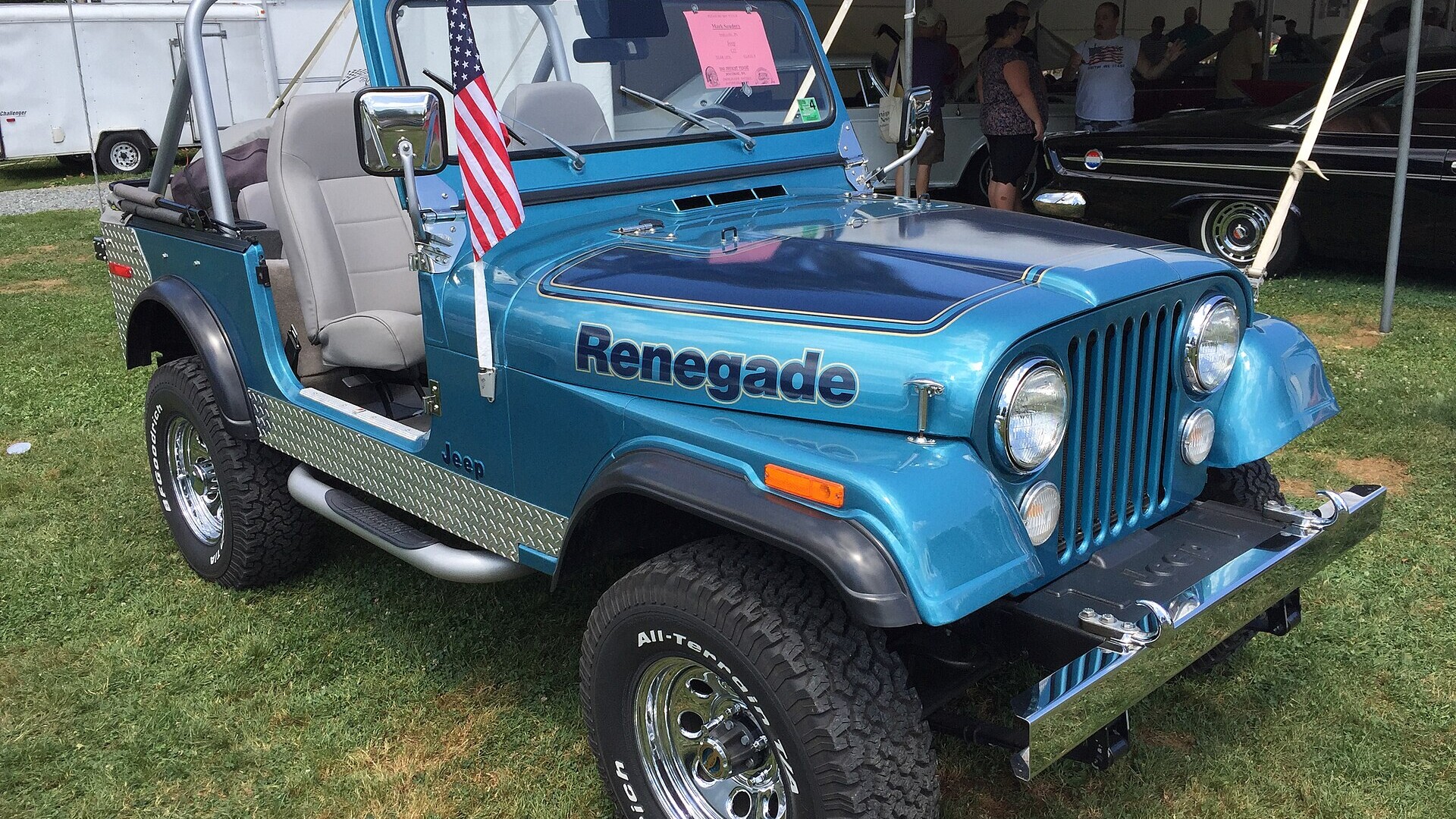
The most useful price movement in the collector market this autumn is not a record. It is a decline. Hagerty’s latest market update, as reported by Carscoops on July 19, 2026, shows Jeep CJ-7 value down 22 percent for 1976–1986 cars during the second quarter of 2026, the steepest fall among five vehicles the report flagged. A record shows what the single most motivated bidder will pay on one afternoon. A broad decline in recent favorites shows where the enthusiast market has stopped following them.
What the Jeep CJ-7 value data shows
Carscoops, citing Hagerty’s data, lists five vehicles with notable declines:
- 1976–1986 Jeep CJ-7: down 22 percent, which the report places in Q2 2026.
- 1968–1972 Buick GS: down 18 percent.
- Split-window Volkswagen Type 2 Bus: down 16 percent.
- 1970–1972 Corvette LT1 (solid-lifter small-block): down 15 percent.
- First-generation Ford Bronco: down 12 percent.
Only the CJ-7 figure carries an explicit timeframe in the coverage we reviewed, so the other four are best read as part of the same cooling trend, not as identical quarterly moves. The same report says private-sale activity has softened, insured-value increases have slowed and average transaction prices are under pressure, while the top end of the market remains strong. Hagerty’s own Price Guide pages could not be retrieved for this article, so every percentage here comes secondhand, through Carscoops.
The top end tells the other half of the story
The split shows up in auction data. RM Sotheby’s Monterey sale in August totaled $380 million at a 90 percent sell-through, with records for a 1991 Ferrari F40 at $8,365,000 and a 1985 Ferrari 288 GTO at $11,555,000, according to DuPont Registry’s results summary. Heritage Gruppe’s Q3 2026 market report, published September 23, puts total Monterey Car Week auction sales at a record $755.6 million and says cars from the 1980s onward sold at median premiums of 31 to 38 percent over Hagerty’s condition-adjusted guide values. The 1950s and 1960s were the only decades to finish below guide. Of 467 verifiable lots across four auction houses, 241 sold below their low estimate, and 148 of those sold for under $150,000. The same report puts Hagerty’s Market Rating at 58.6 in July, inside the band Hagerty calls flat.
That is the shape of a split market: scarce, documented and often modern cars set records while the broad middle waits. Our own coverage of the Ferrari F50 record and the Monza SP2 repricing shows the same divide from the other side.
Comparables: how big is a 22 percent move?
A percentage says little about dollars. Hagerty’s earlier CJ-7 market outlook, which uses data through 2018, put the average #2 (Excellent) CJ-7 at $16,200, up 78 percent from $9,100 in 2010, with a top auction price of $45,100 for a 1981 Laredo in 2017. Those numbers predate the recent boom and are not current values, but they show the scale of the segment: the CJ-7 trades in the teens and twenties of thousands, a market of lifestyle buyers rather than trophy hunters. Carscoops notes that some split-window buses sold for more than $200,000 at the peak, so a 16 percent decline there is a far larger sum for a single owner. Where the first-generation Bronco sits at the very top of its market is covered in our ranking of the ten most expensive Broncos ever sold at auction.
Possible causes: where interpretation begins
Nothing in the data we reviewed establishes why these vehicles fell, so treat what follows as hypotheses, not findings.
The first is buyer profile. The CJ-7, Bronco, split-window bus, LT1 Corvette and Buick GS are broad-appeal vehicles bought largely with discretionary money by a wide enthusiast pool, and that pool tends to react first when financing costs rise or confidence cools. The second is boom-era pricing: vehicles that climbed quickly on lifestyle demand can give ground when new buyers thin out, which the reported softness in private sales would fit. The third is substitution. Hagerty’s earlier outlook argued that the CJ-7 never carried the scarcity argument of the vintage Bronco because the current Wrangler still looks like a CJ and buyers felt less urgency. That logic is consistent with the CJ-7 falling further than the Bronco, although it does not prove it. For the model’s origins, see our look at the Bantam Jeep prototype.
Durable or temporary?
Our reading is that this looks more like a durable reset than a one-quarter blip, though a reset is not a collapse. Two observations support that. The decline spans five vehicles with different eras, body styles and buyer communities, which a model-specific story would not usually produce. And the offsetting strength sits at the opposite end of the market, which suggests money is moving toward scarcity and provenance rather than leaving the hobby. Hagerty’s flat Market Rating argues against a free fall, and the preference for proof over horsepower was visible at Fall Carlisle as well.
The case for temporary is thinner but real. Only one of the five declines carries a stated timeframe, a single quarter is a short window, and these vehicles are liquid enough that prices could recover quickly if financing costs ease or private-sale volume returns. We would not call a bottom on this evidence in either direction.
What would change this view
- The next Hagerty Price Guide update, to see whether the CJ-7 and Bronco declines extend or stabilize.
- Whether private-sale activity recovers, since that is where Hagerty’s data shows the softness first.
- Sell-through on #3 (Good) condition examples at auction, where weakness should appear before it reaches the best cars.
- Whether documented, original examples hold their prices while average driver-quality cars follow the index down.
For collectors, the practical lesson is that the percentage matters less than what stands behind it. Our expectation, and it is an expectation, not a finding, is that original, well-documented examples will be priced on their own merits while average cars follow the index. If you are weighing where mainstream muscle fits in a collection, our guide on whether pre-1973 American muscle is a good investment lays out a framework, and our list of the best collector cars under $50,000 shows where the entry market sits. This is market analysis, not investment advice.
Are you buying the dip on a CJ-7, or waiting to see whether the Bronco and the Buick GS follow it down?
Sources
- Carscoops, “A $200,000 VW Bus Isn’t Worth What It Was, And Neither Is Your Dream Bronco,” July 19, 2026 (citing Hagerty)
- Heritage Gruppe, Q3 2026 Collector Car Market Report, September 23, 2026
- duPont REGISTRY News, RM Sotheby’s Monterey Auction 2026 top 10 results, August 16, 2026
- Hagerty Media, “Why the Jeep CJ-7 isn’t as red hot as the Bronco and Blazer” (data through 2018)
The collector car market, every weekday morning.
Auction results, price moves and what’s crossing the block, read in four minutes. Free, from Modern Car Collector.
No spam, unsubscribe in one click. Or read more about the Brief.




 Kyle Matthews