

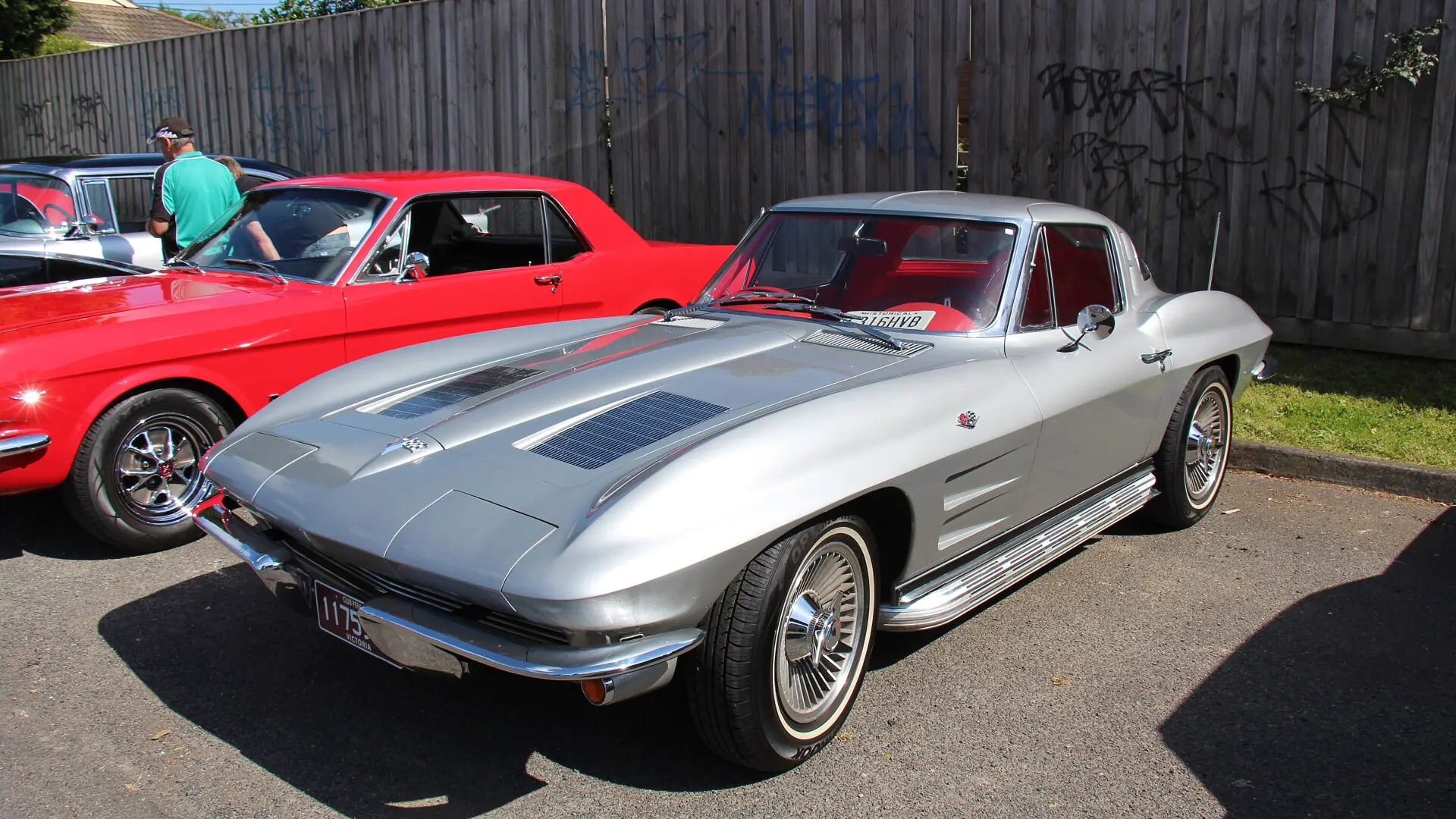
Only one model year of Corvette wore a divided rear window, and that fact alone makes the 1963 split-window coupe the most desirable car of the C2 generation. Hagerty’s valuation page had its value trend at +7.4 percent as of January 2026. With 10,594 coupes built out of 21,513 Corvettes that year, per SCM’s profile of a 1963 coupe, there are enough survivors that a buyer can afford to be picky. The detail worth being picky about is the engine pad.
Why the engine is the originality question on a 1963 Corvette
Collectors say “matching numbers” as though it were a yes-or-no test. The National Corvette Restorers Society, which sets the standard for Corvette authenticity, does not frame it that way. In one NCRS forum discussion, participants note that the society steers clear of the phrase, and that verbal claims from sellers carry little weight. What buyers actually evaluate is a chain of evidence: the stamping on the engine pad, the date codes on the block and heads, the car’s build date, the frame stamping and the paperwork.
The NCRS glossary also states the price consequence plainly. It tells buyers to “pay less” for a car with a Not Original Motor (NOM), and notes that the engine’s status may affect a future sale. We cannot give you a percentage, because the size of the discount depends on the car, its option content and how well the replacement engine is documented. The principle is what matters: the engine is the part of the car where a missing origin story costs the most.
What the stamp is supposed to tell you
SCM’s profile places the engine number on a stamped pad in front of the passenger-side cylinder head and the chassis number on a plate riveted to the body under the glovebox. In an enthusiast-forum example of an early-1963 340-hp stamp, members read a sequence that should match the last digits of the car’s serial number, a plant letter and a month-and-day build date, and a two-letter suffix code that identifies the engine. Treat forum decoding as a starting point, since it is not authoritative.
The date logic is simple and unforgiving. The NCRS glossary notes that almost every mechanical part carries a cast or stamped date code, and that an engine dated March 10, 1964 could not be correct for a 1963 Corvette. The harder cases are the ones where the dates almost work. In the NCRS forum thread above, a car with an October 1962 birth date carried an engine whose pad read December 31 of that year, after the car was built. The engine had a correct 1963 suffix code, so it looked like a legitimate Corvette engine, and the thread notes it could be a replacement from another 1963 car. A correct-type, correct-era engine is not the same thing as the car’s original engine, and an engine dated before the build date is a necessary condition for originality, not proof of it.
Options make the engine matter more
The engine also has to match what the car is supposed to be. SCM notes that the Z06 performance package, priced at $1,818.45 when new, was available only with the fuel-injected 327. Hagerty says only 199 Z06s were built. A car offered as a Z06 with a carbureted engine is not a mystery to be solved, it is a contradiction. The same logic applies to a car advertised as an L76 with 340 horsepower: the suffix code on the pad should say so.
What buyers should verify before purchase
- Read the pad on the car. Ask the seller to clean it only with solvent. Enthusiasts warn that sandpaper, wire brushes and abrasive pads can destroy the very marks being authenticated.
- Compare the sequence to the VIN. The serial-derived number on the stamp should match the last digits of the car’s serial number.
- Check the date against the build date. The engine’s date code should precede the car’s build date by a plausible margin, and the car’s build date comes from its documentation.
- Confirm the suffix code fits the claim. It should match the stated horsepower and induction, including fuel injection on any claimed Z06.
- Inspect the pad for re-stamping. The NCRS glossary describes broach marks left by factory machining and warns that re-stamped blocks are decked first. It also says some expensive shops cut blocks like the factory, so a clean-looking pad is not proof.
- Read the casting and date codes. On most Chevrolet blocks the casting number sits on the bellhousing flange behind the driver’s side head. Look at the heads and other components too.
- Find the frame stamping. One NCRS forum member describes it as the deciding check, located on the driver’s side top surface of the rear frame roughly in line with the rear wheel. Clean the area and use a mirror.
- Verify the VIN plate and trim tag. SCM places the VIN plate under the glovebox. Photograph both and compare them with the paperwork.
- Collect the paper. A build sheet or tank sticker is great authentication, because Chevrolet kept no record of how each car was equipped, but the NCRS notes it can be faked. Prior-owner affidavits can support an unusual stamp, and an NCRS Top Flight award (94 percent or higher on a 4,500-point scale, per SCM) is a strong signal.
- Hire the eyes. Do not accept verbal assurances. The NCRS thread advises assuming the engine is not original until an expert has examined the pad.
How it affects what you should pay
The car SCM profiled sold at Gooding & Company in August 2016 for $110,000 including premium, with no reserve. It was an unrestored, original-paint L76 coupe with about 60,000 documented miles, two NCRS Top Flight awards and its window sticker. SCM’s median for the model was $108,000 at the time, and its high sale was $242,000. Those numbers are nearly a decade old and should not be used as a price guide, but they illustrate the stakes: documented originality is what puts a split-window in the upper half of its own range.
The practical rule is to price the car you can prove. If the pad and paperwork support the claim, pay for an original car. If they do not, pay for a correct-type replacement and treat any premium as a gamble.
Ever walked away from a split-window over its engine pad, or paid for a story the stamp couldn’t back up?
Related reading
Engine numbers are a recurring theme in collector pricing, as in Lewis Hamilton’s Ferrari F40 and the number that matters, and wheels play the same role on a Carrera RS 2.7. For the Corvette market, see how the Grand Sport reset the record, the ZR1X result on Bring a Trailer and Is the C5 Corvette a Good Investment?. For another model where documentation drives value, see our Plymouth Superbird spec sheet.
This is a research aid, not an appraisal. Have any 1963 Corvette inspected by a qualified specialist before you buy.
The collector car market, every weekday morning.
Auction results, price moves and what’s crossing the block, read in four minutes. Free, from Modern Car Collector.
No spam, unsubscribe in one click. Or read more about the Brief.



 Eve Nowell
  Kyle Matthews