

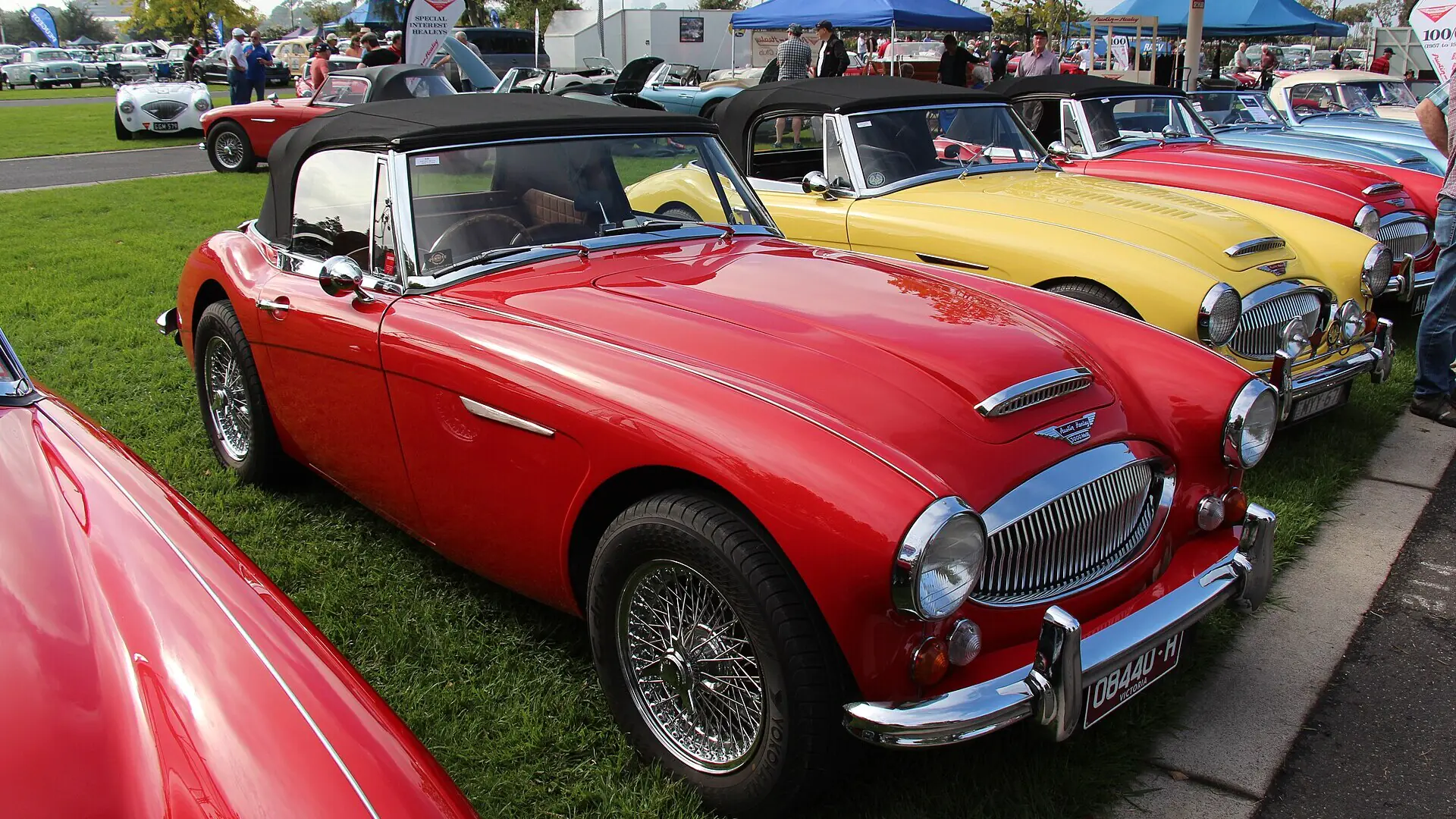
Between 1959 and 1976, three British roadsters sold in large numbers to American buyers who wanted more muscle than an MG could offer: the Austin-Healey 3000, the Sunbeam Tiger and the Triumph TR6. Today the Austin-Healey 3000 vs Sunbeam Tiger vs Triumph TR6 question is a real one for collectors who want a drivable British sports car with six- or eight-cylinder torque, and who have somewhere between $15,000 and $40,000 to spend on a good driver, based on Hagerty’s October 2026 valuation data.
The argument here is that these three cars are priced less by badge than by condition and documentation. Hagerty counted 74 sales of Austin-Healey 3000s, 43 Tigers and 135 TR6s over the past 12 months, but inside each model the spread between a tired car and a strong one is wider than the gap between the models. Recent public sales of the Healey BJ8 run from about $44,000 to about $134,000; the TR6 from about $8,000 to about $37,000 in a single month; and the Tiger from roughly $8,000 to $131,000. Choosing among the three matters less than choosing the right individual car.
Side by side: specifications
| Austin-Healey 3000 (Mk I–III) | Sunbeam Tiger | Triumph TR6 | |
|---|---|---|---|
| Years | 1959–1967 (Mk III/BJ8: 1964–1967) | 1964–1967 | 1969–1976 model years |
| Production | 42,926 across Mk I–III (Mk III/BJ8: 17,712) | Roughly 7,000–7,100; published counts range from 7,005 to 7,128 | About 91,850 (Wikipedia) to about 94,600 in other counts; 83,480 exported, almost all to the US |
| Engine | 2,912 cc BMC inline-six, twin SU carburetors (Mk III) | 260 cu in (4.3 L) Ford V8 (Mk I/IA); 289 cu in (4.7 L) Ford V8 (Mk II) | 2,498 cc inline-six; Lucas mechanical fuel injection (PI) in UK/Europe, twin Zenith-Stromberg carburetors in US |
| Power | 150 hp (BJ8; some sources say 148) | 164 hp (260); about 200 hp (289, sources conflict) | 150 hp early PI; 125 hp later PI; roughly 101–106 hp for US carbureted cars depending on year |
| Transmission | 4-speed manual, optional overdrive; servo brakes standard on Mk III | 4-speed manual | 4-speed manual, optional Laycock overdrive |
| Weight | 2,550 lb (kerb) | 2,653 lb | 2,491 lb |
| Published performance | 0–60 mph about 9.8 s, 121 mph (one commonly cited BJ8 figure) | 0–60 mph 8.6 s (Mk I), 7.5 s (Mk II); 120/122 mph | 0–60 mph 8.2 s, 120 mph (UK PI car, Autocar). A verified US carbureted figure was not found |
| US price new | About $3,565–$3,700 | $3,499 (Mk I, 1964); $3,842 (Mk II) | $3,300 (1973 base) |
Power ratings are not directly comparable. The Healey and Tiger numbers come from the gross-horsepower era, while the TR6’s lower US figures reflect emissions-era detuning and net ratings. On those published numbers, a Tiger Mk I or a BJ8 carries roughly 59–62 hp per 1,000 lb, a PI-engined TR6 about 60, and a US carbureted TR6 about 42 (my arithmetic from the table above).
Three origin stories
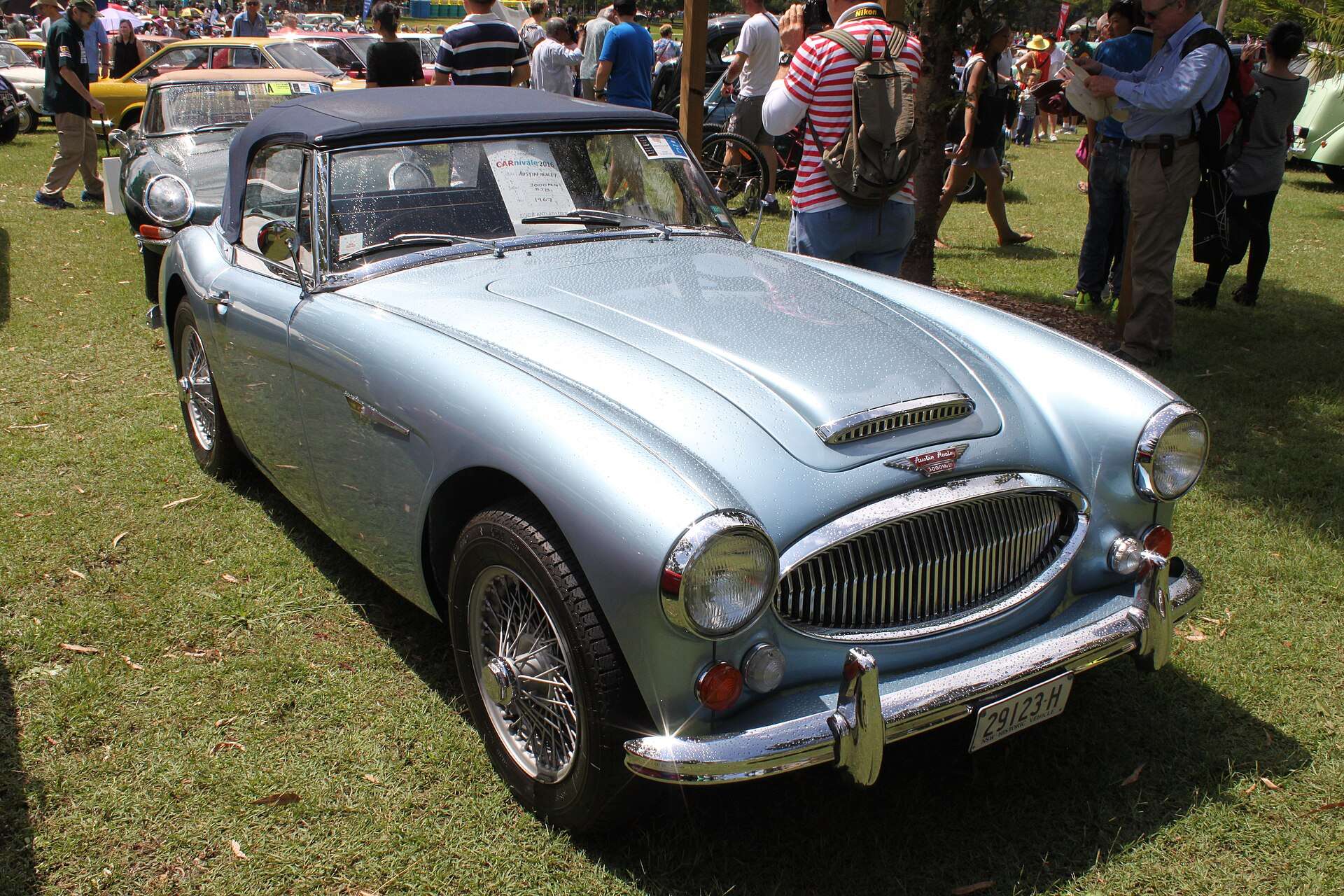
The Austin-Healey 3000 was the final evolution of a line that began with the four-cylinder 100 at the 1952 Earls Court show, moved to six cylinders in 1956 and became the 3000 in 1959 with front disc brakes. Bodies came from Jensen and cars were assembled at BMC’s Abingdon works. The export bias was extreme: in 1963, 91.5 percent of all 3000s left Britain, mostly for North America. The Mk III of 1964 was the most refined version, with a walnut dash, 150 hp and standard power-assisted brakes.
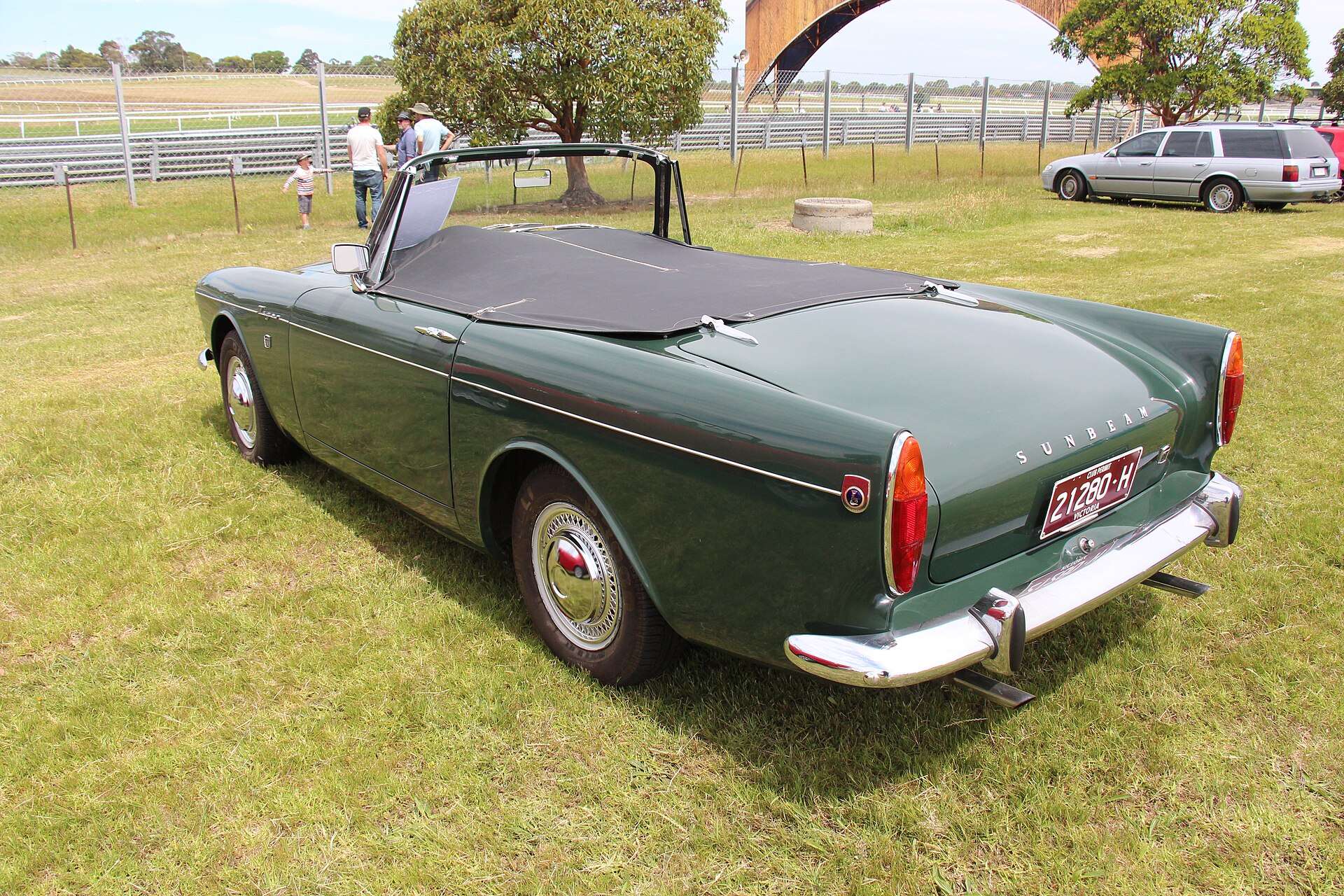
The Sunbeam Tiger started with Carroll Shelby’s V8 treatment of the Alpine in 1963, after Ken Miles had proved the concept with a quick prototype built on a roughly $800 budget. Rootes contracted Jensen, not Shelby, to build the production cars, and paid Shelby a royalty on each one. Chrysler’s growing stake in Rootes ended it: Chrysler did not want a Ford-powered car in its lineup, and production stopped on 27 June 1967 as the Ford engine stock ran out. MCC has covered the Shelby side of that story in our pieces on a 1965 AC Cobra 289 at Zoute and why a Shelby historian chose to build a 427 S/C.
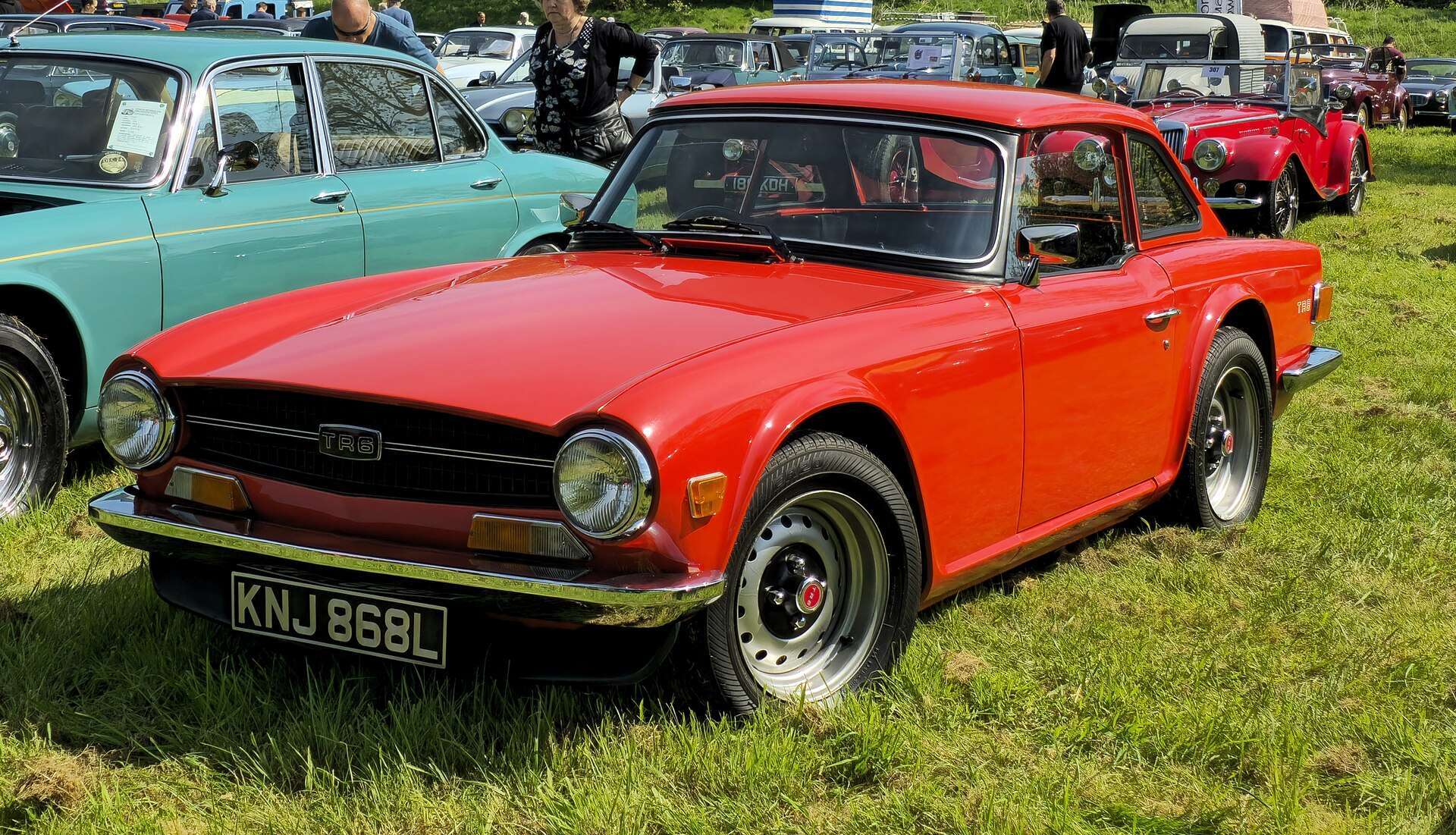
The TR6 was the conservative one. Hagerty describes it as the last of the traditional hairy-chested English roadsters, with a separate chassis, a narrow cockpit and a bouncy ride. Karmann restyled the body for 1969 on largely carried-over TR4/TR5 hardware, and the car stayed in production until July 1976. Most were built for the US, where emissions rules took the car from the injected 150 hp of the UK PI model to a carbureted engine rated around 104 hp.
Production and rarity
Rarity is the cleanest dividing line. At roughly 7,000 cars, the Tiger is about one-sixth as common as the Healey 3000 and roughly one-thirteenth as common as the TR6, using the production figures above. Within the Tiger, the Mk II is the real scarcity: 536 were built according to Sunbeam Specialties (quoted by Hagerty), though serial-number analysis in other sources suggests 633, and all were intended for the US market. Within the Healey, the early BN7 two-seater is much scarcer than the 2+2 BT7 (2,825 versus 10,825 Mk I cars), while the later two-seat three-carburetor Mk II and the Mk III are the models Hagerty calls most popular.
Production counts for all three cars vary by source, so treat any single total as an approximation. For the TR6 in particular, Wikipedia’s 91,850 and other references’ 94,500–94,619 differ by nearly 3,000 cars.
Driving character, with the evidence
Period road tests put the Healey and Tiger in different performance classes. The Motor measured a Mk I 3000 at 11.7 seconds to 60 mph and 115 mph in 1960, and a Mk II at 10.9 seconds in 1961. A later Mk III figure of about 9.8 seconds and 121 mph is widely quoted but comes from a secondary source. The Tiger’s 8.6 seconds (Mk I) and 7.5 seconds (Mk II) place it a full second or two ahead, and RM Sotheby’s cites Road & Track calling the Tiger “a fine automotive package without which the world of sports cars would be poorer.”
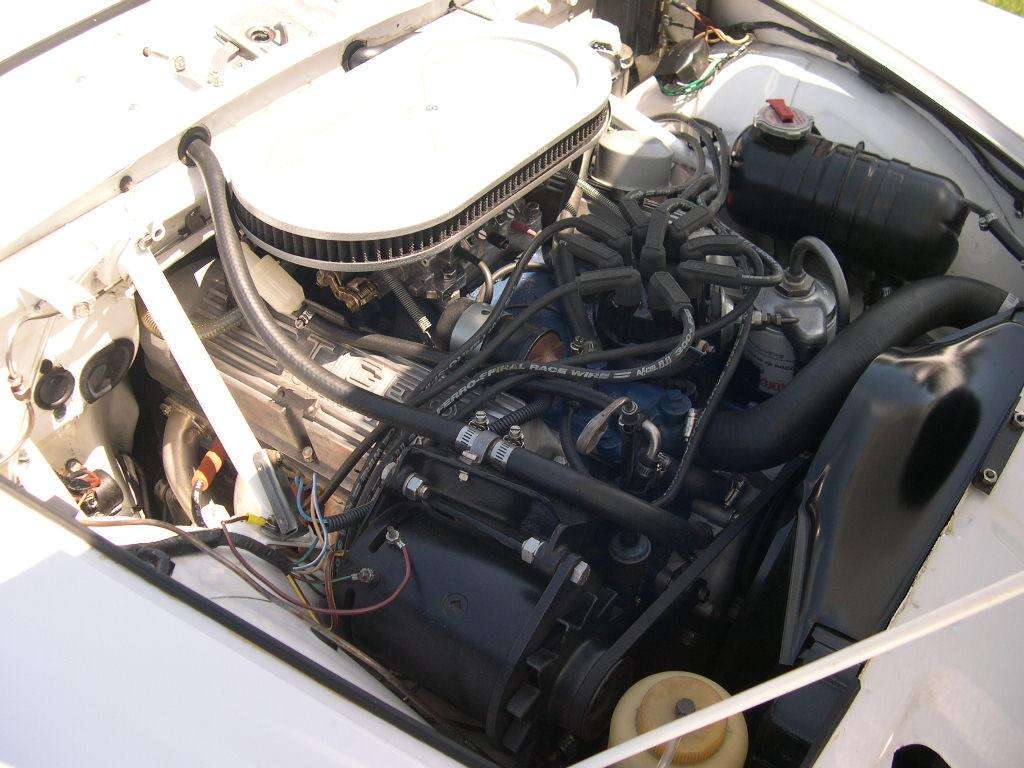
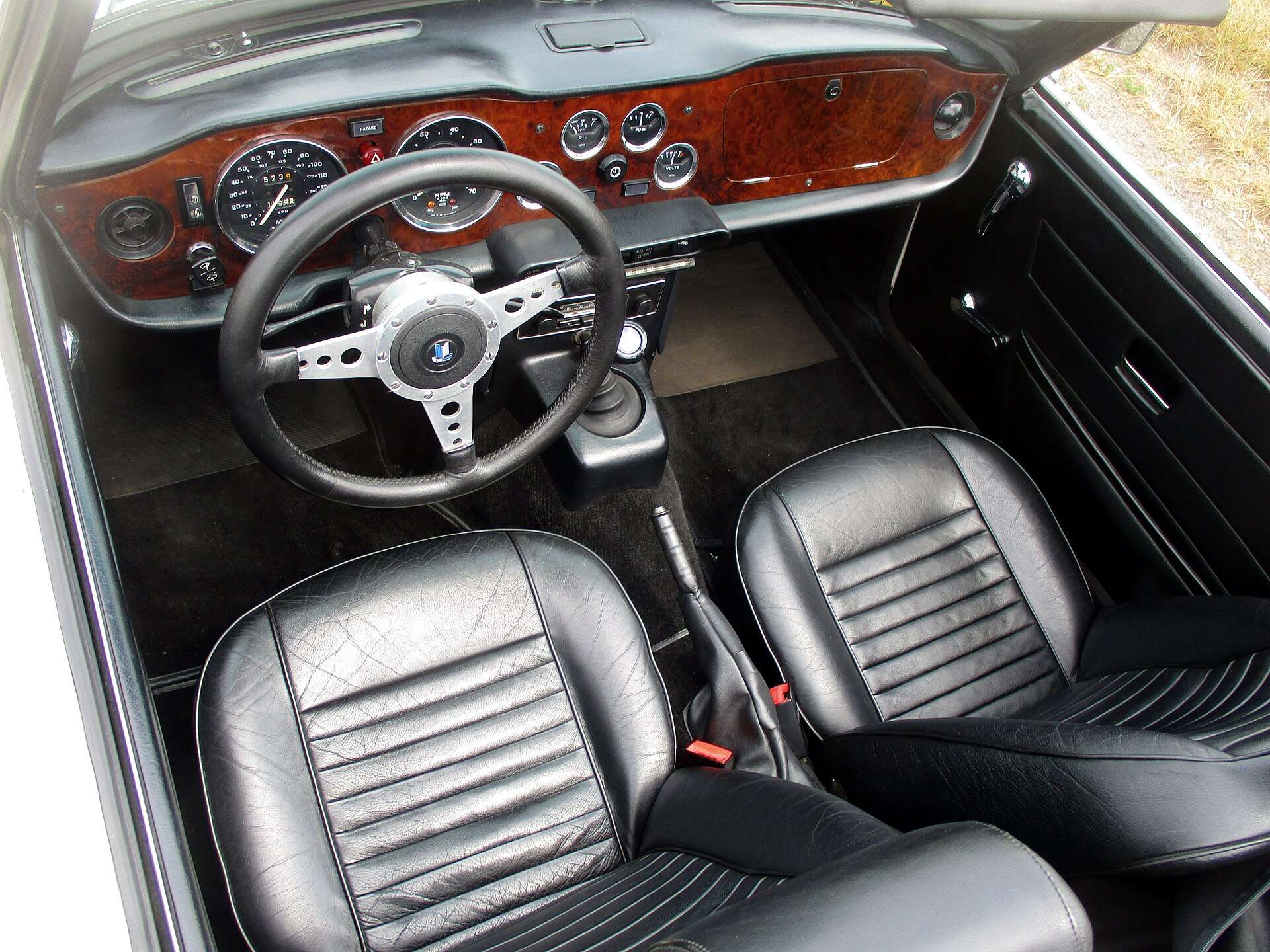
Numbers do not capture the difference in manners. Motorious’s buying guide calls the Healey a superb long-distance cruiser with low-down torque and a smooth six, but notes heavy steering, exhaust heat soaking into the cabin and a somewhat vintage feel. The Tiger’s V8 power meets a leaf-sprung live rear axle; Hagerty’s buyer’s guide says axle hop is common enough that traction bars are nearly universal. Hagerty UK describes the TR6 as simple, well supported and “rather masculine,” offering much of the big-Healey experience at a fraction of the cost, with independent rear suspension that gives limited travel and a bouncy ride.
Options, originality and what to verify
Originality is where the three cars diverge most. Healey buyers should check the model and body style (BN7, BT7, BJ7 or BJ8) against the chassis and engine numbers, and note that overdrive and wire wheels were period options while the Mk III made servo brakes standard. Hagerty’s Tiger guide warns that most surviving Tigers have been modified, often with aftermarket induction kits. It gives the identification clues: Mk I VINs begin B947, Mk IA B382 and the Mk II B382100. Early cars have rounder door corners; later cars have sharper corners and a vinyl boot instead of a metal tonneau cover. Hagerty adds about $5,000 for a hardtop. For the TR6, the fundamental split is between injected and carbureted cars, and the overdrive type changed during production (A-type on early cars, J-type on later cars).
Our earlier coverage of how a heritage certificate settles a Series 1 E-Type and of restoration versus preservation applies directly here: for the Healey and Tiger, paperwork that ties the engine, body and chassis together is worth more than a fresh paint job.
Reliability, maintenance and parts
I could not find a credible published annual running-cost figure for any of the three cars, so this section sticks to what the buyer’s guides report. Rust is the common enemy. On the Healey, corrosion is common in the main rails and outriggers, mud traps between outriggers and sills, and the inner sills are structural and hard to repair. Floorpan and chassis repairs are often poorly done. The BMC six is described as unstressed, with rebuilds of about 200,000 miles achievable, but first gear has no synchromesh and a non-working overdrive is usually an electrical fault. Motorious rates parts availability 4 out of 5, with many items costly.
On the Tiger, Hagerty flags rockers, floors and trunk floors as structural rust areas where repairs can exceed the car’s value. The Ford V8 and transmission are simple and widely supported, the Dana 44 rear axle is described as sturdy, and replacement panels and wiring harnesses are available, though panels come from specialists. The TR6 chassis is less robust than the TR2–4 frame, according to Hagerty UK, with rear trailing arm mounts and the differential mountings prone to trouble. The 2.5-litre six is good for about 100,000 miles before it tires, but parts are plentiful and inexpensive, and UK-style PI cars need a specialist for the Lucas injection pump.
What the market says right now
All figures below come from Hagerty’s Price Guide and past-sales data, viewed on 22 October 2026. Hagerty’s #3 Good condition is the usual benchmark for a car that drives well and shows its age; I could not retrieve the #1 and #2 values.
| Austin-Healey 3000 (1967 BJ8) | Sunbeam Tiger (1965 Mk IA) | Triumph TR6 (1973) | |
|---|---|---|---|
| Hagerty #3 Good value | $38,600 (range $33,233–$49,700) | $37,200 (range $33,700–$45,900) | $15,800 (range $13,167–$22,433) |
| Quarter / year / 3-year change | −2% / −8.7% / −14% | −9% / −14.5% / −28.7% | +15.3% / −14.1% / −3.1% |
| 12-month sales (Hagerty) | 74 sold (all 3000s), $3.5M volume, average $47.5k, unit sales +9% | 43 sold, $2.3M volume, average $52.7k, unit sales +23% | 135 sold, $2.6M volume, average $19.3k, unit sales −4% |
| Recent sold examples | $47,250 (BaT, 8/24/26, 92,000 mi); $52,500 (BaT, 8/12/26, 76,000 mi); $43,956 (Car & Classic, 6/4/26, 59,510 mi); $133,875 (BaT, 3/27/26, 1,300 mi) | $52,500 (BaT, 10/16/26, 1966 Mk IA, 24,000 mi); $56,000 (RM Sotheby’s, 10/8/26, 1965 Mk I); $105,000 (duPont Registry Live, 10/1/26, 1967 Mk IA, 8,221 mi); $131,249 (BaT, 9/23/26, 1964 Mk I, 68,000 mi) | $23,100 (BaT, 10/15/26, 730 mi); $17,325 (BaT, 10/6/26, 8,000 mi); $37,275 (BaT, 10/5/26, 47,000 mi); $8,033 (BaT, 9/27/26, 73,000 mi) |
Two cautions apply. First, the 12-month averages mix condition levels and, for the Healey, three different series, so they are context rather than a price to pay. Second, the Tiger is the most volatile of the three: Hagerty’s #3 value is down 28.7 percent over three years, even as the number of Tigers sold rose 23 percent in the past year. That combination is consistent with a market sorting good cars from weak ones, but one year of data does not show a trend, and Hagerty’s own estimates can be revised. Classic.com separately shows a 1967 Tiger selling for $8,100 in June 2026 and a 1965 car for $14,100 in July, which illustrates how far a project can sit below the headline numbers.
Individual results also show how unusual cars skew the data. A 1,300-mile BJ8 brought $133,875 in March against $43,956 for a 59,510-mile example in June. Across the sales above, the spread from lowest to highest is roughly threefold on the Healey, more than fourfold on the TR6 and far wider on the Tiger, depending on the sales chosen.
Demand and liquidity
Liquidity favors the TR6. With 135 sales in 12 months it traded about 1.8 times as often as the Healey and 3.1 times as often as the Tiger, so a buyer has more comparable sales to lean on and a seller has more potential buyers. The Healey’s 74 sales and +9 percent change in volume suggest steady, broad demand. The Tiger’s 43 sales are the thinnest pool of the three, though the 23 percent rise in volume means more cars came to market. For context on the buyers behind these cars, see our look at how younger collectors are reshaping the market.
Strengths and weaknesses
Austin-Healey 3000. Its strengths are presence, pedigree, broad parts support and a smooth long-distance character. Its weaknesses are structural rust, costly parts and restoration, cabin heat and heavy steering, and a Good-condition price slightly above the Tiger’s. MCC’s coverage of a 1967 BJ8 at Henderson Auctions shows how those cars reach the market.
Sunbeam Tiger. It offers the strongest published acceleration, the lowest production, a Shelby connection and a V8 that is easy to service. Its weaknesses are modified and misidentified cars, structural rust that can exceed the value of the car, rear-axle hop and the thinnest resale market. Condition and documentation make the biggest price difference here.
Triumph TR6. It is the least expensive, the most liquid and the easiest to find parts for, with a simple, well-supported layout. Its weaknesses are chassis rust, weak US-market power (roughly 100–106 hp), complex PI systems on imported cars and a ceiling on value that makes expensive restorations hard to recover.
Which car for which collector
| Buyer priority | Best fit | Why |
|---|---|---|
| Lowest cost of entry and easiest resale | Triumph TR6 | Hagerty #3 value of $15,800 and the deepest sales history |
| Long-distance touring and recognized pedigree | Austin-Healey 3000 Mk III | Torque, comfort and the broadest specialist support |
| Performance and rarity | Sunbeam Tiger | Fastest published times and about 7,000 built, with condition and originality caveats |
| Concours or documented originality | Austin-Healey 3000 | The most clearly defined model and body hierarchy (BN7, BT7, BJ7, BJ8) to document a car against |
| Tinkerer on a budget | Triumph TR6 or Sunbeam Tiger | Simple mechanicals and strong aftermarket support |
| First collector car | Triumph TR6 | Plentiful parts and inexpensive entry; see our first collector car guide |
Long-term ownership and what we could not verify
This is not an appreciation call. Hagerty’s three-year changes are negative for all three cars, and one strong quarter for the TR6 or one strong sale for a Tiger does not make a trend. The practical long-term issue is rust and restoration cost: Hagerty says Tiger structural repairs can exceed the car’s value, and the Healey and TR6 guides likewise point to costly, specialist chassis and floor work, while the sale data show buyers paying large premiums for strong, documented examples. The sensible approach is to buy the best-documented car you can afford, have it inspected on a lift by a marque specialist and treat any price as a snapshot, since Hagerty and auction results are revised constantly.
Limits of this comparison: I could not retrieve Hagerty’s #1 and #2 condition values, I found no published annual running-cost figures, the US-market TR6 acceleration figure was not verified, production counts differ by source, and the Tiger Mk II horsepower figure is inconsistent across references. Recent sale prices were taken from Hagerty’s past-sales listings and have not been checked against each auction house’s own results page.
Sources
- Hagerty Valuation Tools: 1967 Austin-Healey 3000 Mk III BJ8, viewed 22 October 2026
- Hagerty Valuation Tools: 1965 Sunbeam Tiger, viewed 22 October 2026
- Hagerty Valuation Tools: 1973 Triumph TR6, viewed 22 October 2026
- Hagerty Media: Sunbeam Tiger buyer’s guide
- Hagerty UK: Triumph TR6 buyer’s guide (2014)
- Hagerty Marketplace: 1967 Austin-Healey 3000 BJ8 Mk III
- Motorious: Austin-Healey 3000 buying guide
- Wikipedia: Austin-Healey 3000
- Wikipedia: Sunbeam Tiger
- Wikipedia: Triumph TR6
- Supercars.net: Austin-Healey 3000 Mk III BJ8
- Conceptcarz: Triumph TR6
- RM Sotheby’s: 1967 Sunbeam Tiger Mk II lot essay
- Classic.com: Sunbeam Tiger market page
The collector car market, every weekday morning.
Auction results, price moves and what’s crossing the block, read in four minutes. Free, from Modern Car Collector.
No spam, unsubscribe in one click. Or read more about the Brief.
 John Lloyd
 EL Puckett


