

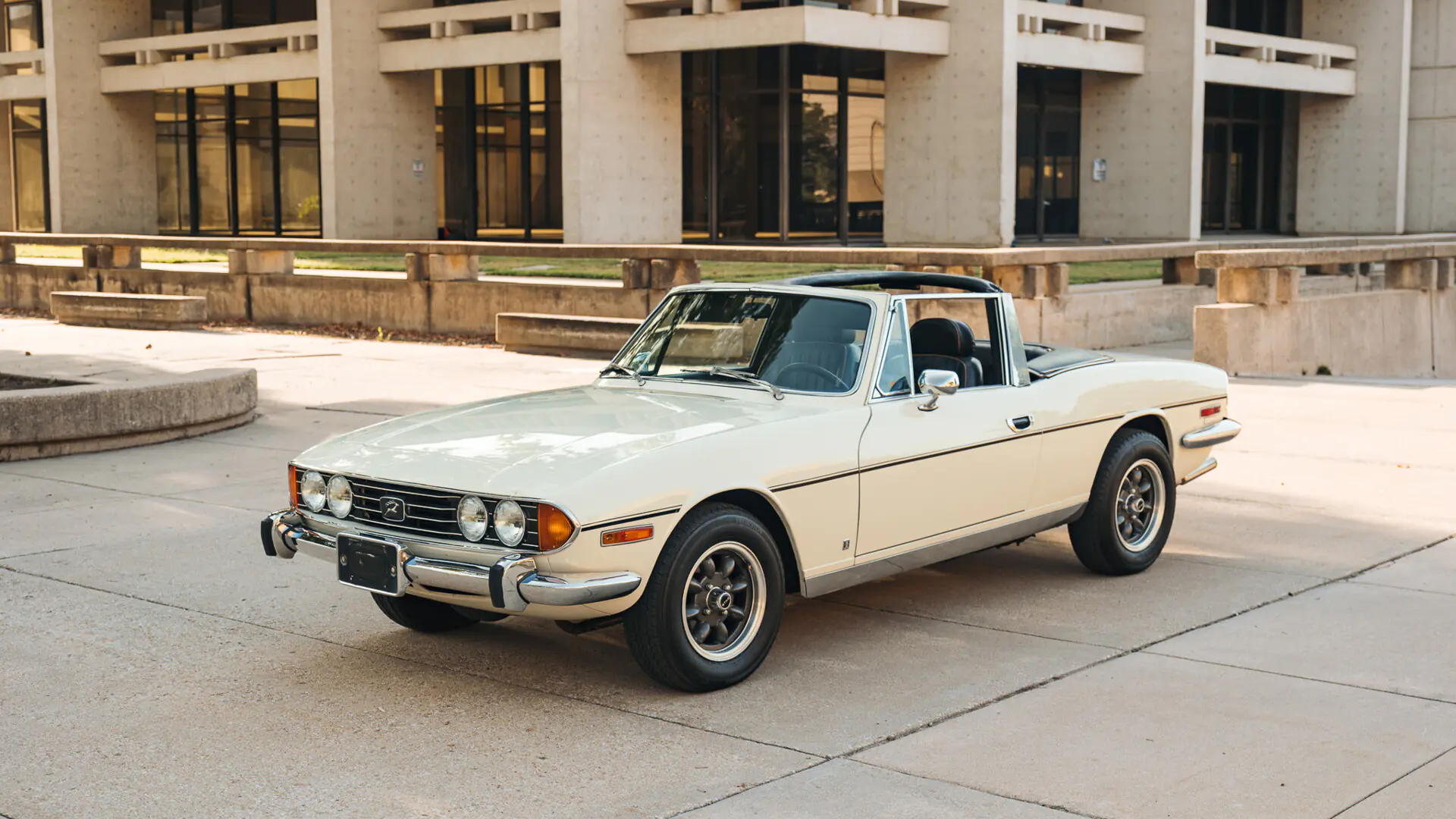
Most British V8 stories end in a repair bill. The 1973 Triumph Stag now closing on Bring a Trailer is a useful place to start because its recent history shows how the market actually prices that reputation. Chassis LE23713U0 appears in Hagerty’s past-sales record as a $19,800 sale at Leake Auctions in Tulsa in June 2017. The same white, black-interior, four-speed car is bid at $7,800 as this is written, with the auction scheduled to end Tuesday afternoon. The final result was not known at the time of writing.
That is the thesis of this deep dive. The Stag is a car collectors price according to what has been proved about its engine, and the spread between a documented example and a mystery one is the story.
Why the Stag matters
Triumph launched the Stag in June 1970 as a four-seat, open-top grand tourer, styled by Giovanni Michelotti. It began life as a styling experiment cut from a Michelotti-designed 2000 saloon prototype, and Harry Webster developed it into a drophead. Sports Car Market notes that the factory saw it as a British rival to the Mercedes-Benz SL. The idea was sound: a V8, a proper T-bar roll-over structure, a removable hardtop and room for four.
Production ran from 1970 to June 1977 and totaled 25,939 cars according to Classic & Sports Car (Wikipedia’s infobox gives 25,939 and its body text 25,877). About 6,780 were exports, and 2,871 of those went to the United States. Bring a Trailer’s listing language puts 1971 production at 3,901 cars. The Mk1 covers chassis numbers below 20001, and the Mk2 begins at 20001 in early 1973.
Specifications and what is mechanically unusual
The Stag’s engine is not a Rover or a Ford. It is a Triumph-designed 2,997 cc overhead-cam V8, an iron block topped with aluminum heads, developed from the company’s four-cylinder family. Sports Car Market lists the Mk1 at 145 bhp at 5,500 rpm and 170 lb-ft at 3,500 rpm, and the Mk2 at 146 bhp at 5,700 and 167 lb-ft. Those are UK-market numbers. The Bring a Trailer listing for this US-spec car lists 127 horsepower and 148 lb-ft when new, which reflects the lower-compression, emissions-tuned federal engine. US cars also carried two Zenith-Stromberg 175 CDSE carburetors, side-impact door beams and DOT lighting.
| Item | Detail |
|---|---|
| Years / production | 1970–June 1977; 25,939 built (about 6,780 export, 2,871 to the US) |
| Engine | 2,997 cc Triumph SOHC V8, iron block, aluminum heads, twin Strombergs |
| Output | UK Mk1: 145 bhp / 170 lb-ft; Mk2: 146 bhp / 167 lb-ft; BaT lists this US-spec car at 127 hp / 148 lb-ft |
| Transmission | 4-speed manual with Laycock overdrive, or Borg-Warner automatic (about half of cars); Type 65 automatic on the last roughly 3,800 |
| Chassis | Unit construction; MacPherson struts front, semi-trailing arms rear; front discs, rear drums; power rack-and-pinion steering |
| Weight / performance | About 2,800 lb; 0–60 mph in roughly 9.5–10.3 seconds and 118–121 mph with overdrive (Car & Classic) |
| Wheels (US) | Wire wheels 1971–72; five-spoke alloys from 1973 |
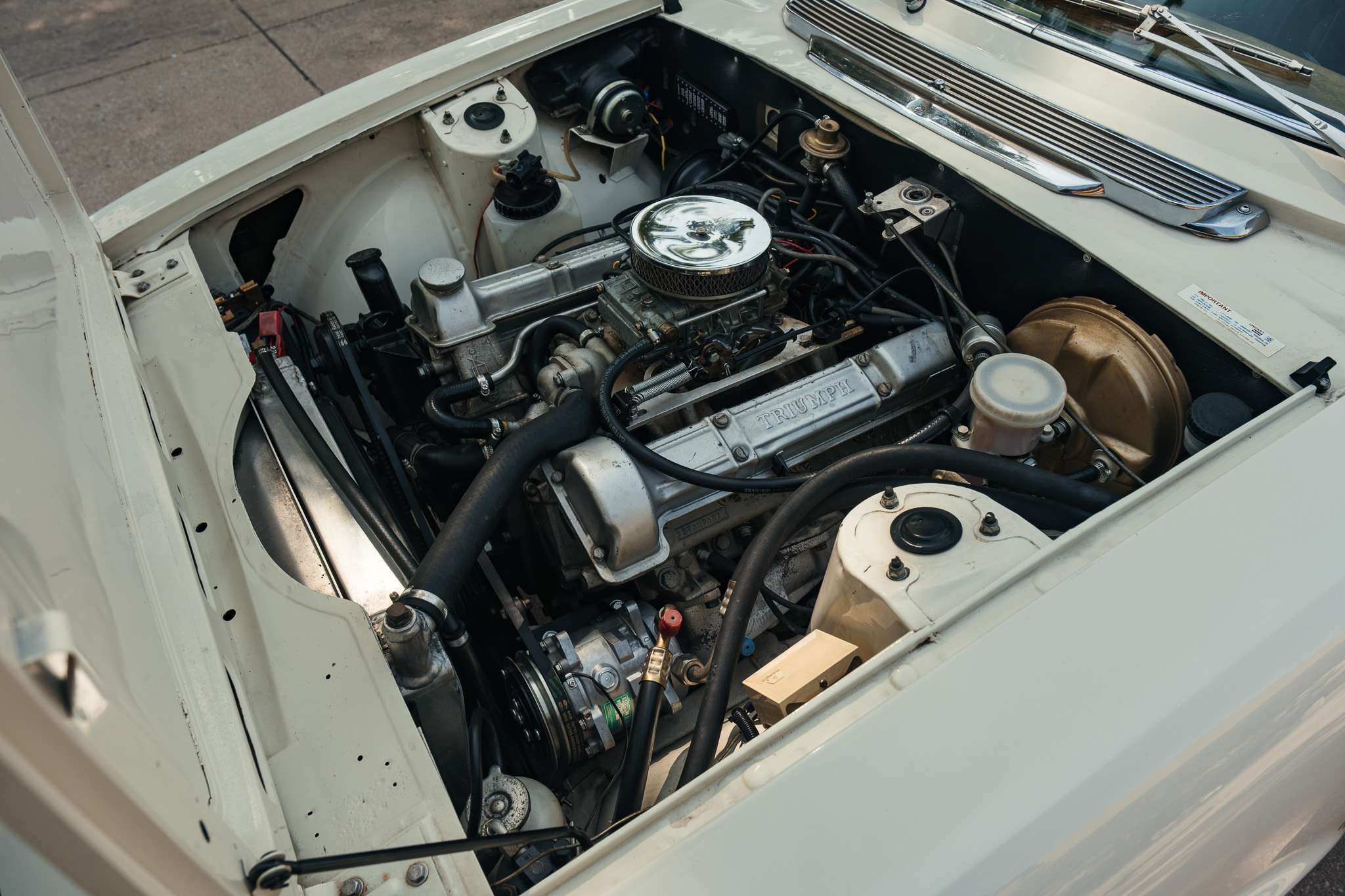
The engineering decisions that matter to a buyer are all in that engine. The water pump sits high in the block, so low coolant can stop circulation and low-grade aluminum heads corrode if year-round inhibited coolant is neglected. Head gaskets fail after overheating, long simplex timing chains can stretch and fail in under 25,000 miles, and a mix of vertical and angled head studs loads the block unevenly. Some factory engines left the line with casting sand and core wire in the coolant passages. Time magazine eventually placed the Stag on its list of the 50 worst cars ever made, a line that still appears in every ownership conversation.
None of that makes the V8 unfixable. Specialists describe a well-maintained engine as good for 150,000 miles or more. The usual cures are an uprated aluminum radiator, an electric water pump conversion, silicone hoses, annual coolant renewal and timing chain replacement roughly every 30,000 miles. Classic & Sports Car says the engine isn’t fundamentally flawed, only unforgiving of neglect.
Options, identifying details and originality
Factory choices were limited: four-speed manual (with Laycock overdrive, which became standard on manual cars in the early 1970s) or automatic, hardtop and soft top, and wire or alloy wheels depending on year. Most cars were sold with both tops. Magenta and Topaz are cited as harder colors to sell, while Mimosa Yellow, the factory color this car wore before its white repaint, is called period-appropriate by Classics World.
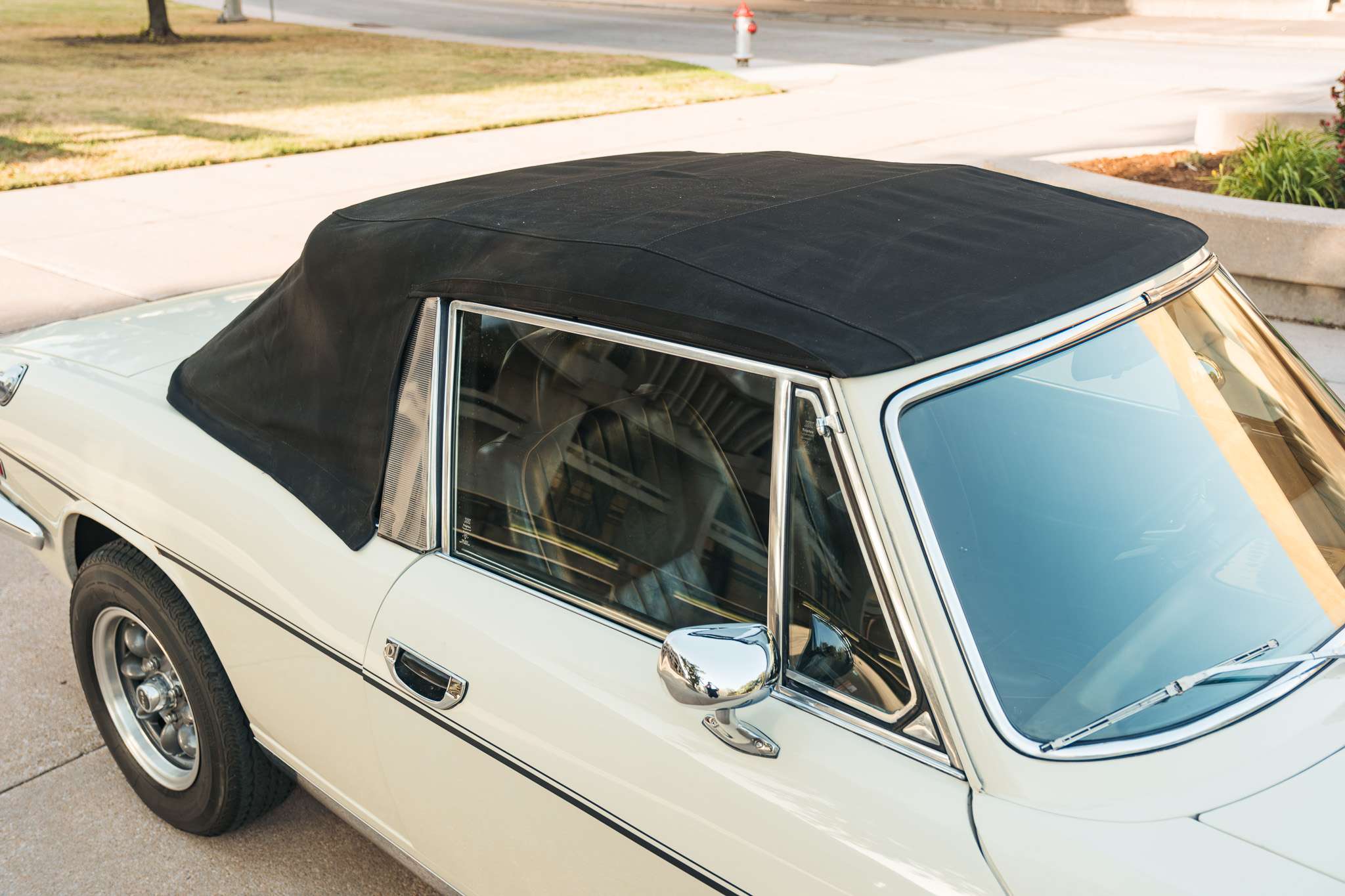
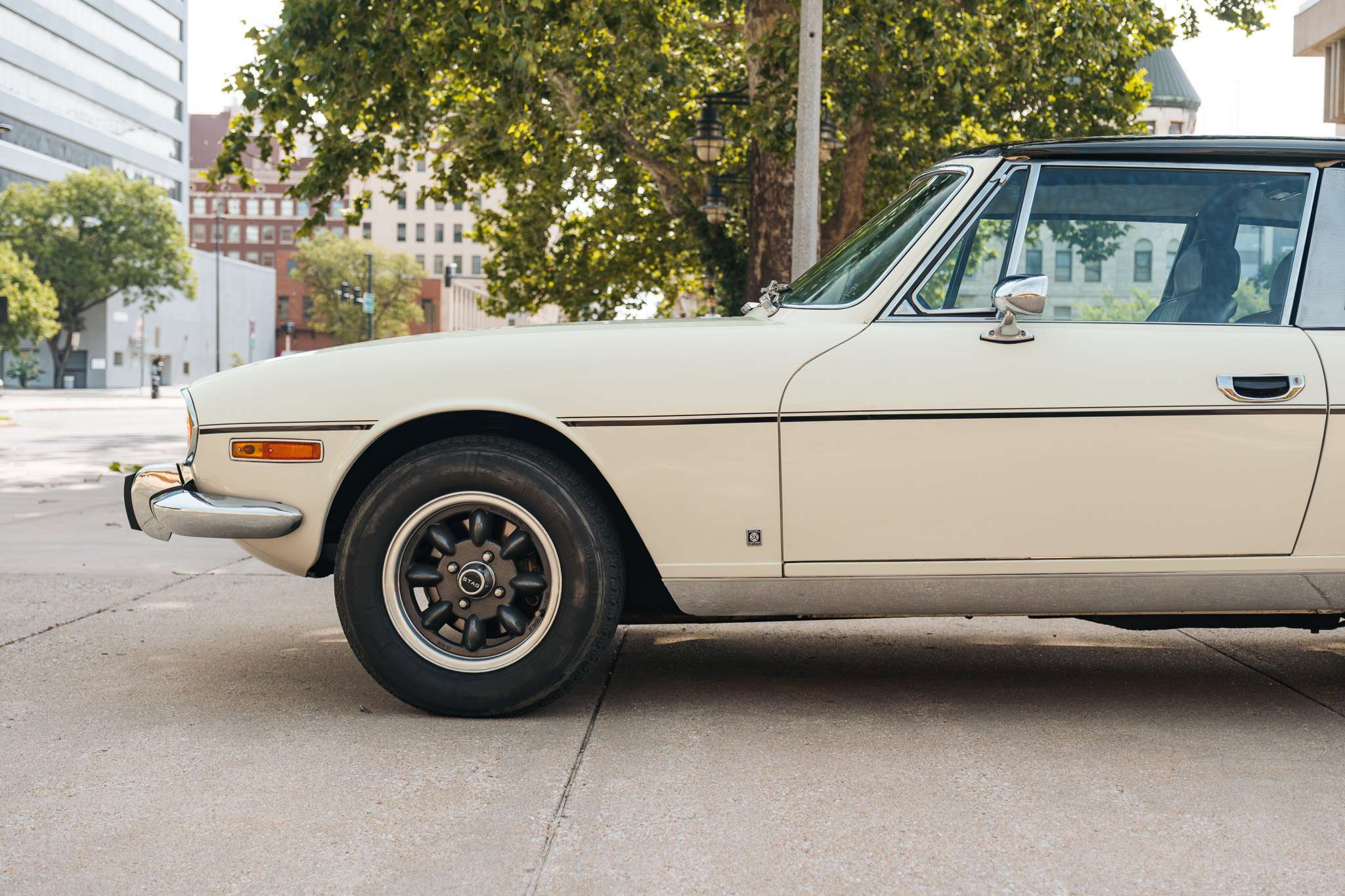
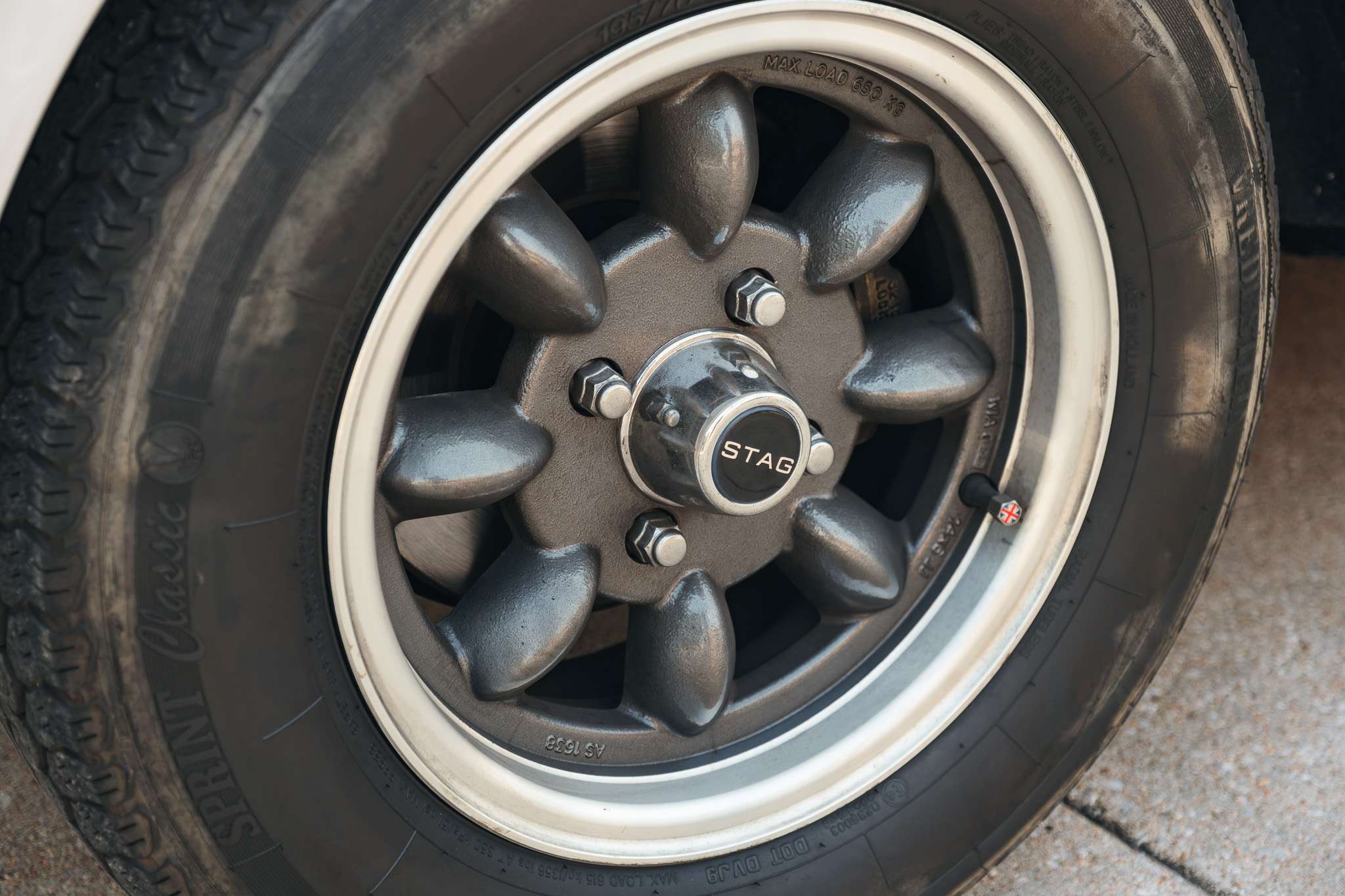
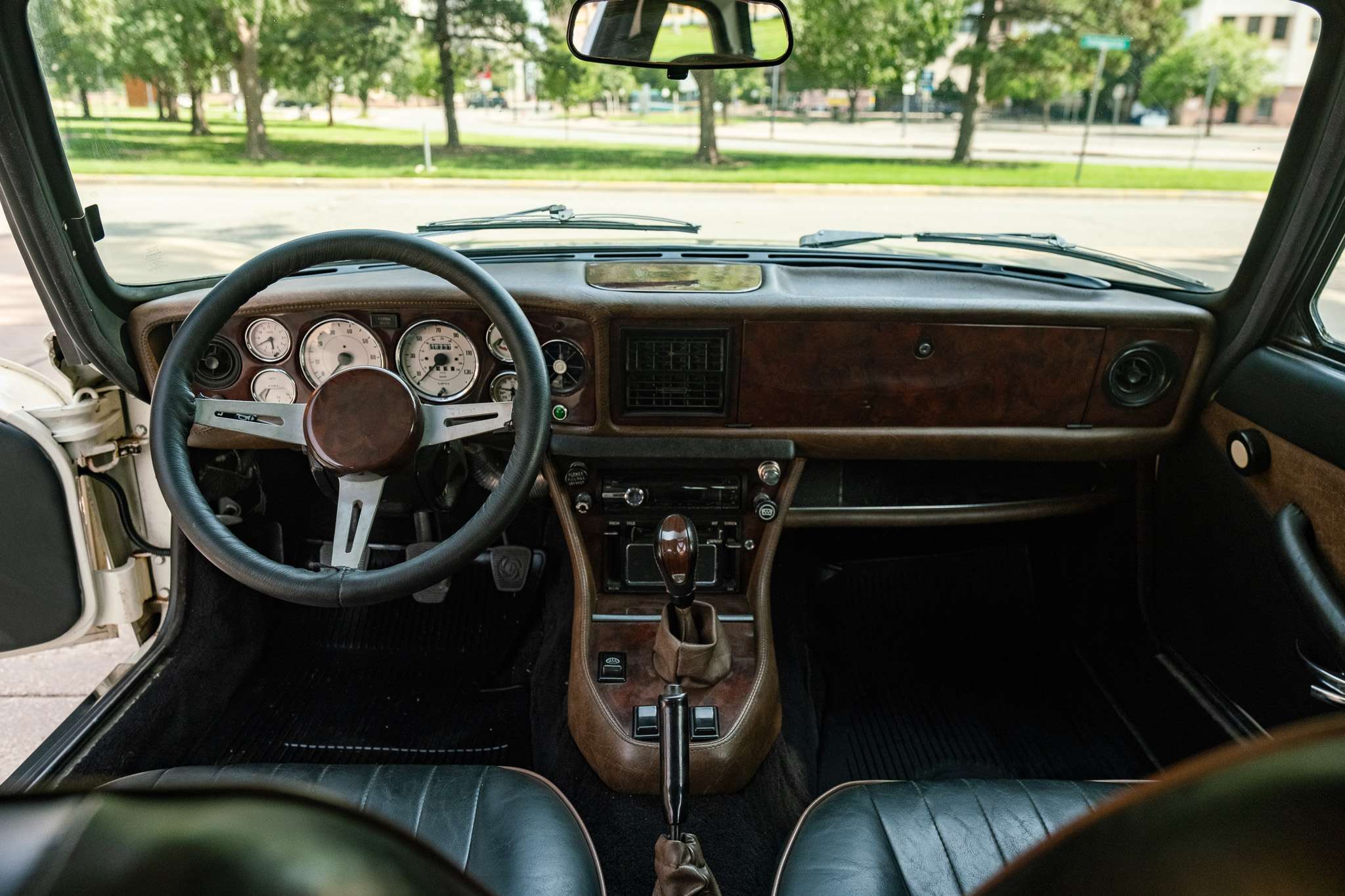
Originality is where this specific car becomes instructive. It was refinished from Mimosa Yellow to white, its twin carburetors were replaced by a single Holley four-barrel rebuilt in 2022, and it rides on Minilite-style 14-inch wheels rather than factory alloys. The seller says the car was bought at auction with few records and believes a previous owner restored it. The listing also notes a cracked wood panel on the dash and loose trim at the top of the windshield. Comment-thread buyers pressed for records on cooling, head and timing-chain work, and the seller said the car does not overheat and leaks no fluids. None of that is a defect. It is simply the difference between a car that has been proved and one that has been described.
For authenticity, Classics World says the original Triumph V8 delivers the highest value and that Rover V8 and Ford V6 swaps devalue the car. Wikipedia cites DVLA data showing that about 92% of surviving Stags known to the agency still have the 3.0-liter engine. Buyers should also ask for a British Motor Industry Heritage Trust certificate, which confirms original color and specification. The August 2026 Bring a Trailer sale of a 1973 Stag at $14,500 came with one.
What the market is paying
Hagerty’s valuation page shows roughly $16,000 for a 1973 Stag in good (#3) condition, with 11 auction sales over three years ranging from $10,053 to $28,612. Bring a Trailer’s results page lists 38 Stag results. The recent sold ones are a reasonable cross-section of how much the market separates cars.
| Sale | Car | Result |
|---|---|---|
| Nov. 8, 2023 | 1971 Stag, four-speed, BaT | $29,000 |
| July 17, 2023 | 1973 Stag, BaT | $27,250 |
| May 2, 2025 | One-family-owned 1973 four-speed, BaT | $13,250 |
| July 3, 2025 | 1973 Stag, BaT | $15,000 |
| March 11, 2026 | 2.8L V6-powered 1973 Stag, no reserve, BaT | $20,000 |
| July 23, 2026 | 1971 four-speed, gradual refurbishment since about 2003, no reserve, BaT | $7,800 |
| Aug. 24, 2026 | 1973 Mk2 automatic, 1995–96 refurbishment, BMIHT certificate, no reserve, BaT | $14,500 |
| Oct. 24, 2026 | 2.8L V6-powered 1973 Stag, no reserve, BaT | $7,500 |
| Nov. 3, 2026 | This 1973 four-speed, chassis LE23713U0 | $7,800 bid, auction open at publication |
Two things stand out. First, the 2023 high of $29,000 for a 1971 four-speed has not been repeated in 2026, when four BaT sales ranged from $7,500 to $20,000. Four sales do not make a trend, and the range says more about condition and documentation than about a direction. Second, swaps are not punished uniformly. A V6-powered car brought $20,000 in March, the highest of the 2026 results, while a Buick V6-powered car stalled at $7,200 in October. Without more evidence, that is a reminder that engine configuration is one input and the quality of the work is another.
UK data is similarly mixed. Classic.com’s record of 1973 Stag sales includes a right-hand-drive automatic at £11,250 in May 2026 and a 29,000-mile manual at £6,750 in October 2025. Those are two data points, not a market, but they point the same direction: documentation and condition matter more than the badge.
Ownership costs and known weaknesses
UK sources put an engine rebuild at £6,000 or more, timing chains at about £600 at a specialist, and inner and outer sill replacement at up to £1,000 per side. Rust is a bigger issue on post-1973 cars and ill-treated examples. Buyers should inspect sills, A-posts, scuttle, front panel, wings, floors and the rear trailing-arm mounts, where electrolytic corrosion can attack the mounting and axle casing. Check for overdrive faults, worn layshaft bearings, hardtop edge rust, a distorted soft-top frame and leaking dampers. Parts and specialist support are described as excellent despite low production.
Competitors and where the Stag sits
The factory aimed at the Mercedes-Benz SL, but collectors weigh the Stag against British cars. Our comparison of the Austin-Healey 3000, Sunbeam Tiger and Triumph TR6 shows how condition outranks badge in this segment. The Stag offers a V8, four seats and a hardtop none of them can match, but it also carries more engine risk. Its closest philosophical neighbors are the cars in our Lotus Esprit V8 and TVR Griffith 500 comparison, where risk and reward are traded openly. For another angle on how British V8 grand tourers are priced, see our Jensen Interceptor S4 coverage. For buyers who care about identification and paperwork, our Lotus Elan originality check makes the same point about chassis numbers and documentation.
What separates exceptional from average
An exceptional Stag has a documented engine history, a cooling system upgraded rather than merely flushed, a sound body with an unmolested hardtop, and either a BMIHT certificate or factory-correct specification. It has its original V8, or a swap done with evidence of quality. An average Stag has a cheap repaint, unknown head history and an engine that is either original but untested or replaced with something nobody can explain. This week’s car sits between those poles: original-type V8, tidy presentation and few records, which is consistent with where the bidding sits.
Established value versus speculative potential
The Stag’s established value is that of a good, usable British convertible: roughly the low-to-mid teens in the Hagerty and Bring a Trailer data when the car is sorted and documented. That is the market’s own judgment, not a forecast. The speculative case is that cooling upgrades and a shrinking pool of survivors push documented original-engine cars higher. Against that, the same engine reputation, rust, and the common swaps keep the ceiling in check. Nothing here supports an appreciation call. What the data supports is narrower: buy the evidence, not the badge.
Factors that could strengthen or weaken desirability
Strengthening factors include a sorted-engine culture among specialists, documented rebuilds, BMIHT certificates, and enthusiasm for four-seat open cars with proper V8 sound. Weakening factors include continued engine stories, rust in post-1973 cars, and the dwindling number of unmodified engines. For collectors, the central point stands: a Stag is a purchase decision about the engine, and the price follows the paperwork.
Sources: Bring a Trailer: 1973 Triumph Stag 4-Speed listing; Bring a Trailer Triumph Stag results; Hagerty past sale, chassis LE23713U0; Hagerty 1973 Triumph Stag valuation; Wikipedia: Triumph Stag; Classic & Sports Car buyer’s guide; Classics World buyer’s guide; Sports Car Market profile; Car & Classic specs; Classic.com 1973 Stag sales.
The collector car market, every weekday morning.
Auction results, price moves and what’s crossing the block, read in four minutes. Free, from Modern Car Collector.
No spam, unsubscribe in one click. Or read more about the Brief.
Related Posts:
- Austin-Healey 3000 vs Sunbeam Tiger vs Triumph TR6:…
- For Sale at Freije & Freije Auctioneers: 2017…

- Scout II vs. K5 Blazer vs. Bronco: Three 1970s 4x4…

- Mitsubishi Eclipse GSX Values: Hagerty Says 65% Up,…

- Record Ferraris, Rare Icons and 15,000 RPM: The Week…

- The Porsche Carrera GT Doubled in 2026. The $6.7…

 Eve Nowell