

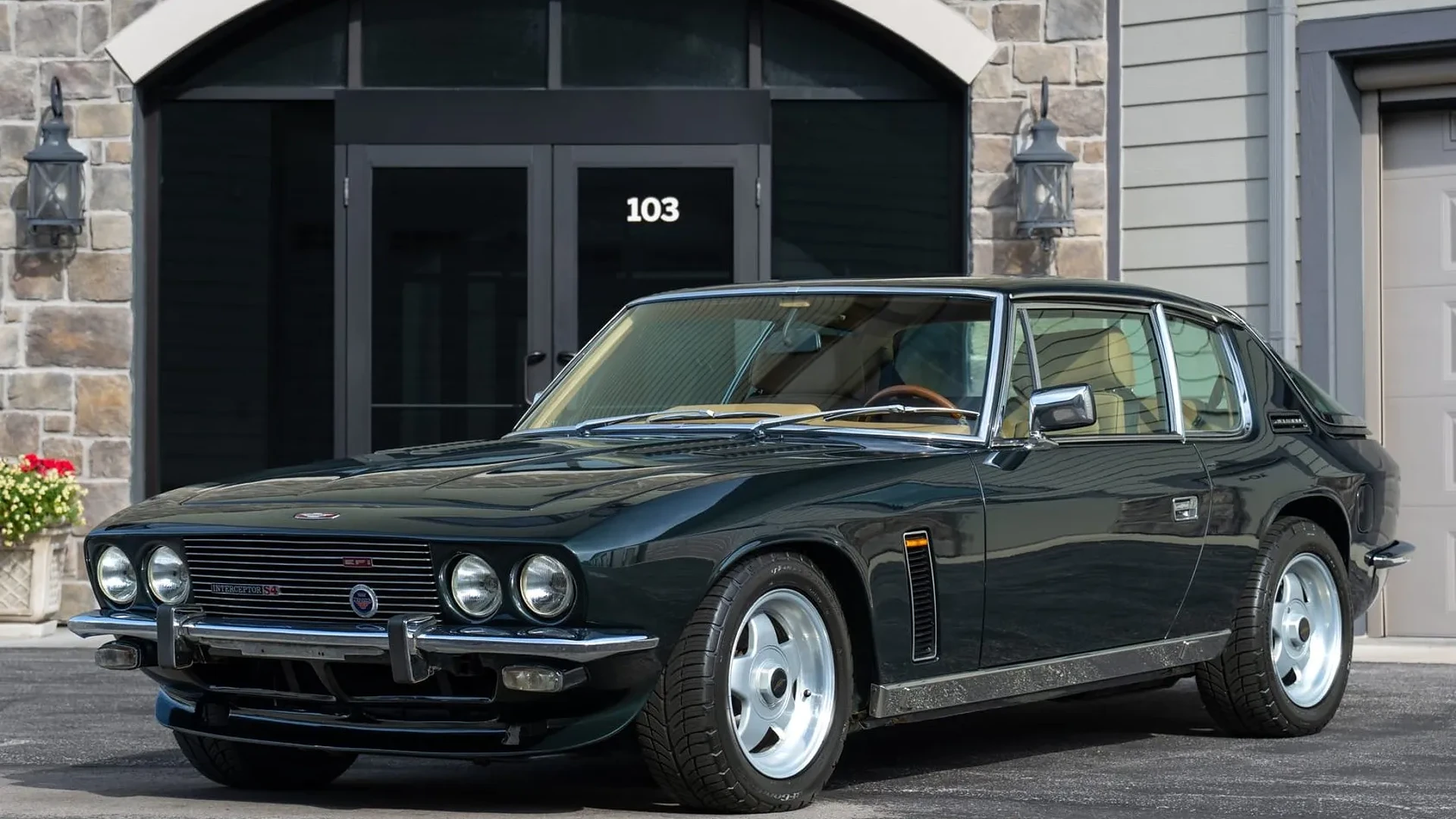
A 1992 Jensen Interceptor S4, chassis 170/2016, the final car of the final series, reached $35,000 on Bring a Trailer when we reviewed the listing. That is almost exactly where the broader Interceptor market sits. It is also roughly a third of the figure at which a tracking service logged the same car, with an Illinois dealer, in September: just under $100,000. The distance between those two numbers is the story.
What “last” actually means
The Interceptor most collectors know ended in 1976, when Jensen Motors closed after roughly 6,400 cars, the Italian-styled, American-powered grand tourer that began with Carrozzeria Touring’s 1966 design. What survived was the service arm. Jensen Parts and Service kept the marque alive through the late 1970s, passed to Ian Orford in 1982, and became Jensen Cars Ltd. in 1984. Orford’s S4 revived the Interceptor on its original lines, built in tiny numbers and largely by hand. Hugh Wainwright’s Unicorn Holdings took control in 1989.
How tiny? Marque registers cite 14 or 15 Series 4 cars, depending on whether a bare shell is counted, and Motor Sport reported in June 1992 that no more than 30 to 35 Interceptors of any kind had been built since 1976, restorations included. Chassis 170/2016, a left-hand-drive saloon, is recorded as the last S4 and was delivered to Germany in 1992.
The car was not a nostalgia product in the cheap sense. The 1992 S4 used a catalytic-converter-equipped 5.9-liter Chrysler V-8 with Holley fuel injection, rated at 244 horsepower and 275 lb-ft, with a claimed 140 mph top speed. Motor Sport noted that a new saloon cost just over £100,000 and a convertible nearly £120,000, at a moment when good 1971 Interceptors were advertised at about £10,750. In other words, the factory was charging boutique prices for a design the used market treated as an affordable curiosity.
Why “last built” is the weakest part of the case
Collectors rarely pay a premium for the last car alone. They pay when the last car closes a chapter the market already agrees was important. Final-series cars from celebrated lines trade strongly because nobody has to be persuaded that the era mattered.
The S4’s problem is that nobody has been persuaded yet. Classic.com’s tracking puts the average Interceptor sale at about $35,000, with recent Bring a Trailer results for 1971 to 1974 cars running from $12,000 to $28,000 and a 1972 car reaching £42,750 at Iconic Auctioneers in July. The same data shows no S4 sale in the past five years. There is no comparable, which cuts both ways: no ceiling, but no floor, and no precedent for a seller or a buyer to lean on.
That is why a $100,000 ask and a $35,000 bid can both be defensible. One prices the car as a unique artifact. The other prices it as an Interceptor with 1990s hardware. The market has not decided which it is.
What a serious buyer should examine
The documentation is the real asset. The car is offered with an assembly photo book, a Jensen briefcase, tools and spares. The photo book matters most: a hand-built car’s claim to be the final one rests on a paper trail, and a build record is the nearest thing to a factory certificate that a tiny-volume manufacturer produces. Collectors should want to see how it ties to the chassis number.
Mileage and condition need to be read together. The listing shows about 20,000 kilometers, stated as true mileage unknown, alongside some wheel oxidation and underside corrosion. Low use and corrosion are not contradictory; they usually point to damp storage rather than hard driving. On a steel-bodied Interceptor, corrosion is the line item that decides whether a car is a collector piece or a project, and it deserves a physical inspection.
The ownership path also deserves attention: delivered in Germany, later Denmark, imported to the United States after 2018, now with an Illinois dealer on a Florida title. A 1992 car comfortably clears the 25-year import threshold, and nothing here is unusual, but a chain across several jurisdictions is exactly where a buyer verifies papers rather than assumes them. The drivetrain, by contrast, is the comfortable part. A Chrysler V-8 and a three-speed automatic are among the most serviceable mechanicals in the collector world, which is a genuine advantage over most low-volume British exotica.
The Jensen name is being tested from both ends
The timing is not incidental. We have written about Jensen International Automotive’s Interceptor GTX and what it asks about the worth of a heritage name, and about what the GTR means for collectors. A new generation of Jensens only carries weight if the original line behind it is credible. A documented, factory-built final car is the most defensible link between the 1966 design and whatever follows, and the market is now being asked to put a number on it.
There is also a quieter lesson for anyone shopping this corner of the market. As our comparison of the Austin-Healey 3000, Sunbeam Tiger and Triumph TR6 argued, British cars with American hearts are priced by condition far more than by badge. The S4 is the extreme test of that rule, a car whose badge, rarity and condition all point in different directions.
The takeaway
“Last” is a claim. It becomes a price only when a second buyer believes it. Whatever figure this sale establishes will be the first public S4 data point in years, and it will quietly set the reference for every other Series 4 car, including the handful that will never come to market. If the number lands near the broader Interceptor average, the market is saying that the final car is simply a very good Interceptor. If it lands well above it, the market is saying the S4 is its own era. Either answer is worth knowing.
The collector car market, every weekday morning.
Auction results, price moves and what’s crossing the block, read in four minutes. Free, from Modern Car Collector.
No spam, unsubscribe in one click. Or read more about the Brief.
Related Posts:
- The Jensen GTX Is the Prototype. The GTR Is the Real…
- The Jensen Interceptor GTX Isn't a Restomod. It's a…
- The Dodge Demon 170 Has Fallen From $225,000 to…
- The Collector Car Market Paid Up for Certainty This…
- A 240Z Owned Since 1975 Proves the Odometer Is the…
- Record Ferraris, Rare Icons and 15,000 RPM: The Week…

 Kyle Matthews
 Shawn Henry