

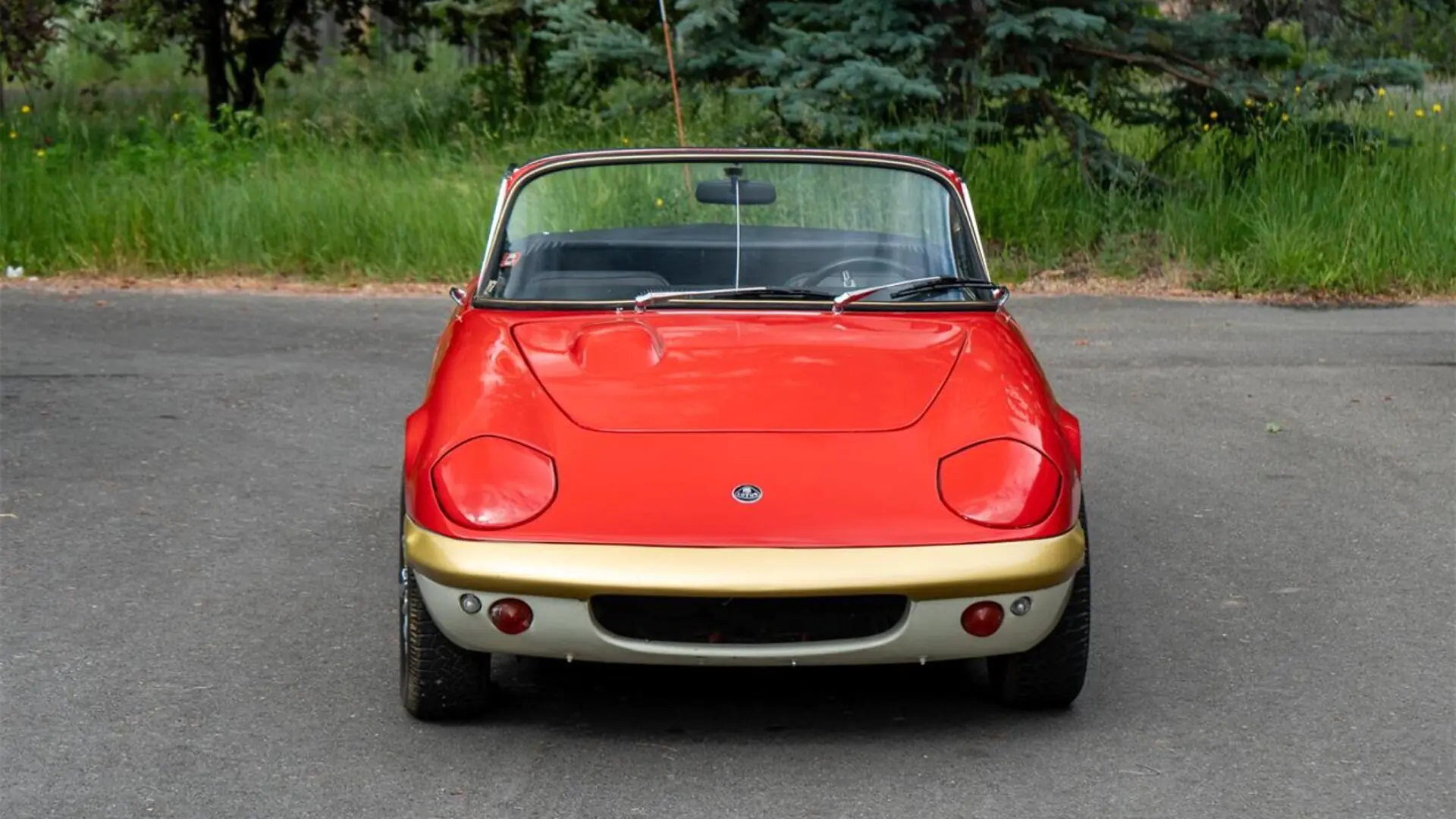
The red-and-ivory Lotus Elan in a current ClassicCars.com listing wears a gold front bumper and “ELAN SPRINT” lettering along its sills. The ad itself is careful. It calls the car a 1969 Elan S4 finished in a “Sprint-style” livery. That caution is the lesson. Stripes, script and gold paint are the easiest parts of a Lotus Elan Sprint to copy, and they are the first things a buyer sees.
A real Lotus Elan Sprint is proved by dates, numbers and paper: a chassis number from the right period, an engine built to Sprint specification and, ideally, a record in Lotus’s archive. This check uses the listing to show what that evidence looks like, what a tribute can borrow, and what a buyer should confirm before paying Sprint money.
What makes a Lotus Elan Sprint a Sprint
According to LotusElan.net, Lotus announced the Sprint at the Earls Court Motor Show in October 1970. Full production at Hethel began in January 1971, and the last car was built on March 6, 1973. Estimates of the total run from about 900 to 1,353 cars because Lotus’s own records were inconsistent; Wikipedia’s Elan entry summarizes the competing counts.
Mechanically, the Sprint was an S4 with the Big Valve Twin Cam: 1,558 cc, 10.3:1 compression and 126 bhp net at 6,500 rpm. Early marketing quoted 135 bhp, a gross figure. Lotus also added a strengthened differential mounting, a differential brace and hazard warning lights. LotusElan.net lists Weber 40 DCOE carburetors at launch, Dellorto DHLA 40s from mid-1972 and Zenith-Stromberg units on Federal cars, although Classic & Sports Car says early big-valve engines used Dell’Orto carburetors. Carburetor type alone is a weak test.
The look was part of the package. Per LotusElan.net, most Sprints left the factory in Gold Leaf-inspired two-tone paint (single-color paint was an option), with semi-gloss black wheels and trim rings, “Elan Sprint” badging and gold-lacquer bumpers that were a Sprint-only feature. The Elan Registry’s identification guide adds that the two-tone scheme could be deleted as a factory option, which is one more reason paint alone never settles the question.
Why the build date does the work
Elan chassis numbers changed format over the production run. Cars built before 1970 carry a type prefix and a sequence number; the Elan Registry lists “36/” for coupes and “45/” for the S3, S4 and Sprint dropheads. From January 1970, LotusElan.net’s parts-list introduction says, the number became a date code (year and month, a production batch, a unit number and a model letter), with the chassis and body numbers the same. The Registry lists Sprint numbers in the 71, 72 and 73 series.
The same table starts S4 production in March 1968. A drophead built in 1969 would therefore predate the Sprint’s announcement by at least ten months. If the ad’s 1969 date is right, the car cannot be a factory Sprint. If the date is wrong, the number will show it. LotusElan.net says the number is stamped on a plate fixed to the left-hand side of the engine bulkhead, and the Registry cautions that Lotus made many undocumented running changes, so treat the number as the anchor and everything else as supporting evidence.
What a Sprint tribute can borrow, and what it cannot
Paint, vinyl lettering and gold bumper paint can be applied to any S4. A larger-valve head can be fitted to an ordinary engine. The listing’s seller says the engine is believed to have been rebuilt under previous ownership with a modified cylinder head with larger valves, which is a sensible performance change but not evidence that the car left Hethel as a Sprint. Wheels are just as portable: the ad lists 13-inch Panasport-style alloys, while LotusElan.net describes the factory Sprint wheel as semi-gloss black with trim rings.
What cannot be borrowed is the date-coded number with the right model letter (LotusElan.net’s Sprint page lists K as the type code for a Federal drophead), the Lotus archive record and the car’s original color. The same logic runs through our other Originality Checks: on an Alfa Romeo Duetto, only a 1600 is a Duetto; on an Austin-Healey 100S, alloy panels and disc brakes prove little; and on a Giulia Sprint GTA, aluminum panels prove little too. Cosmetics travel. Identity does not.
What the ClassicCars.com listing shows
The ad (listing CC-2093972, from Bennyz Auto Sales in Hailey, Idaho) describes a four-speed Elan S4 with a 1.6-liter twin cam, dual Zenith-Stromberg carburetors, four-wheel disc brakes, black vinyl bucket seats and a black convertible top. The odometer reads 51,835 miles. The current owner bought the car as a project in 1990, it sat in storage for many years, and it was recommissioned in May 2026. The ad lists it as repainted in red and ivory with gold accents, says the retractable headlights do not work, and asks $23,000 or best offer. Title status is listed as clear.
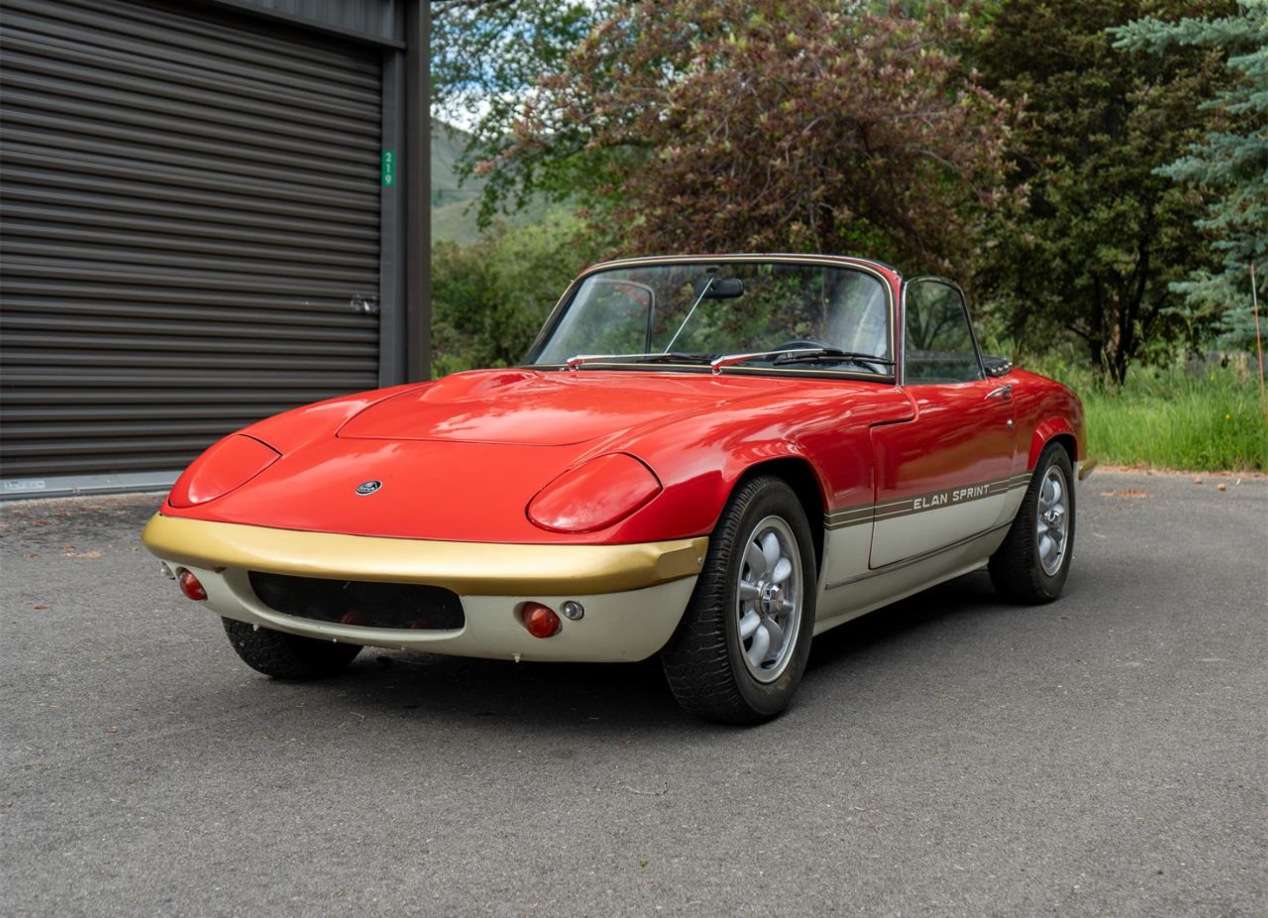
What the ad does not publish is a chassis number or an engine number. Those are the two facts that would settle the Sprint question, and a buyer should ask for both, with photographs of the plate, before anything else. Modern Car Collector has not inspected the car; everything here about it comes from the ad and its photographs.
None of this is a criticism of the seller. The ad discloses the repaint, the engine rebuild and the Sprint-style label, and a car described that way can be priced as what it is: a 1969 S4 with Sprint cosmetics. The risk comes later, when a photograph of “Elan Sprint” lettering outlives the ad copy.
How originality affects the price of an Elan
The Sprint premium is real. Hagerty Media’s October 2019 Elan profile put condition-2 values at $34,400 for an S4 drophead and $43,300 to $45,200 for a Sprint drophead, a premium of roughly 26% to 31%. Classic & Sports Car’s February 2019 buyer’s guide showed a similar gap in sterling: £22,000 for an average drophead and £28,000 for an average Sprint. Both guides are seven years old, so treat them as the size of the gap rather than today’s prices, and check recent sales before paying a Sprint price.
The Classic & Sports Car guide also draws a line that applies here. A replaced chassis does not hurt an Elan’s value, because most survivors have had one and Lotus-made replacements, stamped “LR,” are the most prized. Non-original specification does hurt, apart from reversible, sensible improvements. On an Elan, a new chassis is routine. A Sprint identity that cannot be traced is not. The difference is paperwork, the same point we make in our guides to reading a collector car’s documentation and to what “matching numbers” really means.
What to verify before buying an Elan sold as a Sprint
Start with the plate and work outward.
- Read the chassis plate yourself. Photograph the plate on the left-hand side of the engine bulkhead and compare it with the number in the ad, the title and any registration papers. Note whether it uses the older type-prefix format or the date-coded format.
- Decode the date. A Sprint should carry a date-coded number from the Sprint period (the Registry lists the 71, 72 and 73 series) and a model letter that fits the car’s market. A number from before the Sprint’s October 1970 announcement points to an S4 or earlier car.
- Order Lotus’s paperwork. Lotus Silverstone sells a Certificate of Provenance and a Build Specification Letter that summarize a car’s VIN, paint color and specification and the date it finished production at Hethel, drafted from the Lotus archive. At the 2020 launch it cost £170 plus postage, and the order form asks for the registration and chassis number. PistonHeads noted at launch that it remained to be seen whether every car is on Lotus’s books, so treat the result as one input and compare its color and specification with the car in front of you.
- Ask whether the chassis has been replaced. Most Elan chassis have been, and that is acceptable when documented. Ask who supplied it (a Lotus-made “LR” frame or a Spydercars chassis), get the invoices and find out where the original plate and number went. Our look at restoration versus preservation explains why the paperwork carries the value.
- Get the engine number and the rebuild invoices. A larger-valve head can be a period upgrade or a later modification; only the engine builder’s records and the Lotus build specification can say which. Do not pay for a Sprint engine on the strength of a seller’s belief.
- Ask for the paint history and original color. The ad says this car was repainted. A Certificate of Provenance lists the original paint color, and a buyer can look for traces of the factory color in concealed areas such as door shuts and under trim before trusting a livery.
- Price what the paper proves. If the chassis number and the Lotus record say S4, the car is an S4 with Sprint cosmetics and should be priced against S4 drophead values, however good the lettering looks.
The listing’s own wording shows the right instinct: call the car what it is, then let the numbers speak. On a Lotus Elan Sprint, the stripes are an invitation to check, not proof. For more on the marque, see our Lotus Carlton Deep Dive and the Lotus Esprit V8 versus TVR Griffith 500 comparison.
The collector car market, every weekday morning.
Auction results, price moves and what’s crossing the block, read in four minutes. Free, from Modern Car Collector.
No spam, unsubscribe in one click. Or read more about the Brief.
 Kyle Matthews
 Eve Nowell