

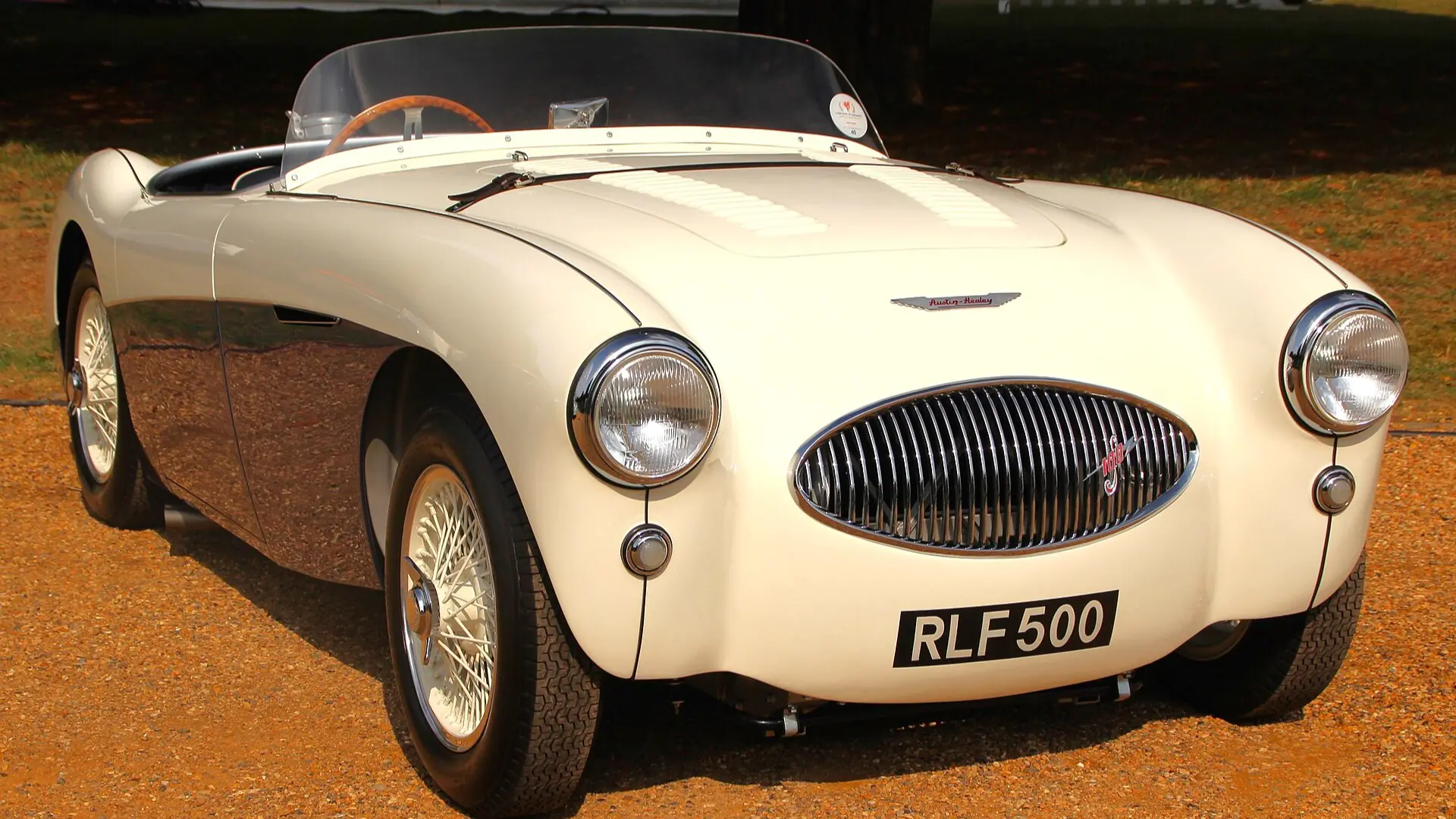
Austin-Healey 100S authenticity is harder to judge than on most British classics because the 100S’s most visible features are the ones a skilled builder can reproduce. The 100S was the competition version of the Austin-Healey 100, hand-built by the Donald Healey Motor Company in 1955 with an all-aluminum body, a Weslake aluminum cylinder head and Dunlop disc brakes at all four wheels. A UK dealer, Pendine Historic Cars, has listed a 2011 recreation built by JME Healeys, openly described as a recreation, with an aluminum body, an alloy head and disc brakes all round.
That overlap changes what a buyer should trust. The body, the head and the brakes describe a type of car. Only the stamped numbers, the physical identity of the frame and body, and a paper trail describe a particular car. And on the 100S the usual British paper trail has a gap: the factory-ledger Heritage Certificate that settles questions on other Austin-Healeys is described by one industry body as excluding Warwick-built and 100S cars.
What a 100S is, and what the premium rests on
Gooding catalogued chassis AHS 3506 as the sixth of just 50 100S competition models built by the Donald Healey Motor Company, and RM Sotheby’s describes AHS-3707 as one of 39 surviving examples of the 50 built. Production totals are not uniform across sources, though. Wikipedia counts 50 production cars plus five works Special Test cars with SPL chassis numbers, Pendine Historic Cars cites 55 original cars, Bill Rawles Classic Cars cites 50 plus five works cars, and the Concept Carz profile gives 49 production cars and seven works cars. Treat any single total as a catalog claim.
Wikipedia says deliveries ran from February to November 1955 and that a works Special Test car’s class win at Sebring in 1954 prompted the “S” designation. RM Sotheby’s puts the gain at 90 to 132 bhp over the standard car and a drop in curb weight from 987 kg to 905 kg. The 100M, the factory’s road-going Le Mans-kit model, made 110 bhp and was built in far larger numbers: 640, according to Wikipedia.
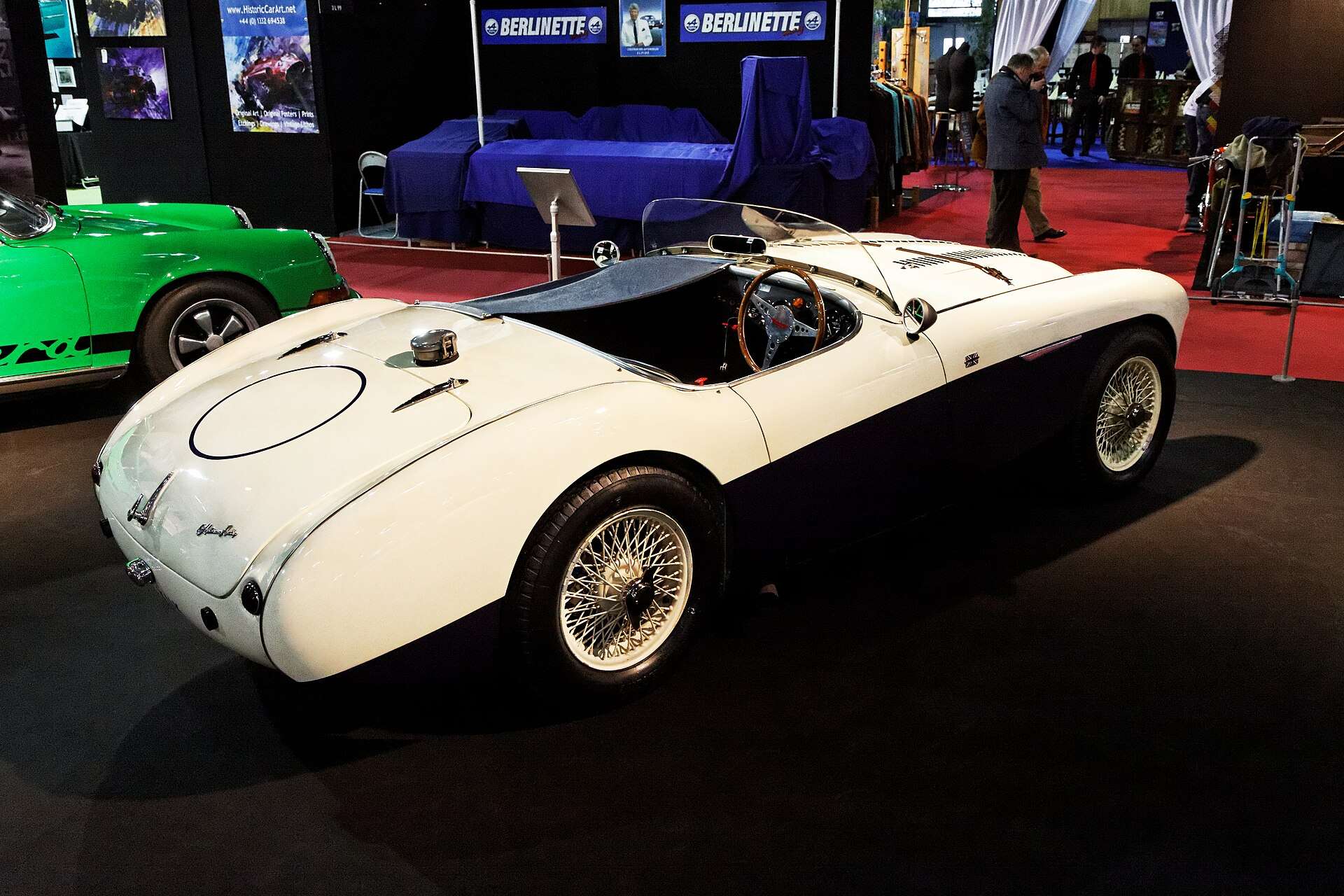
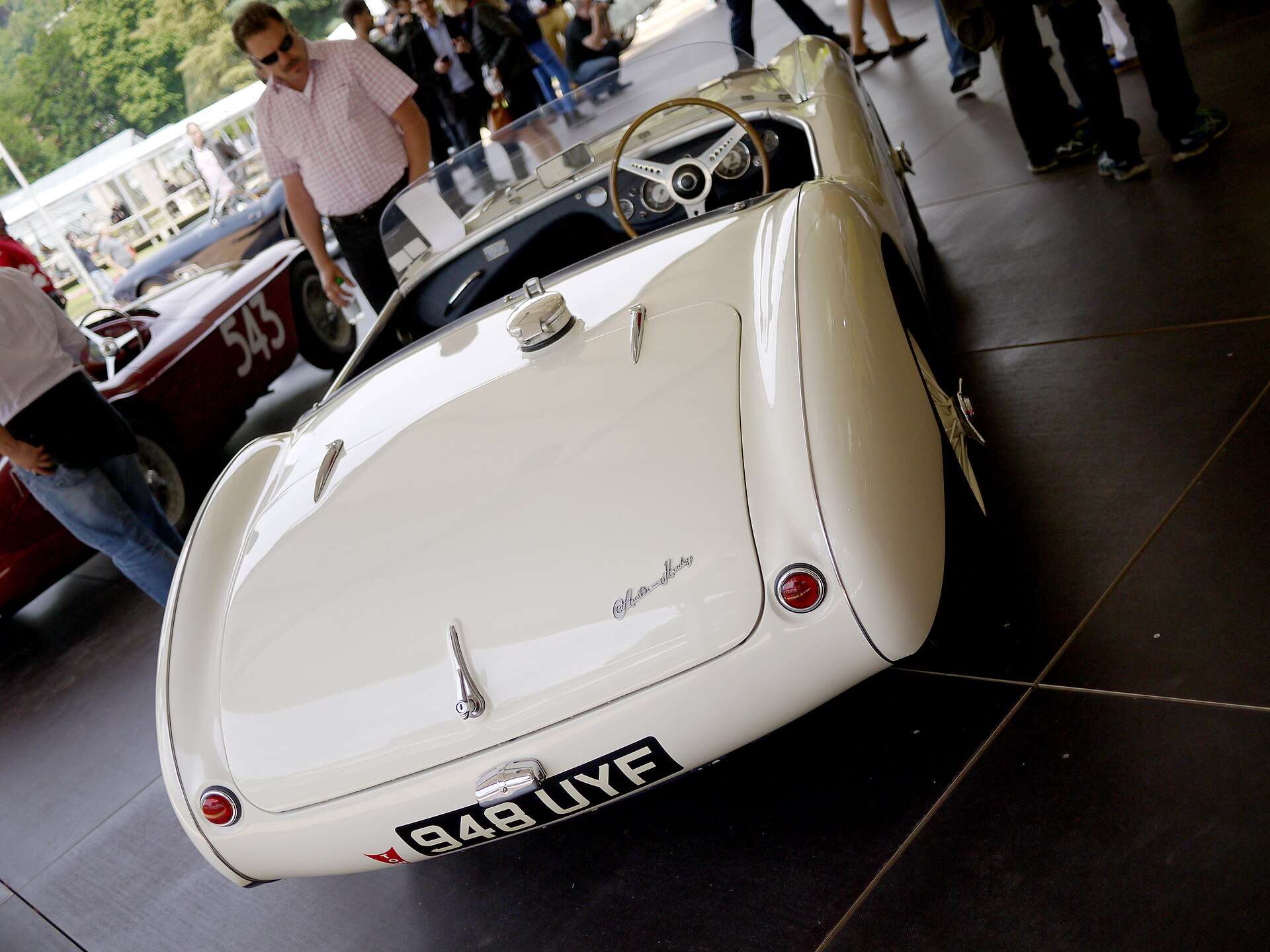
The market treats that difference as a category gap. Classic.com’s 100M page lists 28 sales with an average of $139,799 and a range of $50,000 to $215,000, from listings it shows between September 2023 and May 2025. The 100S results in the table below, where a sale is recorded, run from $379,000 to $1,012,000. The 100S also has period racing history to match: Raymond Flower and FitzRoy Somerset finished third in class in the car below at the 1956 Swedish Grand Prix, according to the photographer’s file description.
Every visible 100S feature has been reproduced
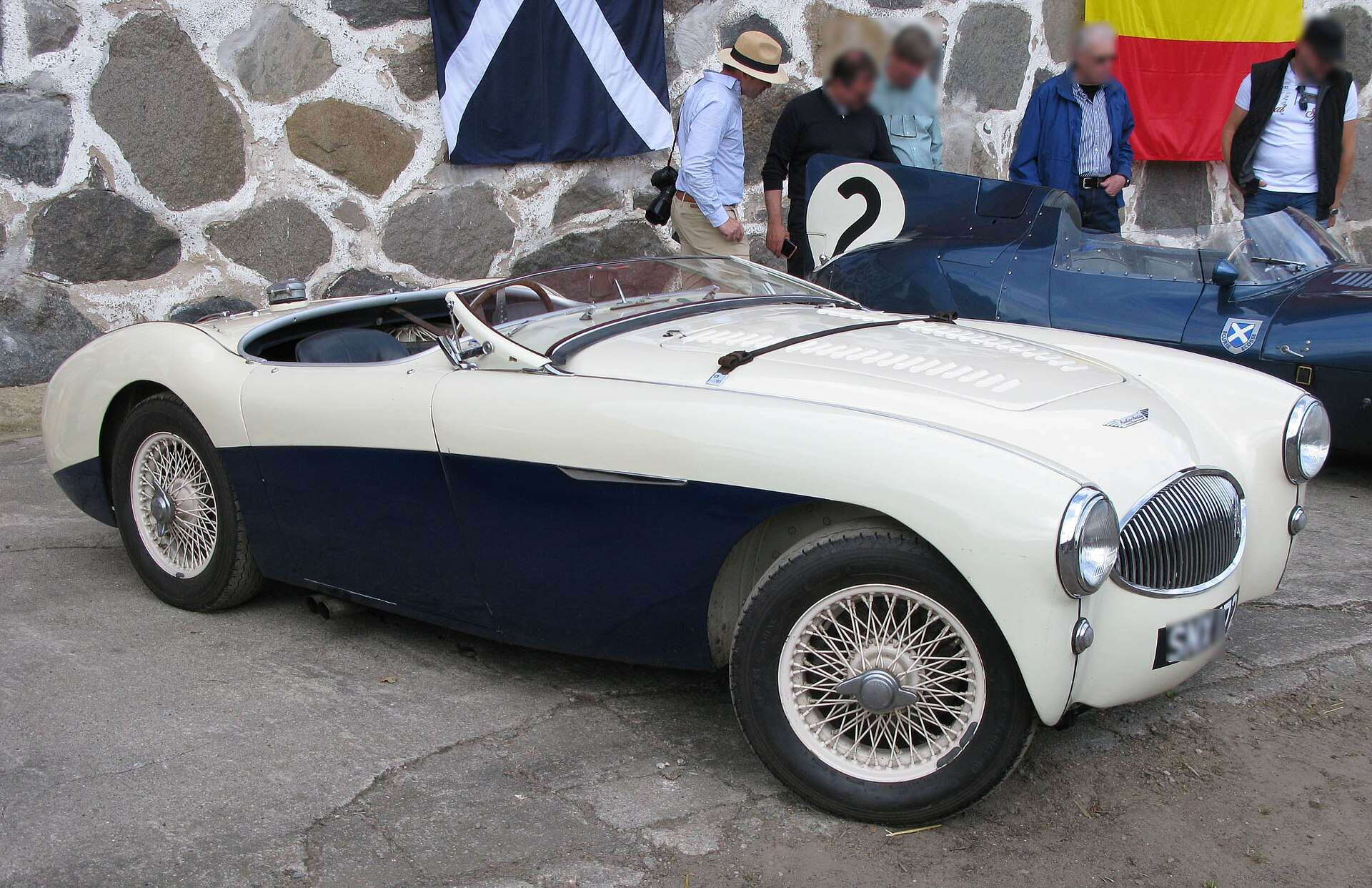
The features sellers lead with are an aluminum body on a steel frame, the Weslake aluminum head, four-wheel Dunlop discs, no bumpers or folding hood, a reduced grille and a Perspex windscreen. Wikipedia and RM Sotheby’s add that the 100S did without overdrive. Pendine’s listing of the 2011 recreation describes an aluminum body, an alloy head, an uprated chassis and disc brakes all round. That is nearly the whole list.
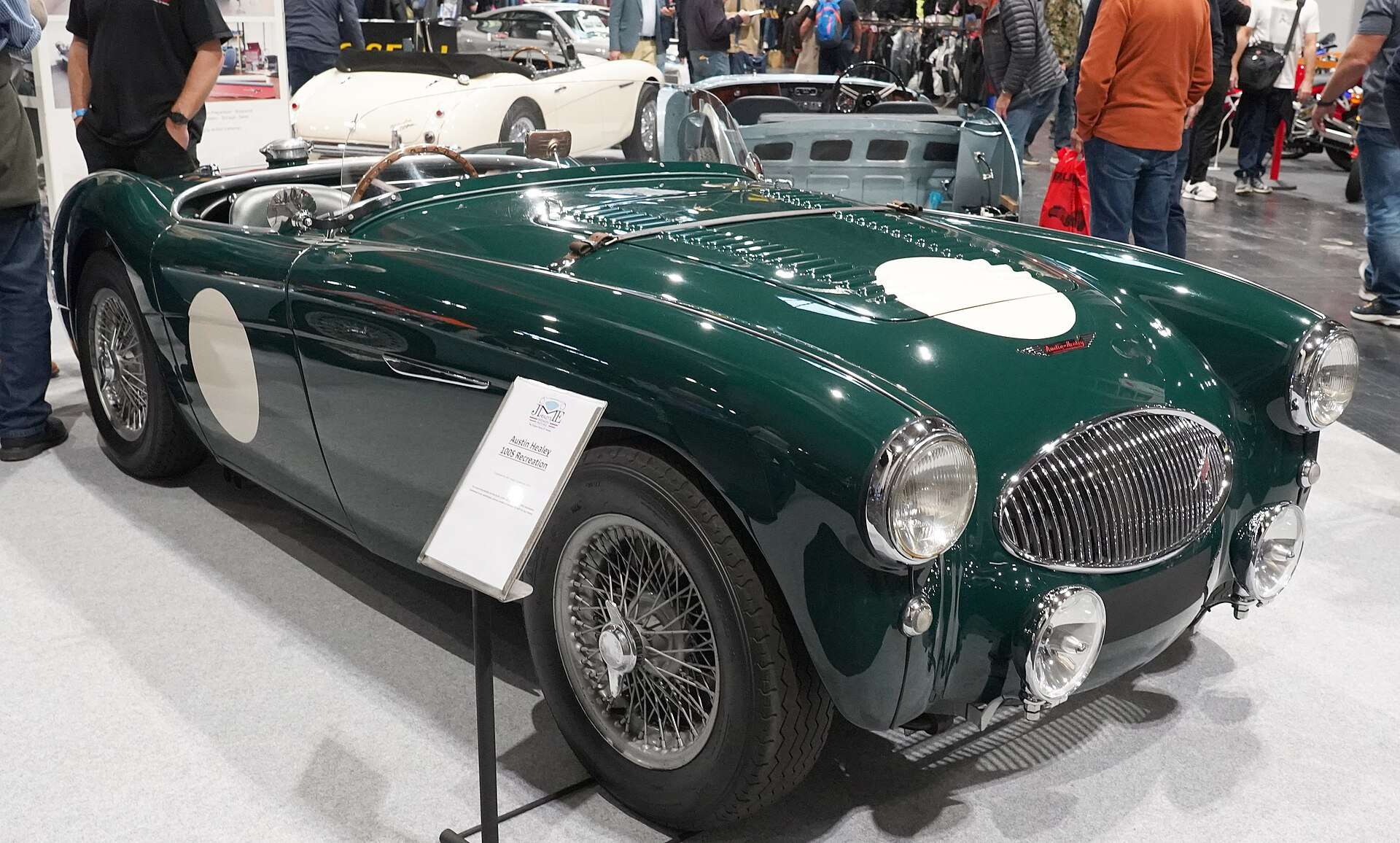
Wikimedia Commons keeps a category specifically for replicas of Austin-Healeys, and the photograph below, taken at the 2025 Classic Motor Show, is filed in it as a 100S recreation. The sources reviewed for this article describe no individual fraud case; the point is narrower. A feature list cannot separate a factory 100S from a well-built copy, so a seller’s description of features is not evidence of identity. The same logic applies to other aluminum-bodied classics, as in our Alfa Romeo Giulia Sprint GTA originality check, where panels prove little until the chassis, engine and archive paper agree.
Where the paper trail is thinner than on other Healeys
The British Motor Museum describes a Heritage Certificate as a certified copy of a car’s entry in the original factory ledger, showing build and despatch dates, engine and body numbers, color scheme and factory-fitted equipment, and its archive list includes Austin Healey 1953–71. The Federation of British Historic Vehicle Clubs’ description of the Trust’s coverage is more specific: Austin-Healey 1953–71, “Longbridge and Abingdon build (not Warwick or 100 S models).” The 100S was a Warwick car.
The museum’s own page does not repeat that exclusion, so the careful reading is to ask the museum whether a record exists for the specific chassis before paying for a certificate or accepting one as proof. Its Production Record Request service is there for that question, and the museum says the ledgers do not record every detail for every model. Where a certificate does exist, it works as it does on the cars in our Series 1 E-Type Heritage Certificate check and 80-inch Land Rover check: it tells you what the factory recorded, not what is on the car today.
Auction catalogs show what substitutes. RM Sotheby’s cites a Woolmer Classic Engineering inspection confirming the original chassis and body plates and the body number stampings on AHS-3707. A dealer listing for AHS 3601 cites an FIVA Identity document issued in October 2012, which is useful corroboration but is not a factory record. Gooding’s entry for AHS 3506 relies on a firewall-mounted data tag to describe a matching-numbers engine block. Each is a physical inspection or a secondary document; none is the factory ledger.
Austin-Healey 100S authenticity: the four numbers catalogs record
Catalog entries for 100S cars record up to four numbers: chassis (AHS prefix), body, engine and gearbox. The table shows the entries reviewed for this article.
| Chassis | Body no. | Engine no. | Gearbox no. | Catalog |
|---|---|---|---|---|
| AHS-3504 | 32 | 1B222705 | 1013 | RM Sotheby’s, Amelia Island 2015 |
| AHS 3506 | Not given in text reviewed | 1B222706 | Not given in text reviewed | Gooding Christie’s, Amelia Island 2026 |
| AHS-3707 | 57 | 1B 222731 | 1029 | RM Sotheby’s, Villa Erba 2015 |
Two cautions. First, three entries cannot establish a numbering rule. The three engine numbers sit in a narrow run, 1B 222705 to 1B 222731, and rise with chassis number, which makes a number far outside that neighborhood a question to put to a marque specialist, not proof of anything. Second, chassis numbers cited across the catalogs and listings reviewed run from AHS 3501 into the AHS 38xx range even though the production run was about 50 cars, so the series is not a simple count. A number that looks plausible is not a number that has been verified.
Restoration choices are part of authenticity
Gooding’s entry for AHS 3506 is unusually plain about what changed: the chassis was replaced during restoration by Steve Pike of Marsh Classic Restorations, and the removed frame accompanies the car. The catalog still calls it “an authentic 100S with period American racing history.” It sold without reserve at the 2026 Amelia Island sale for $379,000 against an estimate of $450,000 to $600,000.
Nothing in the catalog says how much of that gap came from the frame, as opposed to condition, the no-reserve format or the market. What it shows is the question a buyer must be able to answer on any 100S: which identity-bearing parts are original, which were replaced, and where the replaced ones are now. By contrast, RM Sotheby’s entry for AHS-3504 reports a left front fender replaced with a new-old-stock panel after racing damage in June 1955, a body-panel repair with a documented reason. That is the documentation standard we describe in why documentation now outweighs restoration quality.
| Chassis | Sale | Result | Notes |
|---|---|---|---|
| AHS-3504 | RM Sotheby’s, Amelia Island 2015 | $1,012,000 | Catalogued as the first chassis of the 50; engine described as original |
| AHS-3604 | RM Sotheby’s, St. Moritz 2021 | CHF 702,500 | Restored from 2002; catalog calls it believed to be the only 100S exported directly to Switzerland |
| AHS 3901 | Gooding Christie’s, Pebble Beach 2024 | $489,000 | Result as listed by Classic.com, which marks results unofficial |
| AHS 3506 | Gooding Christie’s, Amelia Island 2026 | $379,000 | Estimate $450,000–$600,000, no reserve; chassis replaced in restoration |
| AHS-3707 | RM Sotheby’s, Villa Erba 2015 | Not sold | Estimate €900,000–€1,100,000 |
These are different cars sold at different venues, in different years and conditions. They do not establish a trend, and buyer’s-premium treatment is not stated on every page.
What to verify before you buy
- Get the claim in writing: factory production 100S, works Special Test car rebuilt as a 100S, or recreation. Require the chassis number in the same document.
- Have a marque specialist inspect the chassis plate, the body number stampings and the frame itself, as the Woolmer Classic Engineering inspection cited by RM Sotheby’s did for AHS-3707.
- Record all four numbers (chassis, body, engine, gearbox) and compare them with period documents and with earlier auction catalog entries for the same chassis.
- Ask the British Motor Museum whether a ledger record exists for that specific chassis before paying for a Heritage Certificate, and do not accept a certificate issued for a different Austin-Healey as evidence.
- Establish which identity-bearing parts are original, replaced or missing (frame, body, engine block), and ask for the removed parts, as with the frame that accompanies AHS 3506. Price the car on that answer.
- Treat FIVA documents, club letters and dealer statements as corroboration. They are not the factory record.
- Check any racing history against the chassis: entry lists, period photographs and results that name the car, not only the type.
- Read the listing’s wording. “Recreation,” “tribute” and “evocation” describe a different car from a 100S, whatever the badge says; ask for the builder’s name and the build date.
Related reading
For how the same documentation questions play out elsewhere in the British market, see our Austin-Healey 3000, Sunbeam Tiger and Triumph TR6 comparison, our Renault 5 Turbo originality check on aluminum panels, and our explainer on what “matching numbers” really means.
Sources
- RM Sotheby’s: 1955 Austin-Healey 100S, AHS-3504, Amelia Island 2015
- RM Sotheby’s: 1955 Austin-Healey 100S, AHS-3604, St. Moritz 2021
- RM Sotheby’s: 1955 Austin-Healey 100S, AHS-3707, Villa Erba 2015
- Gooding Christie’s: 1955 Austin-Healey 100S, AHS 3506, Amelia Island 2026
- Classic.com: Gooding Christie’s Pebble Beach 2024 result for AHS 3901
- British Motor Museum: Heritage Certificates and FBHVC: Heritage Certificates from the British Motor Industry Heritage Trust
- Wikipedia: Austin-Healey 100, Bill Rawles Classic Cars: Austin-Healey 100S listing, Pendine Historic Cars: Austin-Healey 100S recreation listing, Concept Carz: 1955 Austin-Healey 100S and Classic.com: Austin-Healey 100M market
The collector car market, every weekday morning.
Auction results, price moves and what’s crossing the block, read in four minutes. Free, from Modern Car Collector.
No spam, unsubscribe in one click. Or read more about the Brief.
 John Lloyd
 Kyle Matthews