

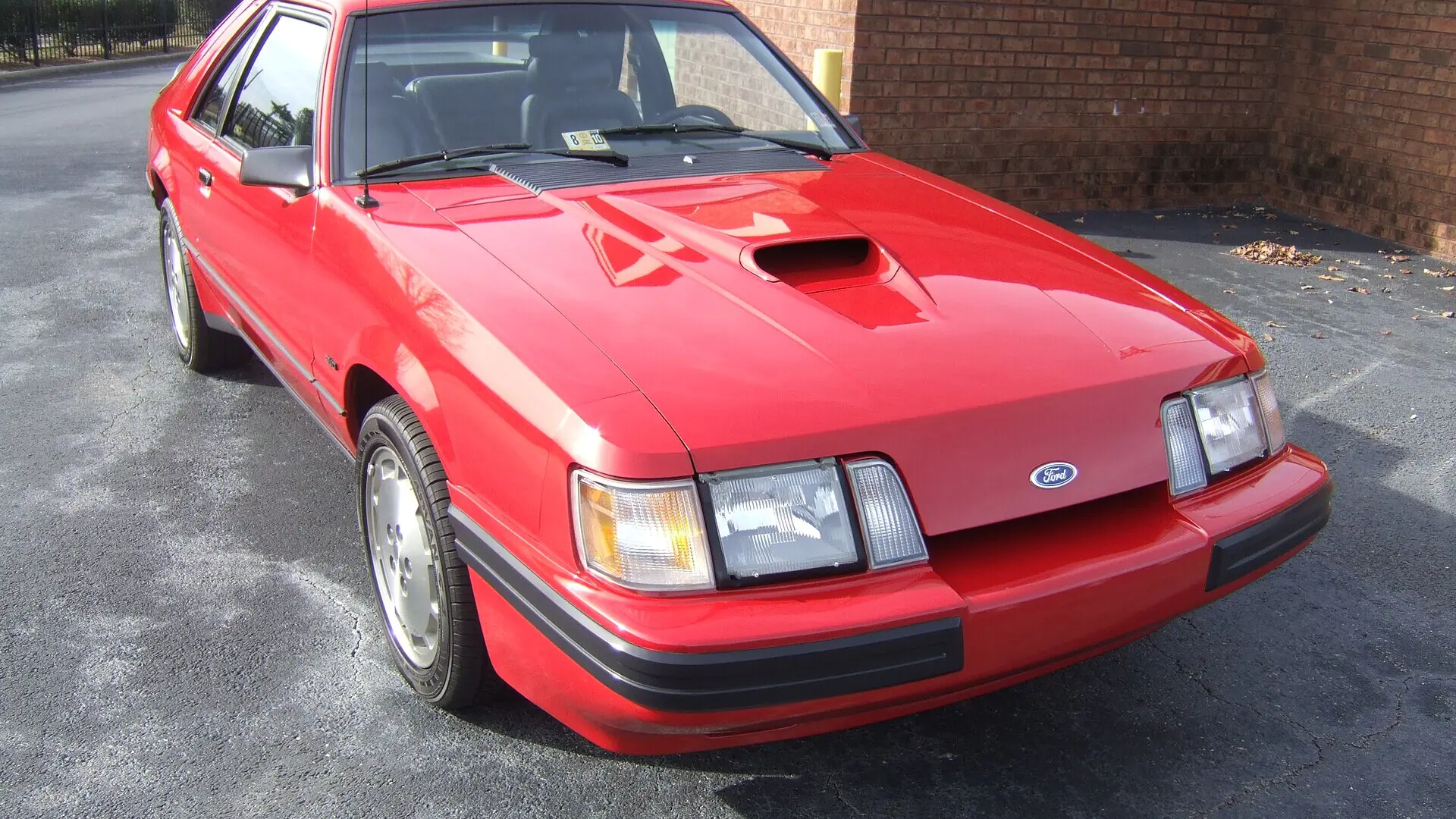
The Ford Mustang SVO was built to pull buyers away from European turbo coupes, and mostly it did not. Ford sold 9,844 of them between 1984 and 1986, at a launch price of $15,585 that sat roughly $6,000 above a V-8 Mustang GT. Four decades on, the car has found the buyers it missed the first time. What the market has not done is settle on a price. Nine recorded sales between October 2025 and September 2026 ran from $5,600 to $29,700, and the distance between those two numbers says more about originality and documentation than it does about mileage.
That makes the SVO an awkward fit for a “future collector car” label. At 40 years old it is already recognized, and Hagerty put it on its list of the 25 greatest Mustangs. But it is not yet a car with a stable, well-understood value curve. This deep dive treats it as established but unsettled: collectible without question, still being sorted by the people who buy it.
Why the Mustang SVO matters
The SVO was the first product of Ford’s Special Vehicle Operations, the racing and limited-edition group formed in late 1979 and led by Michael Kranefuss. Its premise was unusual for an American performance car of the period: take the Fox-platform Mustang and make it a chassis car rather than an engine car. Instead of a bigger V-8, it got a turbocharged four-cylinder, an intercooler, four-wheel disc brakes, adjustable Koni dampers and a Hurst-shifted five-speed. Ford had at one point weighed replacing the Fox Mustang with a Mazda-developed car, and the enthusiast backlash is part of why the Mustang survived. The SVO is a product of that argument.
The result was a car that road testers admired and showrooms ignored. A Mustang GT was cheaper, sounded better and was close in a straight line. The SVO’s case rested on how it handled, and that case has aged far better than the sales numbers did. The central question for a collector is whether the market now values the SVO for what it was trying to be, or only for being rare.
Production numbers
Production is generally given as 9,844 cars, built at Ford’s Dearborn Assembly Plant: 4,508 for the 1984 model year (the car reached dealers in April 1984), 1,954 for 1985 and 3,382 for 1986. Sources do not agree perfectly. A Hagerty Drivers Club profile of the car gives “9,502” sold, which may reflect retail sales rather than production, so treat 9,844 as the working figure and the discrepancy as a reason to ask for documentation on any individual car.
Two small subsets matter more to collectors than the total. The Competition Prep package (option 41C) deleted the sunroof, air conditioning, power windows and locks and the stereo to save roughly 100 pounds; only 123 were built, 40 in 1985 and 83 in 1986. Separately, Hertz took 60 SVOs for its “Rent-A-Racer” program in 1985. Ten of those were painted Dark Sage, and one dealer-side account says only four of the Dark Sage cars are known to survive. The other 50 wore standard SVO colors, which makes them far harder to identify.
There is a useful wrinkle in the year-by-year numbers. 1985 is the scarcest year, but it was also a split year: early cars kept the 175-horsepower tune, while later “1985½” cars received the revised turbo and 205 horsepower. The rarest model year is therefore not automatically the best car to own.
Engine and drivetrain
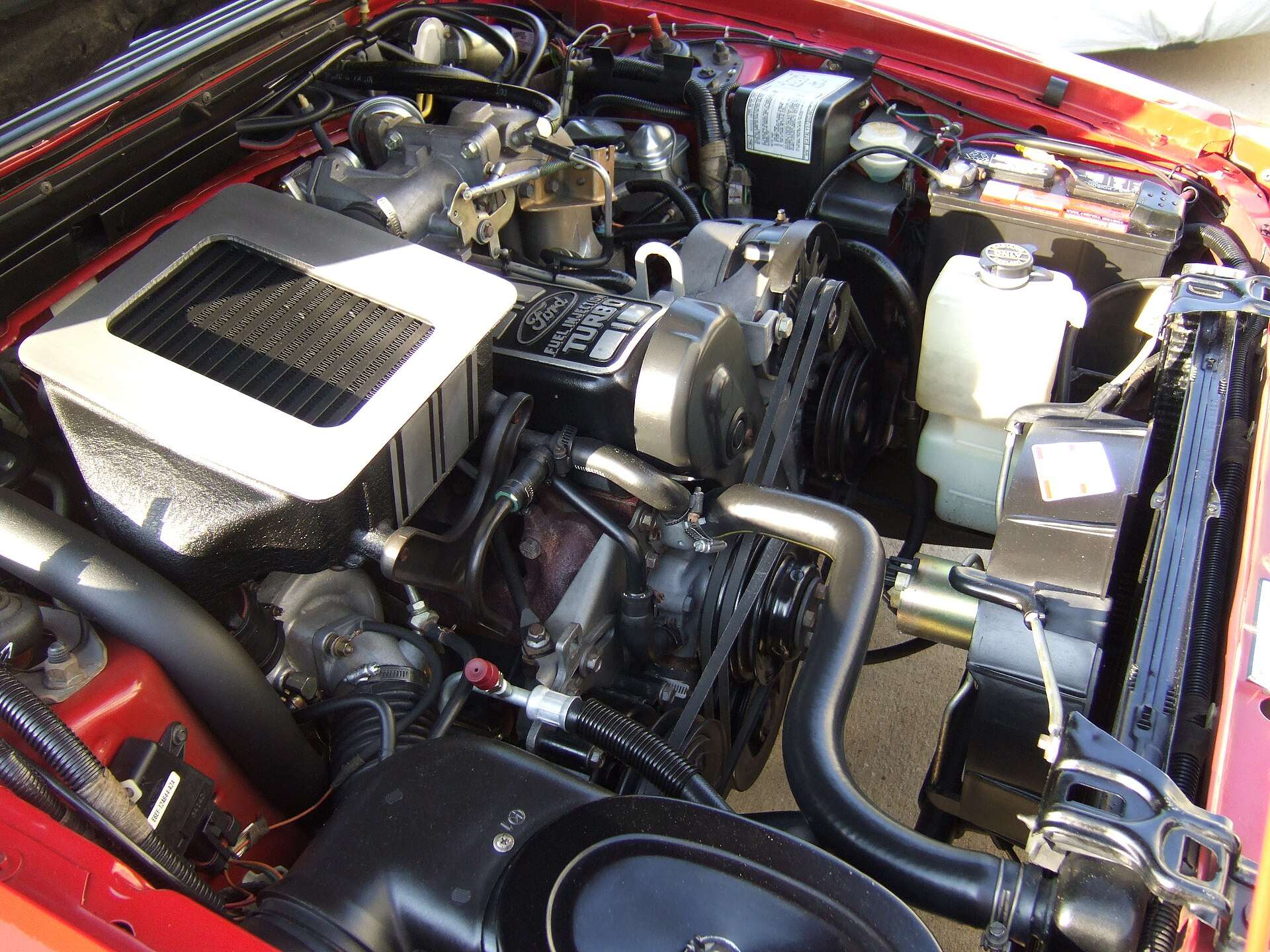
Every SVO used a 2.3-liter turbocharged four-cylinder, longitudinally mounted, with a Garrett T03 turbocharger, Ford’s EEC-IV fuel injection and an air-to-air intercooler fed by a functional hood scoop. A dash switch altered spark advance for premium or regular fuel. Boost ran at roughly 10 psi at low engine speeds and about 14 psi higher up on premium. The engine was described at the time as a detuned relative of the one in Ford’s IMSA Mustang GTP racer.
| Model year | Power | Torque | Notes |
|---|---|---|---|
| 1984–early 1985 | 175 hp @ 4,400 rpm | 210 lb-ft @ 3,000 rpm | Sealed-beam headlamps; 3.45:1 axle at launch |
| 1985½ | 205 hp @ 5,000 rpm* | 248 lb-ft @ 3,200 rpm | Revised turbo, larger injectors, dual exhaust, composite headlamps; 3.73:1 axle |
| 1986 | 200 hp @ 5,000 rpm | 240 lb-ft @ 3,200 rpm | Slightly lower rating; otherwise a continuation of 1985½ |
*Sources give both 200 and 205 hp for the 1985½ tune.
All cars used the Borg-Warner T-5 five-speed with a Hurst shifter, and a 7.5-inch rear axle with a Traction-Lok limited-slip differential, initially at 3.45:1 and later at 3.73:1. In period testing, Car and Driver recorded 0–60 mph in 6.8 seconds and a 15.1-second quarter-mile at 90 mph for a 1985 car. Those are ordinary numbers by today’s standards; the point in 1985 was that the car got there with a fraction of a V-8’s weight over the nose.
Mechanical uniqueness: the chassis was the story
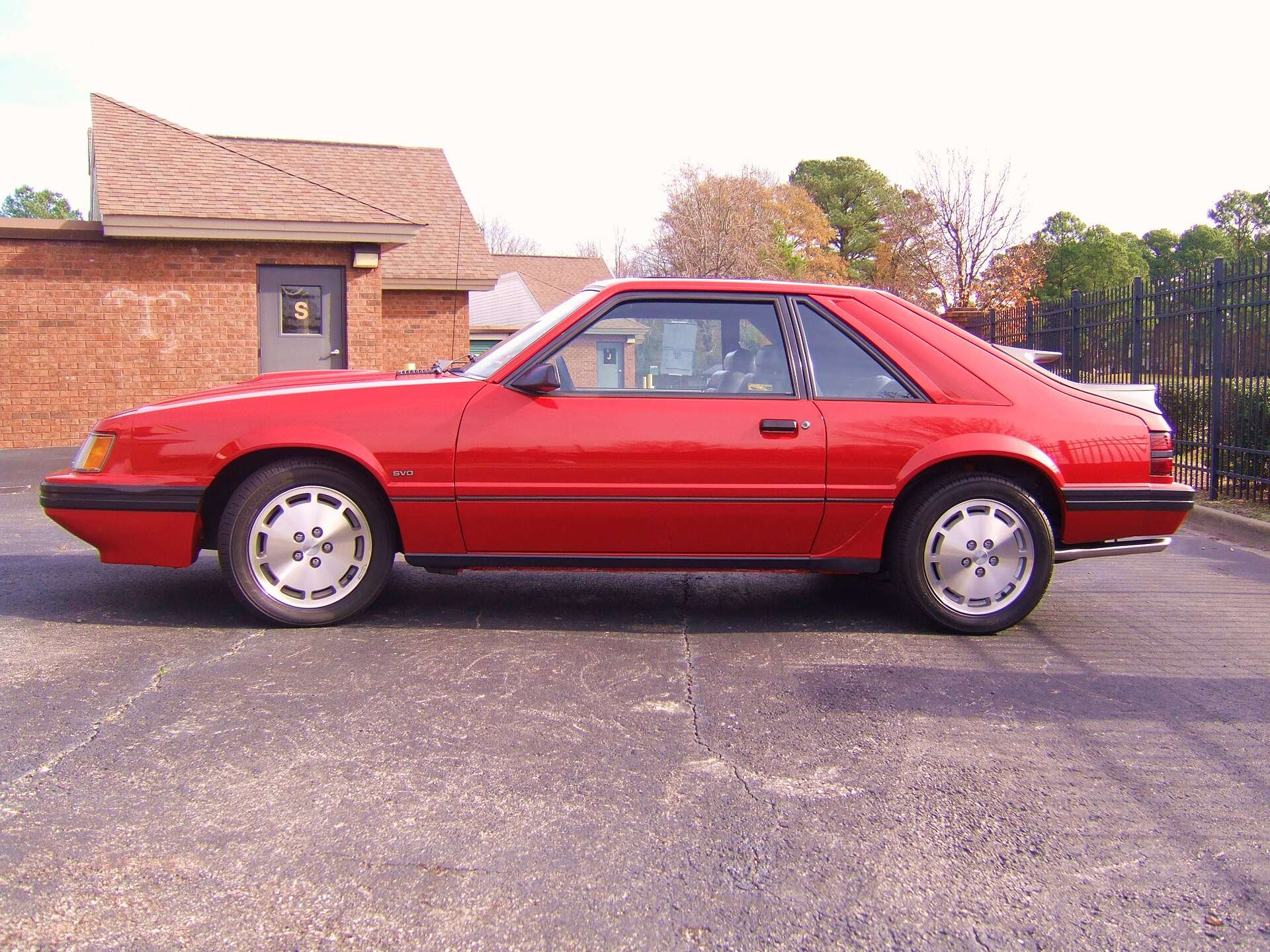
The SVO’s distinguishing hardware was underneath. It was the first Mustang with four-wheel disc brakes, using ventilated units from the Lincoln Continental Mark VII, and the first Fox-body with five-lug hubs to carry them. Wheels were 16 by 7 inches in aluminum, wrapped in P225/50R16 tires. A six-damper Koni setup, with adjustable front struts, adjustable rear shocks and horizontal rear dampers to control axle hop, offered “cross country,” “GT” and “competition” settings. Curb weight was about 2,987 pounds, roughly 150 pounds lighter than a V-8 GT. The SVO’s engine was also shared: the same turbo 2.3 powered the Thunderbird Turbo Coupe and the Merkur XR4Ti, so the SVO was the high-water mark of a family rather than a one-off.
Factory options, colors and identifying details
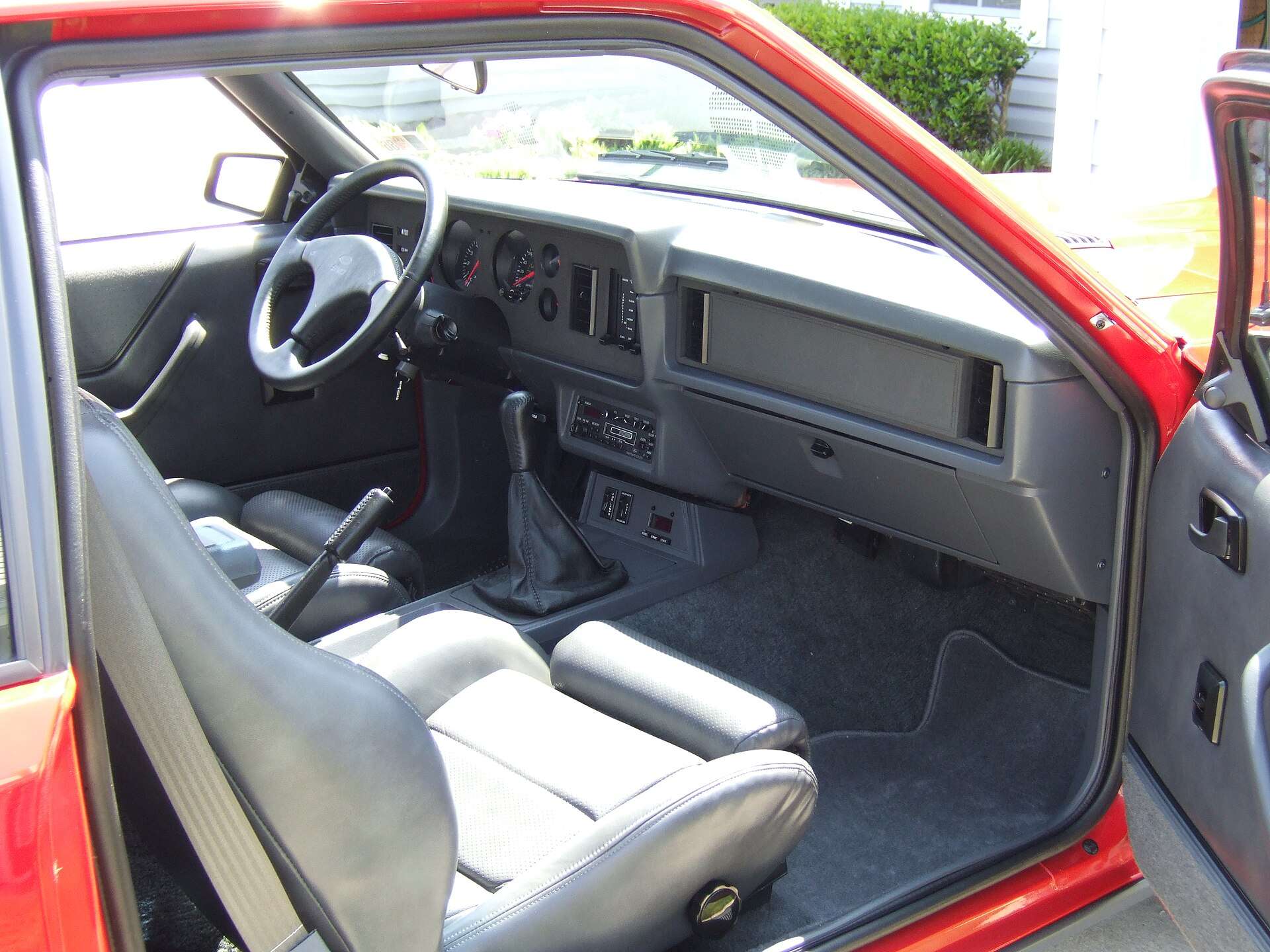
Ordering an SVO was simple by design. The 1984 palette was Black, Silver Metallic, Medium Canyon Red and Dark Charcoal Metallic, with a charcoal interior only, in cloth or leather. The short options list covered air conditioning, a cassette player, power locks and windows, a flip-up sunroof and leather seating. Standard equipment included adjustable sport seats, a leather-wrapped wheel, shifter and brake handle, and a speedometer marked to 85 mph, with unlabeled tick marks up to 140.
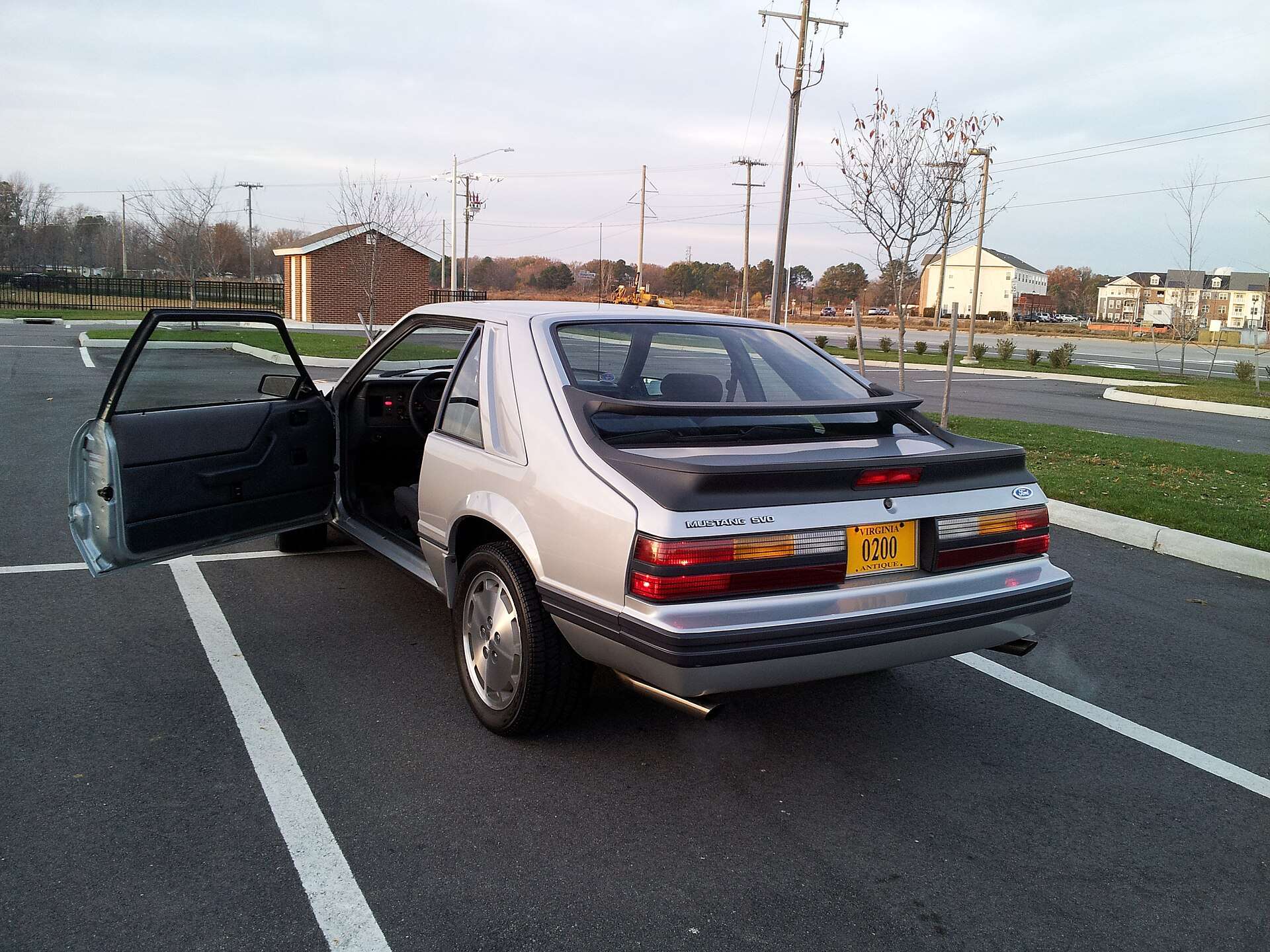
Visually, an SVO is identified by a deeper front fascia, a functional offset hood scoop, a biplane rear spoiler, smaller rear wheel spats and pinstriped taillights. The 1984 and early 1985 cars used sealed-beam headlamps; the 1985½ and 1986 cars switched to flush composite units. VINs on SVOs in the Hagerty and Classic.com records reviewed for this article begin 1FABP28T, which is a pattern worth checking, though it is not a substitute for build documentation. Specialist advice adds a few details: an SVO front wheel well has a notch at the lip that other Fox fenders lack, and on late cars the engine computer markings can help identify the tune. Ask whether Ford build data, such as a Marti Report, exists for the car.
Current market values and comparable sales
The SVO does not have a deep auction record, and the spread is wide. Classic.com’s tracker lists nine sold results with prices between October 2025 and September 2026:
| Date | Year | Mileage | Venue | Sold |
|---|---|---|---|---|
| Sep 26, 2026 | 1986 | 48k | Mecum (Lebanon, TN) | $29,700 |
| Aug 10, 2026 | 1984 | 37k | Bring a Trailer | $14,000 |
| Jun 11, 2026 | 1984 | 25k | Bring a Trailer | $14,100 |
| Apr 9, 2026 | 1986 | 53k | Mecum (Houston) | $10,450 |
| Mar 1, 2026 | 1984 | 6k | Bring a Trailer | $25,250 |
| Feb 21, 2026 | 1984 | 27k | GAA (Greensboro) | $16,500 |
| Feb 9, 2026 | 1986 | 24k | Bring a Trailer | $20,000 |
| Jan 12, 2026 | 1986 | 24k | Mecum (Kissimmee) | $16,500 |
| Oct 31, 2025 | 1986 | 51k | Bring a Trailer | $5,600 |
The average of those nine is about $16,900 and Classic.com’s own benchmark sits near $16,300. A 1985 car also failed to sell in February 2026 at a high bid of $17,000. Three things stand out. First, a 6,000-mile 1984 car brought $25,250, which is the clearest evidence that low mileage is rewarded. Second, mileage alone does not explain the rest: a 24,000-mile 1986 car brought $20,000 in February while another 24,000-mile 1986 car brought $16,500 a month earlier, and two 1984 cars with 25,000 and 37,000 miles landed within $100 of each other. Third, the $29,700 Mecum result on a 48,000-mile car does not fit the pattern at all. Without the condition report, it should be read as one strong result, not a trend.
Hagerty Media has argued that the SVO’s excellent-condition values had pulled level with a V-8 notchback of the same year and ahead of its original import targets, including the BMW 325e and Audi Coupe GT. Hagerty’s valuation pages also show the 1984 car trending up, though the page does not specify the condition tier or time frame, so we have not relied on its dollar figure. These are aggregator and third-party figures; we could not verify individual results against the venues’ own pages, and condition notes were not available for most.
Ownership costs and known weaknesses
The turbo 2.3 itself has a reputation for being tough; one Grassroots Motorsports profile calls the engine family robust and notes it can tolerate much more boost with matching fuel and ignition. The problems live around it. Stock iron heads can crack at the exhaust seats, and uncracked ones are becoming scarce. The SVO’s front lower control arms are unique cast-steel pieces, and when a ball joint wears out the arm must be replaced; Grassroots reported in 2018 that nobody was making new ones, with one workaround being to have a machine shop enlarge the joint pocket to accept a press-in joint from a Lincoln Mark VII or SN95 Mustang. The rear spoiler, much of the interior and all forward body parts are SVO-specific, and the right outer turn-signal lens is cited as particularly hard to find.
Fox-body basics apply too. Hagerty’s Fox-body guide tells buyers to check the unibody for rust, to inspect the rear lower control arm torque boxes for damage from hard launches, and to test T-5 synchros, and it notes that cracked dash tops are common on 1979–86 cars. Owner reports describe boost-control problems on early cars that were traced to a faulty ground, and some first-year cars reportedly shipped with traction bars rather than the later rear damper setup. Generic Mustang parts are plentiful, and specialist suppliers list Koni shock kits for 1984–86 SVOs, but the unique pieces are where cost and delay accumulate. We found no reliable published repair-cost figures, so budget from quotes rather than forum anecdotes.
Originality considerations
Because the SVO’s value depends on its turbo-four identity, the biggest originality risk is a car that has been changed into something else. Turbo 2.3 cars were routinely converted to 5.0 power, and Coyote-swapped SVOs do appear at auction; they may be fun, but a swap removes the thing that made the car an SVO. Check that the intercooler, hood and scoop, spoiler and interior pieces are the correct SVO items. Non-SVO fenders can be drilled to look right, so look for the wheel-well notch. Confirm the engine computer and turbo match the model year, and look at the Konis and brakes for correct, original-style parts.
Mileage deserves skepticism. One Competition Prep car offered in 2023 was listed as “TMU” at 36,037 miles after a vehicle-history report flagged a possible odometer rollback in 2002. The very rare cars are where a tidy story can be hardest to prove, so documentation matters most where the premium is highest.
Competing vehicles
In period, the SVO competed with European and Japanese coupes, and its natural domestic rival was the Buick Grand National, a turbocharged V-6 that took the opposite approach, with a V-6, rear drive and brute force, and that now trades at very different prices; see our report on a 77-mile 1987 Grand National. Within Ford’s own showroom, the V-8 Mustang GT was cheaper and louder, and the Thunderbird Turbo Coupe used the same engine in a larger body. Later Mustangs that carried the SVO’s “special performance” idea forward include the cars covered in our Terminator Cobra buying guide. For readers weighing other turbo-four performance cars that the market is still sorting, our evaluations of the Volvo 850 T-5R and the Saab 9-3 Viggen make a useful contrast, and the Mk2 Golf GTI shows what happens when a once-ignored enthusiast car catches a wave.
What separates exceptional examples from average ones
An exceptional SVO is an unmodified, documented car, preferably from the late-1985 or 1986 production run with the stronger tune, with its original paint, intact SVO-specific trim, working Konis, a healthy T-5 and an uncracked dash. Low mileage is rewarded, but the spread in the sales above suggests that buyers are paying for originality and a clean history as much as for the odometer. Competition Prep cars and Hertz Dark Sage cars are special cases whose premium depends almost entirely on proof. An average SVO is a driver with unknown history, tired Konis, worn control arms, a cracked dash, or a swapped drivetrain, and those cars are the ones trading near the low end of the range.
Established value versus speculative potential
What is established: the SVO has a recognized place in Mustang history, a documented production total under 10,000, and a market in which clean, original cars have recently sold in the mid-teens to mid-twenties. What is speculative: whether that range is the floor of a rising market or just where a thinly traded car happens to sit. Nine sales in a year is not a market with a trend line. Nothing here is a price prediction.
What could strengthen or weaken its desirability
The strengthening case rests on the wider Fox-body market. Hagerty reports that the median excellent-condition value of 1979–93 Mustangs has risen 132 percent since 2013, and it is plausible that the turbo-four cars pick up some of that attention as V-8 cars get expensive. Growing appreciation for analog turbo cars and for the SVO’s chassis could help. On the other side: scarce unique parts, cracked heads, the popularity of engine swaps that shrink the supply of original cars, and the simple fact that a thin market can reverse with a few weak results. Our own overview of Mustang values by generation and the modern collector’s guide to the Mustang place the SVO in that wider context.
The bottom line
The Mustang SVO is a case where the thing Ford got right, the chassis, is finally being credited, and the thing Ford got wrong, the price, no longer matters. It is a legitimate collector car today, but a market still making up its mind. A buyer should pay for originality and paperwork, favor the later cars unless a rarer variant can be proven, and treat a single big auction result as an interesting data point rather than a new baseline. The best SVO is the one that is still unmistakably the car Ford built.
Sources and notes: production, specification and option data from the Wikipedia entry on the Ford Mustang SVO (citing the Standard Catalog of Ford and period road tests), Hagerty Media (25 Greatest Mustangs, Turns out the Mustang SVO Won after All and its Fox-body buyer’s guide), Grassroots Motorsports, Car Throttle, SlashGear on the Hertz cars, and sold results compiled by Classic.com. Sources differ on some figures, including launch price (one cites $15,970) and the 1985½ power rating.
The collector car market, every weekday morning.
Auction results, price moves and what’s crossing the block, read in four minutes. Free, from Modern Car Collector.
No spam, unsubscribe in one click. Or read more about the Brief.

 Shawn Henry
 John Lloyd


