

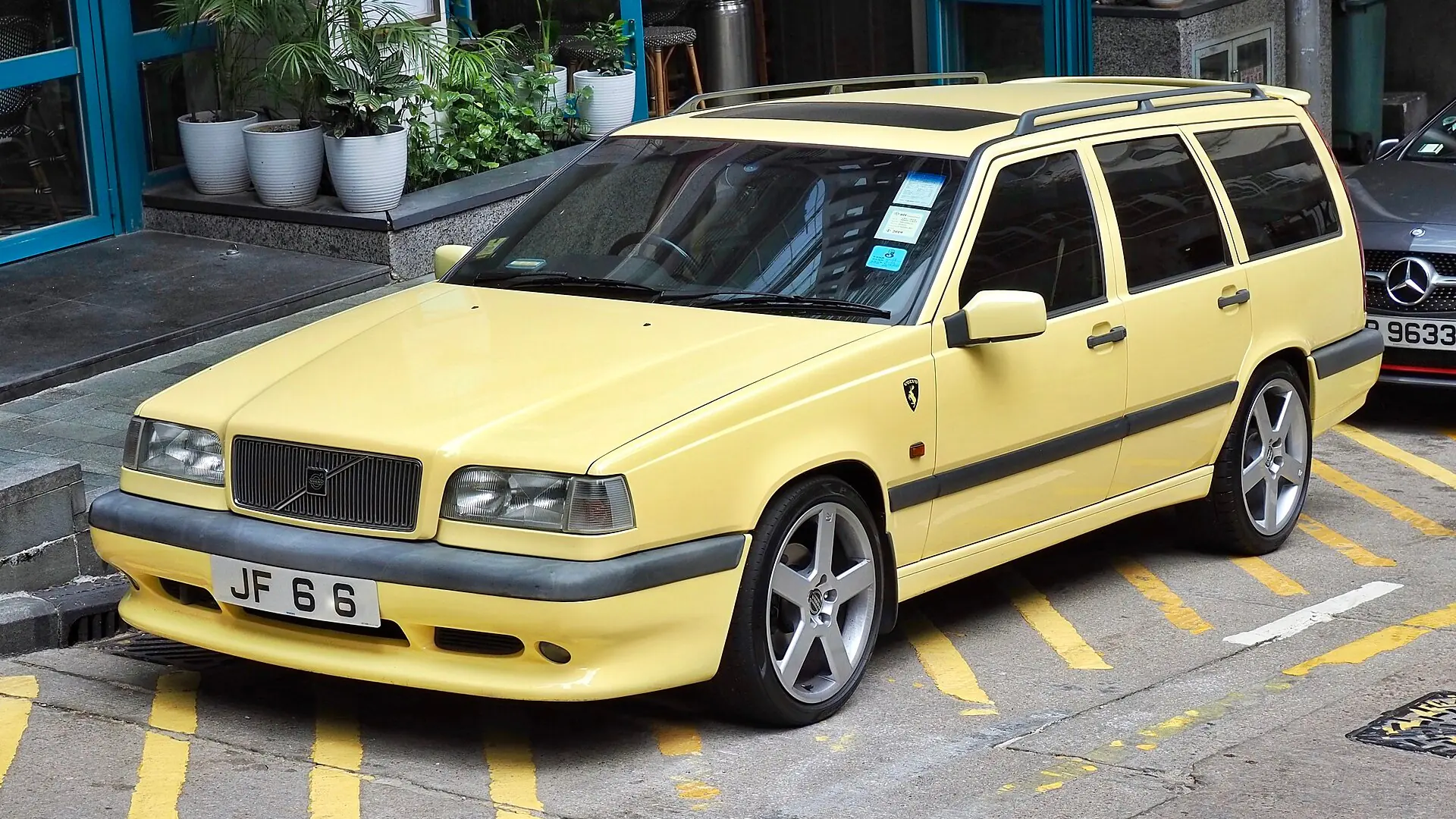
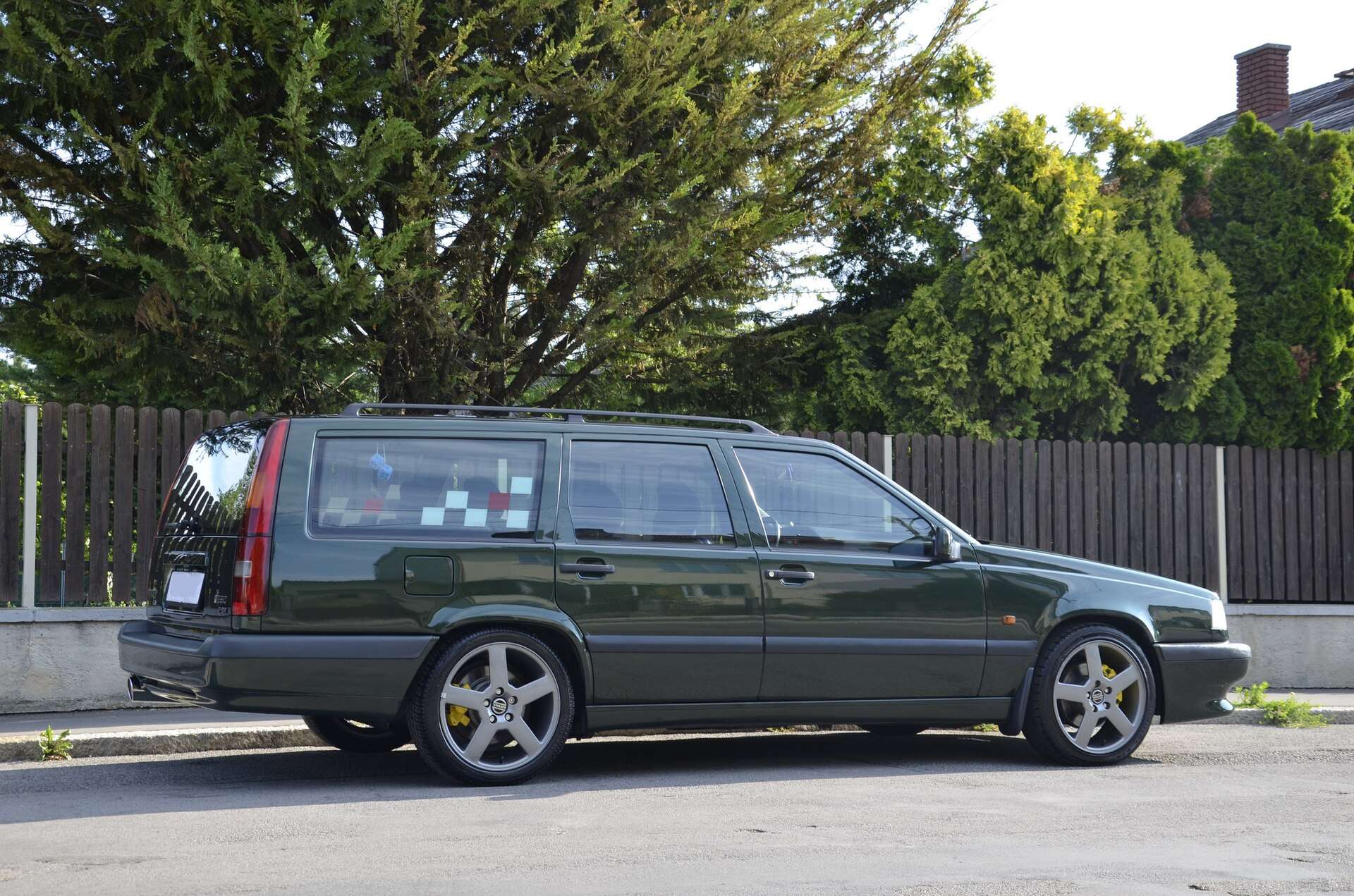
The Volvo 850 T-5R is a 1990s performance car that collectors already recognise and the market has not yet priced with confidence. That is the thesis of this evaluation: the badge is established, but the values are not. A T-5R is still priced more by color, transmission and condition than by the T-5R name, and the gap between those two things is where both the opportunity and the risk sit.
Volvo built the car in 1994–95 as a limited-edition run on the 850 Turbo, with engine-management work done with Porsche. The Wikipedia’s 850 entry puts the run at 6,964 cars worldwide, which is a bigger edition than the badge suggests and a smaller one than it feels when you try to find a clean example.
Why the Volvo 850 T-5R matters
The 850 was Volvo’s first big front-wheel-drive car, and the T-5R was the version that told buyers the brand could be quick as well as safe. It arrived with a front-drive turbo five, a sport chassis and a color, Cream Yellow, that Jalopnik reports dealers struggled to sell in America. The car’s motorsport halo was real too: Volvo and TWR raced the 850 in the British Touring Car Championship, first as an estate in 1994 and then as a saloon, according to Wikipedia’s 850 entry.
What makes it a collector question rather than a nostalgia question is the combination of a limited production run split across three colors, a documented Porsche connection, and a body style, the performance estate, that the market has been re-rating for years. For a related example of how the market treats wagons, see our look at a $252,000 Mercedes W123 wagon that priced one car, not a model.
Production numbers
Per the production statistics from the Volvo Club UK cited by Wikipedia’s 850 entry, and repeated by the Garage Dreams buyer’s guide, 6,964 T-5Rs were built between August 1994 and July 1995. A TimesLive anniversary feature gives 6,954, so treat the last digit as unsettled. The color split is the more useful figure for buyers, and it is the opposite of what the car’s reputation suggests: Cream Yellow was the most numerous color, not the rarest.
| 1995 color | Cars built |
|---|---|
| Cream Yellow | 2,537 |
| Stone Black | 2,516 |
| Olive Green Metallic | 1,911 |
| Total | 6,964 |
Not every market got every color, and Norway reportedly received only yellow. Germany took the most cars (1,433), followed by Italy (914, 2.0-litre turbos), the United States (876), Japan (749), the Netherlands (489), the UK (440), Sweden (321), Spain (185) and Canada (103). In the U.S., Wikipedia’s tally lists 346 yellow sedans and just 49 yellow wagons. Volvo also built two white and two aubergine pre-production cars, and three grey cars for the Arabian market, so an unusual color is a documentation question before it is a rarity claim. The country figures sum to fewer than 6,964, so they are a partial breakdown, not a complete one.
Engine and drivetrain
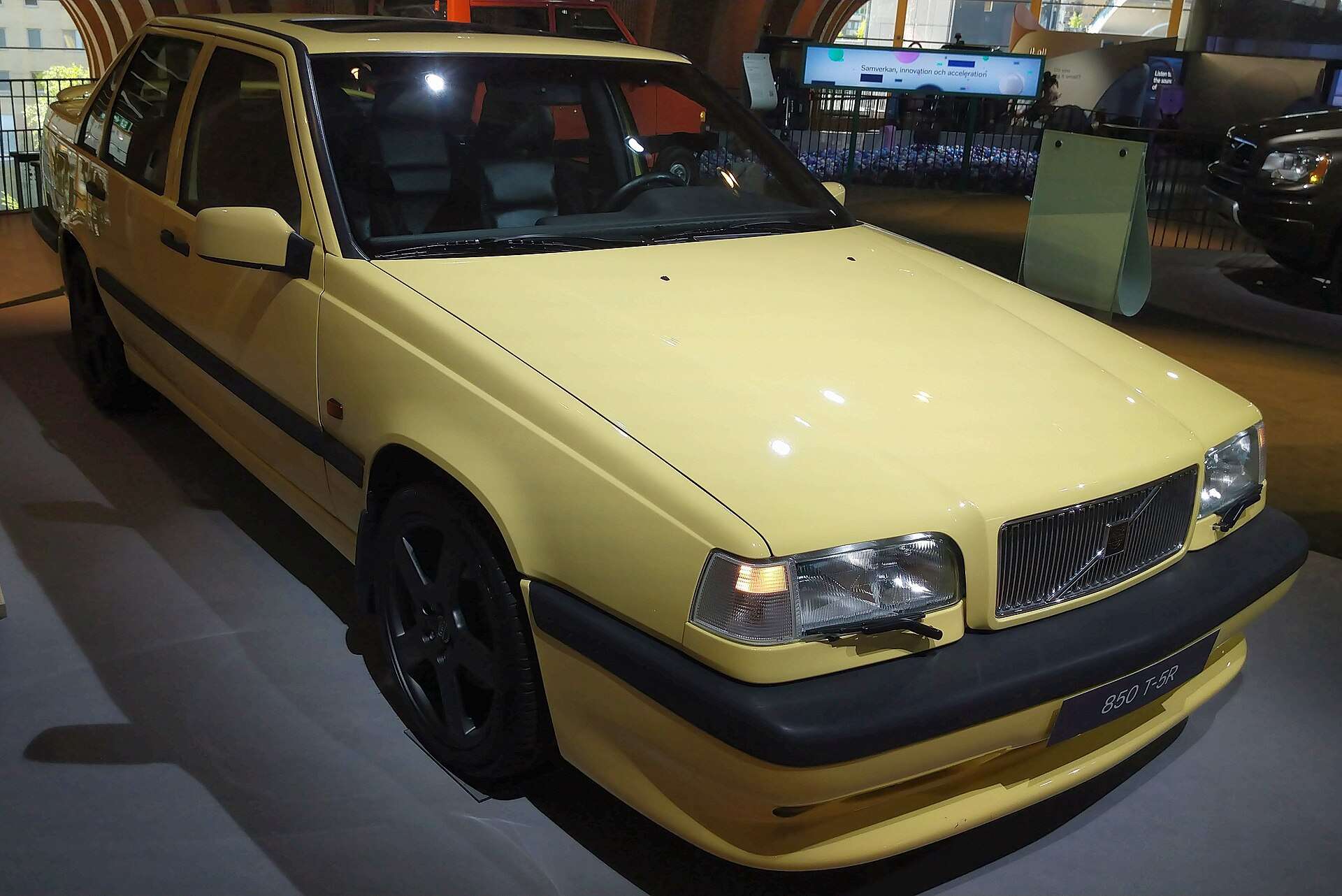
The engine is the B5234T5, a 2,319 cc, 20-valve turbocharged inline five, mounted transversely and driving the front wheels. Volvo rated it at 240 horsepower; the European figure is 225 PS rising to 240 PS on overboost, and torque is quoted at 300 N·m for automatics and 330 N·m for manuals. Not Enough Cylinders describes the overboost function as raising boost from 0.73 to 0.82 bar for roughly 30 seconds, with Porsche’s engine-management calibration in a Bosch ECU.
Transmissions matter here more than on most cars. The U.S. received only the four-speed automatic, while a five-speed manual was sold elsewhere, so a manual T-5R in America is an import. Car and Driver’s 1995 test of a wagon, cited by Jalopnik, reached 60 mph in 6.7 seconds. The 850 R that followed in 1996 raised output to 250 PS and 350 N·m in manual form, according to Wikipedia’s 850 entry, which is why serious buyers keep the two cars separate.
Mechanical uniqueness: what Porsche actually did
The Porsche story is narrower than the legend. Sources agree the work centered on engine management and tuning, with the sources differing on how far it went; Wikipedia’s 850 entry says Porsche also contributed to some powertrain and interior details such as the Alcantara seat inserts, while Not Enough Cylinders says its contribution “focused on engine management.” A collector should repeat the narrower claim. The T-5R is a Volvo with Porsche-calibrated electronics, not a Porsche-built car, in the way that the Audi RS2 Avant was.
The rest of the specification is a conventional sport package: a sport-tuned chassis, 280 mm front discs, standard 17-inch five-spoke “Titan” wheels on Pirelli P Zero 205/45R17 tires, and a lipped front bumper, side skirts and rear spoiler. The front-drive layout brings torque steer, which PistonHeads’ PH Heroes feature notes in its drive.
Factory options, colors and identifying details
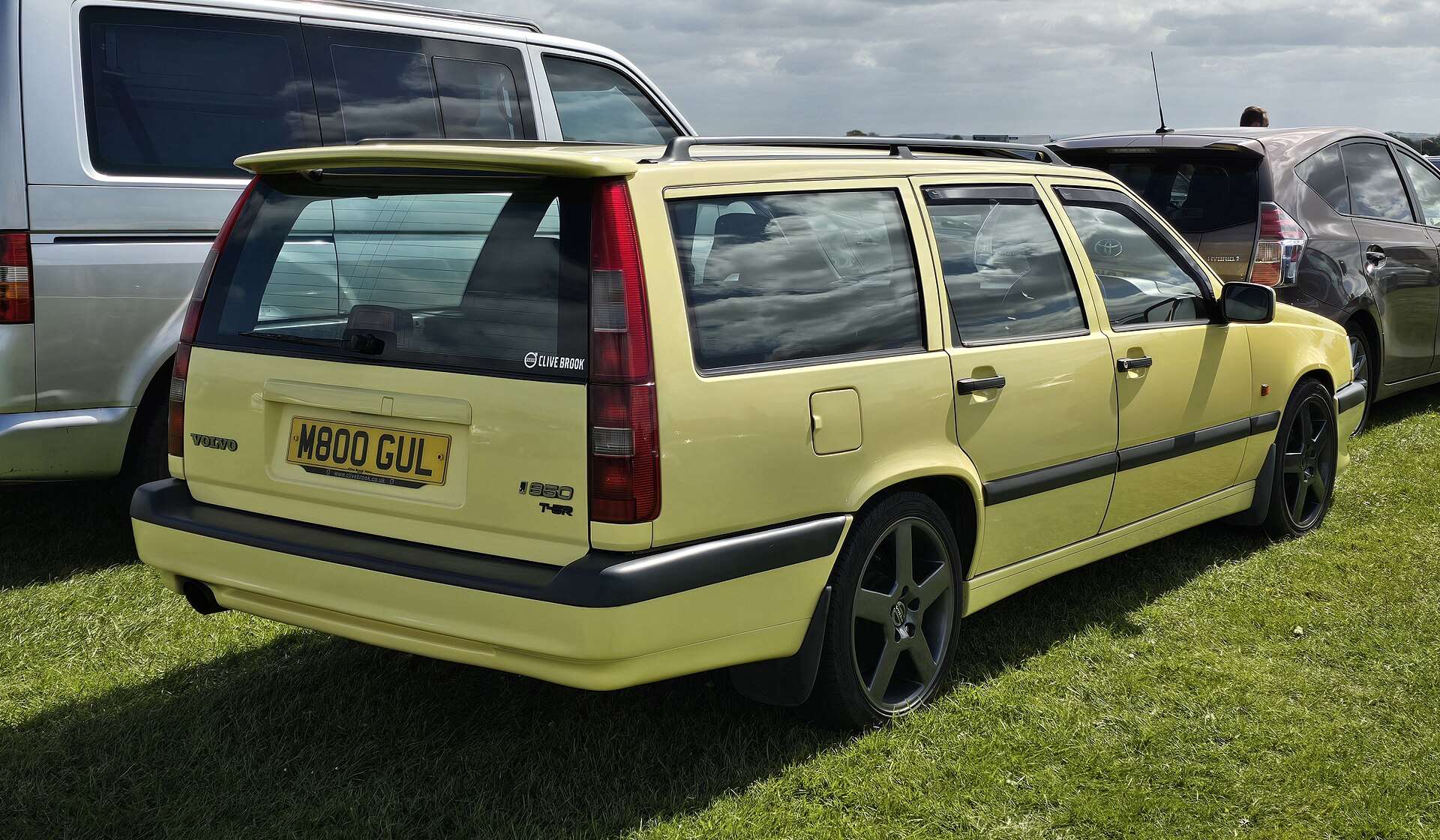
The identifying details are the easiest part of the car to check and the most often overlooked. A real T-5R carries a T-5R badge on the trunk lid or tailgate, graphite leather and Alcantara seats, walnut trim, and the 17-inch Titan wheels. Yellow and black cars shared the same black interior. In North America the option list was almost empty: a trunk-mounted Alpine six-disc CD changer and no-cost 16-inch wheels, per Wikipedia’s 850 entry. The ECU part number is another tell, with Bosch 628 listed for the U.S. and 629 for Europe.
The T-5R name is a 1995-only designation. A 1996 or 1997 car is an 850 R, which dropped Cream Yellow and added colors including Bright Red and Polar White, so a yellow car claimed as an R, or a red car claimed as a T-5R, should not exist.
Market values and comparable sales
The market data is real but thin. The Classic Valuer reports 20 sales of the T-5R since 2020, a median of £12,259, a range of £5,800 to £19,288 and a 62 percent sell-through rate, with its figures converted to pounds. The evidence behind those numbers is a small number of auctions, so any single result moves the picture.
| Date | Venue | Car | Result |
|---|---|---|---|
| 18 Sep 2025 | Bring a Trailer | Cream Yellow sedan, automatic, 106,000 miles, recent timing belt and water pump | £18,118 |
| 6 Nov 2024 | Bring a Trailer | Cream Yellow wagon, automatic, 267,000 miles, modified, 2015 total-loss declaration on Carfax | £15,604 |
| 16 Jul 2026 | PistonHeads | 1995 estate, UK | £12,834 |
| 2 Oct 2026 | Collecting Cars | 1995 estate, Australia | £10,917 |
| May 2021 | Bring a Trailer | Yellow sedan, Canadian car, over 200,000 miles | $15,000 |
Read that table for the spread, not the top line. The Cream Yellow sedan that brought £18,118 and the heavily modified wagon with a total-loss declaration that still made £15,604 show that color is carrying a premium that originality and mileage are not yet fully policing. The PH Heroes feature observes that yellow now commands a premium over darker cars, and PistonHeads’ used buyer’s guide puts the T-5R’s premium over a standard T5 at roughly £1,000, an older, UK-specific figure. Collectors should treat the yellow premium as a market preference, not proof of a durable rarity gap.
Ownership costs and known weaknesses
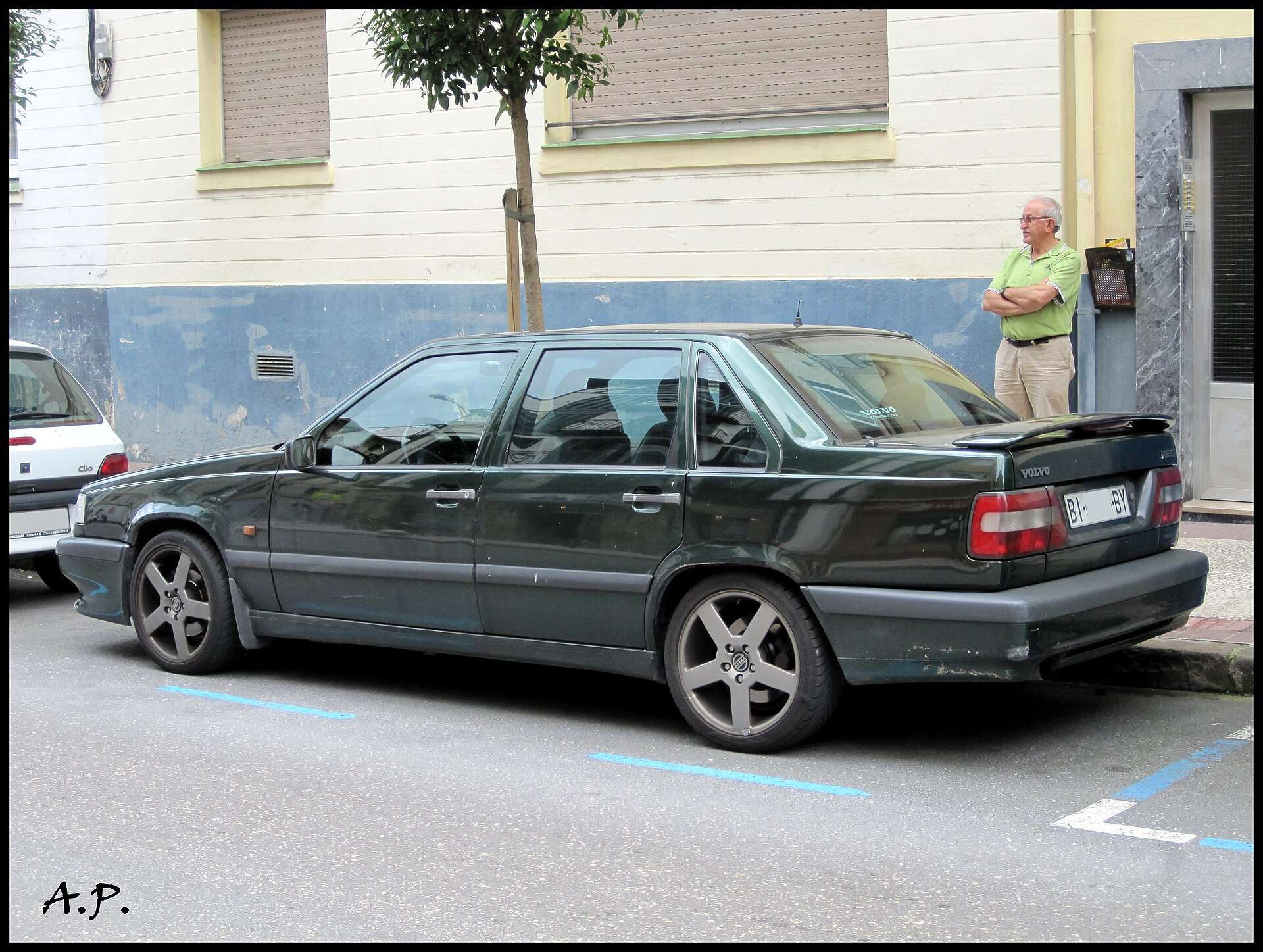
These are 30-year-old turbo cars, and the buyer’s guides are consistent about where the bills come from. The Garage Dreams buyer’s guide flags the rear main seal, a weakness tied to the PCV system, as a job that means removing the gearbox, about six hours, so it is worth doing the clutch at the same time on a manual. It also gives the timing belt as a 110,000 km or five-year item, with the tensioner, idler and water pump changed alongside it, and automatic fluid every 32,000 km or three years.
PistonHeads’ used buyer’s guide adds a more serious warning: connecting rods can bend “with no warning” after a boost-control failure, which makes a service history for the boost control solenoid more than a nicety. Both guides cite power-steering pumps that are available only reconditioned and rust at the rear bumper mounts and exhaust hangers, and the Garage Dreams guide adds that radiators rarely last beyond about 15 years and that heater matrices leak. Estates may also have self-levelling rear suspension that sags with age. Cars imported from Japan and Australia generally have less rust.
Originality considerations
Originality on a T-5R is mostly about what has been added. The November 2024 Bring a Trailer wagon above carried an aftermarket intercooler and radiator, a performance exhaust and lowering springs. The PistonHeads guide notes that many cars wear non-original alloys, and tire sizes and brake upgrades vary. The collector checklist is the correct 17-inch Titan wheels (or the factory 16-inch U.S. alternative), the correct ECU for the market, an unmodified boost system, original paint in one of the three factory colors, and the interior’s Alcantara and leather intact. Interior wear is worth inspecting against the odometer: PistonHeads’ PH Heroes feature found the suede seat trim on its test car had held up well but the steering-wheel rim showed wear.
Competing vehicles
The T-5R competes for a buyer who wants a usable 1990s fast car with a story, and the closest alternatives are worth knowing. The Saab 9-3 Viggen is the other Swedish turbo with a limited, color-specific run and a collector narrative. Our E30 M3 spec sheet covers the established benchmark for a 1990s-adjacent European performance car, and the Group A rally special comparison shows how homologation cars are priced against each other. In the Porsche-adjacent sleeper category, the Audi RS2 Avant and the Mercedes 500 E carry the same developer story and are better known.
What separates exceptional examples from average ones
An exceptional T-5R is a documented, unmodified car in a factory color, with the correct wheels, an intact Alcantara interior, a current timing-belt service and evidence that the rear main seal and PCV system have been dealt with. Mileage is secondary to condition: the Garage Dreams buyer’s guide says it prefers condition to mileage and warns that low-mileage cars in poor shape are common. An average T-5R is the car that has been lowered, re-wheeled, and driven for 200,000 miles on deferred maintenance. The sales above show the market has not fully learned to tell them apart.
Established value versus speculative potential
Established value is modest and real. Cream Yellow cars have brought £15,000 to £18,000 on Bring a Trailer in the last two years, one of them a heavily modified car, and the car has an accepted place in the performance-wagon conversation. Speculative potential is everything beyond that: a belief that the T-5R will follow the E30 M3 or the RS2 up the curve. Nothing in the evidence supports a prediction, and thin, mixed-quality sales data is the reason to avoid one.
What could strengthen or weaken its desirability
Three things could strengthen the case: a continued shortage of unmodified cars, as the best ones leave the market; wider recognition of the BTCC link and the Porsche story; and generational demand for performance wagons. Three could weaken it: the four-speed automatic, which is the only transmission most U.S. buyers can get; parts such as power-steering pumps that can only be had reconditioned; and a shallow market in which a handful of sales set the price. A buyer should pay for the car in front of them, not a forecast.
The bottom line
The Volvo 850 T-5R is an established collectible in a small market. The badge is real, the color and condition spread is wide, and the evidence for future appreciation is thin. Buy a documented, unmodified car you want to drive, and treat any appreciation as a bonus, not a plan.
Verification notes: production, color and country figures come from the Volvo Club UK statistics as reported by Wikipedia and the Garage Dreams guide; sources disagree on the exact total (6,964 versus 6,954) and on the extent of Porsche’s role. Market figures are as published by The Classic Valuer in pounds and by Jalopnik in dollars; Hagerty price-guide values for this car were not available to us. Photographs are licensed under Creative Commons and credited in each caption.
The collector car market, every weekday morning.
Auction results, price moves and what’s crossing the block, read in four minutes. Free, from Modern Car Collector.
No spam, unsubscribe in one click. Or read more about the Brief.


 EL Puckett
 John Lloyd