

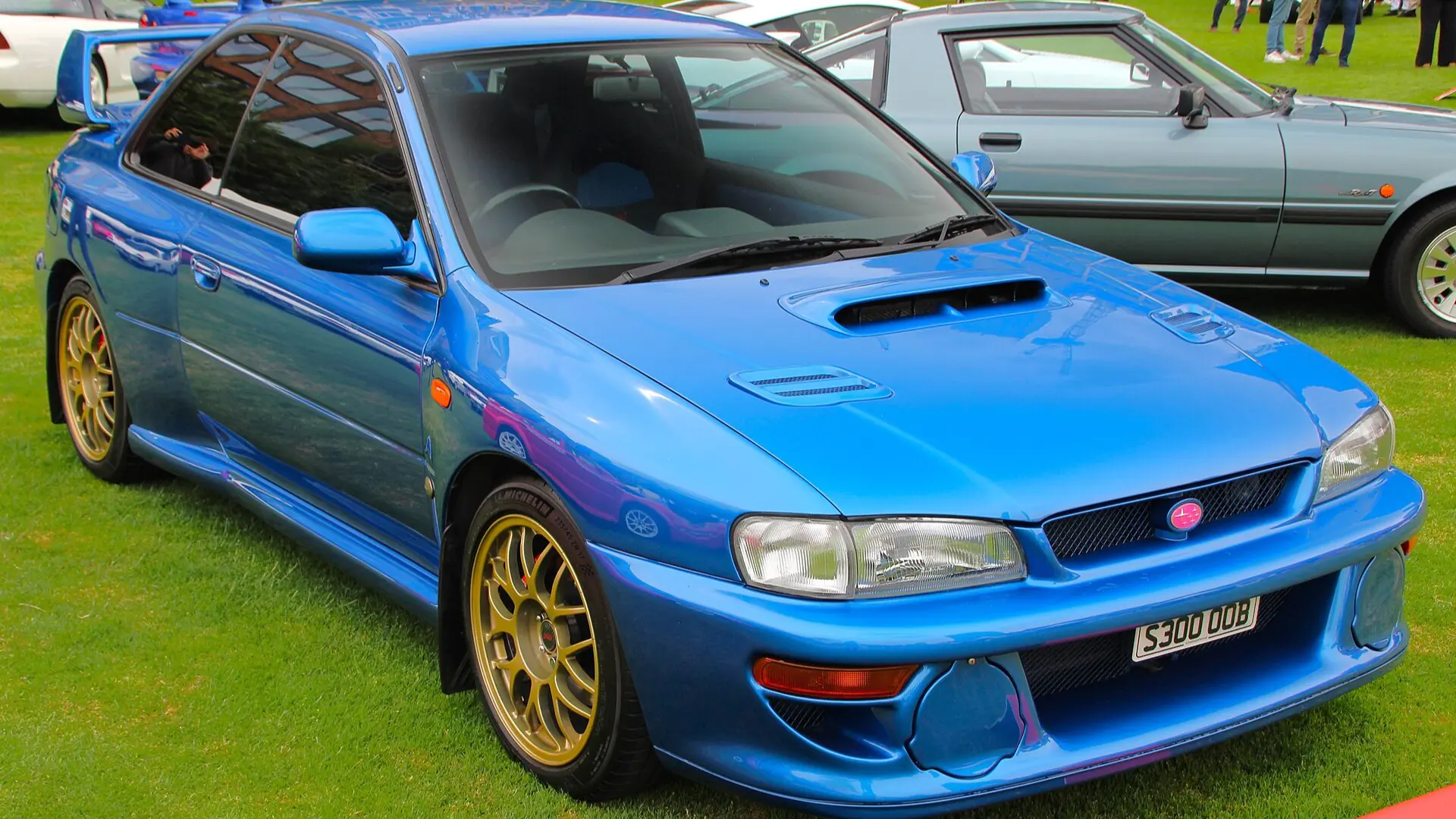
The detail that sets the price of a Subaru Impreza 22B STi is not the blue paint, the gold wheels or even the numbered plaque. It is whether the plaque, the chassis number, the engine and the body panels all tell the same story. Subaru built roughly 424 of these cars, an unusually small and famous run, and that fame is exactly what makes copies and tributes worth building. A genuine 22B is a car you verify, not one you recognise.
Why authenticity sets the price of a 22B
The 22B was built to mark Subaru’s 40th anniversary and its third straight WRC manufacturers’ title, and it sold out almost immediately in early 1998 at just under £40,000, according to Iconic’s listing for car #318. It is the rare modern-era Japanese car where the production run is small enough to be tracked car by car, which is why serious buyers and auction houses quote plaque numbers the way Porsche buyers quote chassis numbers.
That tracking is the buyer’s protection. A 22B that can be tied to a plaque number, a chassis number and an ownership trail is a different asset from a widebody GC8 in the right blue. The same logic drives the market for other numbers-matter cars, from the Studebaker Avanti R2 to the first-generation Acura NSX, and for homologation specials such as those in our Group A rally comparison; see our checks on the Toyota 2000GT convertible and the Datsun 240Z Series I for the Japanese-classic version of the question.
What a genuine 22B actually is
Published sources agree on the shape of the run and differ on the edges. Iconic Auctioneers’ lot 960 listing says 399 cars were built for the Japanese market, with no car numbered 013, plus 24 for overseas markets; Iconic’s listing for car #318 says 399 plus 25. Wikipedia’s WRX STI entry gives 400 for Japan and 24 for export, split as 16 for the UK, five for Australia and three prototypes, for a total of 424. The honest conclusion is that “400 built” is a marketing round number and the exact count depends on how you treat the prototypes.
| Group | Count | Source note |
|---|---|---|
| Japanese market, numbered | 399 or 400 | Iconic: 399, no #013; Wikipedia: 400 |
| UK (Prodrive “Type UK”) | 16 | Iconic and Wikipedia agree |
| Australia | 5 | Wikipedia |
| Prototypes numbered #000 | 3 | Iconic and Wikipedia; sources differ on who received the third |
| Total | about 424 | Sources vary by one car |
The numbered plaque: what it proves and what it does not
Each domestic car carries a numbered plaque out of 400, which ProjectJDM’s collector’s guide places on the center console. A plaque number is the first thing a seller will quote, and it is the least conclusive evidence in the car, because it is a plate. The same guide warns that reproduction plates exist and that the build plate in the engine bay should be cross-checked against the chassis stamp on the firewall. That is one collector guide’s advice and not a Subaru factory procedure, so treat it as a direction to ask questions, not as a test.
The numbering has quirks that make good checks. Both Iconic Auctioneers’ lot 960 listing and Wikipedia’s WRX STI entry say there was no complete plaque for car 13: Wikipedia reports the car was imported by Subaru of America as a press car without receiving its plaque. A car offered with a 13/400 plaque therefore has a question to answer. Three prototypes carried #000 plaques; Colin McRae’s was sold by Iconic in 2023 for £480,500, according to Iconic Auctioneers’ lot 960 listing.
Chassis and engine numbers
The UK cars in the two Iconic listings show the chassis format: GC8068241 for car #29 and GC8071359 for car #318, a GC8 prefix followed by six digits. A standard Impreza shares the GC8 prefix, so a GC8 number alone proves nothing about a 22B. The useful question is whether the seller can connect that specific chassis number to the plaque number and to Subaru, importer or registration records.
The engine is where published sources disagree, and a careful buyer should know it. Not Enough Cylinders calls the engine an EJ22G of 2,212 cc, Wikipedia’s WRX STI entry says internal Subaru material points to a V3 EJ20G block instead, and ProjectJDM’s collector’s guide names it an EJ22D. The sources that give a displacement agree on 2,212 cc, and two describe a closed-deck block; Iconic Auctioneers’ lot 960 listing says it is a separate casting with unique forged pistons, officially rated at 276 bhp (280 PS). Because the designation is not settled in print, do not accept an engine designation on a listing as evidence of originality. Ask for the stamped engine number and how it was checked.
“Matching numbers” is also harder to prove on a 22B than the phrase suggests. a Type-RA owners’ forum thread says the chassis plate lists the engine model code rather than the engine number, and describes the stamping near the starter. That is forum content and not a factory source, but it matches what the auction evidence shows: Iconic’s listing for car #318 describes car #318 as “matching-numbers” while listing the engine number as “TBC,” and Iconic Auctioneers’ lot 960 listing also leaves #29’s engine number as “TBC.” A 22B sold as matching numbers should come with a photographed engine stamp and the document it was matched against.
Body, paint and parts only a real 22B has
The 22B’s visual identity is a specific set of parts, which is why it is copied and why each part is a checkpoint. The table gathers what the sources describe; details differ between sources, so verify against photographs of documented cars.
| Item | What the sources describe | Why it matters |
|---|---|---|
| Paint | Sonic Blue Mica only (ProjectJDM); Robb Report calls its car “World Rally Blue” | A 22B in any other color has been repainted; naming varies by writer |
| Bodyshell | Seam-welded shell with fenders 80 mm wider per side, total width 1,770 mm; flares designed by Peter Stevens (Iconic for the dimensions, Wikipedia for the designer) | Cheap widebody kits copy the look but not the factory shell; check seams, gaps and filler |
| Hood | Unique hood with a functional NACA duct for the intercooler (Not Enough Cylinders) | A standard hood changes the profile and the claim |
| Wheels | 17×8.5 gold BBS wheels, 235/40R17 tires (Iconic, Wikipedia) | The wheel is a high-theft, high-swap item |
| Suspension and brakes | Inverted Bilstein dampers, Eibach springs; red four-piston front and two-piston rear calipers (Iconic, Not Enough Cylinders) | Replacement coilovers are common on driven cars |
| Interior | Recaro seats, Momo wheel, STi gauges (Not Enough Cylinders); numbered console plaque | Trim details differ by source, so compare to documented cars |
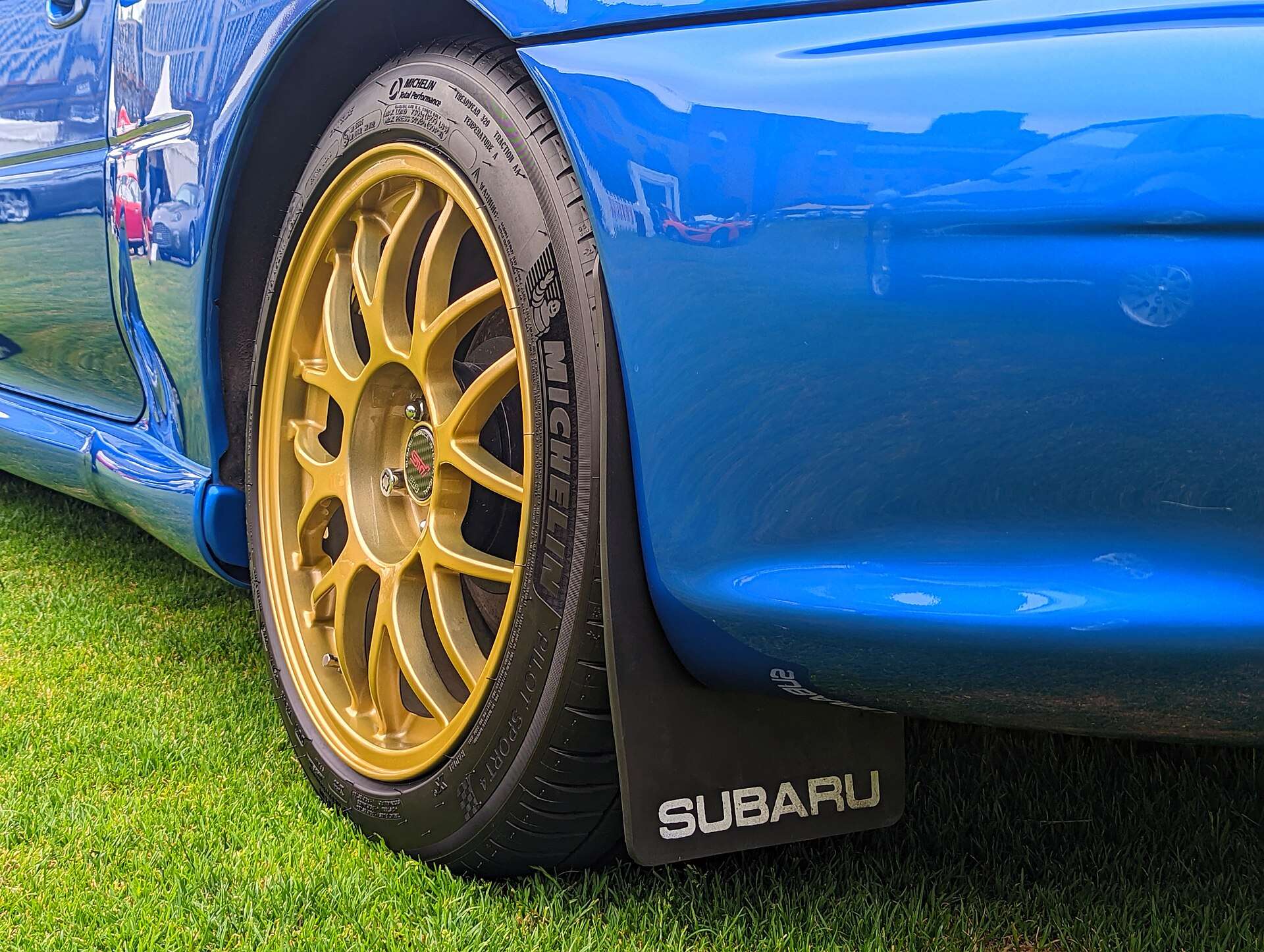
A replacement part is not a disqualifier. A 22B that has had its dampers replaced and the originals kept is a very different car from one with a kit body. The value question is how many original, 22B-specific components survive and whether the seller can show them.
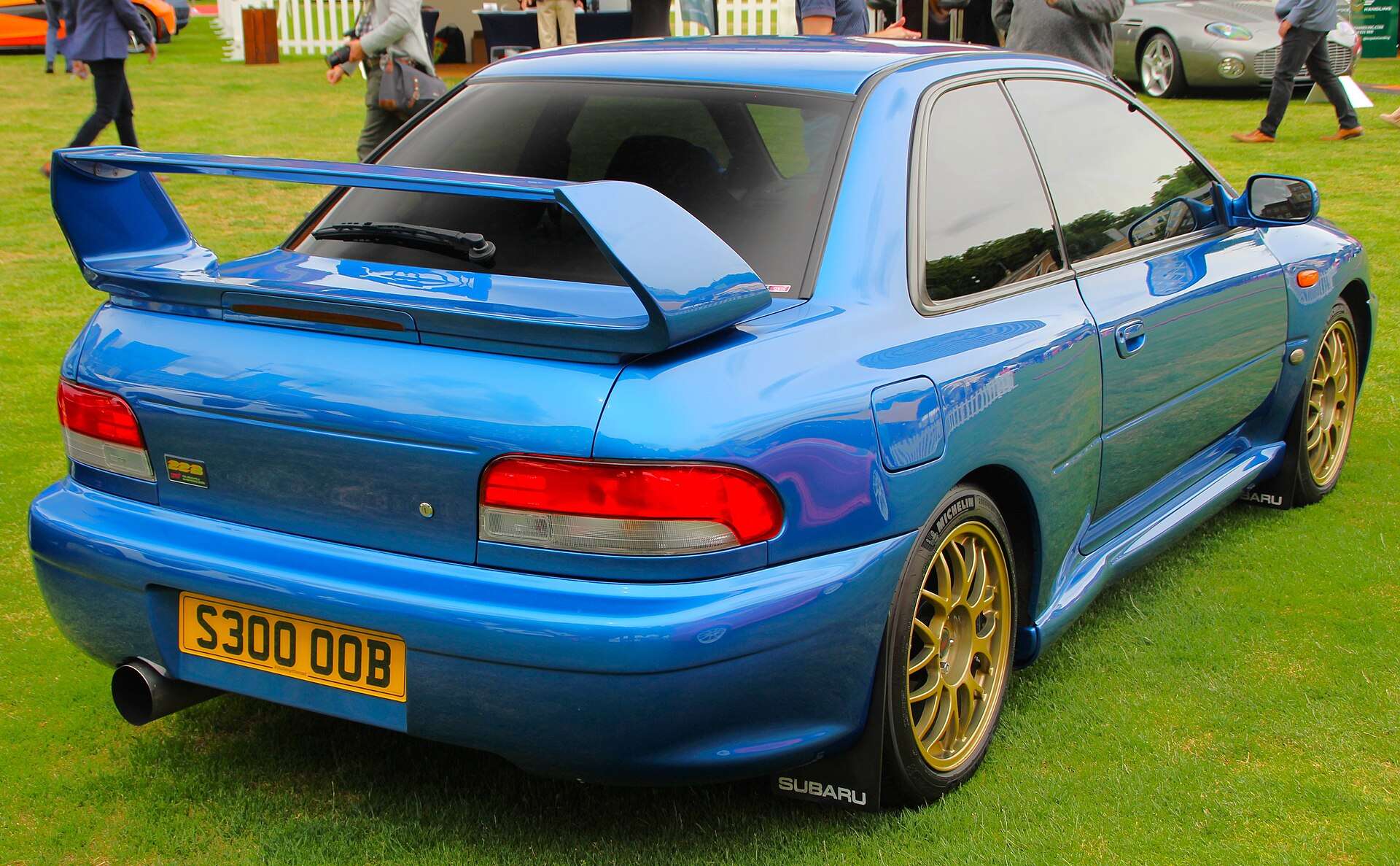
Clones, tributes and the Prodrive P25
The market contains two different things that buyers confuse. Tributes are cars built to look like 22Bs from standard GC8 Imprezas; The Drive describes a Cusco-built clone that swaps in a six-speed gearbox, limited-slip differentials, a big-brake kit and 19-inch wheels, which shows how far from the original specification a good tribute can be. Separately, Prodrive built a 25-car 2022 homage, priced by Iconic Auctioneers’ lot 960 listing at £552,000 at launch. It is a new car sold as a tribute. Neither is a 1998 22B, and either can be honestly valued, but not at 22B money.
The UK “Type UK” cars
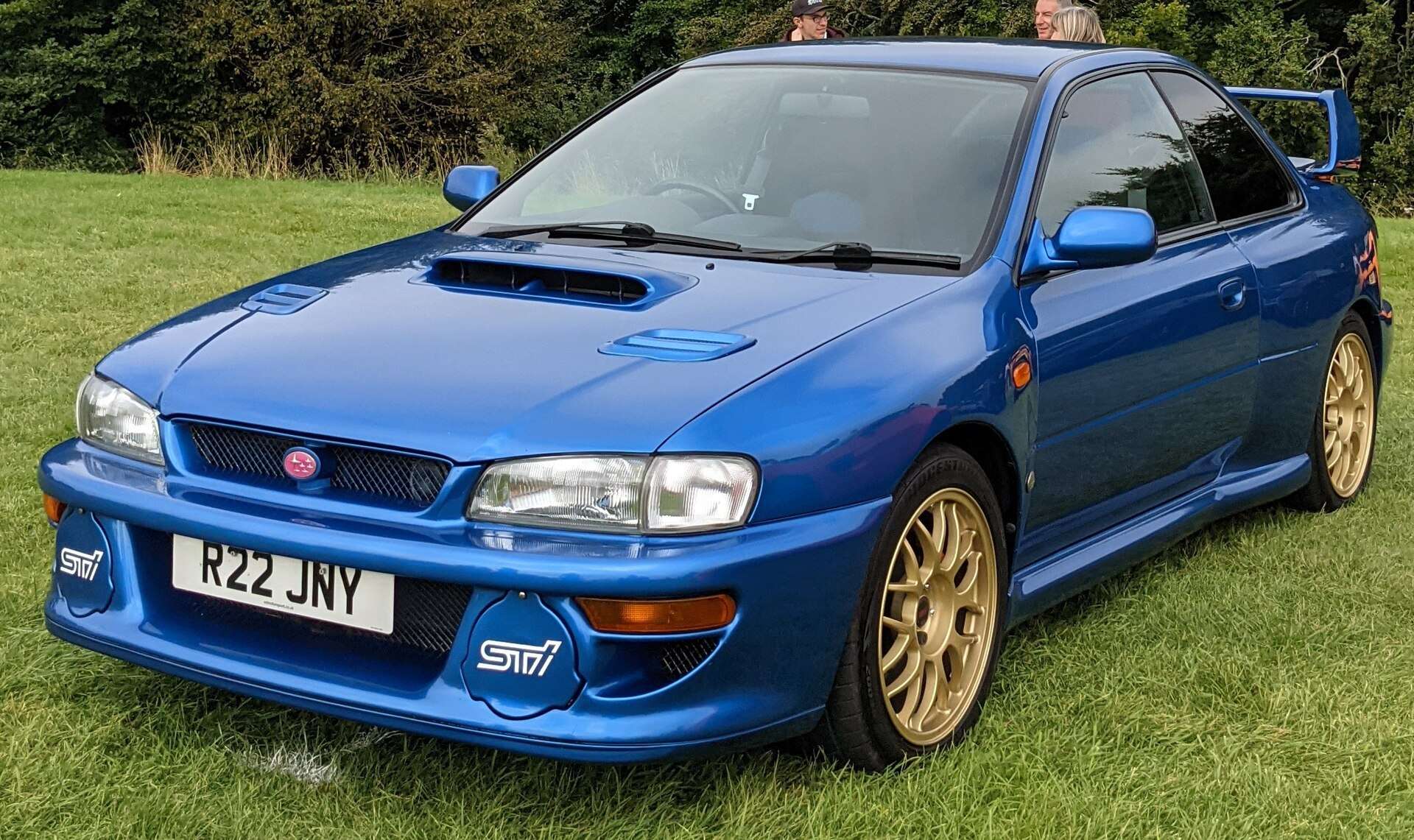
Sixteen cars were officially imported by Subaru UK and passed to Prodrive for modification as “Type UK” cars. Wikipedia’s WRX STI entry says they received longer gear ratios, UK-specific lights and a three-year warranty; Iconic says Prodrive modified them after Subaru UK imported them. These are genuine 22Bs with a different specification, so a seller should say which one is on offer, and a buyer should not pay a standard-car price for a modified one or vice versa.
What authenticity and condition do to value
The public sales data shows a wide spread, and it is not purely an authenticity story. Mileage, condition, color originality and market all move the number.
| Date | Venue | Car | Result |
|---|---|---|---|
| 6 Mar 2026 | Gooding Christie’s | About 8,000 km (5,000 miles) | $329,500 |
| 23 Mar 2026 | Collecting Cars (New Zealand) | About 15,000 km (9,000 miles) | NZD 350,000 |
| 21 Feb 2026 | Iconic Auctioneers | About 47,000 miles | £187,875 |
| 27 Jan 2026 | Bring a Trailer | About 19,000 miles | $205,000 |
| 27 Nov 2025 | Collecting Cars (Australia) | About 37,000 miles | AUD 243,500 |
| 2023 | Iconic Auctioneers | Colin McRae’s #000 prototype | £480,500 |
| Undated in source | Bring a Trailer | Car #156, over 25,000 miles, right-hand drive | $312,555 |
Dates and mileages for the first five lines come from Classic.com; the McRae figure is from Iconic Auctioneers’ lot 960 listing; the last line is from Robb Report, which did not date the sale. The spread between $205,000 for a 19,000-mile car and $329,500 for an 8,000-mile one is a mileage story. The authenticity premium is harder to see in public data, because clones and tributes rarely sell as 22Bs. That is itself a finding: the price of a 22B assumes the paper trail, and the unsold or undated lines in the record, such as car #29’s “not sold” result at Silverstone in February 2024, are reminders that the market tests each car individually.
What buyers should verify before paying
- Match the plaque to the chassis. Photograph the console plaque, the engine-bay plate and the firewall stamp, and ask how the plaque number was tied to this chassis.
- Reject impossible numbers. Two sources say there was no completed plaque 13, and three prototypes were numbered #000.
- Get the engine number in writing. “Matching numbers” should come with a photographed stamp and the document used to match it, not “TBC.”
- Inspect the shell. Look for factory seam-welding and clean fender-to-body transitions rather than bolted or filled flares.
- Check the 22B-specific parts. Unique hood, gold BBS wheels, inverted Bilstein dampers, Recaro seats and red calipers, and ask for any original parts that were removed.
- Confirm the paint. Sonic Blue Mica is the only factory color, so any other color means a repaint.
- Know which 22B it is. A domestic car, a Type UK car and a #000 prototype are different assets.
- Separate a tribute from a car. Cusco-style builds and the Prodrive P25 are valid cars, but not 1998 22Bs.
Common misrepresentations
Three claims recur. “Exactly 400 built” is a round number, and the sources put the total nearer 424. “22B” is often said to refer to engine capacity, but Iconic Auctioneers’ lot 960 listing attributes the name to the 555 sponsorship, since 555 in hexadecimal is 22B, and calls the engine link a common error. And “matching numbers” is frequently asserted with the engine number not yet confirmed.
The bottom line
On a 22B, the plaque is where the verification starts. The value rests on whether the chassis, engine, shell and paper agree, and on whether the seller will put that agreement in writing. Buy the evidence first and the car second.
Verification notes: no Subaru factory build record was available to us, so identification points rest on auction-house listings, Wikipedia and specialist guides, and the sources disagree on the engine designation and exact production count. The engine-number location comes from a forum post and the plaque and reproduction-plate comments from a single collector’s guide; neither is a factory source. Photographs of the plaque, console and engine stamp were not available under a free license, so the images show exterior and wheel details only.
The collector car market, every weekday morning.
Auction results, price moves and what’s crossing the block, read in four minutes. Free, from Modern Car Collector.
No spam, unsubscribe in one click. Or read more about the Brief.
 EL Puckett