

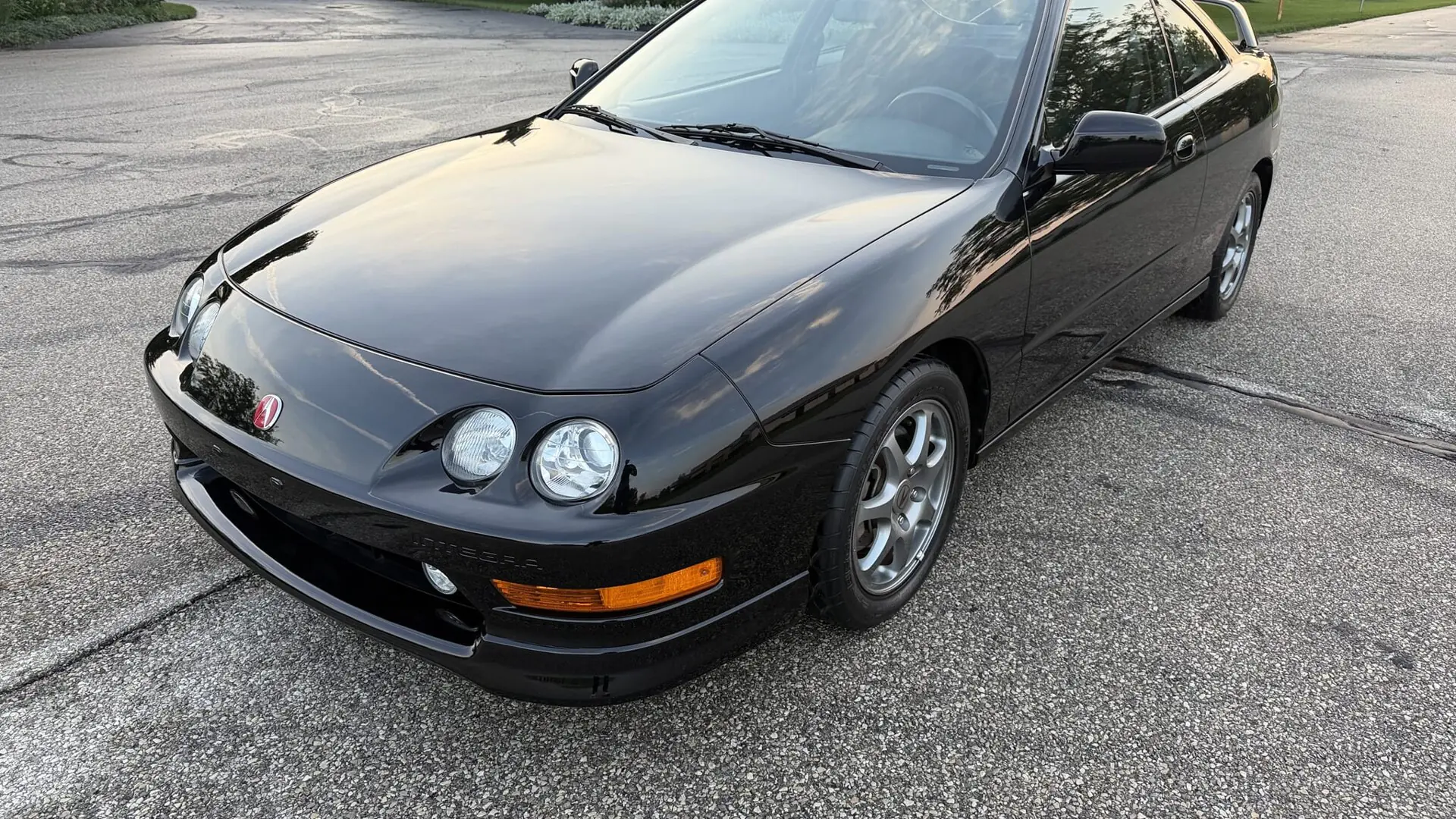
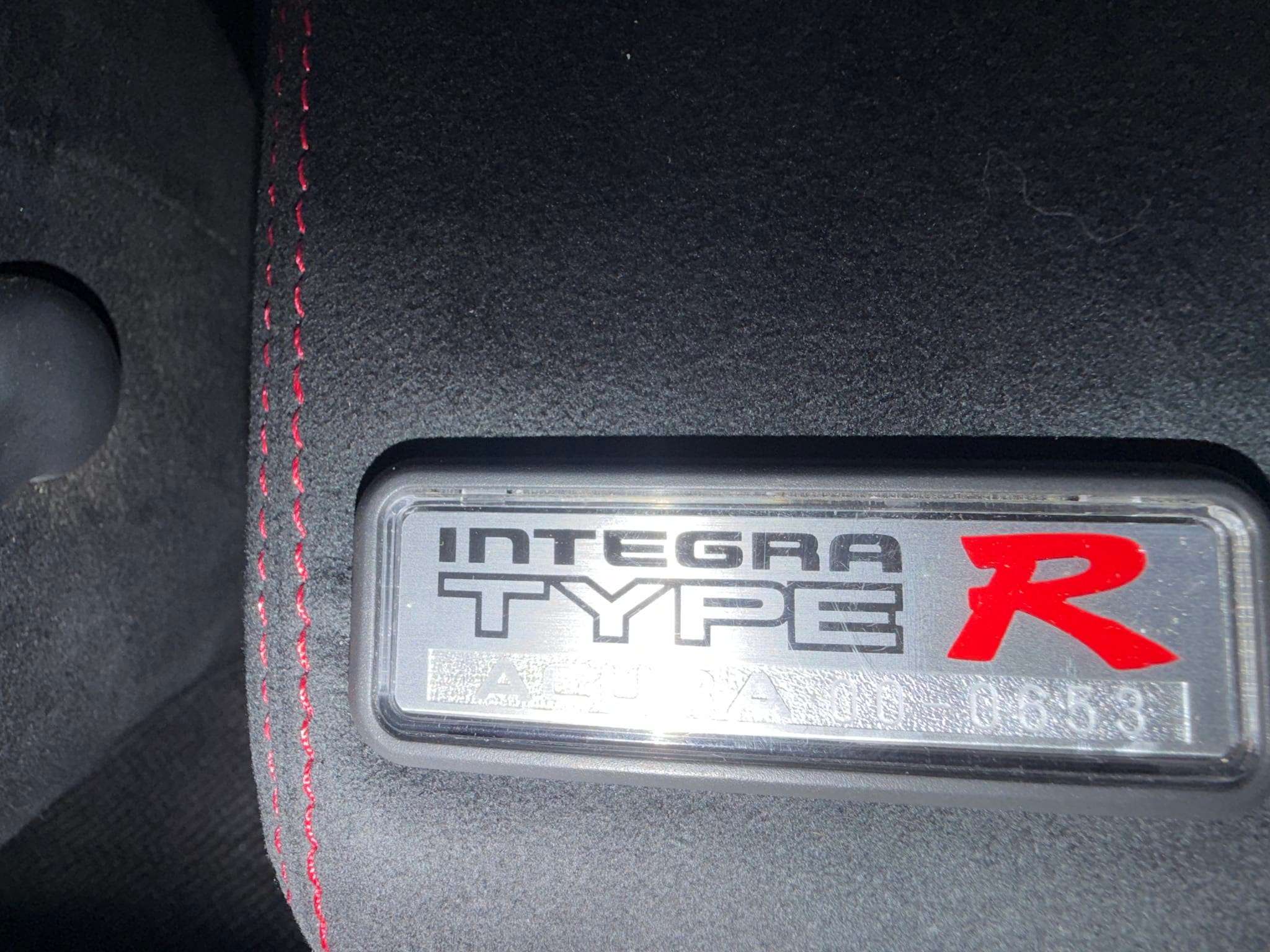
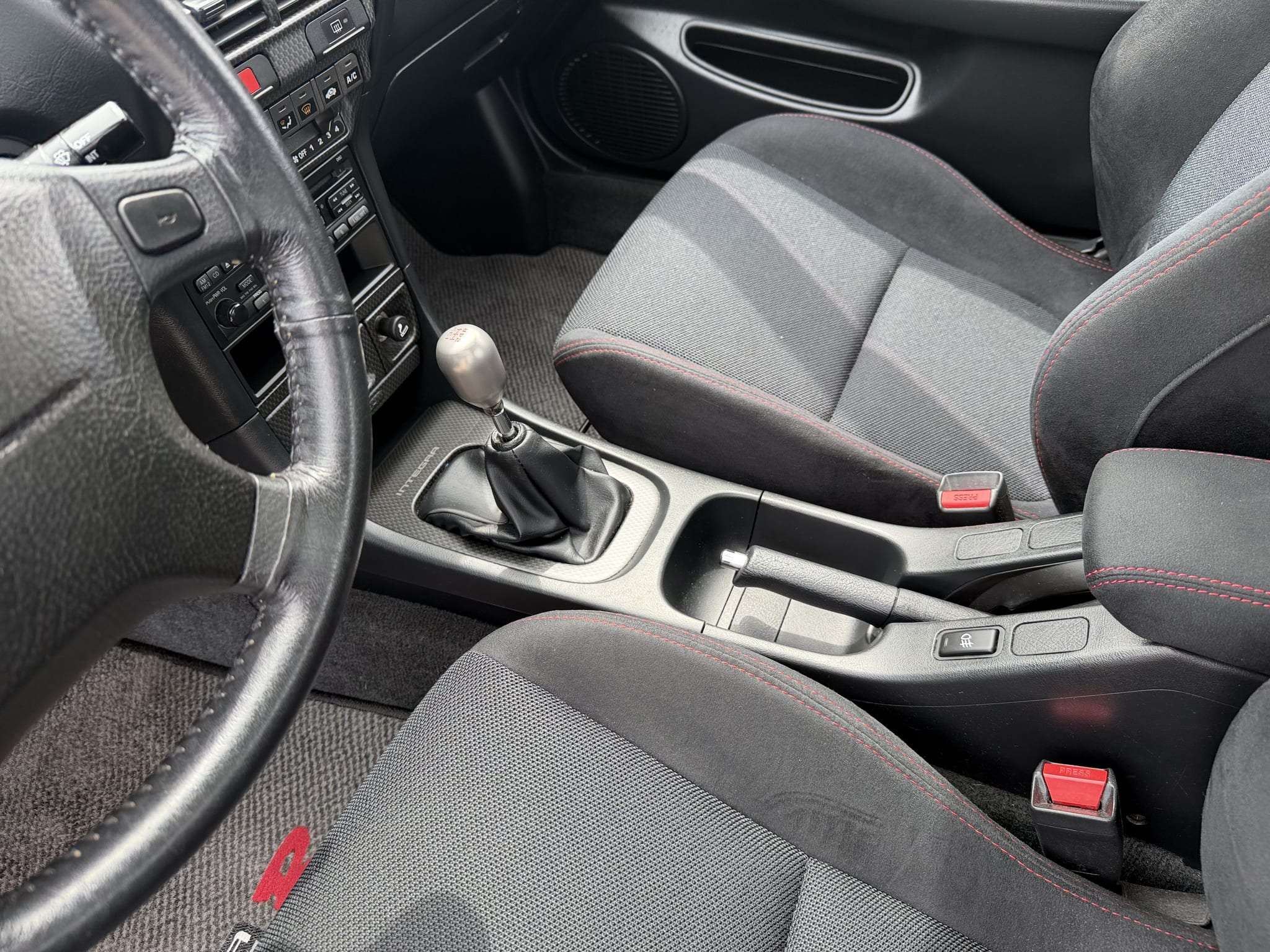
On a 2000 Acura Integra Type R, the badges, the red-stitched seats and the numbered console plaque are the parts a clone builder can chase. Integra Type R originality is decided somewhere less photogenic: in a VIN that has to agree across the body, the powertrain and the paperwork. A 19,000-mile Flamenco Black Pearl car on Bring a Trailer, scheduled to close at 2 p.m. Eastern on October 30 with a $76,500 high bid at last check, makes a useful teaching case because its photo gallery documents most of that chain.
Why Integra Type R originality sets the price
The Type R was a limited-production, high-revving coupe: a 195-horsepower 1.8-liter B18C5 with VTEC, a five-speed manual, a limited-slip differential and an 8,400-rpm redline, according to Acura’s launch materials and the listing. That formula is easy to imitate from the outside, because a standard third-generation Integra shares the shape. Grassroots Motorsports notes that many ordinary Integras were modified to look like Type Rs, and that few of the copies went as far as the Type R’s five-lug hubs.
Scarcity is also murkier than collectors tend to assume. The listing calls this car #653 of roughly 1,355 built for the US market in the 2000 model year, and Hagerty’s valuation page cites about 1,350 examples for the year. Hagerty Media’s buyer’s guide, however, lists 2,633 North American sales for 2000. When published tallies disagree by nearly a factor of two, a plaque number is context, not proof. The proof is the chain of identifiers that ties one body to one engine and one set of original papers.
What the factory paperwork on this car records
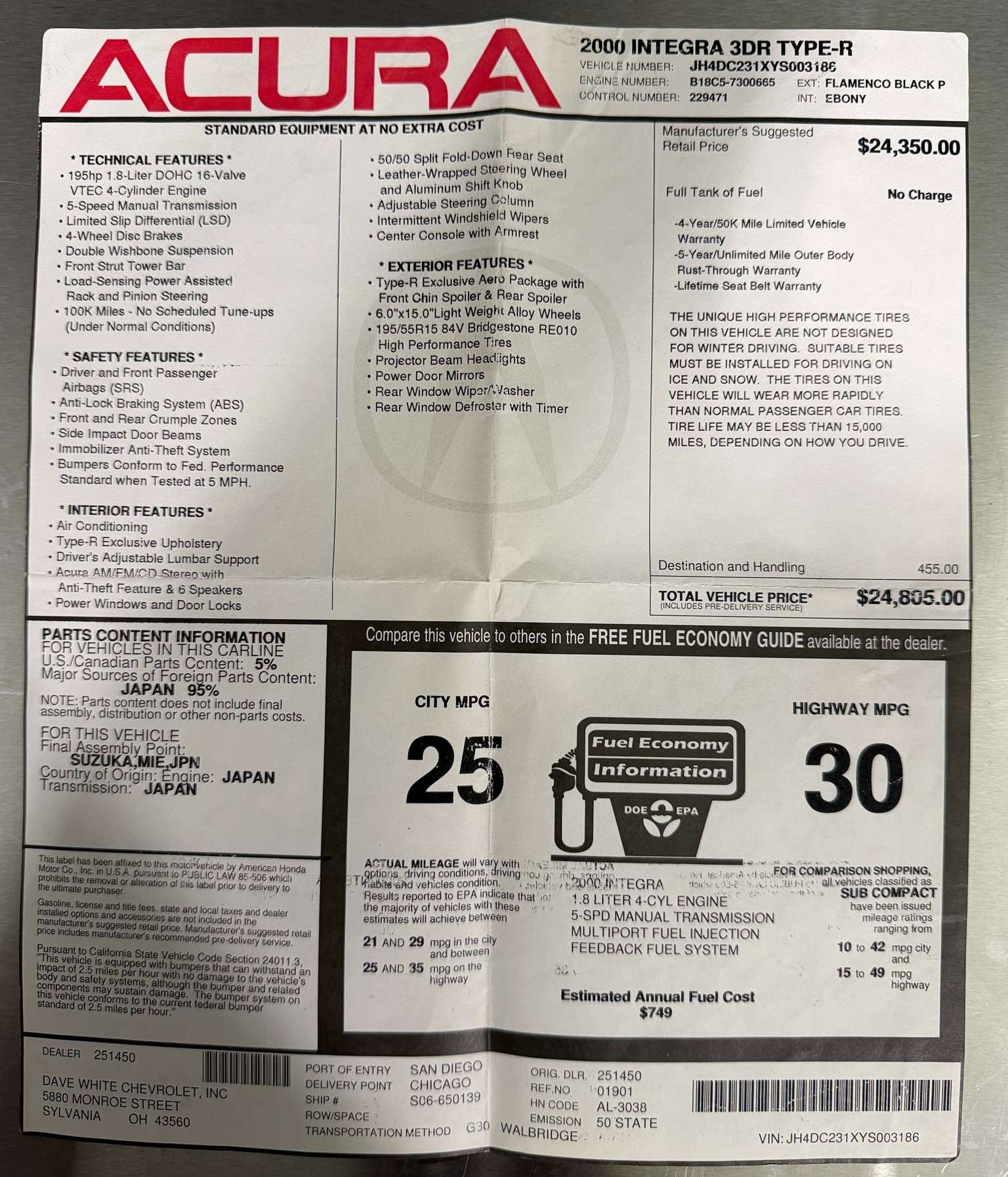
The most useful photo in the gallery is the original window sticker. It identifies the car as a 2000 Integra 3DR Type-R in Flamenco Black Pearl over an Ebony interior, lists the VIN and a B18C5 engine number, and shows an MSRP of $24,350 and a $24,805 total. It also states Suzuka, Japan as the final assembly point. For a buyer, the engine number is the detail that matters: a car carrying its sticker gives you a number to compare against what is stamped on the engine, instead of taking the seller’s word that the powertrain is the one the car left with. The listing does not itself pair the two, so a buyer can ask for a photo of the stamped number to set beside the sticker.
The VIN trail: body, powertrain and title
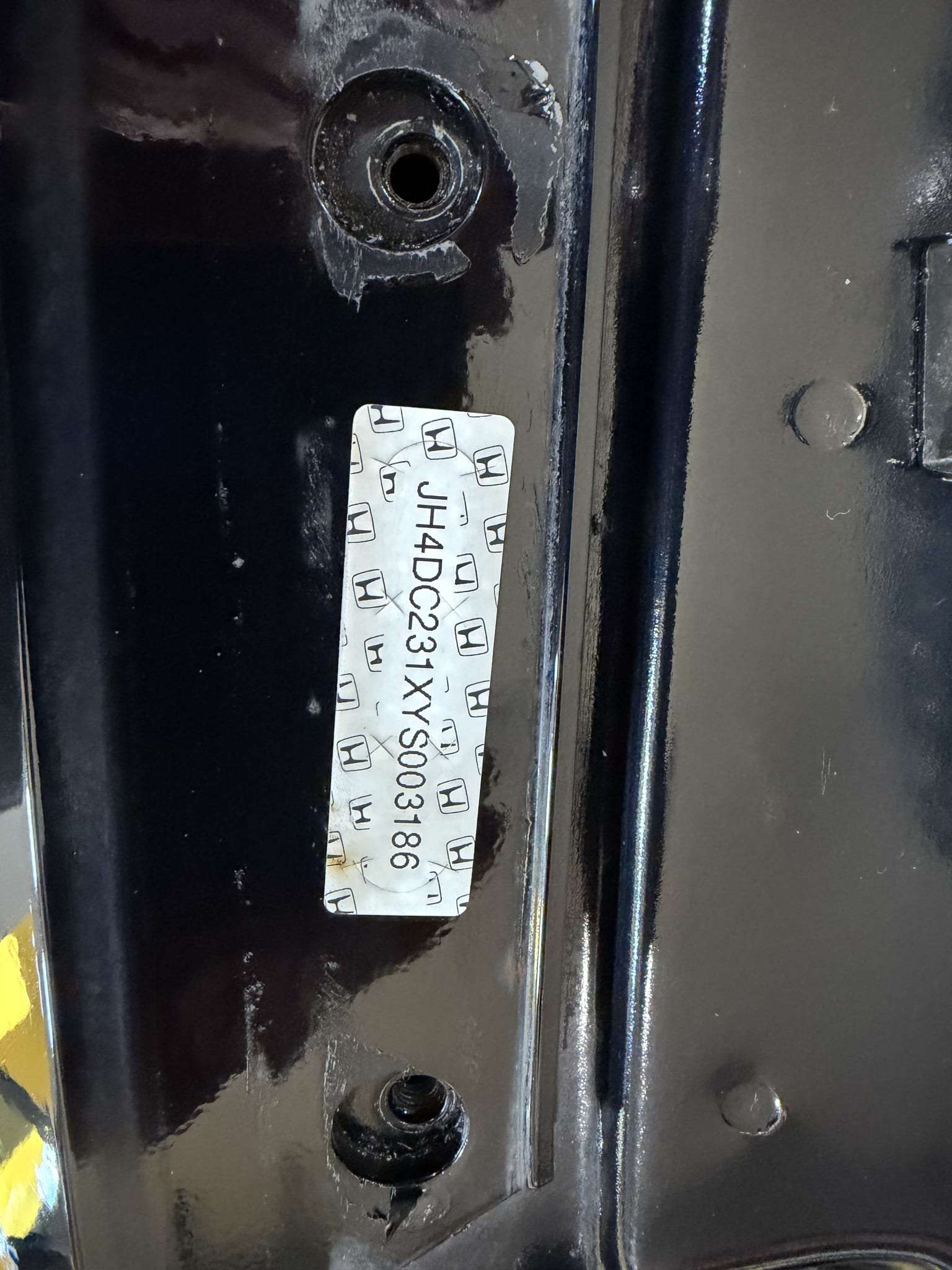
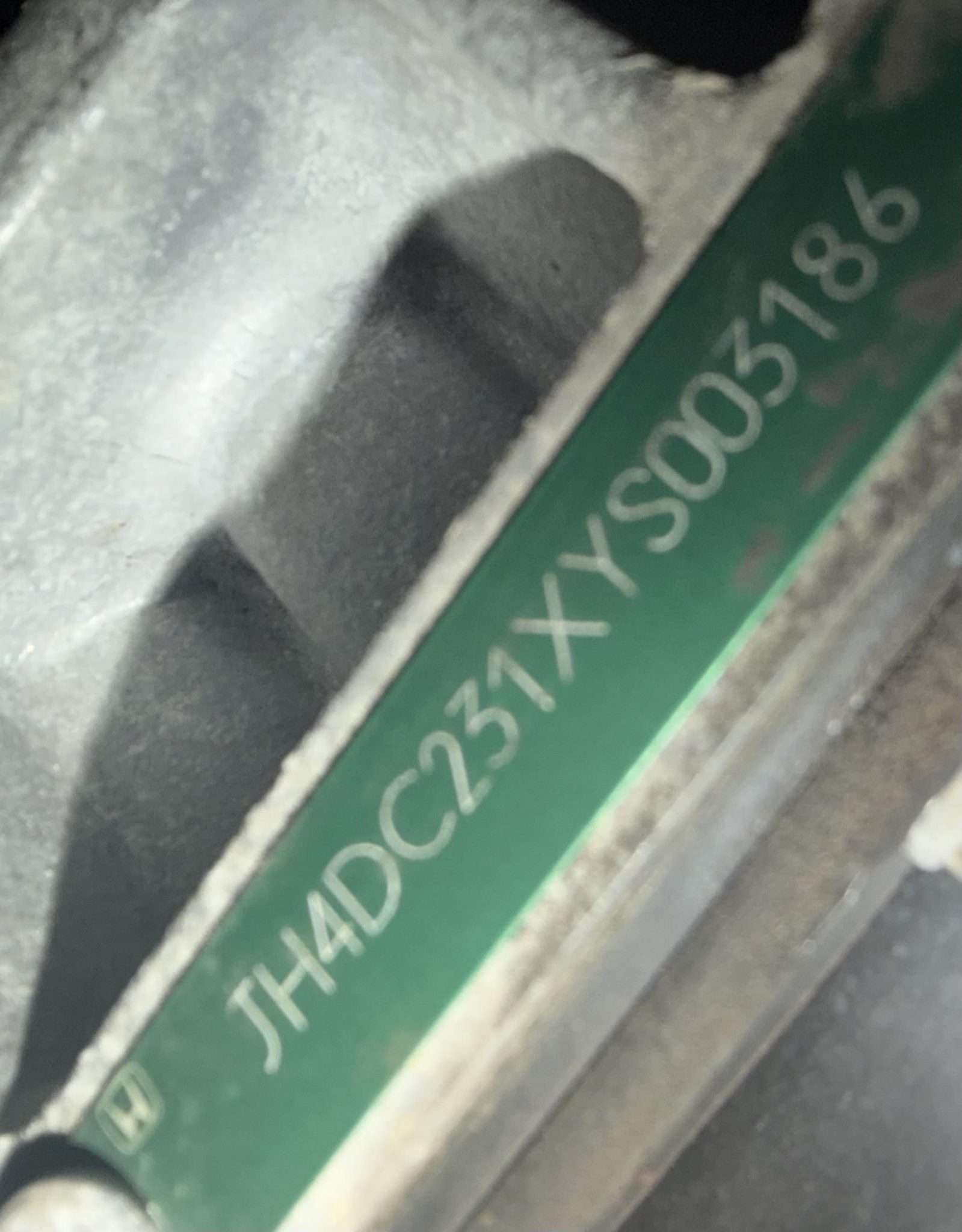
Hagerty’s buyer’s guide tells buyers to check the VIN stickers on the doors, hatch, hood and fenders, and warns that replica stickers exist while factory Honda stickers carry a watermark. The same guide describes the Type R powertrain as a B18 engine and Type R transmission with matching VIN tags. Grassroots gives the identifying prefix for a genuine US car: the VIN starts JH4DC231. On this car the sticker and the listing agree on JH4DC231X, and the tenth character, Y, is the standard VIN code for the 2000 model year.
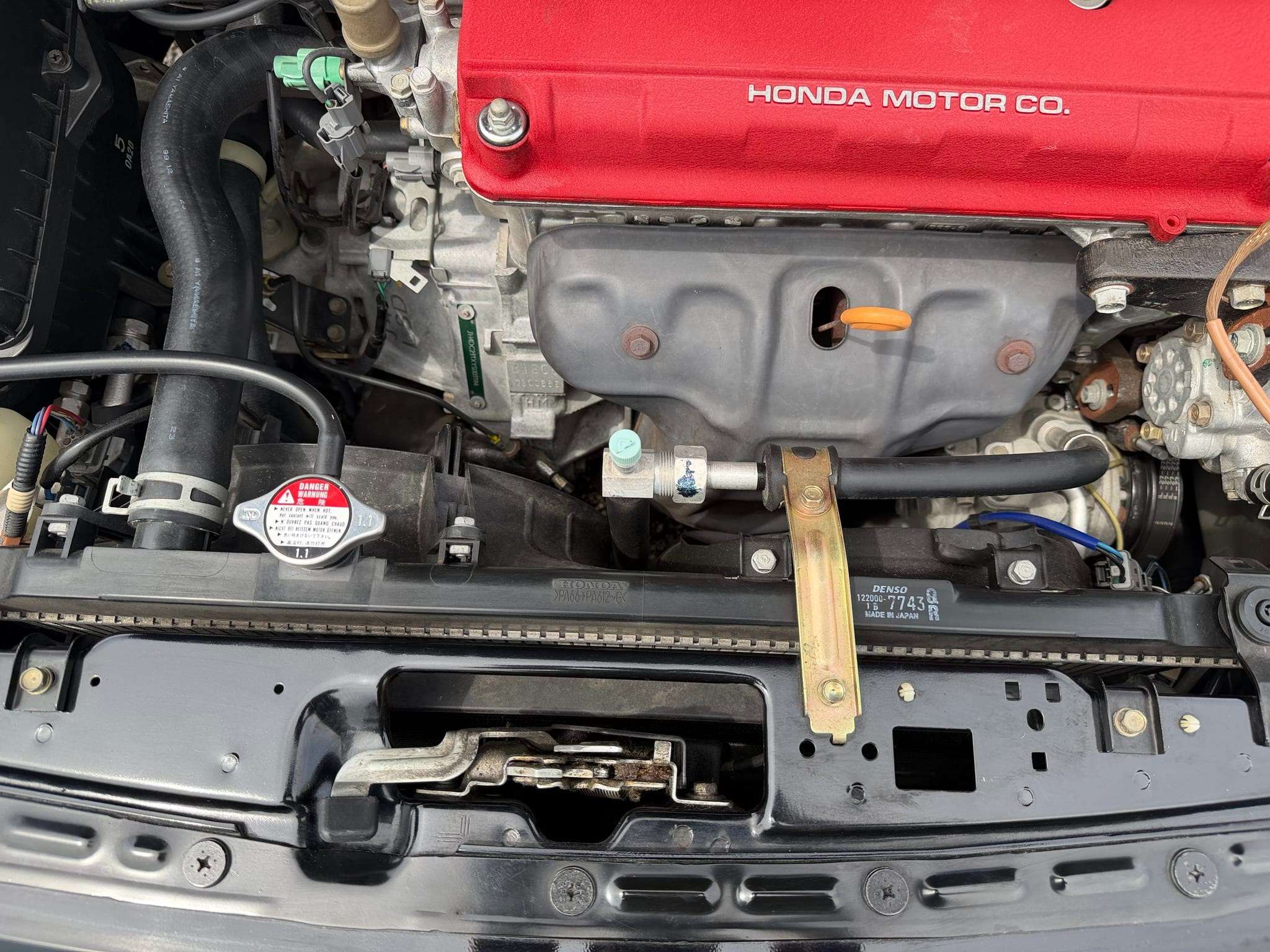
The seller photographs body-panel stickers in the gallery and, in a comment on the listing, adds that the engine carries its own VIN label on the front of the engine just above the oil pan. The green tag in the photo below is that kind of evidence: small, easy to overlook, and worth a close photograph before any money changes hands. A panel that has lost its sticker has presumably been replaced or repainted, which is not disqualifying but should come with an explanation and a paint-thickness record. This listing includes paint-meter photos, and Grassroots does warn that thin paint is typical of the black cars.
Where Type Rs go wrong
Three failure modes recur in the sources. The first is the clone: a GS-R or other standard Integra dressed with Type R parts, which fails on the VIN prefix, the missing Type R bracing and the four-lug hubs. The second is the swap. Hagerty notes that some cars have had their original powertrains stolen or replaced with non-VTEC units, and that the Integra was a theft target (the 1999 model was America’s most-stolen car). Grassroots advises checking the title for theft-recovery history. The third is the parts-bin car, where a US-spec shell wears Japanese-market front-end parts or an incorrect color for the year.
Color is the cleanest cross-check. Acura launched the 2000 Type R in Phoenix Yellow and Flamenco Black Pearl, per its own release, while Hagerty reports Championship White was confined to 1997 and 1998 and that Nighthawk Black Pearl replaced Flamenco Black in 2001. A white car described as a 2000 should prompt hard questions about the paint or the model year. Hagerty also notes that genuine bumpers carry embossed INTEGRA lettering, and that its absence suggests aftermarket parts.
What buyers should verify before bidding
- VIN prefix and year digit. A genuine US Type R VIN starts JH4DC231; a 2000 car carries Y as the tenth character. Match it to the title, door-jamb label and window sticker.
- Body-panel stickers. Look for factory stickers on the doors, hatch, hood and fenders, check for the watermark Hagerty describes, and ask about any panel without one.
- Powertrain tags. Confirm a B18C5 with matching VIN tags on the engine and transmission, and compare the engine number with the window sticker where one exists. Ask for a title or Carfax history that rules out theft recovery.
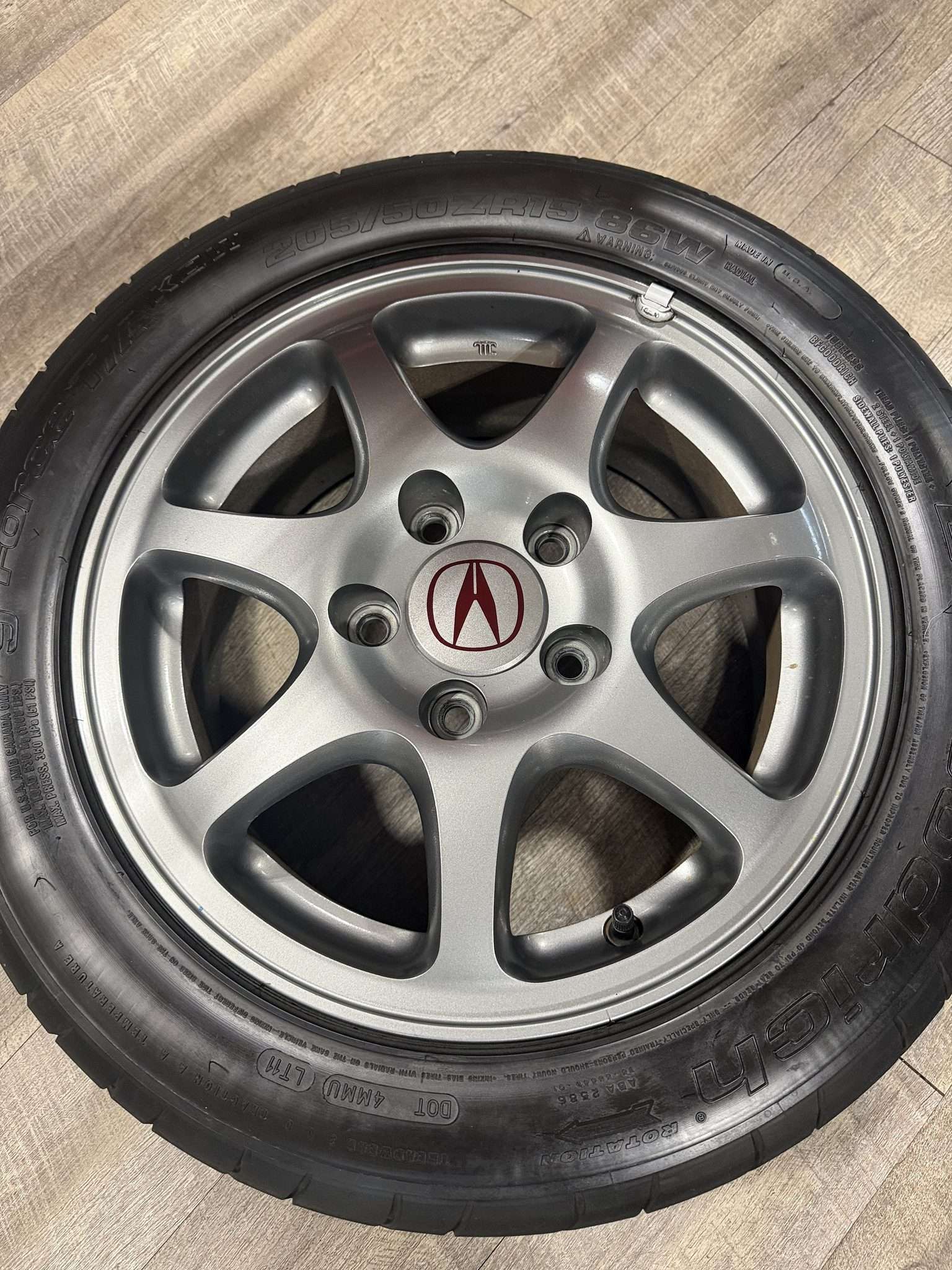
- Type R hardware. Five-lug hubs and wheels, the strut-tower and rear bracing, red-stitched Type R seats, the amber-lit cluster and the INTEGRA bumper embossing. A clone usually misses some of these.
- Year-correct color. Flamenco Black Pearl or Phoenix Yellow for 2000, with paint-thickness readings in hand.
- Paper. The window sticker, owner’s literature, service records and Carfax. On this car the seller lists ten detailed records, five previous owners and a clean Carfax. Hagerty’s guide also suggests the Type R Club of America forums for confirming a car is what it claims to be.
- Dealer and owner additions. The seller discloses that the accessory trunk mat was added after purchase. That level of candor is what a buyer should expect and ask for.
How originality shows up in value
Prices for the Type R have moved enough that the paperwork is now worth real money. Hagerty put a 1997 Type R in #2 (Excellent) condition at about $40,000 in May 2018 and $65,500 by April 2023, and reported that 1998 to 2001 cars had caught up with the 1997s. The BaT history on this very car shows $43,777 in October 2019 and $73,000 in September 2022, against the $76,500 high bid at last check. At the far end, a 4,800-mile 2001 Type R, #1,086 of 1,173 for that model year, sold on Bring a Trailer for $204,204 in 2025, as reported by Top Gear. Those figures are not a forecast. They show that a car with low mileage, its original sticker and an unbroken VIN trail sits in a different market from one that cannot prove the same thing.
For context, the sticker price on this car was $24,805. That gap is the reason cloners bother, and the reason the identifiers above exist. For related authentication reading on MCC, see our checks on the Subaru Impreza 22B STi plaque and chassis, the Hakosuka GT-R and the E46 M3 CSL build record, plus our look at how the market prices paperwork on Ayrton Senna’s Honda NSX and the head-to-head Honda S2000 versus BMW Z4 M Roadster.
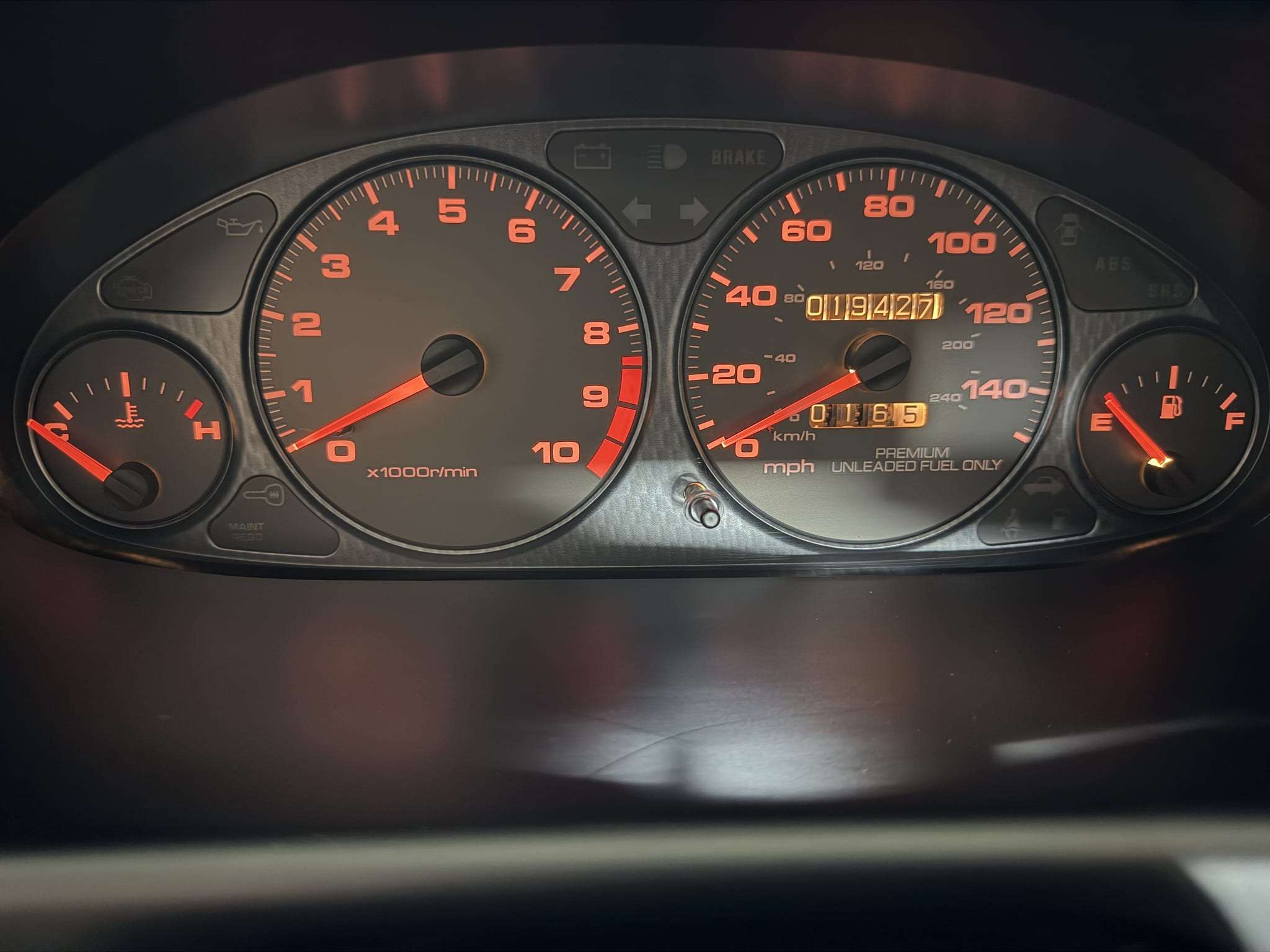
The Type R plaque tells you where a car sits in a production run. The VIN trail tells you whether it is the car at all, and on a 2000 Integra Type R, a buyer who checks the second before admiring the first is the one least likely to overpay.
Sources: Hagerty Media Type R buyer’s guide; Grassroots Motorsports Type R buyer’s guide; Acura 2000 Integra Type R press release; Hagerty valuation tool, 2000 Integra Type R; Top Gear; the Bring a Trailer listing.
The collector car market, every weekday morning.
Auction results, price moves and what’s crossing the block, read in four minutes. Free, from Modern Car Collector.
No spam, unsubscribe in one click. Or read more about the Brief.
Related Posts:
- Acura's Zanardi Edition NSX Was Always a Tribute.…
- On a Subaru Impreza 22B STi, the Plaque Is Only the…
- First-Generation Acura NSX (1991–2005): Collector Spec Sheet
- A 1969 Corvette L88 Convertible Is at $160,000. The…
- Bring a Trailer Auction Offers a Stunning 21k-Mile…
- The Complete Guide to the Yenko Camaro
 Shawn Henry
 Eve Nowell
 EL Puckett