

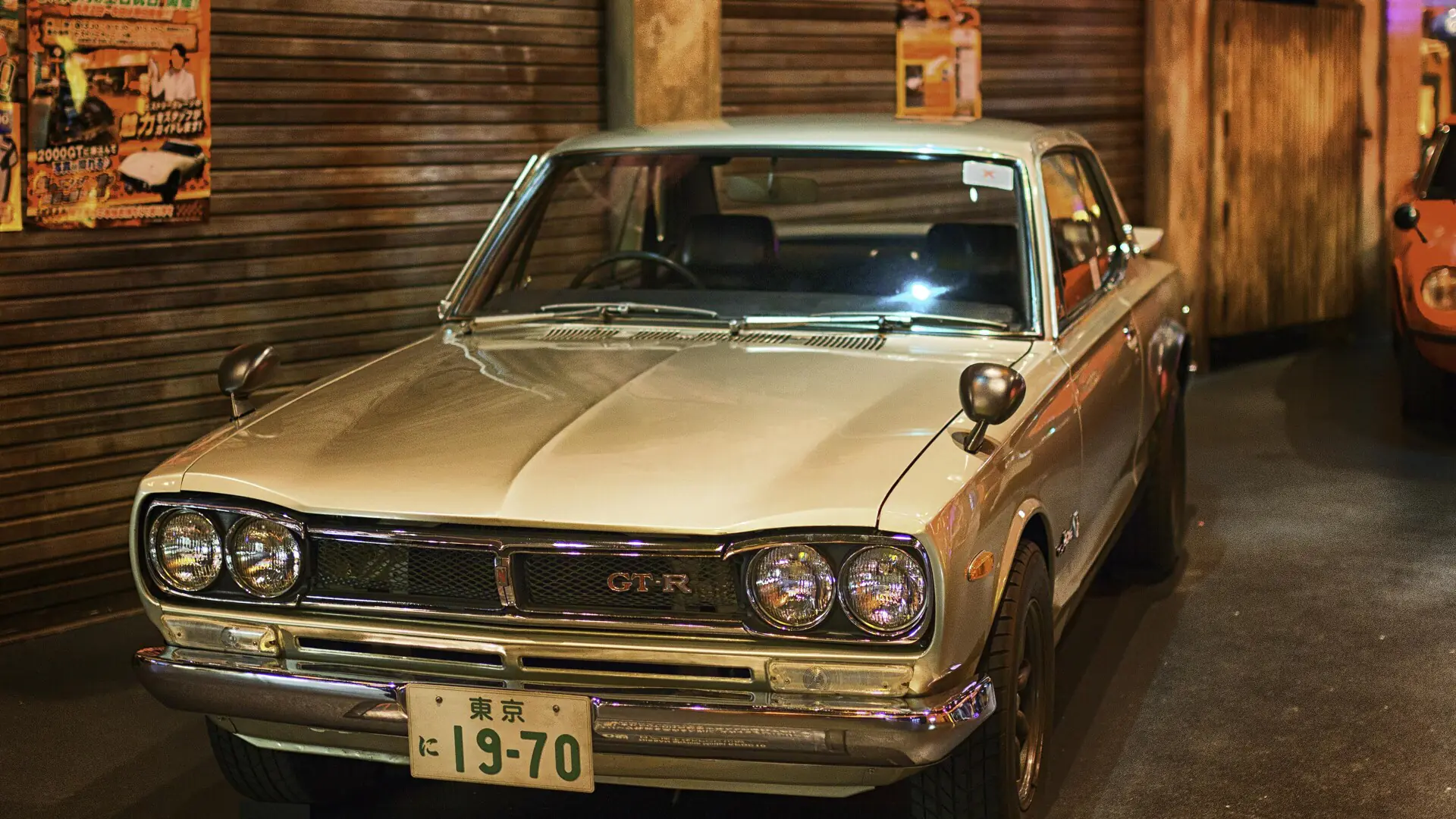
The Nissan Skyline 2000GT-R built from 1969 to 1972, known in Japan as the Hakosuka, started the GT-R line, and Hakosuka GT-R originality comes down to one question: is the S20 engine, together with the body and identity plate that left the factory with it, the real thing? The GT-R grille badge, the flared rear arches and the fender-mounted mirrors are what people photograph. They are also what a lower-spec Skyline can be dressed in.
What Nissan actually built
The first GT-R arrived as the four-door PGC10 on 4 February 1969. The two-door KPGC10 coupe followed in October 1970, and production ended in September 1972. Nissan has not published an official total. Wikipedia’s tally is 2,029 cars, split 832 sedans and 1,197 coupes, while research cited by WhichCar suggests 1,947, with 1,115 coupes. RM Sotheby’s has described 1,115 coupes as the believed figure. Treat the exact coupe count as unsettled and the scale as settled: roughly two thousand cars over a little more than three and a half years.
What made them GT-Rs was the S20, a 1,989 cc twin-cam, four-valve inline-six with three Mikuni-Solex side-draft carburetors, rated at 160 PS at 7,000 rpm. WhichCar describes it as a re-engineered version of the Prince GR8 from the R380 racing car, and credits the GT-R with about 50 race wins between May 1969 and March 1972. The 2000GT-X that shared the body style used the L20.
Why the engine sets the value
A genuine Hakosuka GT-R is priced as a homologation-era racing car with a registration. A clone is priced as a restored or modified Skyline. The gap between those two markets is wide, and the public data points show why. RM Sotheby’s sold a largely original, sympathetically restored 1972 coupe, chassis KPGC10-001445, with its Japanese export certificate, for $242,000 at Monterey in 2014. WhichCar reports that RM also sold a four-door for $88,000. Hagerty later reported that a 1973 KPGC110, the 197-car successor that used the same S20, brought ¥47.3 million, about $430,000, at Best Heritage’s Tokyo Terrada auction. The Hagerty report we reviewed carries no date, so confirm current comparables before relying on it.
None of those figures prices the car in front of you. They show the shape of the market, and they explain why sellers have every incentive to make a lesser Skyline look like a GT-R.
Hakosuka GT-R originality starts with the plate
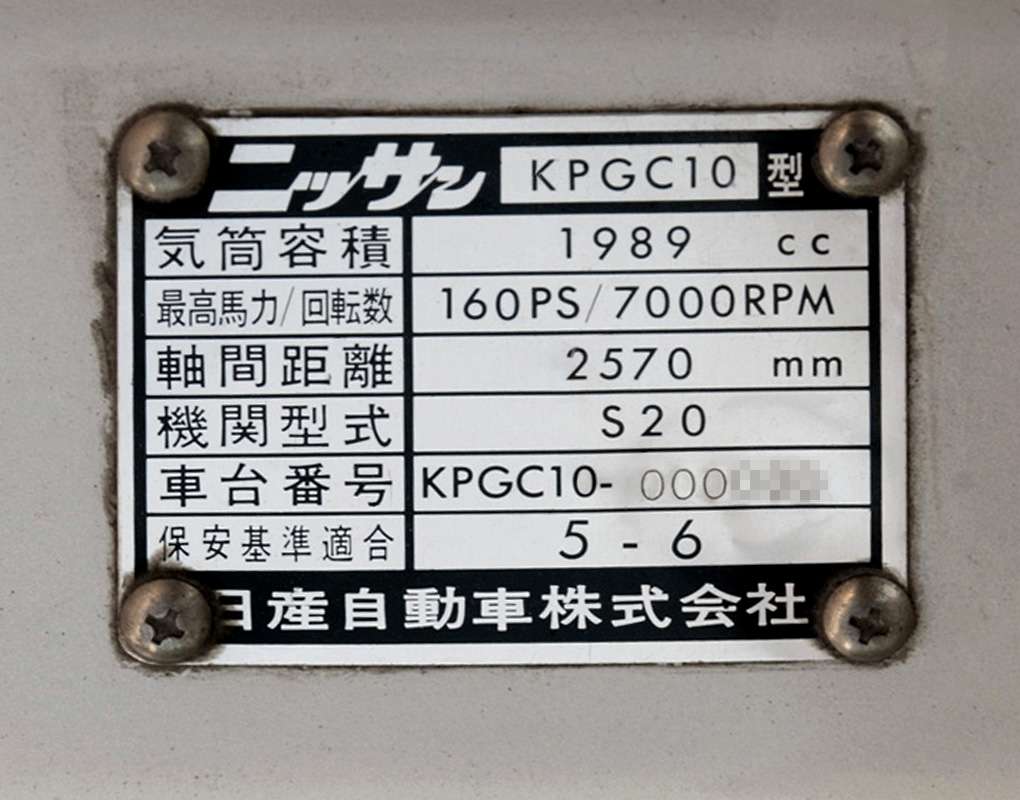
The maker’s plate in the photograph above, taken from a KPGC10, lists five facts: the model code (KPGC10), displacement (1989 cc), output (160 PS at 7,000 rpm), wheelbase (2,570 mm) and engine type (S20), followed by a chassis number that begins KPGC10- and a serial, which is blurred in this picture. RM’s 1972 coupe carries KPGC10-001445, so the format has a documented example.
Every field should agree with the car. A coupe whose plate names a different model code, or a plate reading S20 over an L-series engine, answers the originality question on the spot. The reverse is the trap: a correct-looking plate is evidence only when its number agrees with the registration or export paperwork and the car’s history. MCC made the same point about the Subaru Impreza 22B, where plaque, chassis, body and paper must all agree.
How clones and costumes get made
WhichCar reports that replicas are common, often built from lower-spec C10 Skylines and fitted with L-series engines, and that mismatched engine-and-body combinations are common. Speedhunters documents the process openly: a KGC10, which left the factory with an L20, restyled as a GT-R and fitted with an L28, and presented as a replica. A build like that is a legitimate car when it is sold as what it is.
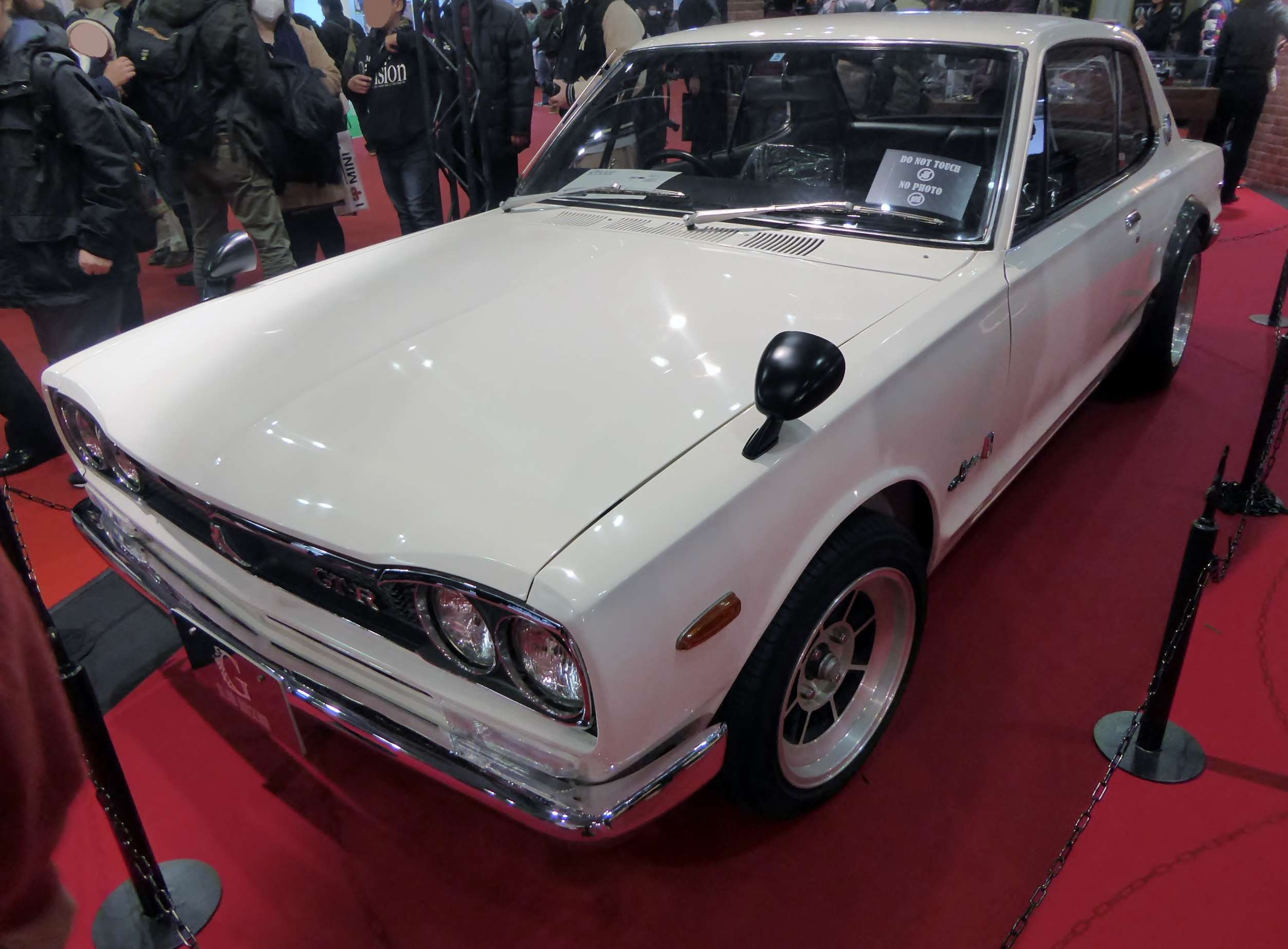
The cosmetic parts list is what makes the costume convincing. Wikipedia lists black fiberglass-reinforced-plastic rear-arch overfenders, different wing mirrors and a redesigned grille among the changes on the KPGC10 coupe. Those are exactly the items a builder can reproduce, and Speedhunters describes the flares on its replica as factory-looking. They establish how a car is styled. They say nothing about what it is.
The S20 is necessary, not sufficient
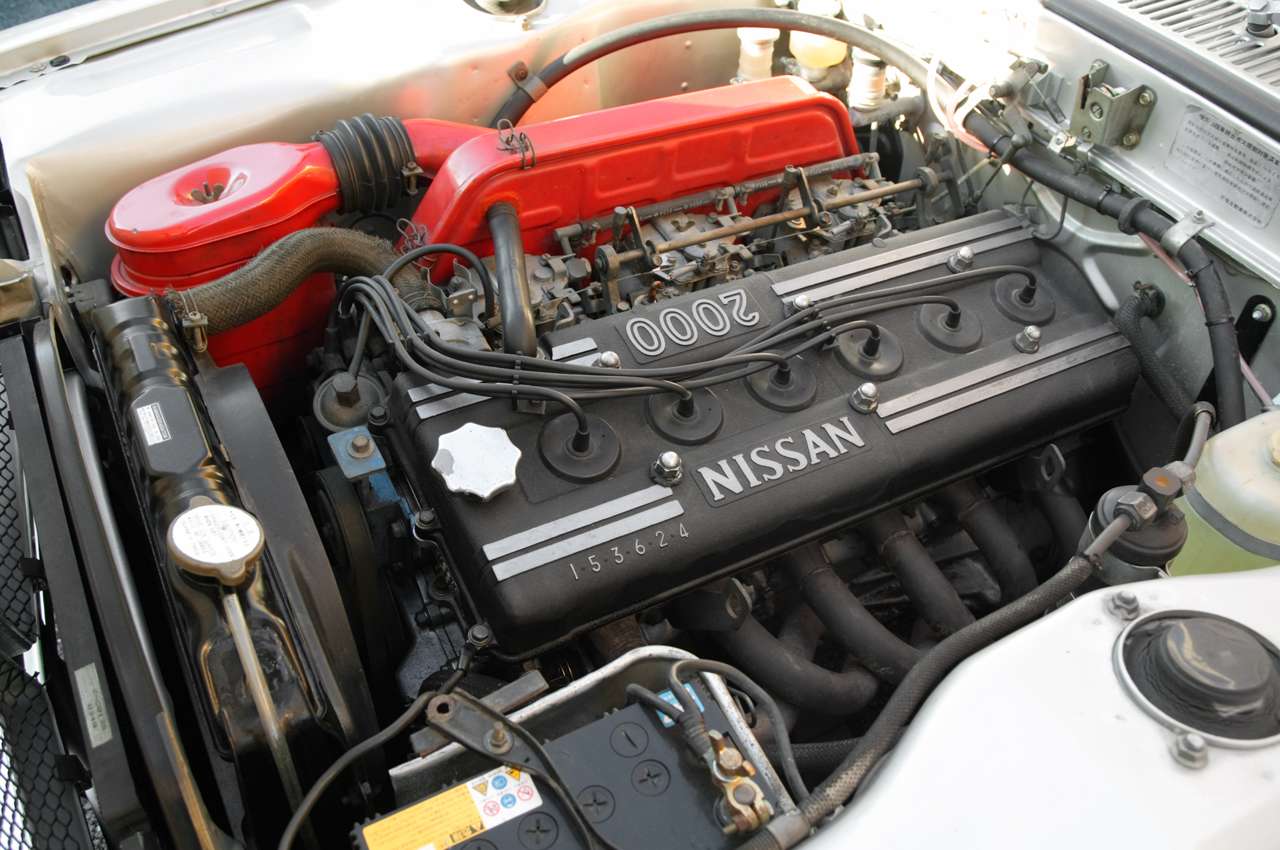
The S20 was not exclusive to the Skyline. It also powered the Datsun Fairlady Z432, of which about 419 or 420 were built, the Z432R homologation special, and the 1973 KPGC110. A real S20 in a non-GT-R body is not a GT-R. Because the engine is the valuable part, a buyer should also expect a specialist to confirm that it is the right engine for that chassis, not just a correct-looking one. We found no public, verified method for proving that from an engine number alone, so a seller’s assurance should not substitute for documentation.
What to verify before you buy
- The plate. Model code KPGC10 on a coupe or PGC10 on a sedan, engine type S20, 1989 cc, 160 PS, and a serial in the KPGC10-xxxxxx format. Match the number against the registration or export papers.
- The engine. Confirm by inspection that it is a twin-cam, 24-valve S20 with three Mikuni-Solex side-draft carburetors, and have a marque specialist examine it. A cam cover or a badge proves nothing.
- The body identity. A GT-R was built only as the PGC10 sedan or the KPGC10 coupe. A KGC10 identity, the lower-spec model Speedhunters documents, means the car began life as something else.
- The paper trail. Look for a Japanese export certificate, as the RM car had, registration history, auction and ownership records, and written verification from a recognized specialist.
- The cosmetics last. Grille, flares and mirrors are supporting evidence at best. Judge them only after the plate, engine and paperwork agree.
- The description on the invoice. If the car is a replica or a GT-R-style build, get that stated in writing and price it accordingly. A well-built tribute can be a good car. It is not a Hakosuka GT-R.
The bottom line
The part of a Hakosuka that the market pays for is mostly unglamorous: an engine type stamped on a plate, a serial that matches the paperwork, and a power unit that belongs in that chassis. The part everyone photographs is the part anyone can build. Buyers who start with the plate and the paper, and who treat the badge and flares as the last thing to check, are the ones least likely to pay GT-R money for a costume. The same discipline applies to other Japanese icons, as our checks of the Toyota 2000GT convertible and the Datsun 240Z Series I show.
Sources: RM Sotheby’s, 1972 Nissan Skyline H/T 2000GT-R lot; Hagerty Media; WhichCar; Speedhunters; Wikipedia entries for the Nissan Skyline GT-R and the Nissan S20 engine.
The collector car market, every weekday morning.
Auction results, price moves and what’s crossing the block, read in four minutes. Free, from Modern Car Collector.
No spam, unsubscribe in one click. Or read more about the Brief.

 Kyle Matthews
 Eve Nowell