

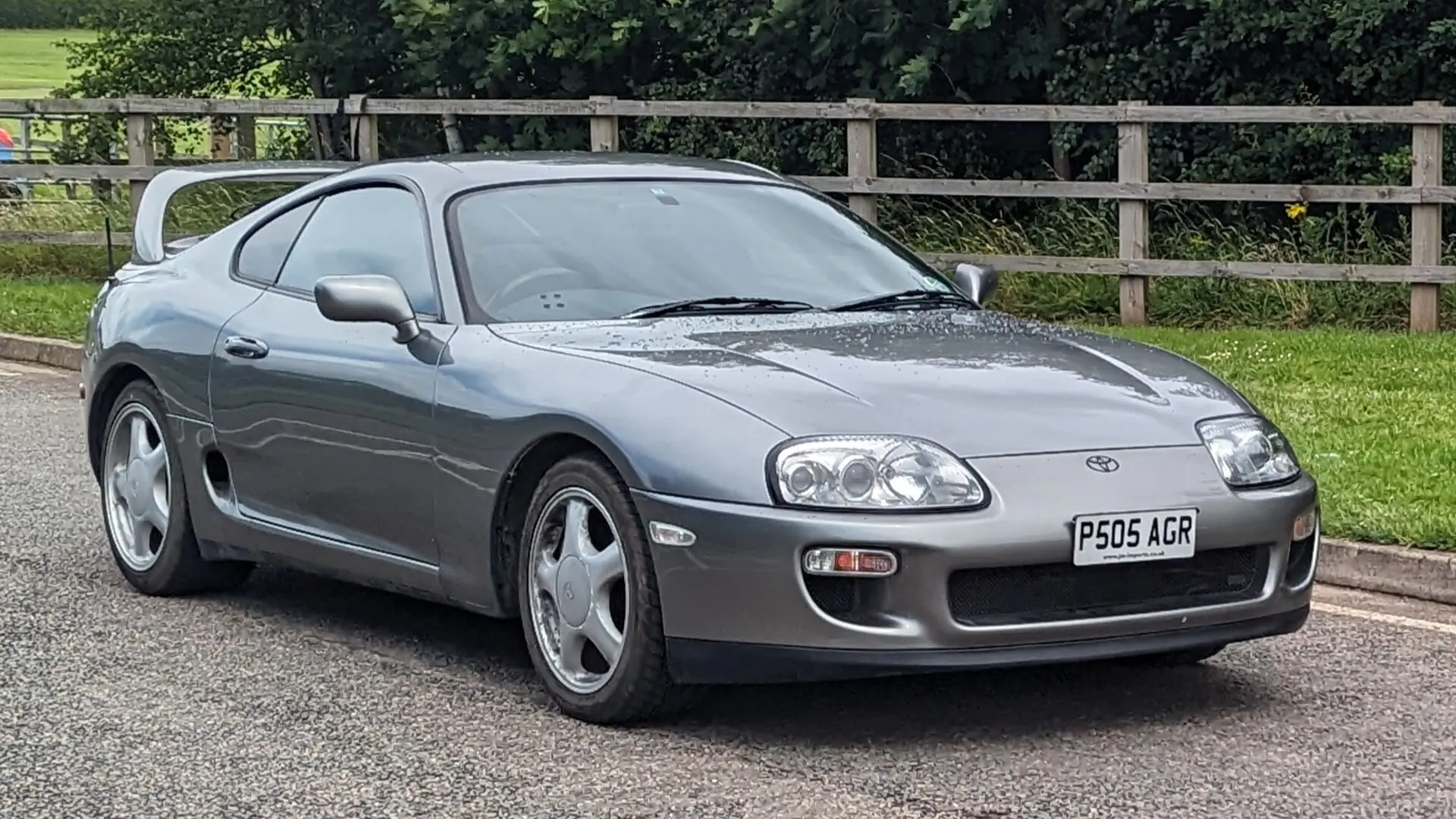
The fourth-generation Toyota Supra, the A80, is the Japanese performance car that collectors spent two decades watching tuners use up. This Toyota Supra Mk IV spec sheet focuses on the U.S.-market Turbo sold from 1993 to 1998: a 3.0-liter twin-turbo inline-six, an optional six-speed manual, and a body that still looks current. Toyota sold fewer than 7,000 Turbos here, and a large share of them have since been modified or crashed. Hagerty’s October 2026 guide puts a 1994 Turbo Sport Roof in #3 (good) condition at $78,500. Below: production numbers, VIN tells, weak points and current values, so you can tell a good A80 from one that’s been through three owners and a dyno.
Toyota Supra Mk IV Turbo (1993–1998) at a glance
| Item | Detail |
|---|---|
| Model | Toyota Supra Mk IV (A80, chassis JZA80), U.S. market, 1993–1998; Japanese production continued to August 2002 |
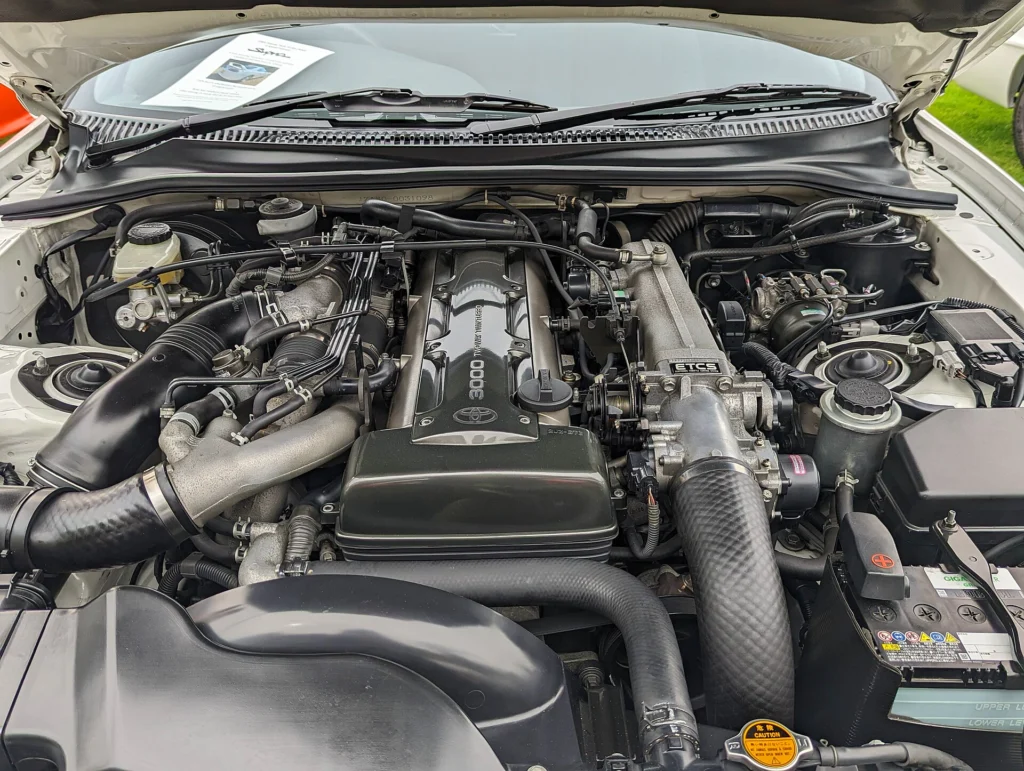
| Engine | 2JZ-GTE 3.0-liter (2,997 cc) DOHC 24-valve inline-six, cast-iron block, sequential twin turbochargers |
| Output (U.S. Turbo) | 320 hp at 5,600 rpm and 315 lb-ft at 4,000 rpm (Japanese-market cars were rated at 276 hp) |
| Transmissions | Six-speed V160 manual (developed with Getrag) or four-speed A340E automatic |
| Drivetrain | Rear-wheel drive; limited-slip differential and TRAC traction control standard on Turbo |
| Body | Two-door liftback, fixed hardtop or removable “Sport Roof” targa panel |
| Weight | About 3,450 lb for a manual Turbo (Wikipedia); turbo cars carry a 53/47 front/rear balance |
| Performance | 0–60 mph in as little as 4.6 seconds and a 13.1-second quarter mile at 109 mph (Car and Driver, cited by Wikipedia); 70–0 mph braking in 149 ft (Hagerty) |
| U.S. Turbo sales | 6,977 retail sales, of which 4,038 had the six-speed (MKIV.com) |
| Hagerty #3 value | $78,500 for a 1994 Turbo Sport Roof; $82,500 for a 1997 Limited Edition Turbo (October 2026) |
Production totals
Toyota never published a clean U.S. production ledger for the A80, so collectors lean on retail sales figures compiled by the owner site MKIV.com. Those figures cover U.S.-imported cars only and count 11,239 Supras sold from 1993 to 1998: 6,977 Turbos and 4,262 naturally aspirated cars. Wikipedia carries a separate North American estimate of 12,059 cars through 1999, which includes Canada, so expect small disagreements between sources.
| Turbo configuration | 1993 | 1994 | 1995 | 1996 | 1997 | 1998 | Total |
|---|---|---|---|---|---|---|---|
| 6-speed, hardtop | 233 | 75 | 18 | – | – | – | 326 |
| 6-speed, Sport Roof | 431 | 1,708 | 526 | – | 768 | 279 | 3,712 |
| Automatic, Sport Roof | 830 | 1,213 | 262 | 88 | 409 | 137 | 2,939 |
| All Turbos | 1,494 | 2,996 | 806 | 88 | 1,177 | 416 | 6,977 |
Three numbers matter most to collectors. Only 326 Turbos were sold with the six-speed and the fixed hardtop, and just 18 of those came in 1995. The 1996 model year produced 88 Turbos, all automatics, because the manual was not certified for that year’s emissions and OBD-II rules. And six-speed Turbos returned for 1997 and 1998 in smaller numbers than the 1994 peak. The same site’s Turbo color counts list Black (2,797) and Renaissance Red (2,314) as the most common colors, with Quicksilver FX (33) and Imperial Jade Mica (24) offered only for 1998. Those color counts add up to 7,866 cars, which doesn’t match the 6,977 sales total, so treat them as a guide to relative rarity rather than exact figures.
Engine and drivetrain
The 2JZ-GTE pairs a cast-iron block with an aluminum twin-cam head and two turbochargers that work in sequence: the first does the work at low rpm, and the second joins in higher up. U.S. and European cars got more power than Japanese ones (320 hp versus 276), and Wikipedia credits part of that to revised turbos and larger injectors. The 2JZ’s party trick is taking far more boost on a stock bottom end, per Hagerty. It goes a long way toward explaining why so many were modified.
Six-speed Turbos use the V160 gearbox and a 3.133:1 final drive. The A340E automatic, offered on both engines, has a manual shift mode. Naturally aspirated cars use the 220-hp 2JZ-GE with the five-speed W58 manual or the same automatic. Different car, much lower values. It’s why the VIN gets checked before anything else.
Special options and equipment
- Sport Roof: a removable roof panel over the front seats, offered on both base and Turbo models. It became standard on Turbos for 1996 (Wikipedia), and fixed-roof Turbos are now the rarer body.
- Turbo equipment: 17-inch wheels, larger brakes, a rear spoiler, a limited-slip differential, TRAC traction control and firmer suspension, according to Consumer Guide, Hagerty and Import a Vehicle.
- 1995 SE: MKIV.com lists 1,004 naturally aspirated SE hardtops for 1995 only. It is not a Turbo, and should not be priced as one.
- 1997 15th Anniversary / Limited Edition: every 1997 Supra was a 15th Anniversary car, with special badging, a rear spoiler, premium sound and the return of the six-speed on Turbos. Edmunds reports that 1997 Turbos also got the Sport Roof and polished wheels as standard. Hagerty values these separately as the “Limited Edition Turbo.”
- 1998: a three-spoke steering wheel and a redesigned radio, per Wikipedia. Wikipedia also says the Turbo was not sold in states that follow California emissions rules (CARB) that year.
Identifying details
Begin with the VIN. MKIV.com explains that a VIN starting with JT means a car built in Japan and that the 10th character gives the model year: P (1993), R (1994), S (1995), T (1996), V (1997) and W (1998). How you tell a Turbo from a non-turbo car changes partway through the run.
- 1993–1995: the series code (the 7th character) separates the two. Turbo VINs on Hagerty-recorded sales begin JT2JA82, and naturally aspirated cars begin JT2JA81. The body-type character distinguishes the Sport Roof from the hardtop.
- 1996–1998: the engine code (the 5th character) separates them. Recorded Turbo sales begin JT2DE82, and naturally aspirated cars begin JT2DD82.
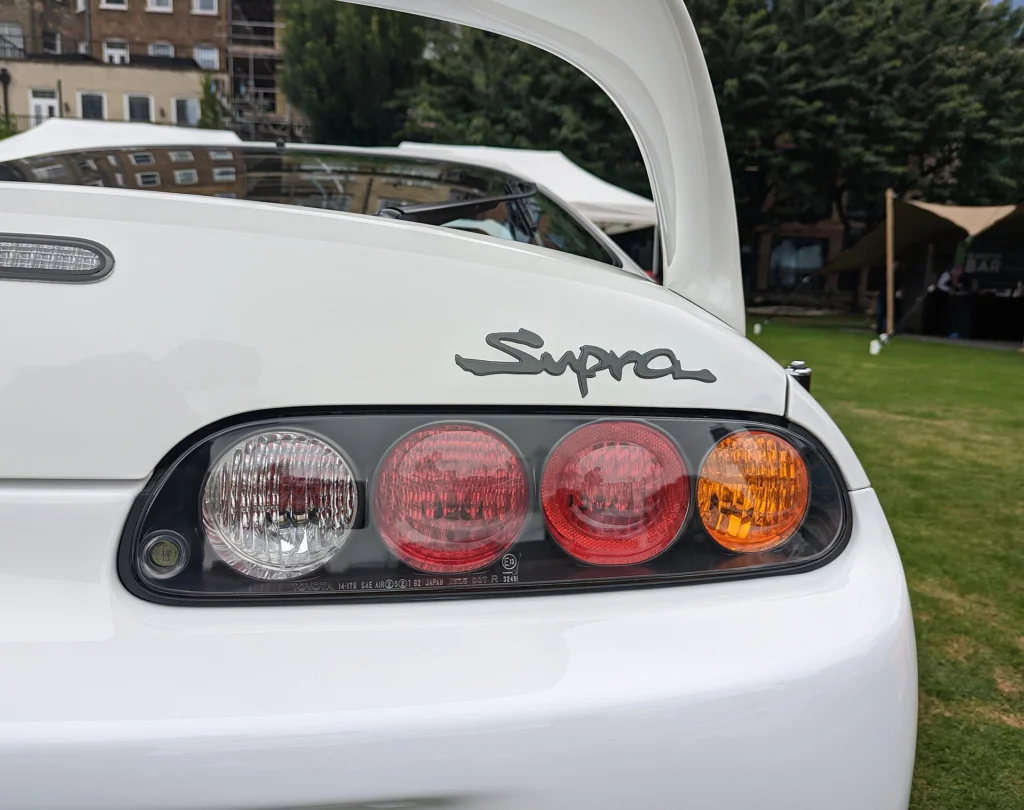
- Visual cues: 1997 and later cars have a revised front bumper, headlights and taillights, and from 1998 a three-spoke steering wheel. 1997 cars carry “15th Anniversary” emblems inside.
- Paperwork: a window sticker, Toyota build data and early service records showing “Turbo” are worth more than a badge, because badges and spoilers are easy to add to a naturally aspirated car.
Always check a VIN against a full decoder, Toyota’s records and the car itself. A 2JZ-GTE under the hood doesn’t make a factory Turbo; swaps into naturally aspirated cars are common.
Common weaknesses
- Modification history: the biggest risk with any A80. Single-turbo conversions, aftermarket engine management, non-factory bodywork and lowered suspension are common. Reversing them costs money and rarely brings back factory originality. Hagerty notes that many cars have also been crashed.
- Sequential turbo system: buyer guides say the second turbo should come in at about 4,500–5,000 rpm. If it arrives late or not at all, look at the turbos themselves and the control hardware. Whining, smoke or slow response point to tired turbos.
- Oil leaks and consumption: valve-cover gaskets, cam seals, the rear main seal and the turbo oil return lines leak. Blue smoke on a cold start suggests worn valve-stem seals. Consumer Guide also reports sludge-related oil consumption, for which Toyota extended the warranty.
- Ignition and cooling: coil packs fail and cause misfires. Guides single out the original water pump on 1993–1995 cars and a worn driver-side engine mount.
- Roof and body: the 1993–1995 Sport Roof seals can leak water, and roof bolts can seize. Check under the sill covers, the floors, the tailgate glass surround and the rear bumper beam for rust, and look for overspray and uneven panel gaps that point to accident repair.
- Automatic gearbox: heat is the main enemy of the A340E, especially on cars with added power.
- Interior: cracked dashboards, worn seat bolsters and a disconnected ABS or TRAC warning light (ask why it was disconnected).
Current value range
Hagerty’s October 2026 price guide for a 1994 Supra Mk IV Turbo Sport Roof lists:
| Condition | Hagerty value (Oct. 2026) | Range shown |
|---|---|---|
| #1 Concours | $262,000 | $227,333–$296,667 |
| #2 Excellent | $158,000 | $131,500–$192,667 |
| #3 Good | $78,500 | $67,767–$105,000 |
| #4 Fair | $46,300 | $35,567–$57,033 |
Hagerty values the 1997 Limited Edition Turbo at $82,500 in #3 condition, and its #3 figure for a naturally aspirated 1994 coupe is $61,900. The #3 Turbo value is down 12% over the past year and flat for the quarter. Over the last 12 months Hagerty counts 48 1993–1998 Supras sold at auction for an average of $92,400. Recent results show how wide the spread is: in September 2026 a 1993 Turbo six-speed brought $129,150 on Cars & Bids, a 1993 Turbo coupe brought $113,400 on Bring a Trailer, and a 1993 Turbo Sport Roof sold for $86,993. CLASSIC.COM’s market benchmark for U.S./Canadian-spec Twin Turbos is $107,458. Film-car provenance sits apart: Hagerty records a top sale of $550,000 for a 1994 car. For more results, see our list of the 10 most expensive Toyota Supras ever sold at auction.
What separates a good Supra Mk IV from an average one
- Factory Turbo and factory specification: a VIN, paperwork and drivetrain that agree. That means the original turbos, intake, exhaust and catalytic converters, the stock ECU, factory wheels and the correct spoiler. As we noted in our look at an unmodified 1993 Supra Turbo on Cars & Bids, bidders now pay for restraint more than for perfection.
- The right gearbox: six-speed Turbos are the most sought after. A six-speed hardtop is the rarest U.S. combination.
- Documented history: the window sticker, the number of owners, service records with timing-belt and seal work, and a clean title with no accident history.
- Original paint and panels: paint-meter readings that match from panel to panel, even gaps, and no structural repair. Low mileage helps, but a well-kept car with documented use can be a better buy than one that has sat unused.
- Color and year: rare 1998-only colors and 1997 Limited Edition cars bring extra interest, but condition and originality come first.
- Healthy turbo changeover: a clean handoff to the second turbo, no smoke, a dry engine and working TRAC and ABS warning lights.
Shopping the wider 1990s Japanese field? Compare this car with our first-generation Acura NSX spec sheet, read about the Mitsubishi 3000GT VR-4 collector market, or see whether the 2026 GR Supra Final Edition could follow the A80. For an earlier Japanese icon, see our Datsun 240Z collector spec sheet.
Hagerty has a good-condition stock Turbo at $78,500. Would you pay that for stock, or less for a well-sorted modified one?
Sources
- Hagerty Valuation Tools: 1994 Toyota Supra Mk IV Turbo (October 2026)
- Hagerty Valuation Tools: 1997 Toyota Supra Mk IV Limited Edition Turbo
- MKIV.com: 1993–98 Supra retail sales numbers by model
- MKIV.com: 1993–98 Supra color production by model
- MKIV.com: How to read the Supra VIN
- Wikipedia: Toyota Supra (A80)
- Consumer Guide: 1993–98 Toyota Supra
- Edmunds: 1997 Toyota Supra review
- Import a Vehicle: JDM vs. USDM Toyota Supra
- Garage Dreams: Toyota Supra Mk4 buyer’s guide
- CLASSIC.COM: Toyota Supra 4th generation market
The collector car market, every weekday morning.
Auction results, price moves and what’s crossing the block, read in four minutes. Free, from Modern Car Collector.
No spam, unsubscribe in one click. Or read more about the Brief.
Related Posts:
- Depreciation and Market Comparison of the Pontiac…
- The 10 Most Expensive Toyota Supras Ever Sold at Auction
- This Unmodified 1993 Supra Turbo Shows the Mk IV…
- Dodge Viper RT/10 (1992–1995): Collector Spec Sheet
- First-Generation Acura NSX (1991–2005): Collector Spec Sheet
- The Porsche Carrera GT Doubled in 2026. The $6.7…
 John Lloyd