

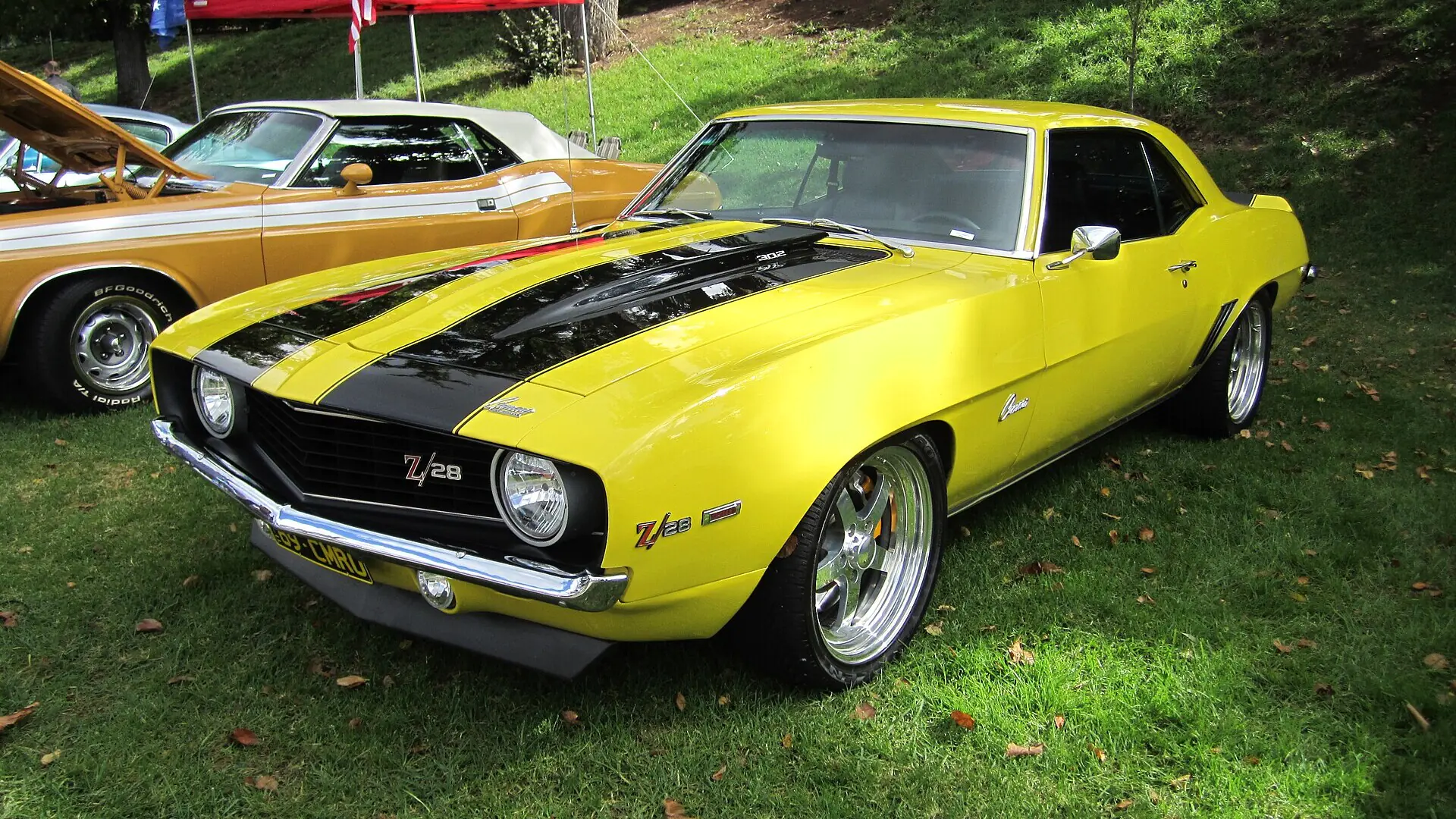
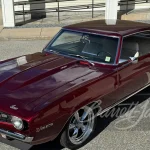
A 1969 Camaro Z/28 is one of the most copied muscle cars in the hobby, and its originality is hard to prove for a simple reason: the VIN cannot tell you the car is a Z/28. The VIN gives you body style, engine type, model year and plant. It says nothing about RPO Z28. So a convincing clone needs only stripes, badges, a 302 and a four-speed, all easy to buy. Three things separate a real car from a tribute: the stamped engine pad, the cowl tag, and the factory paperwork that ties them to the VIN.
Why the 1969 Camaro Z/28 VIN Is Not Enough
Chevrolet created the Z/28 to homologate the Camaro for SCCA Trans-Am racing. The heart of it was a 302 cubic inch small-block, rated at 290 horsepower, paired with a mandatory four-speed manual. In 1969, Chevrolet built 20,302 of them. That is more than 1967 and 1968 combined. Every one was a coupe, and every one carries a VIN that looks exactly like the VIN of any other 1969 V8 Camaro coupe.
That is the whole originality problem. A 1969 Camaro VIN beginning 12437 tells you it is a V8 sport coupe. Then comes a 9 for the model year and a letter for the plant: N for Norwood, Ohio, or L for Van Nuys, California. Nothing in that sequence decodes as Z/28. The same is true of the 1964–65 Pontiac GTO, where only the PHS paperwork can prove the option. On a 1969 Camaro Z/28, by contrast, the evidence sits all over the car, so buyers need to read all of it.
The Originality Detail That Sets the Price: The DZ Engine Pad
The single most important item on a 1969 Camaro Z/28 is its original engine. On a small-block Chevrolet, the assembly stamp sits on a machined pad at the front of the block, just ahead of the passenger-side cylinder head. On a Z/28, that stamp should show a plant code (V for Flint engine) and a four-digit month-and-day assembly date. It should also carry the suffix code DZ, which identified the 302 built for Z/28 use. The block itself should carry casting number 3956618. However, Chevrolet also used that number for 1969 350 blocks, so the casting alone proves nothing.
In addition, the block should carry a derivative of the car’s VIN. Matching that partial VIN to the dash VIN plate is what makes a car “numbers matching.” Without it, a correct DZ engine is only a correct replacement engine, and the market pays for that difference. Restamps are common enough that Camaro Research Group members routinely ask for clear photos of the stamping before giving any opinion (CRG forum discussion).
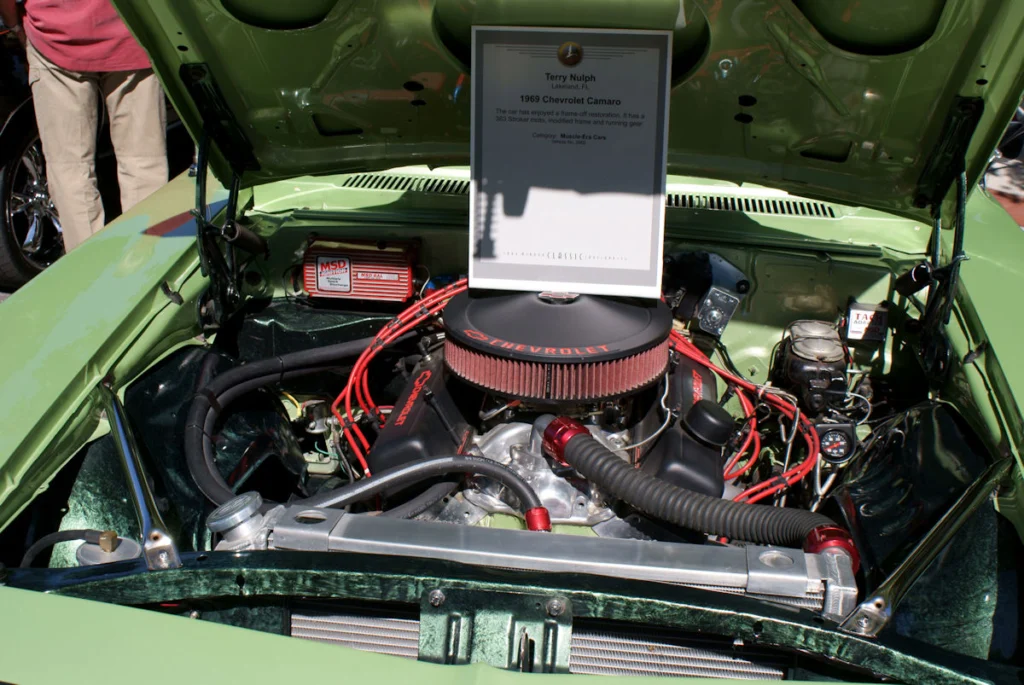
How the dates must line up
Every stamped and cast number on a real 1969 Camaro Z/28 tells part of one originality timeline. First, the block casting date should come before the engine assembly date on the pad. It is written as a letter for the month, then the day and a single-digit year. Then, the engine assembly date should come before the build date on the cowl tag, normally by days or a few weeks. Likewise, the heads, intake, carburetor, transmission and rear axle carry their own codes and dates, and they should fall into the same window. A DZ stamp dated after the car was built, or a head dated a year earlier than everything else, is a red flag that needs an explanation.
The Cowl Tag: Helpful on Norwood Cars, Silent on Others
On a 1969 Camaro Z/28, the trim tag riveted to the cowl is a key originality clue. It gives the body build date, paint code and trim code. On many later Norwood cars, it also carries an X-code that summarizes the package. For example, X33 turns up widely on Z/28s. CRG members decode it as Style Trim with Special Performance Equipment (Z28). Other X-codes, such as X77, also appear on Z/28s. Norwood appears to have started putting X-codes on tags around December 1968. Van Nuys cars did not use them (CRG, CRG).
Two warnings follow. First, a missing X-code does not disqualify a car. An early Norwood car or any Van Nuys car can be a genuine Z/28 with a silent tag. Second, the presence of X33 proves very little on its own. CRG members note that the X33 tag is among the most reproduced. So check the rivets, the finish and the paint around it. Then compare its build date with the drivetrain date codes.
Documentation That Ties the Package to the Car
The strongest 1969 Camaro Z/28 originality cases rest on paper. For instance, a window sticker or dealer invoice listing RPO Z28 can settle questions that stampings cannot. So can a Protect-O-Plate or a build sheet found during disassembly. Norwood cars may also show grease-pencil marks on the rear seat bulkhead, and some owners have matched them to the X-code. Paper also keeps a car’s story intact at auction, as buyers showed again at Fall Carlisle, where six-figure cars were paid for proof.
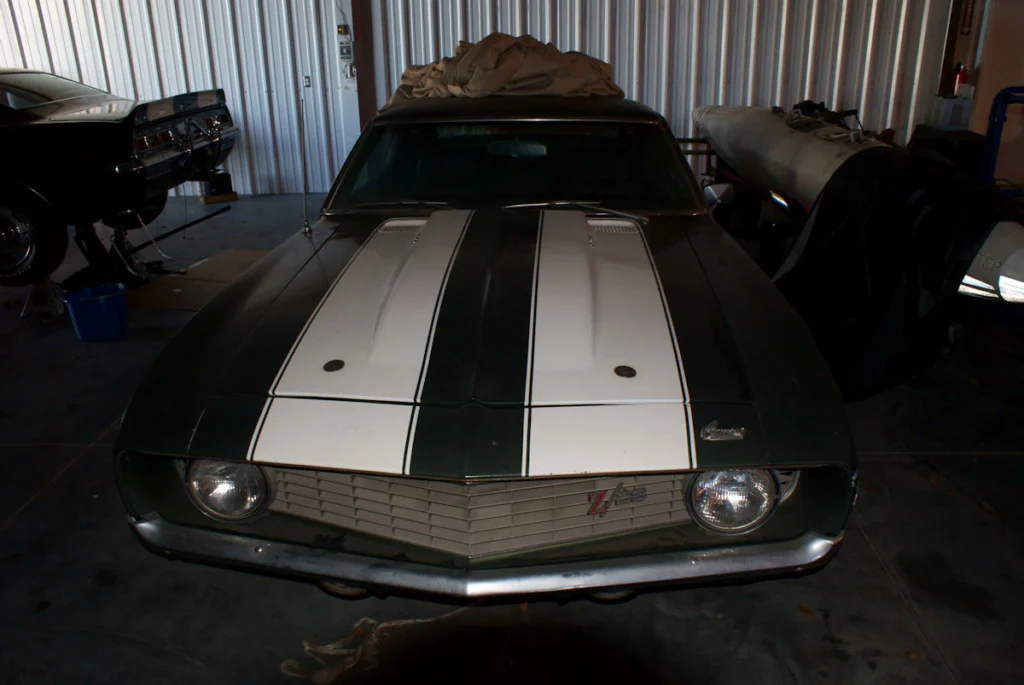
How Originality Moves 1969 Camaro Z/28 Value
The market sorts every 1969 Camaro Z/28 into rough tiers. At the top are documented cars with the original, VIN-matched DZ engine. Next come real Z/28s with a correct but replacement DZ engine, or with a numbers-matching engine but no paper. Below them sit cars that are probably real but unproven. Finally, clones and tributes trade like well-built V8 Camaros. Aftermarket wheels and an updated ignition are reversible and cheap. Nobody can undo a lost original block, a restamp or a missing story. The same pattern runs through the most valuable cars on our list of the most expensive Camaros ever sold at auction, and through rarer siblings like the 1969 Camaro ZL1 (COPO 9560).
What Buyers Must Verify Before Buying a 1969 Camaro Z/28
Numbers and stampings
- VIN plate and title. Confirm the dash VIN begins 12437, carries a 9 in the sixth position for 1969, followed by an N or L plant code, and matches the title exactly. Inspect the plate’s rivets for signs of removal.
- Engine pad stamping. Ask for sharp, well-lit photos of the front pad before you travel. Look for the plant code, assembly date and DZ suffix, with factory broach marks visible around the characters. Uneven depth, mismatched fonts or a freshly smoothed pad call for an expert opinion.
- Derivative VIN on the block. Find the partial VIN on the block and confirm it matches the dash VIN. If it is missing, treat the engine as a replacement until someone proves otherwise.
- Block casting number and date. Confirm 3956618 and a casting date that falls before the engine assembly date.
- Date-code timeline. Check heads, intake, carburetor, transmission and rear axle codes against the cowl tag build date. Expect a four-speed manual, and note whether the transmission carries a VIN derivative of its own.
Tag, body and paperwork
- Cowl tag. Read the build date, paint and trim codes, and any X-code. On a Norwood car, X33 is supportive. On a Van Nuys or early Norwood car, a missing X-code is normal. Inspect the tag and rivets for reproduction signs.
- Body and chassis evidence. A four-speed car should show factory clutch-linkage and shifter provisions, and the car should have the hardware expected of the Z/28 package. Have a specialist check provisions that are hard to fake, such as original holes and brackets that conversions often miss.
- Paperwork. Originality claims need proof, so ask for the window sticker, dealer invoice, Protect-O-Plate, build sheet, ownership history and restoration photos. Also, restoration photos taken before paint often show the stamping and body in original condition.
- An independent inspection. Pay a Camaro specialist with no interest in the sale to inspect the car in person. After all, the engine stamp can move the price by tens of thousands of dollars, so that fee is cheap insurance.
The Bottom Line
A 1969 Camaro Z/28 earns its premium through proven originality, not appearance. Stripes, spoilers and 302 badges tell you what the car wants to be. The DZ stamp, the VIN derivative, a date-code timeline that adds up and paperwork naming RPO Z28 tell you what it is. Collectors who have bought a 1963 Corvette split-window by its engine pad, a Boss 429 by its KK number or a Hemi ‘Cuda by its broadcast sheet will recognize the rule. Verify the numbers first, then fall in love with the car.
Ever walked away from a Z/28 over the pad? What did the stamp, or the seller, give away?
The collector car market, every weekday morning.
Auction results, price moves and what’s crossing the block, read in four minutes. Free, from Modern Car Collector.
No spam, unsubscribe in one click. Or read more about the Brief.
 Eve Nowell