

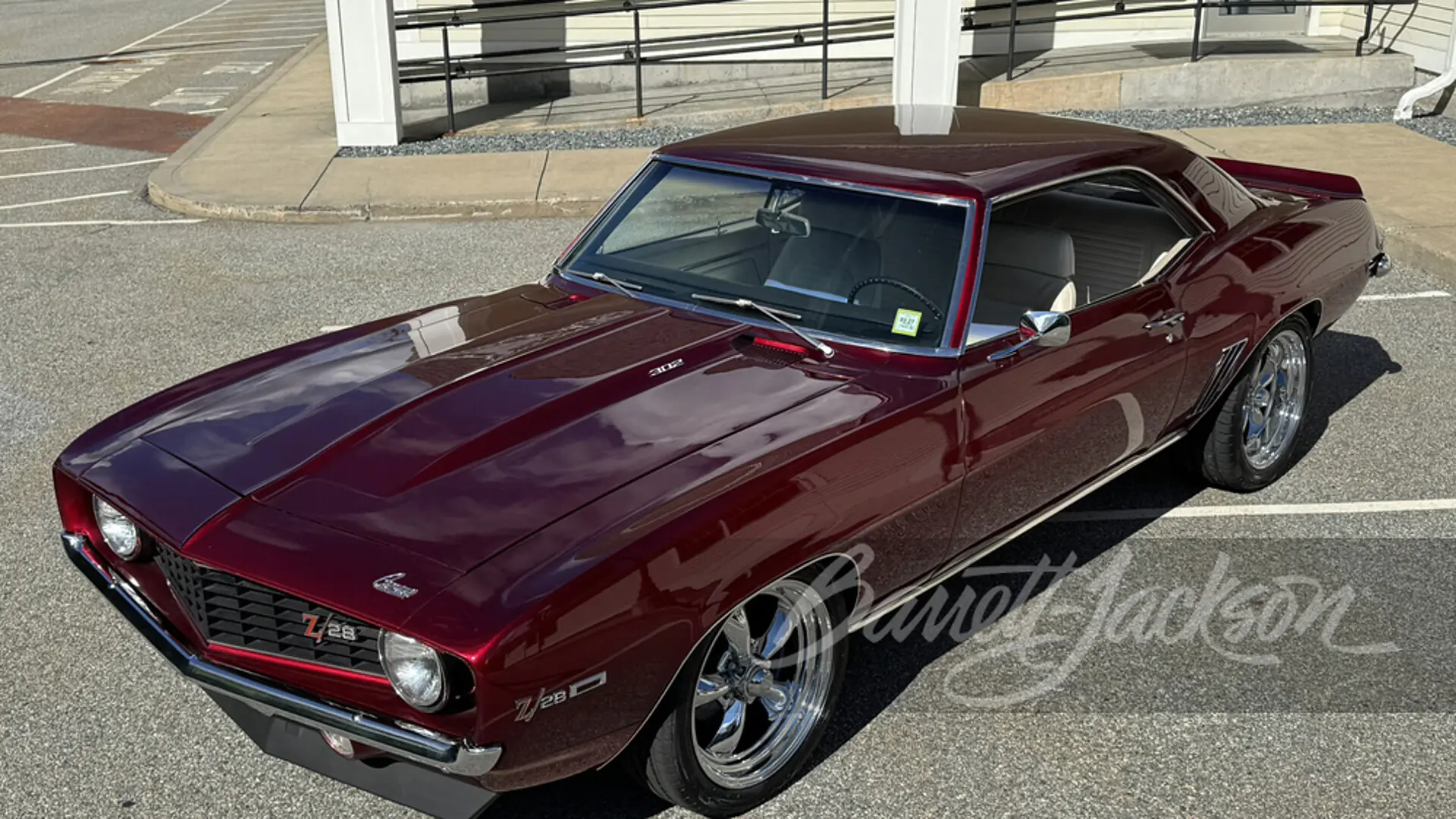
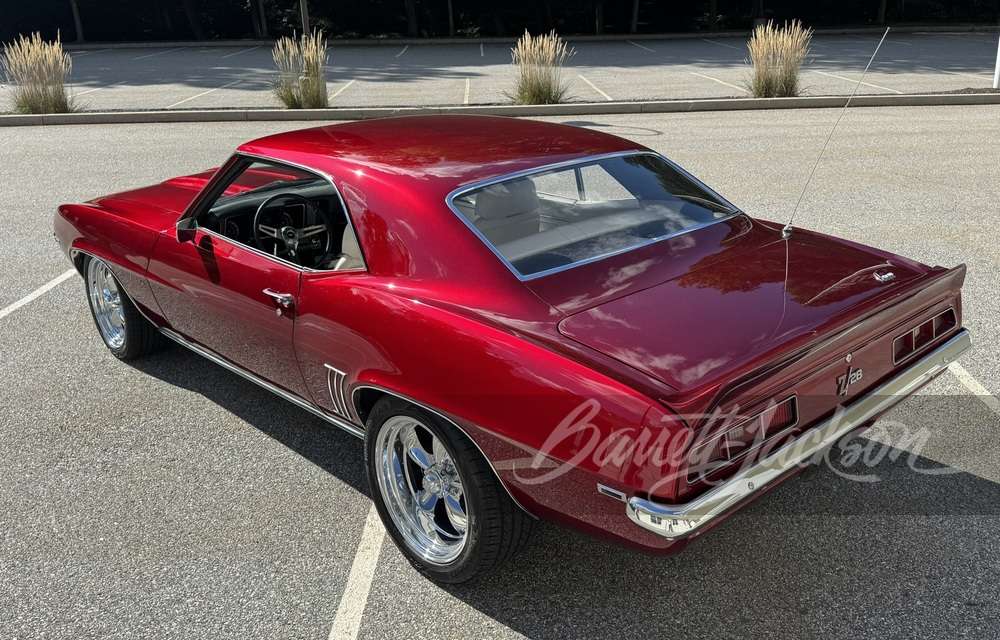
Lot 683 at Barrett-Jackson’s 2026 Las Vegas auction was, by the auction house’s own description, a custom car. A 1969 Chevrolet Camaro Z/28 refinished in House of Kolor Candy Apple Red, lowered, riding on 18-inch chrome American Racing wheels and powered by a “performance-built small-block V-8” rather than anything Chevrolet’s order guide would recognize. It crossed the block at no reserve and sold for $100,100, including buyer’s premium.
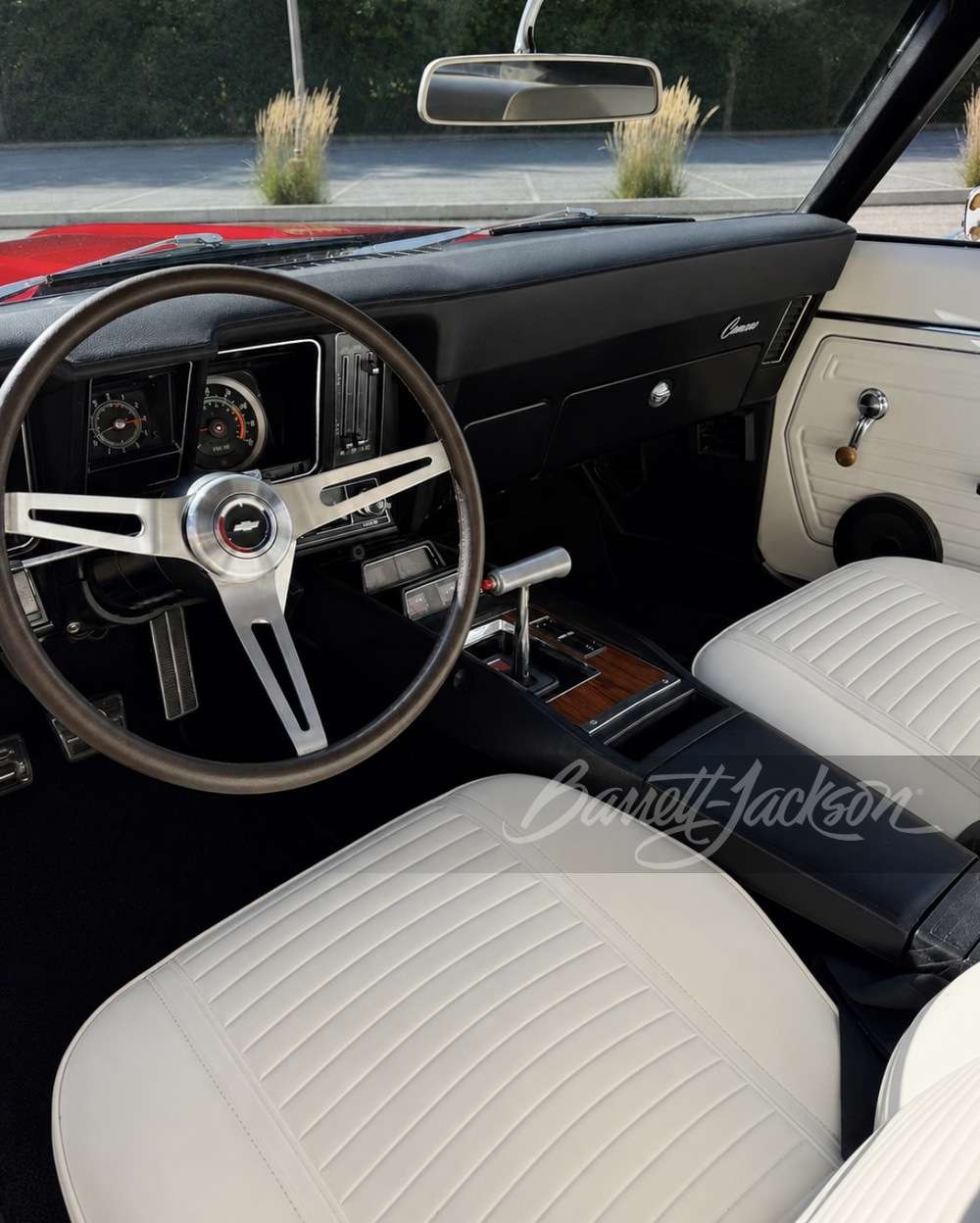
Skim the listing and you would file it under restomod. Read it carefully and a different car emerges. The sheet metal is original. The 12-bolt rear axle is the original BU-code unit. The white interior is original. And the documentation includes the two items that carry more weight in first-generation Camaro circles than almost anything a seller can hand across the table: the original cowl trim tag, coded X33 and D80, and the Protect-O-Plate.
That is the story. A buyer spent six figures on a modified muscle car, and what they were really buying was proof.
Why a 1969 Z/28 Has to Prove Itself
Start with the VIN: 124379N654709. Decoded, it identifies a Chevrolet Camaro (124) V-8 sport coupe (37), 1969 model year (9), assembled in Norwood, Ohio (N). What it does not identify is a Z/28. Nothing in a 1969 Camaro VIN does.
That gap is the root of every Z/28 conversation. Mechanically, the Z/28 was a regular production option, RPO Z28, layered onto an ordinary V-8 coupe. Its most visible signatures, the stripes, the spoilers, the badges, even a 302, are things a competent builder can bolt onto a base car, and over five decades plenty have. The result is a market that treats any Z/28 claim as exactly that, a claim, until something independent of the car’s current appearance corroborates it.
The cowl tag is that corroboration. On 1969 Norwood cars, the Fisher Body trim tag carried an X-code describing the car’s trim content, and X33 denotes a Z/28 equipped with the Style Trim group. D80 confirms factory front and rear spoilers. The Protect-O-Plate, the embossed metal warranty plate issued with every new Chevrolet, was stamped with the VIN and codes for the original engine, transmission and rear axle. It is the closest thing a muscle car has to a birth certificate, and unlike a factory file, it traveled with the car.
Add an original BU-code 12-bolt, a 3.73:1 Positraction unit, and you have a chain of evidence. No single link is decisive. Together, they are the reason this car was catalogued as a Z/28 at all, and the reason it brought Z/28 money in custom clothes.
What the Z/28 Was, and Why It Still Matters
The Z/28 exists because of a rulebook. The SCCA’s Trans-Am series capped displacement at 305 cubic inches, and Chevrolet’s answer was the DZ 302: a four-inch-bore small-block paired with the three-inch-stroke crankshaft from the 283. It was rated at 290 horsepower, a number nobody who drove one took seriously, and it was sold through Chevrolet showrooms so the Camaro could go road racing. (For the car’s origins, see our look at the 1967 Camaro’s debut.)
It worked. Roger Penske’s Sunoco Camaros, with Mark Donohue driving, delivered Chevrolet the Trans-Am championship in 1968 and again in 1969. Production followed the results: 602 Z/28s in 1967, 7,199 in 1968 and 20,302 in 1969.
That last figure deserves a pause. Twenty thousand cars is not scarcity. The 1969 Z/28 is not a blue-chip muscle car because there are few of them; it is one because it is the most complete expression of the first-generation Camaro’s motorsport purpose, built in the year that purpose paid off on track. Collectors rarely pay for horsepower. They pay for a racing story they can verify, and verification is exactly what this car’s paperwork supplies.
What Was Changed, and What Was Kept
The modifications are real. The paint is not a factory color. The suspension has been lowered, the wheels are modern and, most consequentially, the engine is described as a performance-built small-block. Barrett-Jackson’s description does not claim the original DZ 302 survives, and a serious buyer should assume it does not until shown otherwise. This is not a matching-numbers car, and nobody should price it as one.
But look at the pattern of what survived. Original sheet metal means no replacement quarter panels, no transplanted cowl, none of the surgery that invites questions about a car’s identity. The original axle stayed under it. The original interior stayed in it. The trim tag and the Protect-O-Plate stayed with it.
Whoever built this Camaro changed the things that can be changed back and left alone the things that cannot be replaced. Paint can be redone in the factory code. Wheels and suspension are bolt-on work. A correct, date-appropriate DZ 302 is expensive and takes patience to find, but it can be found. Original Norwood steel and original documentation, once lost, are gone for good.
An engine can be sourced. A birth certificate cannot. In the first-generation Camaro market, the most valuable component on a car is often a small stamped plate riveted to the cowl.
Reading the Result
It would be easy to read $100,100 as evidence that the market has embraced customized first-generation Z/28s. That is the wrong conclusion. The better reading is that the market priced a documented Z/28 identity, then adjusted for the work and expense required to take the car back toward factory specification, or, for a different kind of buyer, paid for a usable Z/28 whose pedigree is not in dispute.
That dual appeal is the overlooked detail. This car has two natural owners: the enthusiast who wants a real Z/28 to drive without the anxiety of using a concours car, and the long-term collector who sees a restoration candidate with its hardest-to-replace elements intact. Two buyer pools means liquidity, and at no reserve, liquidity is what sets the price. A Z/28 conversion with the same paint, wheels and engine would have had neither audience.
The contrast with another Camaro from the same Las Vegas sale is instructive. A late-model Camaro ZL1 Collector’s Edition brought $125,400 on the strength of manufactured scarcity and a factory-issued paperwork kit. This 1969 car earned its number with paperwork that was never meant to be collectible, which is precisely why it is trusted. We made a similar argument about a documented 440 Superbird earlier this week, and in our recent market brief on what paperwork is worth. The muscle-car market has quietly become a documentation market.
What a Serious Buyer Should Verify
Documentation only creates value if it is authentic, and reproduction trim tags and Protect-O-Plates exist. Before paying Z/28 money for any first-generation car, original or modified, the checklist is consistent:
- The trim tag. Have a first-generation specialist inspect the tag itself, its attachment to the cowl and whether its body number, paint, trim and option codes are consistent with a 1969 Norwood car.
- The Protect-O-Plate. Confirm the stamped VIN matches the car, then decode the engine and transmission codes. They record what left the factory and define what a correct restoration would require.
- The axle. Check that the BU 12-bolt’s date and assembly codes make sense against the car’s build date.
- The original color. The trim tag records the factory paint code. It tells a future owner what the car should be refinished in, and whether the original combination adds or subtracts desirability.
- The engine. Ask for the build specification, parts list and any dyno results, and ask whether any original drivetrain components accompany the car.
- The sheet metal. “Original sheet metal” is a meaningful claim on a 57-year-old unibody. Have it confirmed on a lift, not in a catalog.
The Larger Lesson
The custom-car market and the collector-car market are usually discussed as if they were separate worlds. This Camaro sits on the border between them, and it shows where the border actually lies. Modification by itself does not destroy value. Losing the ability to prove what a car was does.
The builder of this Z/28 seems to have understood that. The next owner can decide what this car should become, a driver, a restoration, or something in between. The owners before them made sure it never lost the ability to prove what it was.
Lead image: Barrett-Jackson
The collector car market, every weekday morning.
Auction results, price moves and what’s crossing the block, read in four minutes. Free, from Modern Car Collector.
No spam, unsubscribe in one click. Or read more about the Brief.
Related Posts:
- The Complete Guide to the Yenko Camaro
- Record Ferraris, Rare Icons and 15,000 RPM: The Week…

- This 383-Stroker 1969 Camaro Convertible Is Built to…
- 1969 Chevrolet Camaro Z/28 For Sale From GAA Classic…
- The Collector Car Market Paid Up for Certainty This…

- A 1969 Corvette L88 Convertible Is at $160,000. The…
 EL Puckett