

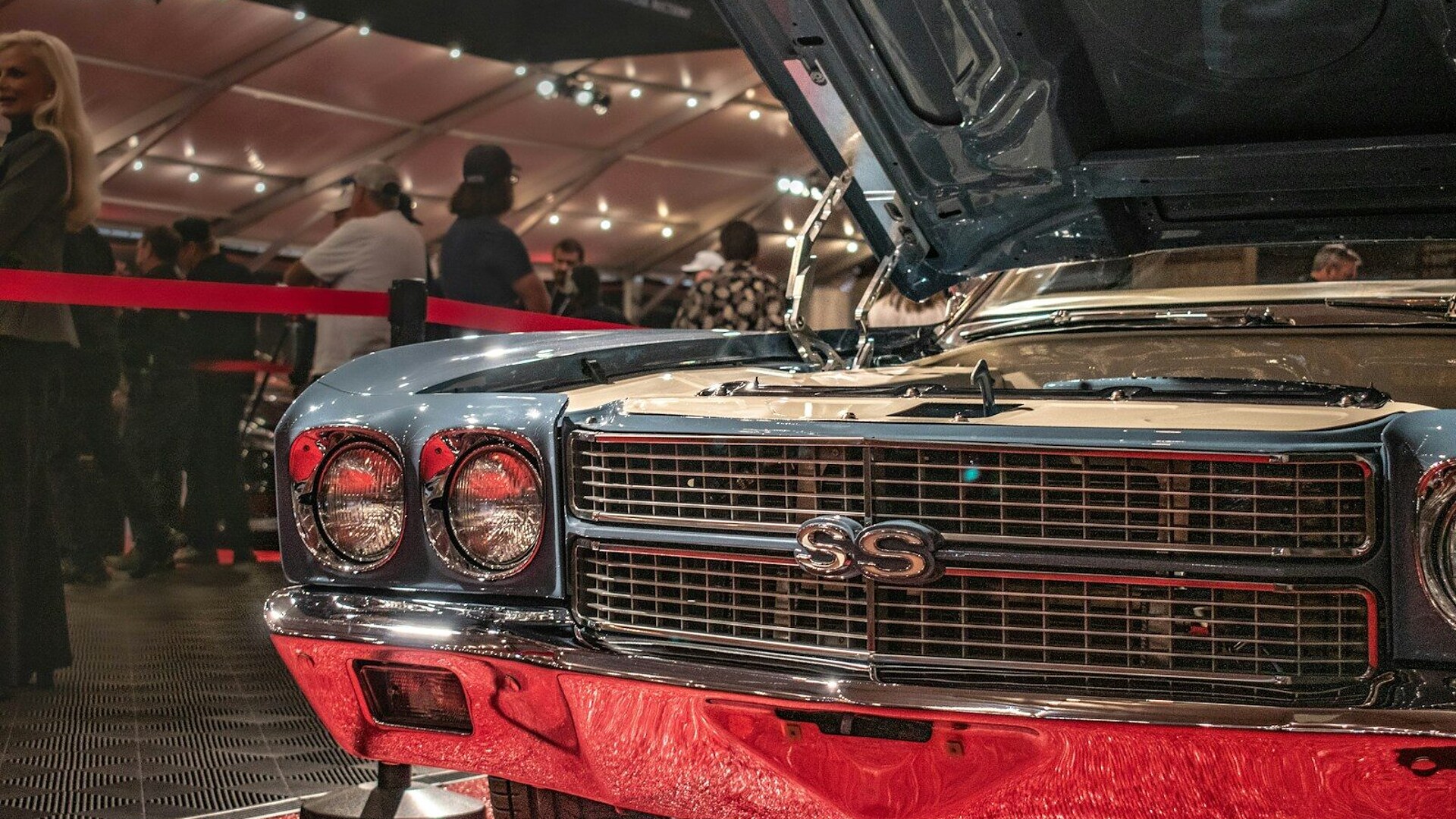
Barrett-Jackson’s return to Las Vegas this past weekend produced the numbers that travel well: nearly $36 million in three days, a $968,000 Ford GT, and UFC CEO Dana White placing a $1.5 million winning bid on a pair of charity Ram pickups on the twenty-fifth anniversary of September 11th. Those are the figures that will show up in headlines everywhere. They are not, however, the story that matters most to serious collectors.
Strip away the leaderboard and a more revealing pattern comes into view. Among the ten highest sales of the weekend, not a single vehicle was a factory-original, unmodified classic with documented history. The list was built almost entirely from restomods, licensed continuation builds, and modern supercars: a widebody Shelby GT500KR, a custom split-window Corvette, a licensed “Eleanor” tribute Mustang, and a one-off custom GMC Jimmy once owned by singer-songwriter Edie Brickell. These are well-executed, desirable machines. They are not, by any traditional definition, blue-chip collector cars. That distinction is not a criticism of Las Vegas. It is a clue to what the Las Vegas Auction actually is, and why collectors should read its results differently than they read Scottsdale’s.
The Top Ten Is a Mirror, Not a Market
Barrett-Jackson runs four flagship live auctions a year, and each has developed its own personality. Scottsdale, held every January at WestWorld, remains the company’s blue-chip proving ground, the venue where its Scottsdale Fall Auction generated more than $56.6 million and where seven-figure Duesenbergs, factory Hemi ‘Cudas, and documented low-mileage originals routinely headline the docket. Las Vegas is a different animal. Staged inside the Las Vegas Convention Center during a weekend built around nightlife, celebrity sightings, and a charity spectacle, it rewards personality over paperwork. That is precisely why a licensed continuation Mustang can out-earn a genuine survivor car in Nevada, the same dynamic that recently produced a $550,000 result for a tribute build at Barrett-Jackson’s inaugural Columbus auction. Collectors who mistake a Las Vegas sales chart for a barometer of the broader market are measuring the wrong thing. Vegas measures appetite for theater. Scottsdale measures appetite for history.
The Ford GT Is the Exception That Explains the Rule
The one genuine outlier atop the Las Vegas chart was the $968,000 sale of a 2019 Ford GT Lightweight Carbon Series, and it earned its place for reasons that have nothing to do with restomod culture. Ford built the second-generation GT for only six model years, from 2017 through 2022, in numbers deliberately kept in the low thousands worldwide. The Lightweight Carbon Series pushed exclusivity further still, stripping weight and adding visible carbon-fiber bodywork to a car already essentially hand-assembled by Multimatic in Canada. A car like this doesn’t need forty years of hindsight to qualify as a collector piece; its production numbers and engineering pedigree did that work at birth. It’s the same dynamic that has been pushing modern GT values upward across the market, including a record-setting Ford GT result at GAA Classic Cars’ July sale earlier this year. The lesson for buyers is straightforward: scarcity created by design, not scarcity created by neglect or survival, is what gives a modern supercar staying power.
Dana White’s $1.5 Million Wasn’t a Market Signal
The auction’s most emotional moment, White’s winning bid on a first-retail-production 2027 Ram 1500 Rumble Bee SRT and a 2005 Dodge Ram 1500 SRT-10 sold together with all fees waived, belongs in a different ledger entirely. With the full hammer price split between the Folds of Honor Foundation and the UFC Foundation, this was philanthropy staged as theater, not a data point about what two trucks are worth. Barrett-Jackson has built a genuine specialty in this kind of charity moment, and it works precisely because everyone in the arena understands the bid isn’t about resale value. Collectors reading auction results for market signal should set charity lots aside entirely; folding them into average or top-sale figures distorts the picture of where real demand sits.
The Two Most Significant Cars in the Building Weren’t for Sale
The cars that actually mattered to history in Las Vegas never crossed the block. A 1951 Cadillac Series 62 Royal Parade convertible, built at the factory for a young Princess Elizabeth’s tour of Canada months before she became Queen Elizabeth II, sat on display: genuine royal provenance, the kind no restomod or continuation build can manufacture. So did a 2006 Maybach 57, Elizabeth Taylor’s last car, willed to stylist Jose Eber and driven only 7,200 miles since her death. Both are headed to Barrett-Jackson’s January 2027 Scottsdale Auction rather than the block in Las Vegas, and that routing decision tells collectors something important: the company itself treats Scottsdale as the venue where documented, historically significant cars are tested against serious money. Las Vegas was the warm-up act for cars like these, not their stage.
What This Means for Collectors
None of this makes the Las Vegas Auction any less successful on its own terms. Close to $36 million changing hands, the second-best automobilia result in company history, and a charity bid that pushed Barrett-Jackson’s lifetime philanthropic total past $173 million are all real achievements. But collectors who read this auction as a snapshot of where the broader market stands should look past the top-line number. Originality and documentation didn’t win the weekend in Las Vegas; charisma did. That’s a fine outcome for an entertainment-driven event built around a nightclub reception and a fan zone. It’s the wrong lens for judging what a car is actually worth. For a useful comparison of how heritage names get valued when customization enters the picture, see our recent look at the Jensen Interceptor GTX.
The real test of this season’s inventory comes in January, when the Princess’s Cadillac and Elizabeth Taylor’s Maybach finally cross the block at WestWorld, in front of buyers who show up to bid on paperwork, not just personality. Watch that result closely. It will tell you far more about the health of the collector market than any number generated on the Strip.
The collector car market, every weekday morning.
Auction results, price moves and what’s crossing the block, read in four minutes. Free, from Modern Car Collector.
No spam, unsubscribe in one click. Or read more about the Brief.




 Kyle Matthews