

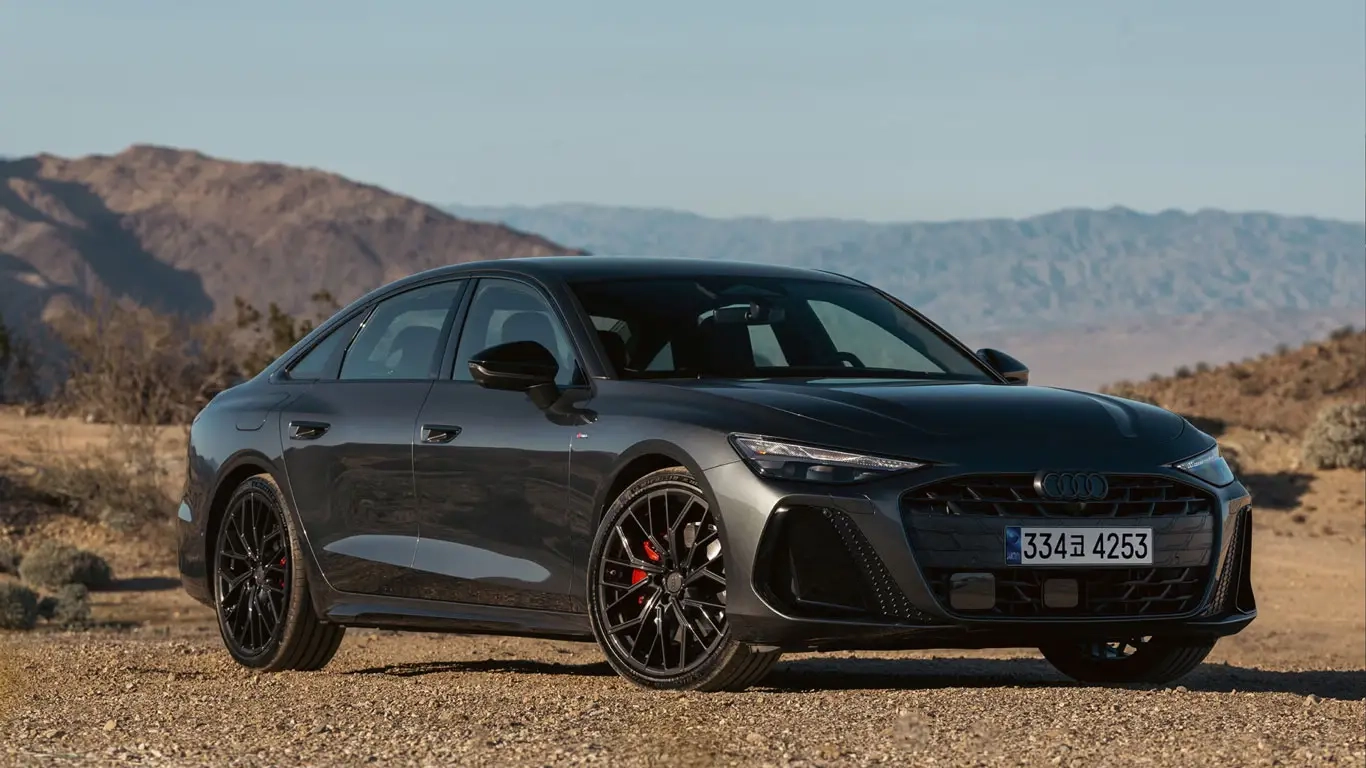
Audi’s Korean division has capped a new appearance package for the A6 sedan at exactly 100 units, and predictably, the number is doing most of the talking. It always does. Whenever a manufacturer attaches a hard production cap to anything, that figure becomes the headline, the marketing hook, and often the presumed proof of future collectibility. But rarity is not the same as significance, and there is a real, demonstrable difference between a car that is hard to get today and a car that will still matter in twenty years.
The A6 45 TFSI quattro S line Black Edition, offered exclusively in South Korea, applies a comprehensive black-out treatment to the standard A6 sedan: darkened mirror caps, window surrounds, badging, and exhaust outlets, joined by 21-inch Audi Sport wheels and red brake calipers. Inside, Audi carries over its current digital cockpit, a 14.5-inch center display, a dedicated passenger screen, carbon-fiber trim, and a Bang & Olufsen sound system. Mechanically, the package rides on the existing A6 45 TFSI quattro largely unchanged: a 2.0-liter turbocharged four making 272 horsepower and roughly 400 Nm of torque, a seven-speed dual-clutch transmission, quattro all-wheel drive, and rear-wheel steering. Zero to 100 km/h arrives in 6.2 seconds. None of that is slow. None of it is remarkable, either, by 2026 standards for a mid-size luxury sedan.
That context matters more than the styling. This isn’t a homologation special built to satisfy a racing series, and it isn’t a send-off for a discontinued platform. It’s an appearance package, priced at 94.9 million won, or roughly $68,000, built for a single national market where Audi competes hard against Mercedes-Benz and BMW for status-conscious buyers. A hard cap of 100 cars isn’t a supply constraint dictated by engineering or materials; it’s a marketing decision, a way to generate dealer waiting lists and press coverage for what is otherwise a trim option. Regional exclusives like this exist to move metal in a specific, competitive market, not to create the next blue-chip Audi.
What Real Audi Collectibility Looks Like
Compare that to what real Audi collectibility looks like. Audi Sport recently began selling its historic LMP and DTM race cars to private collectors in drivable condition, and the appeal there has nothing to do with a printed production number. It comes from matching chassis histories, works-team results, and machinery that shaped the brand’s motorsport identity. That is provenance a specialist can document down to the chassis plate. A blacked-out A6 with red calipers carries none of that; it shares its structure, powertrain, and market position with thousands of other A6s built the same year.
That distinction extends well beyond Audi. Genuinely collectible limited runs tend to earn their status through a paper trail rather than a press release: build sheets, factory documentation, and a connection to a person or program collectors already care about, the same argument we made about tribute cars like the GMMG Dick Harrell Camaro. A production run of 100 means nothing on its own; it only becomes meaningful once collectors have a reason to compete for those specific 100 cars decades later.
The Warning Signs at Auction
Recent auction results are instructive here too. A 3,062-mile Ford F-250 Harley-Davidson Edition failed to find a buyer at no reserve, twice, despite carrying a recognizable co-branding partner and remarkably low mileage. Badge-driven editions without a deeper story routinely underperform expectations once the initial press cycle fades. A regional Audi appearance package, sold only through one country’s dealer network, with no motorsport tie and no design-language milestone attached, fits that pattern far more comfortably than it fits the profile of cars that later show up at Monterey.
What Actually Moves the Market
None of this means the A6 Black Edition is a bad car, or even a bad purchase for someone who wants three years of blacked-out styling in Seoul traffic. It simply means the production number shouldn’t be mistaken for a market signal. As we noted in our latest collector car market brief, value inside a model line is increasingly decided by originality, documentation, and specific configuration, not by whichever number appears on a manufacturer’s press release. Genuine scarcity moves markets. Manufactured scarcity mostly moves showroom traffic.
Collectors have learned to tell the two apart, even if marketing departments haven’t caught up. A production cap tells you how many were built. It has never once told you how many will still matter.
For buyers who simply like the car for what it is, that’s reason enough to order one. For anyone shopping with one eye on the collector market twenty years from now, the more useful question isn’t how many were built. It’s whether Audi, or anyone else, gave this particular car a reason to be remembered.
The collector car market, every weekday morning.
Auction results, price moves and what’s crossing the block, read in four minutes. Free, from Modern Car Collector.
No spam, unsubscribe in one click. Or read more about the Brief.
Related Posts:
- Is the Audi RS 3 Competition Limited a Future Collector Car?

- The Complete Guide to the Yenko Camaro
- The Name Is the Story: Audi's Nuvolari Arrives in America

- BMW’s 100 Jahre Nürburgring Edition Is an Appearance…

- Is the BMW Z4 Final Edition a Future Collector Car?

- Acura's Zanardi Edition NSX Was Always a Tribute.…

 Eve Nowell