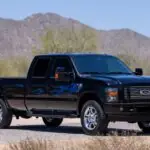

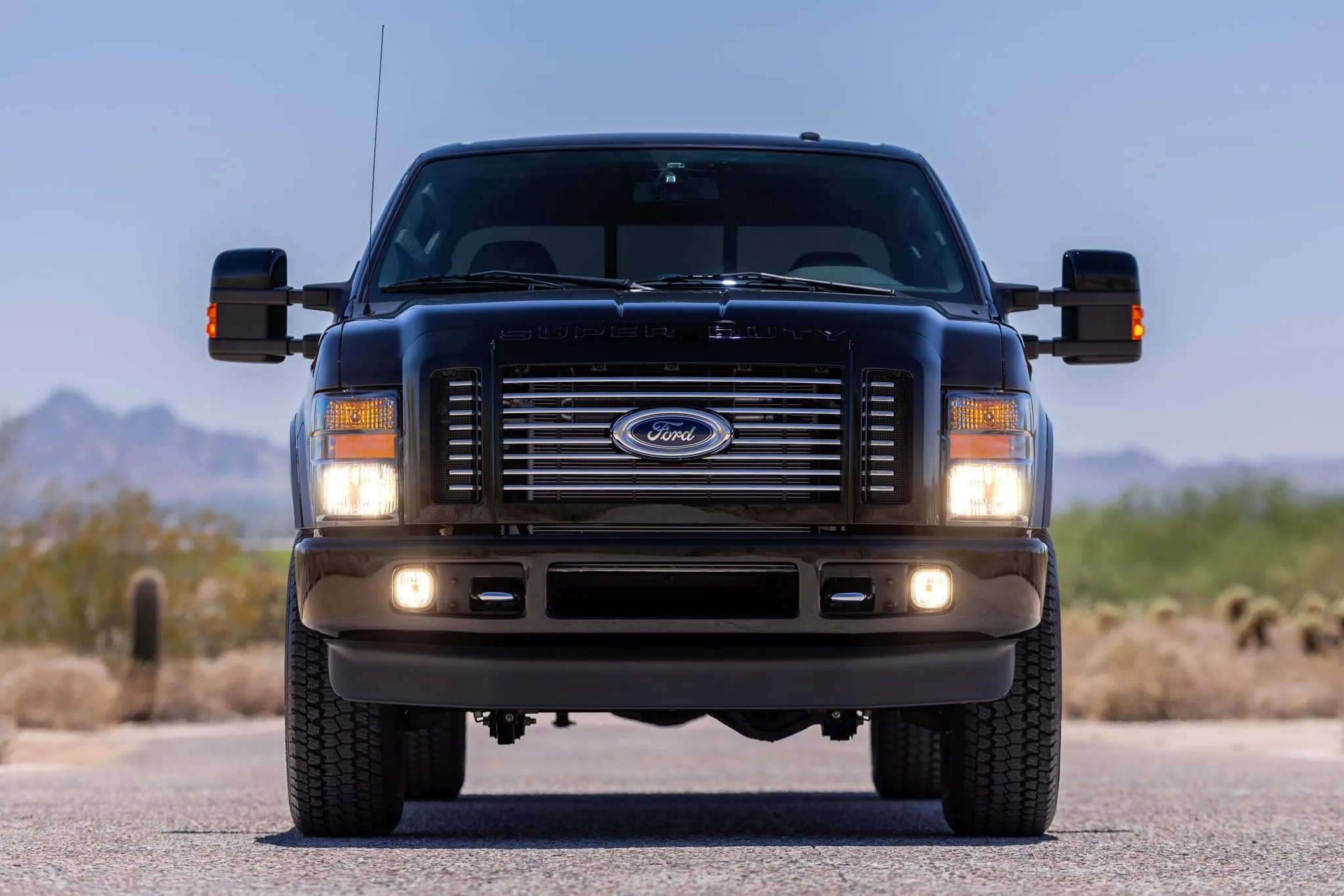
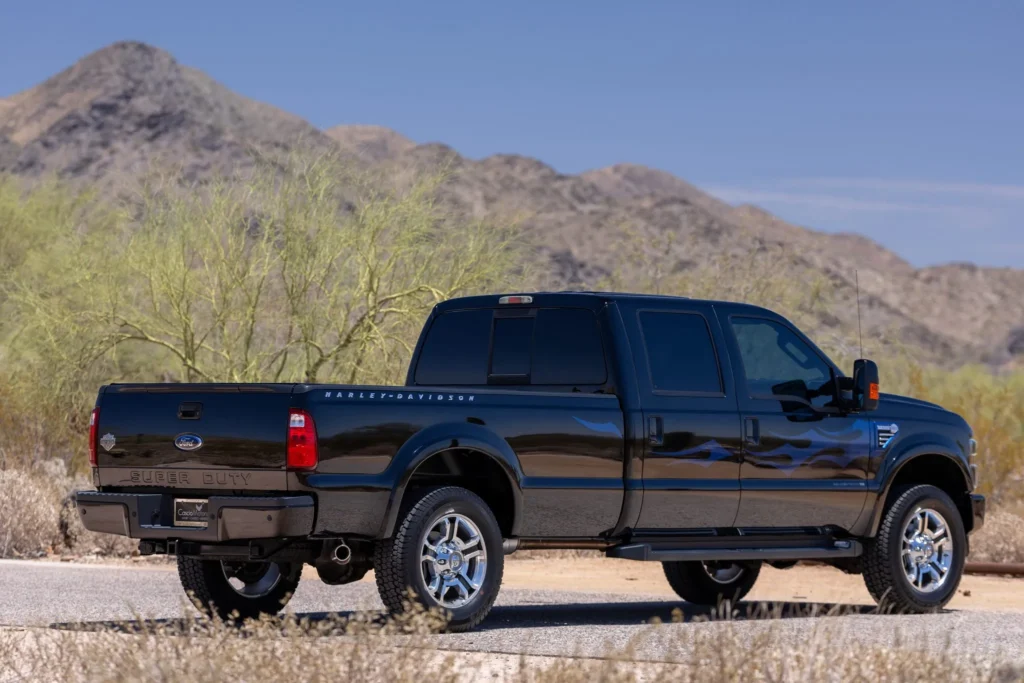
On paper, a Harley-Davidson Edition Super Duty sounds like exactly the kind of factory novelty that ages badly: a marketing tie-in from the early 2000s, stitched logos on the seats, a flame graphic down the flank, built for buyers who wanted their truck to match their motorcycle. That reputation isn’t entirely wrong, and it’s exactly why the example currently crossing the block on Bring a Trailer deserves a longer look. This 2009 F-250 Super Duty Lariat Crew Cab has covered 3,062 miles in seventeen years, has never left the ownership of the family that special-ordered it and the single dealer that took it in trade, and carries the kind of factory paperwork most modern trucks shed within a decade. It is about as close to new as a Harley-Davidson Super Duty gets. That it is selling at no reserve for a second time, after an earlier buyer failed to close, tells us far more about the mechanics of online auctions than it does about the truck itself.
Ford’s alliance with Harley-Davidson Motor Company began on the F-150 in 2000 and expanded to the Super Duty line by mid-decade, running alongside the standard Lariat and King Ranch trims until Ford redirected its performance-truck ambitions toward the SVT Raptor at the end of the 2000s. The Harley package was never a dealer-installed appearance kit. It was an engineered factory option, developed with Harley-Davidson’s design input and backed by Ford’s own warranty, built in numbered runs rather than open-ended production. That distinction matters more now than it did when these trucks were new. A generation removed from daily use, the Harley-Davidson Super Duty reads less like a marketing gimmick and more like a documented, limited-production variant of a truck Ford otherwise built by the hundreds of thousands — the same logic that has turned appearance-package muscle cars of the same era into legitimate collector vehicles.
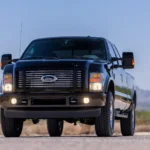
This particular truck left The Ford Store of Morgan Hill, California, with more than $12,000 in factory options stacked on top of its Lariat equipment, pushing the window sticker to $53,615. Black Clearcoat paint with Vista Blue flame graphics, illuminated running boards, power-adjustable pedals, and Ebony leather trimmed in Harley-Davidson’s Bar and Shield motif arrived bundled in the Alliance Package, and a console badge identifies this truck as number 127 in that model year’s production run. Under the hood is Ford’s 6.8-liter Triton V10 — 362 horsepower, 457 lb-ft of torque — paired with a five-speed automatic, an electronic shift-on-the-fly transfer case, and a 4.10 limited-slip rear axle. None of that is exotic machinery. What is unusual is how little of it has actually been used.
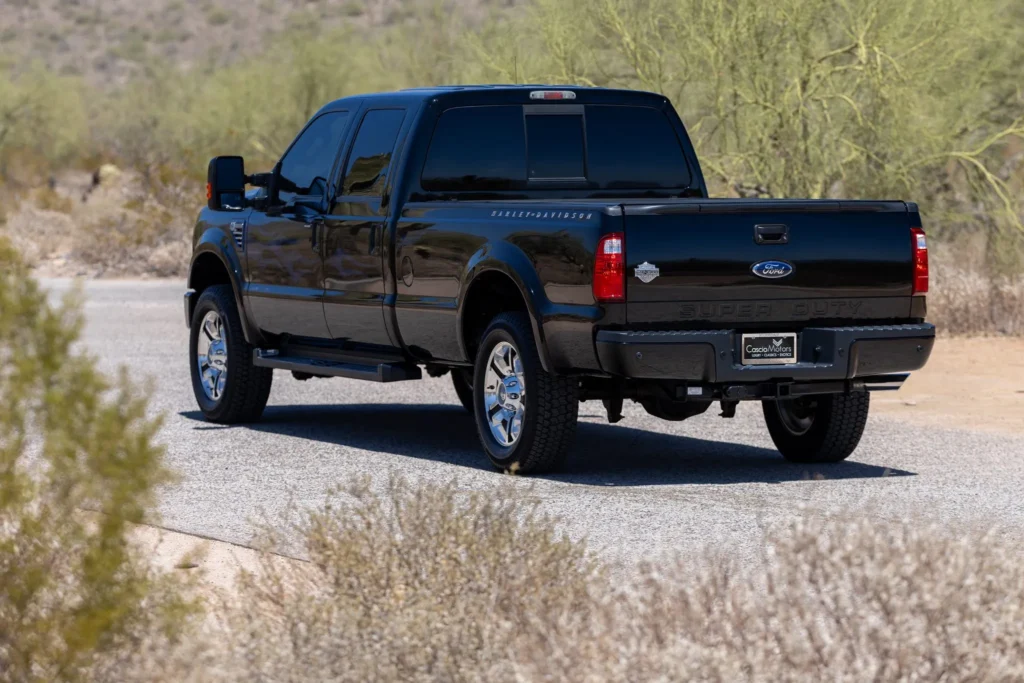
Collectors have learned, often expensively, that low mileage alone doesn’t make a modern vehicle significant. What makes a truck like this worth serious attention is the paper trail behind the odometer: the original window sticker, the owner’s manual, a Carfax report showing two owners and no accident history, and service records that track a vehicle that was maintained rather than simply parked. A ceramic coating applied in 2021 and an oil change performed ahead of this sale both point to a truck that has been prepared for use, not preserved behind glass. That combination of ultra-low mileage and continuous, documented care is far rarer than low mileage by itself, and it is the difference between a vehicle that has survived and one that has merely sat.
We first covered this F-250 when it crossed the block at no reserve carrying a single-family ownership history and a heavily optioned build sheet. Weeks later, we followed up when it resurfaced under a fresh listing, the result of a winning bidder who failed to complete the original purchase — a default that Bring a Trailer’s own listing notes had nothing to do with the truck itself, and one that cost that bidder their platform standing and their buyer’s premium. No-reserve auctions are built to find a genuine market price, but they carry a structural risk that has nothing to do with the vehicle under the hood: a winning bid is only as good as the winning bidder behind it. For serious buyers, that risk has cut in their favor. It has kept a well-documented, single-family truck in play at a bid that, with one day remaining, sits at $21,000 — a fraction of its as-optioned sticker price, and a legitimate reading of where the market currently prices a low-mile, factory-collaboration Super Duty.
Modern trucks remain a young collector category, and the market is still sorting out which variants will matter in twenty years. Performance-driven specials like the Hennessey VelociRaptor 600 have found buyers on horsepower and tuner provenance; the Harley-Davidson Super Duty makes its case differently, on factory collaboration and originality rather than outright capability. Buyers weighing either should apply the same discipline collectors bring to any low-mile modern classic: match the VIN and build sheet against the window sticker, confirm that paint and graphics are original rather than resprayed — flame graphics are a common repaint target on tired examples — and treat service continuity, not the odometer reading alone, as the real measure of preservation.
The Harley-Davidson Super Duty was never going to be cross-referenced against a Ferrari or a Porsche in a serious collection, and it doesn’t need to be. Collector value has never required a vehicle to be exotic, only honest about what it is and unusually complete in how it survived. This F-250 is both. Whoever wins it when bidding closes will not be buying a truck that failed to sell twice. They will be buying a rare case of a modern factory special that time, rather than a showroom, forgot to use up.
The collector car market, every weekday morning.
Auction results, price moves and what’s crossing the block, read in four minutes. Free, from Modern Car Collector.
No spam, unsubscribe in one click. Or read more about the Brief.