

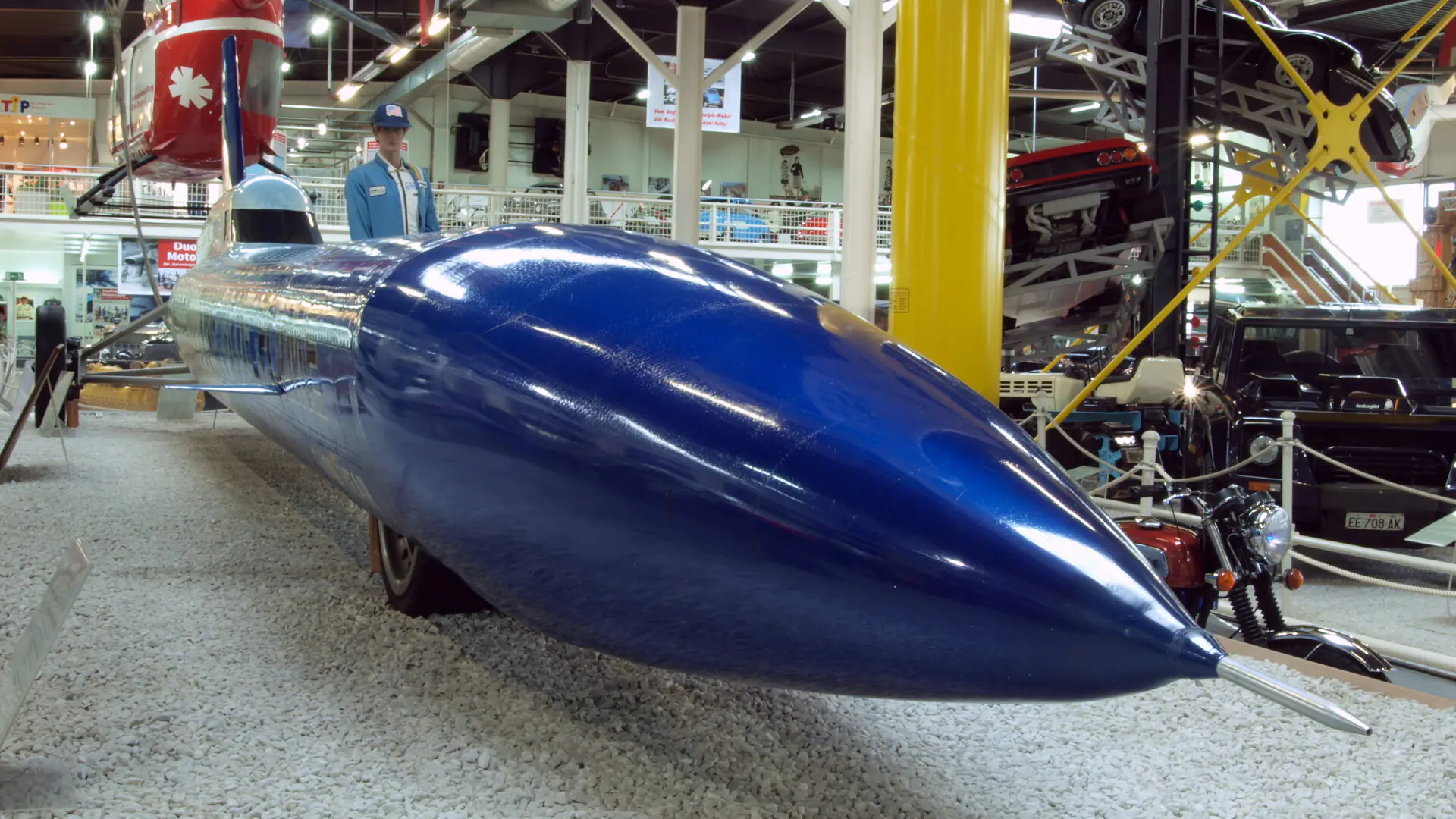
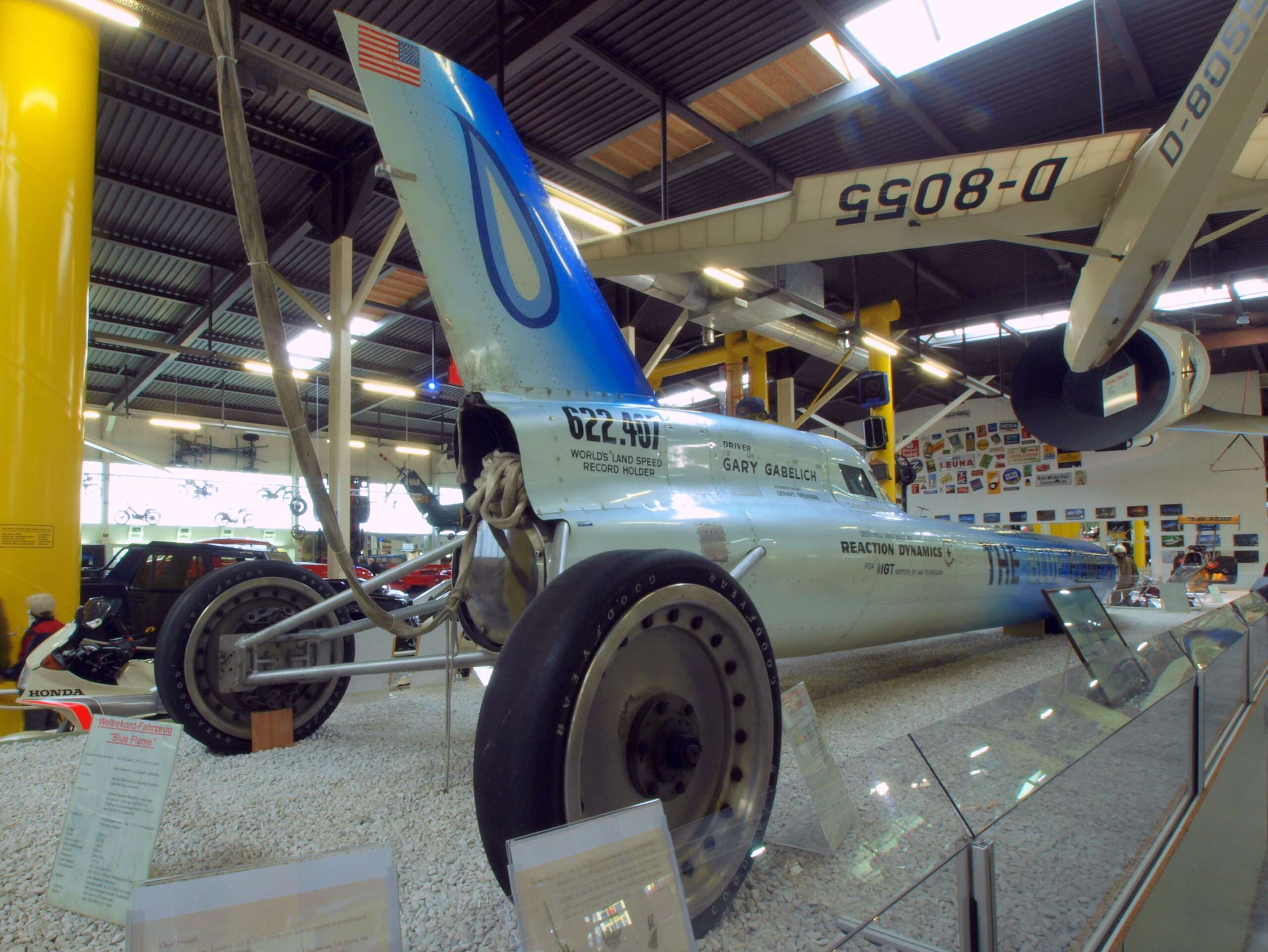
On October 23, 1970, on the Bonneville Salt Flats in Utah, Gary Gabelich drove the Blue Flame rocket car through the measured mile at an average of 622.407 mph (1,001.667 km/h), the first FIA mile record above 1,000 km/h. Nobody went faster over a mile for thirteen years. The machine that did it was not a manufacturer’s halo project or a hot rod anyone could buy. It was a 38-foot rocket on wheels, burning liquefied natural gas, and it was paid for by the gas industry.
That origin is the point of the story. Blue Flame is one of the most important performance vehicles ever built, and it sits almost entirely outside the collector market. What it teaches collectors is how historical significance, documentation and preservation work when there is no auction block to set a price.
Three Milwaukee Enthusiasts and a Gas-Industry Sponsor
Blue Flame was built by Reaction Dynamics, a Milwaukee company formed by Pete Farnsworth, Ray Dausman and Dick Keller. The trio had already built the X-1, a rocket dragster that ran in 1967 and 1968 on a small liquefied natural gas motor, according to the American Oil & Gas Historical Society. The X-1’s publicity value persuaded American Gas Association executives to sponsor a land speed attempt, with technical help from the Institute of Gas Technology. Illinois Tech faculty, graduate students and undergraduates contributed to the design, and Goodyear developed the tires.
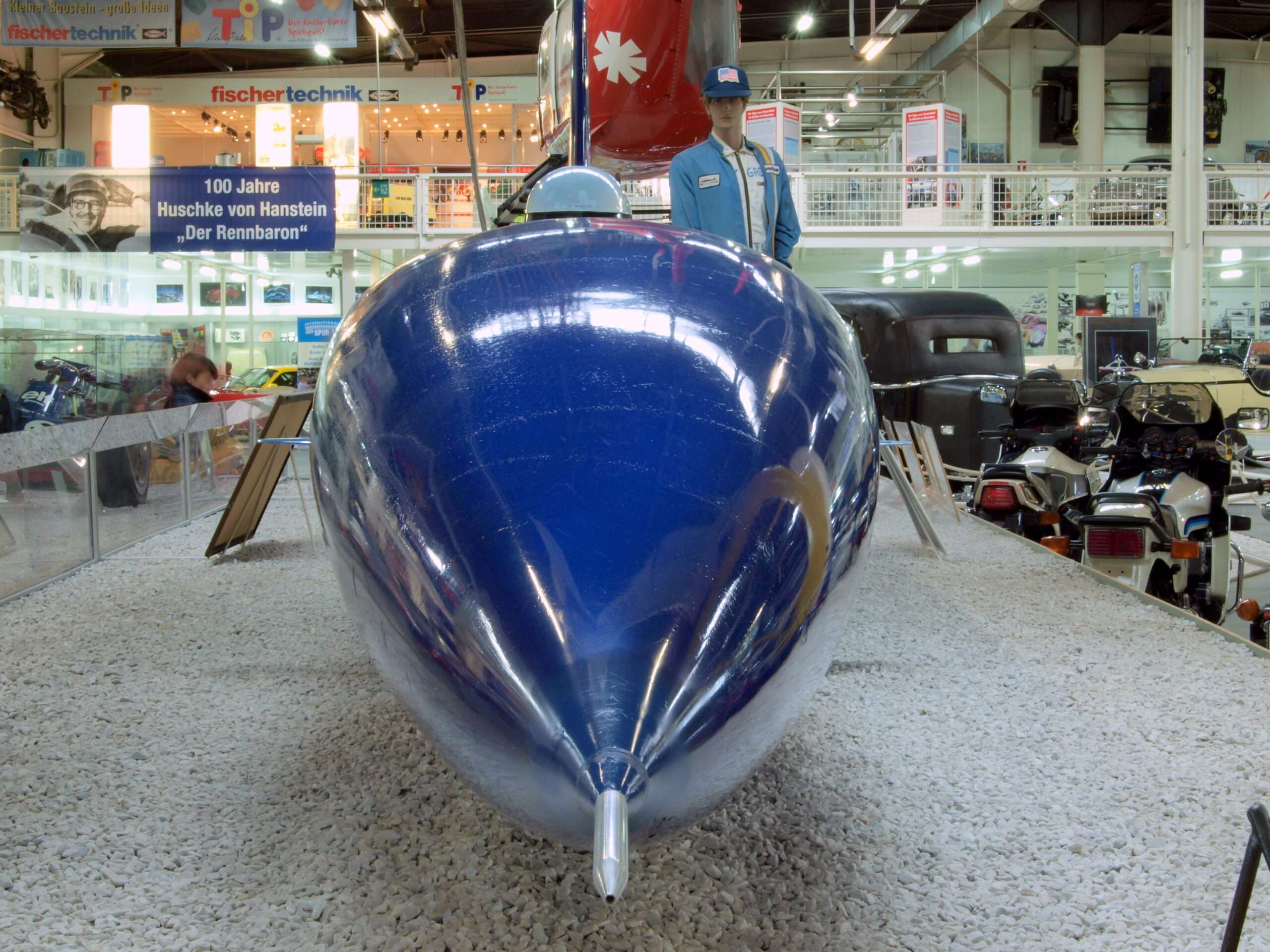
The engine was a regeneratively cooled, variable-thrust rocket that burned liquefied natural gas with hydrogen peroxide as the oxidizer, pressurized by helium. It was rated at 22,500 lbf of thrust, roughly 58,000 horsepower, for about 20 seconds at full output. On the record runs the team used far less, roughly 13,000 to 15,000 lbf. The car was about 38 feet long and weighed roughly 6,500 to 6,600 pounds, depending on the source. The association originally budgeted $165,000; the historical society reports that more than $250,000 was spent.
The Run That Broke 600 mph and Then Some
The target was Craig Breedlove’s Spirit of America – Sonic I, which had set a 600.601 mph record on November 15, 1965, with a General Electric J79 turbojet. Under FIA rules a record requires two runs through the course within one hour, with the speeds averaged. Gabelich’s kilometer record of 630.388 mph was the average of two passes at 629.412 and 631.367 mph. Wikipedia’s account of the car puts its momentary peak near 650 mph, which is a reported figure rather than an FIA-certified one.
Gabelich was a Long Beach, California, driver who worked for about nine years at North American Aviation and set a 200.44 mph quarter-mile drag boat record in 1969. He died in a motorcycle crash on January 26, 1984, at 43. Natural gas was the sponsor’s real product, and Gabelich appeared on television shows, including The Dating Game, to promote it.
Why the Record Mattered
Blue Flame’s kilometer mark stood until Andy Green’s supersonic ThrustSSC run in 1997, and its mile record fell on October 4, 1983, when Richard Noble averaged 633.468 mph in the jet-powered Thrust2 at Black Rock Desert, Nevada. Illinois Tech describes Blue Flame as the last American car and driver to hold the absolute land speed record and the last record set at Bonneville. The Technik Museum Sinsheim notes that the FIA later split records into jet and rocket categories, so Blue Flame still holds a world record in its own category, though no longer the absolute one.
Bonneville had been a record venue for decades before that. If you want the earlier, far more accessible end of that history, see our look at Ab Jenkins and the 1932 Pierce-Arrow Twelve’s Bonneville record run, a production-based car that collectors can still own.
How a Record Car Ended Up in a German Museum
According to the American Oil & Gas Historical Society, American museums declined to take the car in the early 1970s. A private European collector bought it, reportedly for about $10,000, and it eventually reached the Auto & Technik Museum Sinsheim in Germany, where the museum says it has been on display for more than 30 years. Its nose cone, tail fin and record-speed lettering are still on view, and in 2020 Illinois, Wisconsin and Utah marked the 50th anniversary by proclaiming October 23 Blue Flame Day.
Value Context: There Is No Market, and That Is Informative
We found no public auction result, private-sale report or appraisal for Blue Flame, and nothing suggests it is for sale. Treat the roughly $10,000 purchase price as a historical anecdote about how little the car was valued in the 1970s, not as a comparable. A museum-held, one-of-one record vehicle with no sale history cannot be priced from comps, and any figure attached to it today would be speculation.
The market question is therefore indirect. Cars that can trade carry their record and racing history into the price only when documentation and originality support it; for a look at how that plays out when a record-linked car does cross the block, see our analysis of Bugatti’s Legends Veyrons. For the institutional side of preservation, our report on the National Corvette Museum’s new Collections Facility shows how museums are now treating historically important cars as archives rather than showpieces.
What Collectors Should Know
Blue Flame is a reminder that significance and marketability are different qualities. The most historically consequential vehicles are often built for a sponsor, run once or twice and then orphaned, which is why builder records, sponsor paperwork and FIA-certified results matter so much for any record-era car that does come to market. Enthusiasts who want to see this one in person can find it at the Auto & Technik Museum Sinsheim.
A note on the date: October 23, 1970 is the date given by the Technik Museum Sinsheim, Illinois Tech, SEMA, the American Oil & Gas Historical Society and Wikipedia. One enthusiast site’s text gives October 28, but its own data table lists October 23.
Sources: Technik Museum Sinsheim; American Oil & Gas Historical Society; Illinois Tech; SEMA; Wikipedia: Blue Flame, Gary Gabelich, Thrust2.
The collector car market, every weekday morning.
Auction results, price moves and what’s crossing the block, read in four minutes. Free, from Modern Car Collector.
No spam, unsubscribe in one click. Or read more about the Brief.

 Shawn Henry