

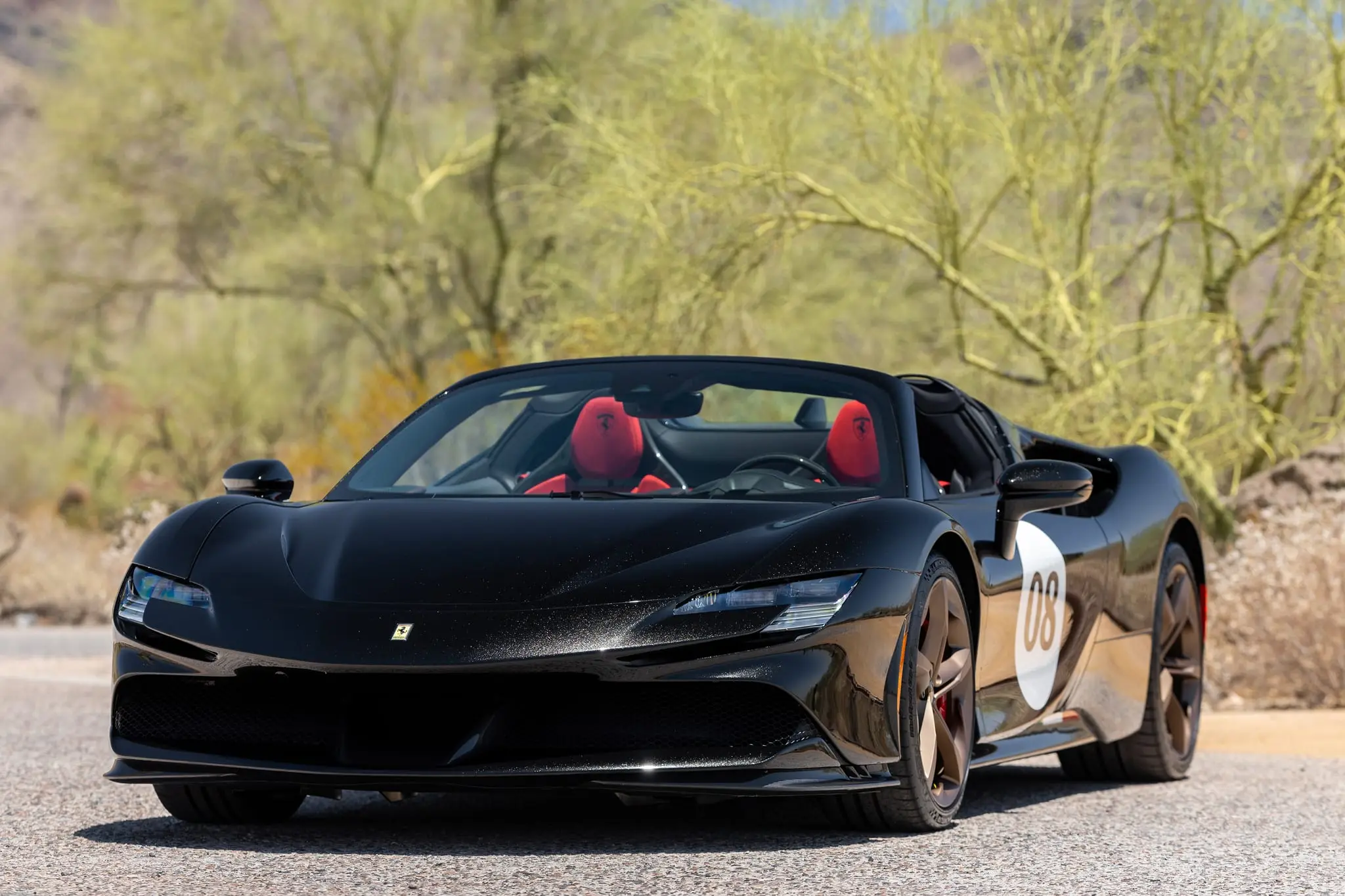
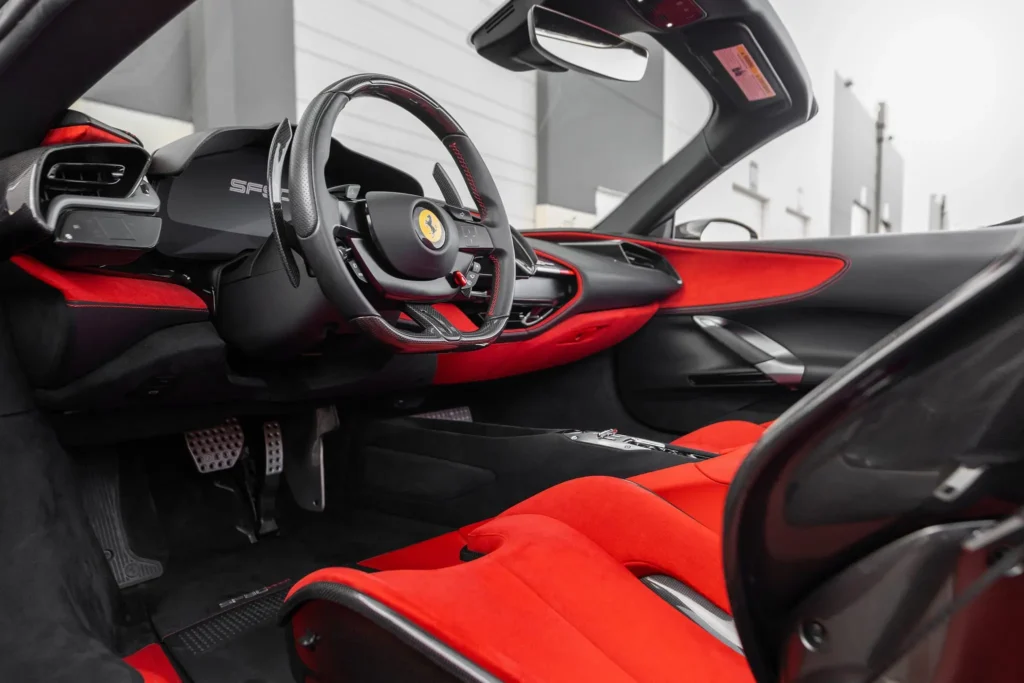
A 2023 Ferrari SF90 Spider currently bidding on Bring a Trailer sits at $460,000 with the auction closing July 28, a figure that will draw plenty of attention on its own. We flagged this listing when bidding opened, and the number has kept climbing since. But the bid isn’t the real story here. The story is a small plaque mounted between the seats, confirming this SF90 was commissioned through Ferrari’s Atelier program, and that single detail changes what this car actually is.
Ferrari’s SF90 line has not been a kind investment for most of the people who bought one. The car deserves better than that reputation, and understanding why requires separating two very different questions: whether the SF90 Spider is a good collector car, and whether an Atelier-commissioned SF90 Spider is.
A Model Line That Hasn’t Been Kind to Its Owners
A nearly new SF90 Spider we covered recently sold at roughly a $125,000 loss with only 185 miles on the odometer, a depreciation rate north of $400 per mile. That is not a performance problem. The SF90 pairs a twin-turbocharged 4.0-liter V8 with three electric motors for a combined 986 horsepower and all-wheel drive, figures that stack up against any hybrid hypercar of its generation. It is a market-structure problem. Ferrari built the SF90 in far greater numbers than true limited-run hypercars like the LaFerrari, and it arrived at a moment when hybrid supercar technology was moving quickly enough that buyers stopped waiting for it to become scarce.
Our recent Market Movers column described today’s collector market as a two-speed system, where the gap between the Blue Chip Index and the broader Hagerty Hundred has widened to more than 27 points. Standard SF90s live in that cooling middle bracket, where ordinary depreciation curves reward liquidity over cachet. An Atelier-commissioned example is the question of whether a single car can be pulled out of that bracket entirely.
What an Atelier Commission Actually Buys
Ferrari has long offered its Tailor Made program, which allows extensive customization within an established menu of colors, materials, and trim. Atelier sits a level above that, functioning as a more exclusive channel that opens up paint, livery, and material combinations well outside the standard configurator, typically for clients with deeper factory relationships. This particular Spider carries roughly $184,000 in factory options against a total suggested retail price of $762,120, and that spending is concentrated almost entirely in the exterior, livery, and craftsmanship decisions Atelier exists to enable.
It helps to see this car alongside others we have covered. An Azzurro Dino Mica Atelier Spider that crossed the block at RM Sotheby’s carried nearly $178,000 in personalization, while a Tailor Made Spider built as a tribute to a 1957 racing chassis carried close to $195,000 in options. Three completely different design languages, landing within a tight band of factory investment. That consistency suggests collectors chasing Atelier and Tailor Made SF90s should judge these commissions by how coherent the design is, not by the dollar figure printed on the window sticker.
Why This Particular Execution Holds Up
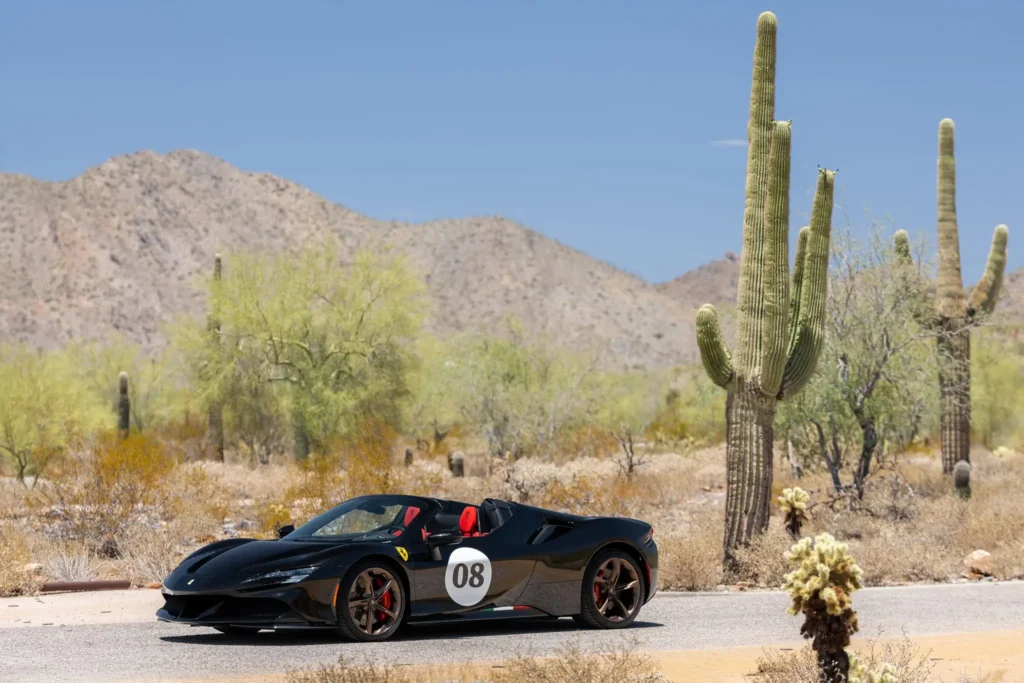
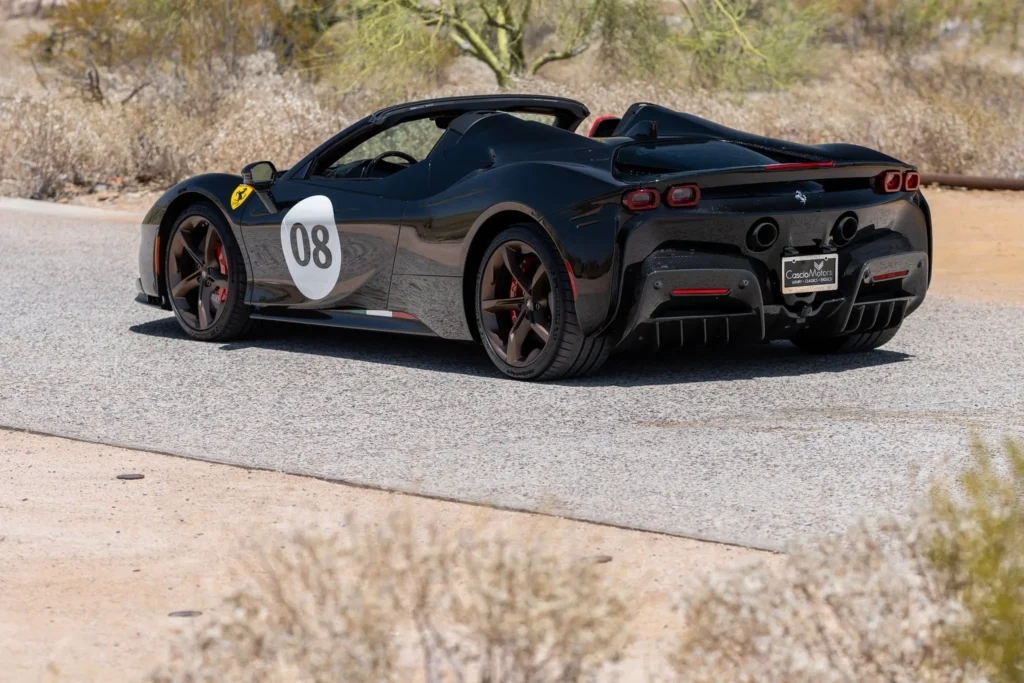
This car wears a four-layer Extra Range Glossy Nero Galaxy finish beneath a tri-color livery, white door roundels, and airbrushed Scuderia Ferrari fender shields, paired with Rosso Ferrari Alcantara racing seats and matte bronze forged wheels. It has worn a full-body paint protection film since new. Unlike a tribute livery tied to one specific historic chassis, which resonates mainly with buyers who know that chassis’s history, this presentation borrows Scuderia Ferrari’s racing identity in the broadest sense. Red, white accents, and roundels have marked factory racing cars for decades, which makes the theme legible to a wider population of future buyers. That is worth remembering, because the buyer pool for a highly specific tribute car is always smaller than the pool for a car that simply looks unmistakably like a factory racer.
Paperwork Is Doing as Much Work as Paint
The Carfax report on this car is clean: one owner, corporate registration, four service records, and no reported accidents or damage, with a documented odometer reading of 2,332 miles. The selling dealer acquired the car in 2025 and is now offering it with the owner’s manual, a charging cable, and a clean New Jersey title, alongside the chassis-stamped trunk plaque, a digital copy of the original window sticker, and the Atelier plaque between the seats. On a car this specialized, documentation is what separates verifiable provenance from an expensive paint job. A personalization commission without a paper trail is just a used car with unusual options. This one has the paperwork intact, and that will matter to a future buyer far more than a few hundred additional miles ever would.
Why This Matters Now
Ferrari ended production of the SF90 Stradale and Spider in 2024, which means the total population of Atelier and Tailor Made SF90 Spiders is now fixed. No more will ever be built. That closure matters alongside what the SF90 represented in the first place: Ferrari’s first series-production plug-in hybrid architecture, introduced to mark the 90th anniversary of Scuderia Ferrari and the first mid-engined Ferrari road car built with all-wheel drive. The SF90 occupies a technological hinge point the way the 288 GTO or F50 once did for earlier eras, except this transition runs from combustion to hybrid rather than naturally aspirated to turbocharged. As Ferrari pushes further into hybrid and eventually electric architecture, the SF90 will increasingly be read as the car that opened that chapter, not simply another depreciating supercar.
The Takeaway for Collectors
The final bid on this auction is almost beside the point. What this sale actually tests is whether Ferrari’s Atelier program can do for a modern hybrid hypercar what coachbuilding once did for pre-war chassis: turn a shared platform into a genuinely individual object whose value logic detaches from the model line underneath it. Personalization is starting to function in the collector market the way coachbuilding once did, not as decoration, but as differentiation.
Buyers watching this segment should prioritize commissions built around a coherent design theme over scattered option boxes, insist on complete documentation down to the plaques and window sticker, and recognize that with SF90 production now closed, the population of genuine Atelier cars will never grow. Whether that scarcity translates into real pricing power, the way it eventually has for the model’s naturally aspirated predecessors, is the question this auction and the ones that follow it will begin to answer.
The collector car market, every weekday morning.
Auction results, price moves and what’s crossing the block, read in four minutes. Free, from Modern Car Collector.
No spam, unsubscribe in one click. Or read more about the Brief.
Related Posts:
- Everything Modern Car Collector Covered Last Week
- Record Ferraris, Rare Icons and 15,000 RPM: The Week…

- Heavily Optioned 2023 Ferrari SF90 Spider Bid to…
- A 240Z Owned Since 1975 Proves the Odometer Is the…
- The Collector Car Market Paid Up for Certainty This…

- Barn-Find Hemis, a 277-MPH Bugatti & Dream-Car…
 Eve Nowell