

Hagerty’s third quarter contains what looks like a contradiction. Aggregate auction sales across Broad Arrow and Hagerty Marketplace rose 65.3% to $111.6 million. Private sales rose 88.1% to $99.9 million. Total revenue fell 9.5% to $354.2 million, and the company raised its full-year profit outlook anyway.
The contradiction is the story. The volume of the collector market is visible at the hammer. The money, increasingly, is made elsewhere: in the policy, in the loan, and in the introduction to the next owner. Read Hagerty’s results as a map of where the company closest to the collector market chooses to put its capital, and the sales totals become the least interesting part.
Why revenue fell while profit guidance rose
The revenue decline is largely mechanical. Effective January 1, Hagerty Re’s U.S. quota share rose from 80% to 100% under the restructured Markel fronting arrangement, which removed $138 million of Essentia-related commission revenue from the quarter by the company’s own accounting. Hagerty now keeps the premium rather than collecting a fee for placing it. Earned premium rose 41.7% to $265.1 million, the Hagerty Re combined ratio improved to 79.7% from 89.6%, and adjusted EBITDA climbed 63.5% to $97.1 million.
Net income, at $36.3 million, was below last year’s $46.2 million, which is worth stating plainly. Still, Hagerty lifted its 2026 net income range to $48–60 million from $18–30 million, and its adjusted EBITDA range to $305–315 million from $270–280 million. Policies in force reached 1,909,254, up 18.1%, and the company added 402,168 new members in nine months. The practical meaning is that Hagerty has become less a broker of collector-car risk and more a carrier of it, with a profit line tied to claims experience across nearly two million policies. An insurer carrying that exposure has every reason to track what these cars are really worth.
One quarter, and a private-sale number worth a second look
This is Hagerty’s own platform data for a single quarter. It does not describe the whole market. Within those limits, one figure deserves attention. Private sales are down 18.4% year to date, at $180.9 million, yet the third quarter alone produced $99.9 million. By simple subtraction, the first half yielded roughly $81 million, less than the third quarter delivered by itself. Auction sales tell a steadier story: $351.4 million year to date, up 82.8%.
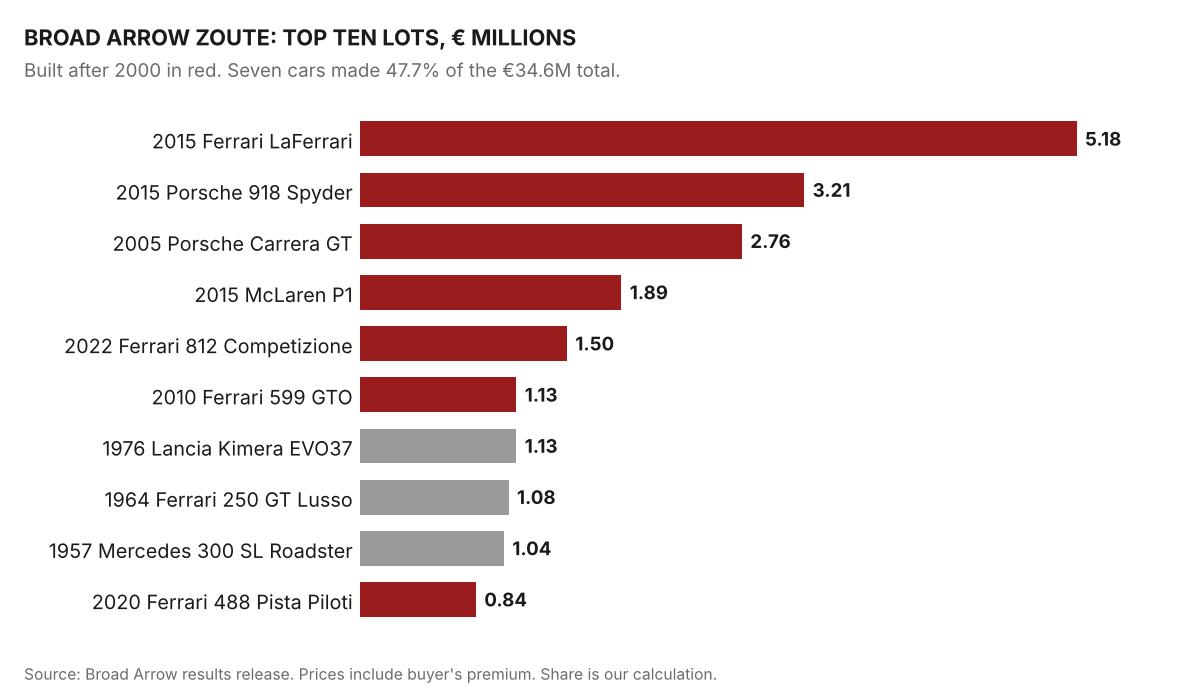
The shareholder letter points to what drove the quarter: Broad Arrow’s Wynn Concours sale in Las Vegas, plus the Zoute and Zürich auctions in Europe. Zoute’s hammer total reached €36 million, up 35%, with a LaFerrari, a McLaren P1 and a Porsche 918 Spyder among the cars. The letter also credits Broad Arrow’s brokerage with winning a 918 Spyder whose original owner had never retitled it, which is precisely the kind of consignment that moves a quarterly private-sales figure. MCC covered the room as it happened, from a 92-kilometer LaFerrari in Zürich to the $18.7 million F50 in Las Vegas.

That concentration matters. Hagerty says supercars and hypercars made up nearly half of the record $756 million sold across all houses at Monterey Car Week. The quarter’s strength was carried by a narrow band of modern, well-documented cars sold into the most liquid buyer pool in the hobby. It should not be read as a verdict on every segment. MCC’s reporting has already shown how uneven the picture is, whether early Porsche 356 values rising in Hagerty’s index while Monterey’s auction room disagreed, or Hagerty’s supercar index running far ahead of the classics.
The number that doesn’t fit
Marketplace revenue fell 6.4% to $32.2 million in the same quarter that aggregate auction sales rose 65%. Year to date, Marketplace revenue is up 7.9% against auction sales up 82.8%. Sales volume is what changes hands; revenue is what Hagerty keeps, and the two are not moving together. Any explanation beyond that is inference, but the lesson holds: a record hammer total does not translate into a proportionate fee line, and collectors should be careful about treating platform volume as a measure of platform health.
Credit arrives at the top of the market
Broad Arrow’s loan portfolio ended September at $162.3 million, up 62.2%. Lending against collector cars is an old business, but a publicly traded company growing its book at that pace suggests financing is becoming part of how important cars change hands. That is constructive for liquidity, since it lets a buyer carry a six- or seven-figure car without selling other assets. It is also pro-cyclical. Credit is most available when values are highest, which is not the moment to read it as reassurance.
What Hagerty’s own caution says
The most useful passage in the shareholder letter is not about growth. Management notes that top-end prices surged in 2026 and says it “would not be surprised to see them take a breather.” The company behind the valuation tools much of the hobby relies on, and which sees values move through the cars it insures, is warning against reading the quarter as a straight line. It also acknowledges that members selling their cars is its largest source of attrition; retention was 88.2%, down from 88.6% a year earlier.
What serious buyers should take from it
Treat Hagerty’s sales totals as a read on the modern and hypercar segment, where its platforms are strongest, not on the market for prewar or postwar classics. Watch the spread between what the indexes report and what individual auctions clear, a gap MCC has tracked in its market briefs. And note who Hagerty believes the next buyers are: management expects Gen X, millennial and Gen Z collectors to favor modern, higher-value cars, including supercars and JDM models. That is a bet on the very segment that carried the quarter.
The auction totals will be quoted widely. The more durable signal is that the company closest to the data is building an insurance book, a loan portfolio and a brokerage around the top of the market while telling its members, in writing, that prices may pause. A market reveals what it believes by where its closest participants put their capital, and by what they are willing to say aloud about the risk.
The collector car market, every weekday morning.
Auction results, price moves and what’s crossing the block, read in four minutes. Free, from Modern Car Collector.
No spam, unsubscribe in one click. Or read more about the Brief.
Related Posts:
- Three LaFerraris, Three Rooms, and the Estimate That…

- The Thoroughbred Motorsports Collection Cleared 99…

- Five Built, Three That Count: How to Read the MCA…

- The RADwood Collection Gives Three Modified Builds…

- A €5.2M LaFerrari, a Valkyrie With a Haircut, and…
- A €5.2M LaFerrari, a Valkyrie With a Haircut, and…
 EL Puckett