

Modified cars from the 1980s and 1990s usually reach the market with a story and no evidence. The builder is a name on a forum thread, the parts list lives in someone’s memory, and the build is judged on photographs. The RADwood Collection, three cars now offered with no reserve on Hagerty Marketplace, reverses that. Each was built to a shared budget, filmed in a six-part series, shown to a crowd, and listed with a written inventory of what was done and what is still wrong. That documentation, more than any hammer price, is what makes this small group worth a collector’s attention. See the full set on the Hagerty Marketplace RADwood Collection page.
Three builders, one budget, one vote
The cars come from Hagerty’s first RADwood Build Challenge. Photographer and content creator Larry Chen, Vin Anatra and StanceWorks founder Mike Burroughs each bought and modified an ‘80s or ‘90s vehicle to the same budget (the amount was not disclosed), with the work covered in a six-part YouTube series hosted by Jason Cammisa. The finished cars were shown at RADwood NorCal on October 24, 2026, at the Gold Bar Hangar in Alameda, California, an event Hagerty reports drew more than 10,000 attendees and nearly 150 vehicles.
Attendees voted for their favorite. Chen’s Accord won, and the prize was split: $50,000 to the builder and $50,000 to a charity of his choice, the RPM Foundation, which supports career pathways for skilled restoration craftspeople. RADwood itself dates to 2017, and Hagerty announced its acquisition of the event in March 2022, so this is a company selling cars from its own show.
The Accord SiR: a JDM homage built around a turbo H22A
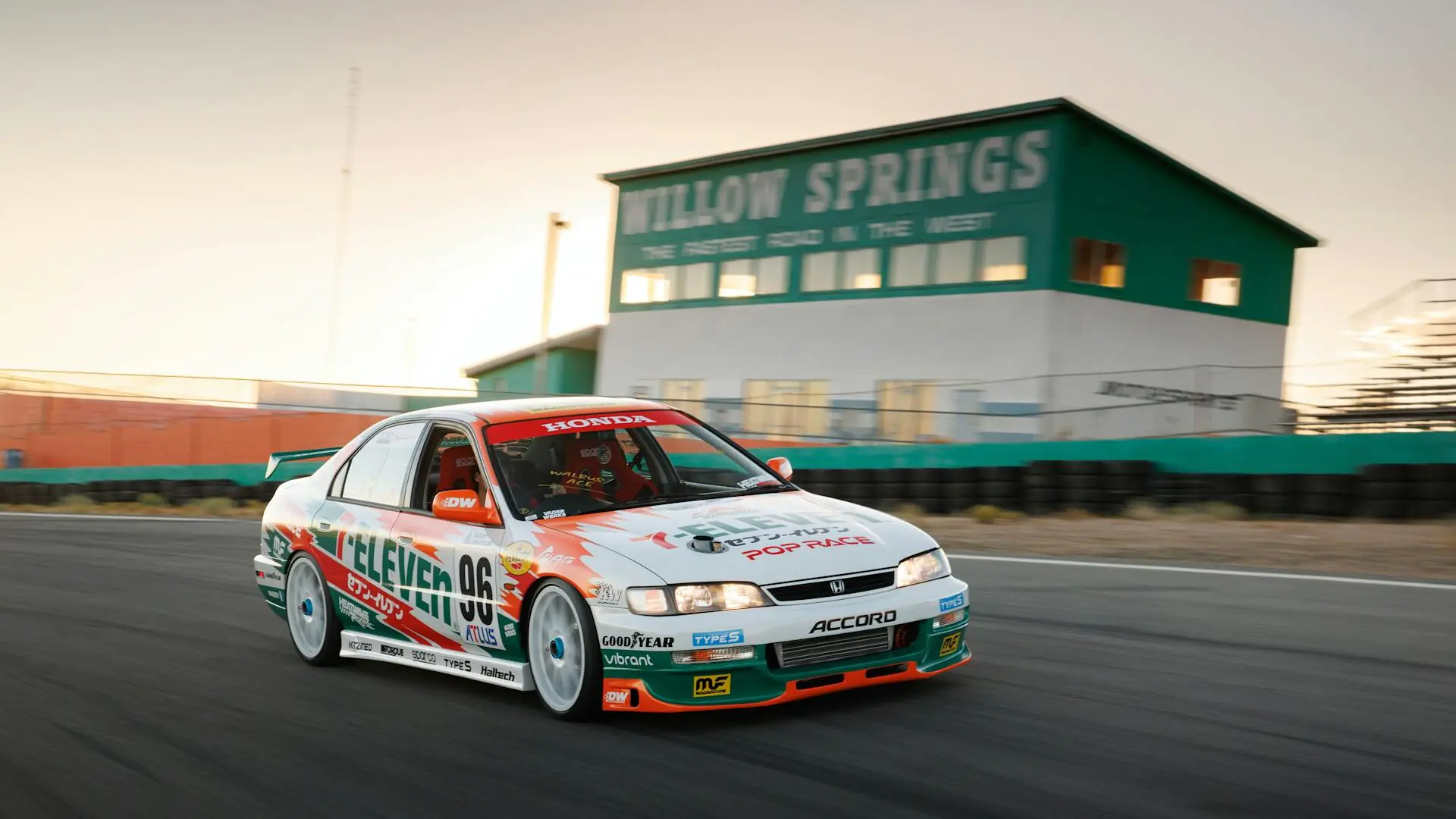
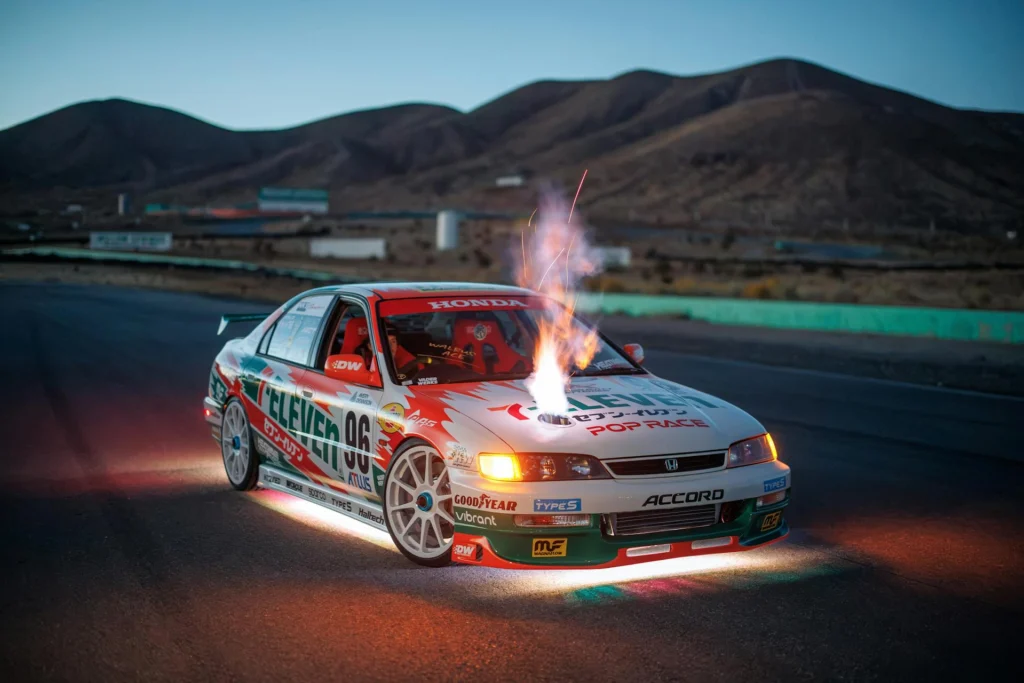
Chen’s car is a 1996 Honda Accord SiR, a model the listing says was never sold in the United States. The SiR was Japan’s performance version of the fifth-generation Accord, powered by the high-revving 2.2-liter H22A VTEC four-cylinder also used in the Prelude SiR, and it arrived while Honda was racing the Accord in the Japanese Touring Car Championship. Chen sourced his from Japan earlier this year and styled it after those touring cars: white paint, a 7-Eleven vinyl livery, a JTCC-style rear wing and replica Mugen bumpers and side skirts.
The engine is the substance. The listing credits Tom Jung with building the H22A with forged internals and a head with larger valves, then adding a GReddy turbocharger with a hood-dump wastegate, a custom MagnaFlow exhaust, a DeatschWerks fuel system, a Haltech Nexus R3 ECU and an ACT StreetLite flywheel. The five-speed front-drive sedan also gets KW coilovers, an electric power-steering conversion, forged 19-inch wheels, Sparco QRT-R seats and a Haltech digital dash. It shows 0 miles on the listing (true mileage unknown), carries a clean Montana title in the name of the owner’s LLC, and Hagerty warns it may not pass emissions testing in some areas. Read the full Accord SiR listing for the photo gallery and bid history.
The Silverado dually: the rarest idea in the group
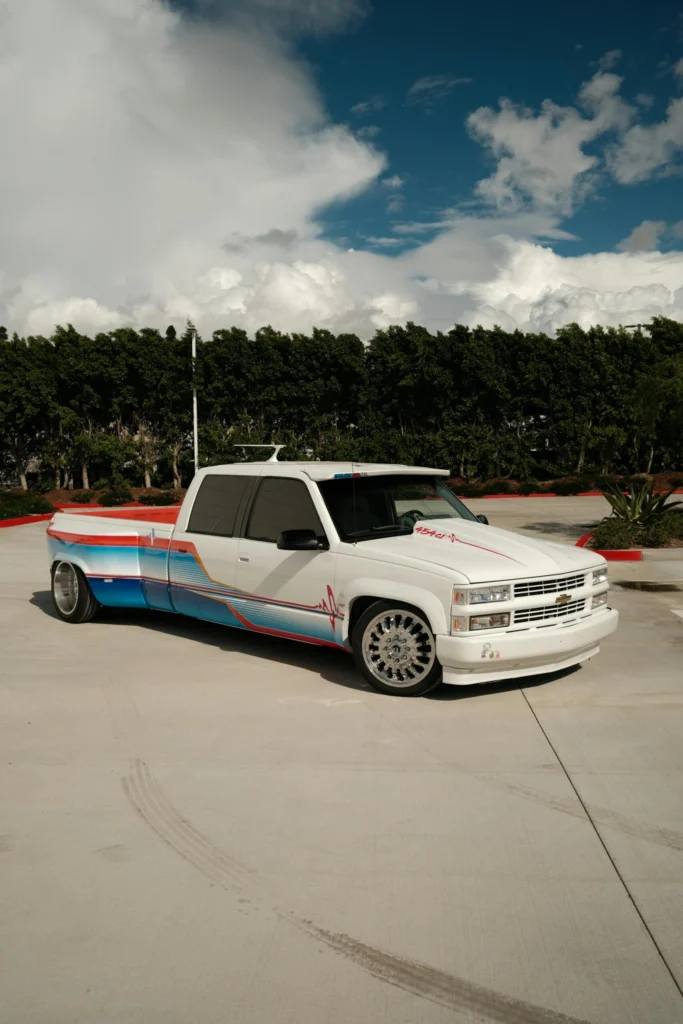
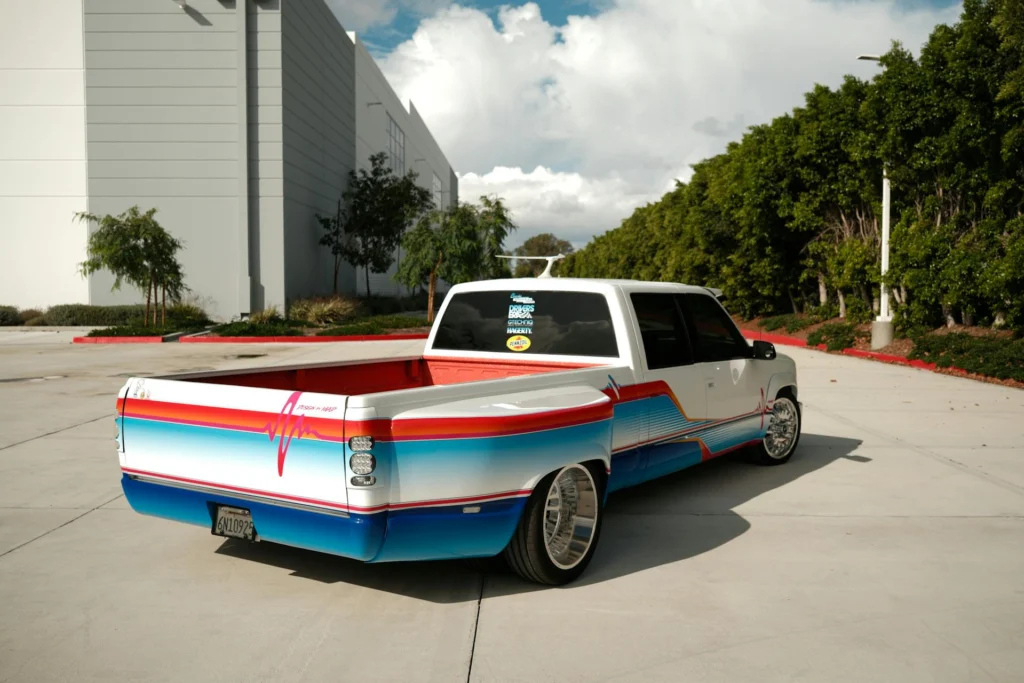
Anatra chose a 1994 Chevrolet Silverado 3500 crew cab dually, a configuration the listing calls unusual. The GMT400 generation was built for contractors, farmers and RV owners, so a lowered, graphic-wrapped crew-cab dually is a deliberate joke about utility. Anatra, known for his Hoonigan work, found the truck in California and used a 454-cubic-inch V8 with an automatic, a steel-cowl hood, widened bedside flares, 20-inch wheels and red-and-blue graphics, with some parts reportedly sourced from flea markets.
It is also the most honestly documented car of the three. The Silverado listing discloses 184,500 miles, loose door-panel clips, a front passenger door handle that needs replacing, paint overspray on trim, front wheels that rub and removed catalytic converters. The CARFAX shows California registration history with a reporting gap from 2006 to 2016.
The Esprit: a Giugiaro wedge in a Sony-inspired wrap
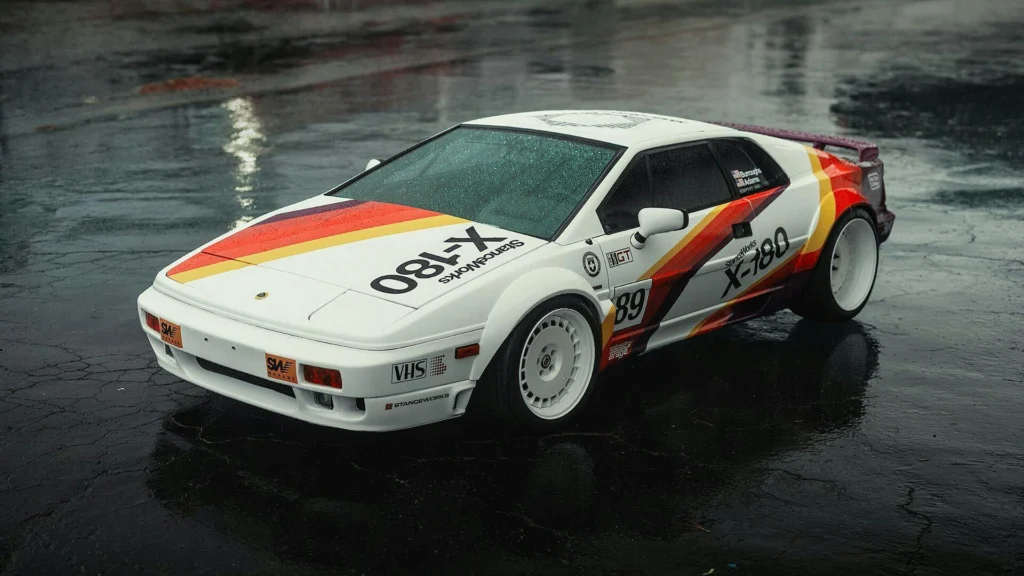
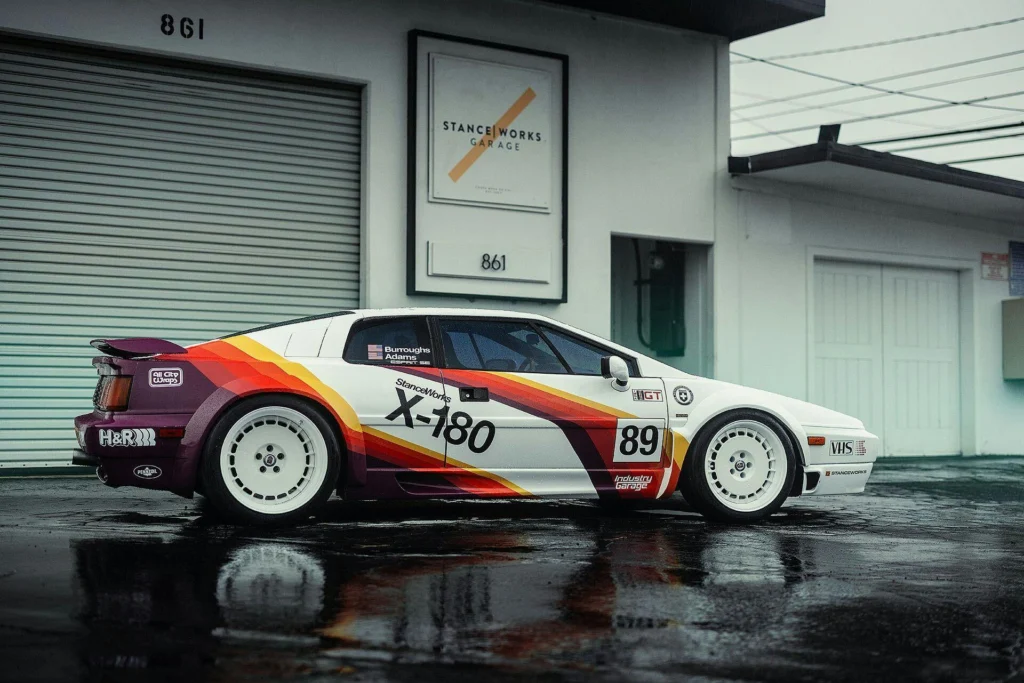
Burroughs, who runs StanceWorks, took a 1989 Lotus Esprit SE Turbo. The Esprit ran from 1976 to 2004 with Giorgetto Giugiaro’s wedge shape and a Bond-film pedigree, and this car pairs the factory turbocharged 2.2-liter four with a five-speed manual. He added H&R coilovers, a custom 3.5-inch stainless exhaust, fabricated fender flares, HRE 935 wheels with Goodyear tires and Recaro buckets trimmed in Recaro Gradient fabric. A retro Sony-inspired wrap was installed by All City Wraps of Santa Ana, California. The engine and gearbox were serviced for the challenge, and the car shows 51,000 miles (TMU) with a clean title.
The builder’s own assessment in the Esprit listing is the most useful sentence in the collection: the car runs temperamentally and should not be driven in its current state, given its engine operation and lowered suspension. Hagerty’s write-up adds overheating and tire rubbing to the to-do list. For readers who track the model, our look at the Esprit V8 versus the TVR Griffith 500 covers the risks of the later cars.
Why a documented build changes the collector math
Collectors usually discount heavily modified cars because the changes are unknowable. A buyer cannot tell a careful build from a weekend of zip ties. Here the work is on camera, the builders are named, the parts are itemized, and the faults are disclosed in writing. That is a partial answer to the problem we raised in our piece on a custom Ferrari F355 that traded originality for attention: originality is gone, so documentation is what remains. The same builder-as-provenance logic ran through the Thoroughbred Motorsports Collection, also sold on Hagerty Marketplace.
The Accord also fits a category this site already follows closely: ‘90s Japanese performance cars, as in our comparison of ‘90s Japanese turbo coupes. A one-off, emissions-questionable build is a different proposition from a clean factory car, though, and these three are better read as documented period artifacts than as investments.
Bids so far, and what to verify
As of November 3, the Hagerty collection page showed high bids of $17,000 on the Accord, $21,500 on the Esprit and $11,750 on the Silverado, all with no reserve. The listings show the Accord closing on Thursday, November 5, at 2:00 p.m. ET, the Esprit at 2:05 p.m. and the Silverado at 2:10 p.m. These are bids, not sale prices, and no estimates were published for any of the three. With no comparable sales for one-off builds, the result will say more about demand for RADwood-era culture than about book value.
Prospective bidders should confirm emissions and registration rules in their state, ask how true mileage was established on the Accord and Esprit, request the parts receipts, and note that the Accord is displayed at SEMA from November 4 to 6, with delivery coordinated from Van Nuys, California, starting November 9 or later. The Accord’s listing notes the title is in transit.
A disclosure worth reading
Each listing states that Hagerty has an ownership interest in the lot and that a Broad Arrow Auctions specialist, working for a Hagerty subsidiary, is acting as agent. That does not make the descriptions unreliable, and the honest defect lists suggest otherwise, but readers should know the platform, the show, the video series and the seller share a parent.
The takeaway for collectors is practical: when the next modified ‘90s car comes up, ask what the RADwood cars already answer. Who built it, to what budget, with which parts, and what is still broken? A car that can answer those questions has a provenance, even if its originality is long gone.
The collector car market, every weekday morning.
Auction results, price moves and what’s crossing the block, read in four minutes. Free, from Modern Car Collector.
No spam, unsubscribe in one click. Or read more about the Brief.

 Kyle Matthews
 EL Puckett