

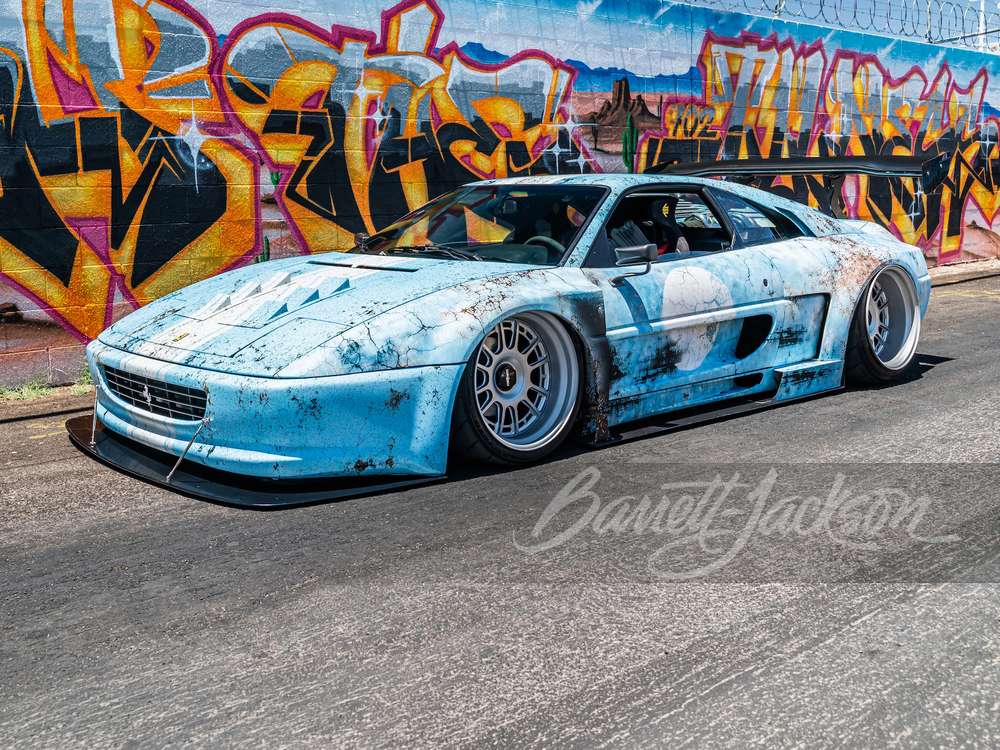
A 1996 Ferrari F355 crossing the block at Barrett-Jackson’s 2026 Las Vegas auction, without reserve, will not be judged by matching numbers, factory colour codes, or service books. It has none of those in the traditional sense. Its bodywork was hand-sculpted in clay before being digitally scanned. Its twin-turbocharged V8 was built by a California fabrication shop, not Maranello. Its finish looks less like paint than weathered concrete, an intentional patina applied to a car that, underneath, is barely broken in. This F355 made its debut not at a concours lawn but at the SEMA Show.
None of that makes it unimportant. It makes it a different category of object entirely, and understanding that distinction is more useful to a serious collector than any hammer price.
What Actually Made the F355 Collectible
Ferrari built the F355 from 1994 through 1999 as the replacement for the 348, and it remains the car most credited with rescuing Ferrari’s reputation for build quality and daily usability after a difficult decade. The 3.5-litre V8, with five valves per cylinder, produced 375 horsepower, and buyers could choose a traditional open-gated six-speed manual or, from 1997, Ferrari’s first electrohydraulic paddockshift, the F1 transmission. Roughly 11,000 examples were built across Berlinetta, GTS targa, and Spider body styles.
The collector market has been quietly re-rating clean, manual, matching-numbers F355s for several years now, and the reasoning is straightforward: it is the last Ferrari V8 to offer a true gated manual before paddle shifters became standard, and it remains one of the few relatively attainable entry points into a factory-original, air-cooled-era Ferrari ownership experience. That value is built entirely on originality, documentation, and mechanical honesty. Our earlier look at what “matching numbers” really means for a collector car explains why that single detail carries so much weight in valuations across the board, not just for Ferrari.
A professional restomod house taking a different approach with the same chassis, as we covered when Evoluto’s reimagined Ferrari F355 completed testing ahead of a limited production run, at least still aims to preserve and refine the driving character Ferrari built into the car. The Barrett-Jackson car has no such ambition. It was never trying to be a better F355. It was trying to be something else altogether.
A Build, Not a Restoration
The specification sheet reads more like a concept car than a collector car. A custom twin-turbo system, fabricated by Voodoo Design, uses centre-mounted, mirror-image Xona Rotor turbochargers on a bespoke CNC frame, feeding 3D-printed intercoolers tucked behind the rear tyres. Tubi headers route into a ceramic-coated Inconel exhaust with 3D-printed tips. The suspension is a hidden AccuAir air-ride system, with an F430 Scuderia diffuser at the rear. The bodywork borrows visual cues from three different Ferrari eras at once: front-end styling influenced by the F40, fender and hood vents inspired by F430 Super GT race cars, and a carbon-fibre wing modelled after the 488 GTC. The rear engine cover is acrylic, cut from aircraft windshield material. The wheels are one-off, polished, fifteen inches wide at the rear.
This is not restoration work in any sense the collector market usually means. It is closer to coachbuilding as performance art, executed on a Ferrari chassis instead of a blank canvas. That distinction matters because it changes the question a buyer should be asking. Nobody bids on this car to preserve Ferrari history. They bid on it because it is a genuinely well-executed, one-off piece of automotive sculpture with real engineering behind it, and because owning the only one of something still means something in car culture, even when that something isn’t a factory Ferrari anymore.
Why “No Reserve” Means Something Different Here
No-reserve status usually signals seller confidence, backed by an active comparable market. A numbers-matching Ferrari, Corvette, or Bel Air sold without reserve tells bidders the consignor trusts an established market to find fair value; we saw that logic at work in a 1957 Chevrolet Bel Air that abandoned matching-numbers status by design and still had a clear market logic behind its build choices. A one-off show car has no such comparable sales to lean on. Every bid is a fresh negotiation between the room and the car, decided almost entirely on visual impact, build quality under close inspection, and how much the audience wants to own the only example in existence. That is a fundamentally different kind of price discovery than the one collectors use for blue-chip originals, and it is worth remembering before treating any number this car brings as a data point for F355 values generally. It isn’t one.
The Real Story: A Market Splitting in Two
The more useful lesson here isn’t about this specific Ferrari. It’s about how clearly the collector market has split into two lanes that rarely intersect. One lane still runs on provenance, originality, and documentation, the traditional grammar of collector cars, where a car’s value compounds precisely because it hasn’t been changed. The other runs on execution, spectacle, and story, where a car’s value comes from what was done to it and how well it was done. We made a similar argument recently about a Ferrari SF90 Spider whose real significance had nothing to do with its auction bid, and the same logic applies in reverse here: the interesting part of this F355 isn’t what it might sell for, it’s what building it required and what buying it says about the purchaser.
Neither lane is wrong, but they are not interchangeable, and confusing them is where collectors get hurt. A car built for attention rarely holds value the way a documented original does, because its worth is tied to novelty and craftsmanship rather than history that only grows scarcer with time. That doesn’t mean modification is inherently value-destroying; thoughtful, sympathetic upgrades can even help a daily-driven collectible, a point we explored in our guide to upgrades that don’t hurt resale. But there is a wide gulf between a sympathetic upgrade and a full identity change, and this F355 sits firmly at the far end of that spectrum.
The Takeaway for Serious Buyers
Collectors rarely pay a premium for horsepower alone. They pay for moments in history, for originality that compounds like interest, or, occasionally, for a piece of rolling craftsmanship so complete that it becomes its own justification. This Ferrari F355 belongs firmly in that last category. It will never be mistaken for a numbers-matching example, and it was never meant to be. The buyers who understand that distinction, and bid accordingly, will be the ones who walk away satisfied regardless of the final number on the board.
The collector car market, every weekday morning.
Auction results, price moves and what’s crossing the block, read in four minutes. Free, from Modern Car Collector.
No spam, unsubscribe in one click. Or read more about the Brief.
Related Posts:
- Everything Modern Car Collector Covered Last Week
- Record Ferraris, Rare Icons and 15,000 RPM: The Week…

- A White Six-Speed F355 With 34,943 Miles Is at…

- Black 1996 Dodge Viper RT/10 Roadster With a Dyno…
- The Collector Car Market Paid Up for Certainty This…

- Inside the Estate of John Harrah: A No-Reserve Reno…
 John Lloyd
  Kyle Matthews
  Elizabeth Puckett