

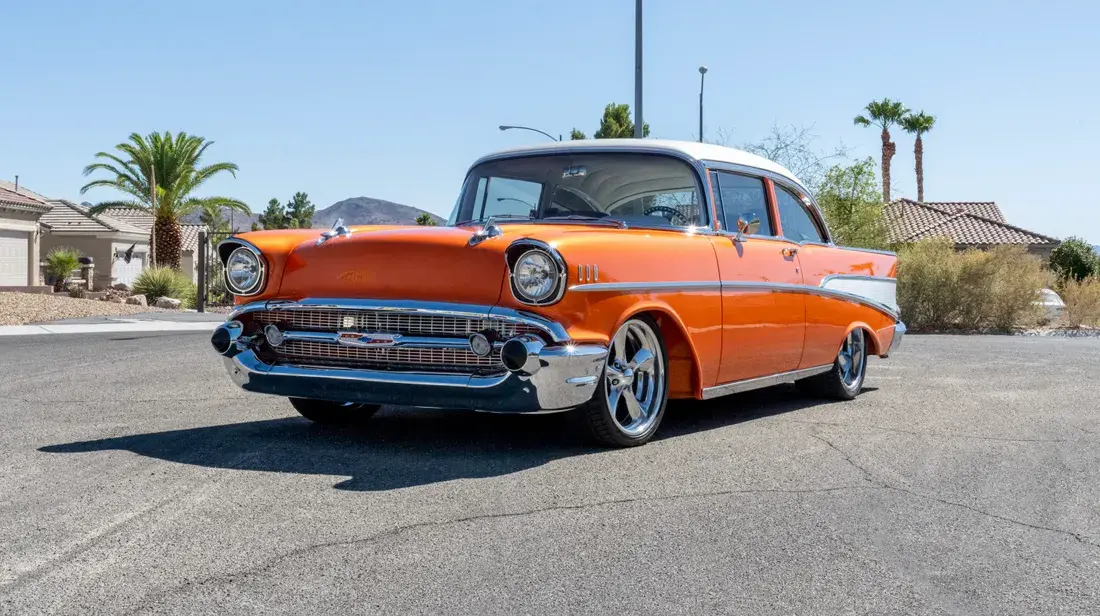
A 1957 Chevrolet Bel Air two-door hardtop is currently crossing the block through Sotheby’s Motorsport, consigned by a private seller in Henderson, Nevada, with bidding opening at $52,000. On paper, that’s an unremarkable transaction in a Tri-Five Chevrolet market where correctly optioned, numbers-matching Bel Airs regularly bring six figures. But this car isn’t competing in that market at all. Its original drivetrain is long gone, replaced by a 525-horsepower LS3 crate engine mounted in a fully custom Art Morrison chassis. There is no broadcast sheet to authenticate, no factory drivetrain to verify, no numbers to match. That absence is exactly why this car is worth examining — not as a curiosity, but as a clean illustration of how the collector market has split into two distinct, equally serious pursuits.
A Tri-Five Built to Drive, Not Preserve
Completed in 2020 after what the consignor describes as a comprehensive, rotisserie-level build, this Bel Air wears House of Kolor Tangelo Pearl paint with a Snow White Pearl roof, a two-tone treatment that plays directly off the model’s original color-blocked design language. The transformation runs far deeper than paint. The stock frame and suspension have been replaced entirely by an Art Morrison GT Sport chassis with independent rear suspension, JRI adjustable coilovers, and Detroit Speed power rack-and-pinion steering, backed by a Strange S-60 rear axle and Wilwood disc brakes with hydraulic boost assist. Inside, custom leather work, Dakota Digital instrumentation, and Vintage Air climate control replace the original’s bench seat and mechanical gauges. To an unfamiliar eye, these are simply upgrades. To a serious pro-touring builder, they are pedigree markers. Art Morrison chassis, Detroit Speed steering components, and JRI shocks occupy roughly the same reputational tier in the resto-mod world that a coachbuilder’s badge occupies in the traditional collector world — informed buyers recognize the names and price accordingly.
Why the 1957 Bel Air Still Commands Attention
The 1957 model year closed out what collectors call the Tri-Five era — 1955, 1956, and 1957 Chevrolets that reshaped the brand’s image with modern V8 power and contemporary styling. The 1957 cars, with their quad headlights, revised grille, and tailfins, remain the most visually distinctive of the three, and arguably the most culturally recognizable American car of the decade. Chevrolet built well over a million cars that year across its full lineup, and the Bel Air hardtop was among the most popular body styles in the catalog. Scarcity, in other words, was never the source of the Bel Air’s appeal. Desirability instead concentrated around specific options, such as fuel injection, dual four-barrel carburetion, and particular color combinations, and for decades, around originality itself. Because so many Tri-Five Chevrolets survived and because the reproduction-parts industry supporting them is so mature, collectors have long been able to choose between chasing correctness or chasing customization without one market cannibalizing the other. Readers curious what that correctness-driven market looks like in practice need only look at Modern Car Collector’s recent coverage of three original 1957 Chevrolets from the Jay Cimino collection — cars valued for precisely the untouched qualities this Bel Air has left behind.
The Resto-Mod Market Plays by Different Rules
In the traditional collector world, value is built on documentation: matching numbers, factory build sheets, verified ownership chains, and untouched originality. Modern Car Collector recently examined that logic through two very different 1969 Boss 429 Mustangs, one a concours-correct restoration and the other an unrestored survivor, where the entire editorial argument turned on how originality is weighed against presentation. A car like this Bel Air opts out of that argument entirely. Once the drivetrain and chassis are replaced, authenticity in the numbers-matching sense becomes irrelevant. What replaces it is fabrication quality, the reputation of the shops that performed the work, and documentation of the build itself, which is why the build sheet and service records included in this sale function as this car’s equivalent of a broadcast sheet. This is not an isolated phenomenon. Modern Car Collector covered a similarly LS3-powered 1962 Corvette restomod out of Hemmings Auctions earlier this year, another case where buyers were explicitly not paying for originality but for engineering execution and modern drivability layered over a familiar silhouette. Taken together, these cars point to a resto-mod segment maturing into its own collecting discipline, with its own standards and its own dedicated buyers, many of them younger collectors drawn to cars they can drive daily rather than trailer to shows. Modern Car Collector has tracked this generational shift in detail, the growing cohort of Gen X and millennial buyers reshaping demand away from strict originality and toward usability, technology, and reliability.
What Serious Buyers Should Actually Evaluate
Evaluating a build like this requires a different due-diligence checklist than evaluating a numbers-matching original. Chassis and drivetrain component invoices matter here the way a broadcast sheet matters on an original car; Art Morrison, for instance, can often verify chassis builds directly with a buyer. Fabrication quality deserves close inspection, since panel fit, wiring integration, and paint execution reveal far more about a resto-mod’s long-term value than any spec sheet. Buyers should also weigh the economics honestly. Builds of this depth, including a full chassis replacement, a crate LS3, and a completely re-trimmed interior, routinely cost their owners considerably more to create than they return at resale. This is a private-party, as-is sale, and bidders are responsible for their own inspection, a reality that applies with even more force to a heavily modified car than to an original, where at least a paper trail can substitute for a physical inspection.
The Real Story
The headline number here is $52,000, and it will likely move before the auction closes. But the price was never the real story. This Bel Air isn’t asking to be judged against a correctly optioned, numbers-matching Sport Coupe with factory fuel injection; that’s a different car serving a different collector. It’s asking to be judged on its own terms, as proof that the resto-mod segment has developed a value logic as rigorous, in its own way, as the originality-driven market it grew up alongside. Originality is often described as the quality that compounds value over time in the traditional collector world. In the resto-mod world, craftsmanship performs that same function, and this Tri-Five spends it convincingly. See it here.
The collector car market, every weekday morning.
Auction results, price moves and what’s crossing the block, read in four minutes. Free, from Modern Car Collector.
No spam, unsubscribe in one click. Or read more about the Brief.


 John Lloyd