

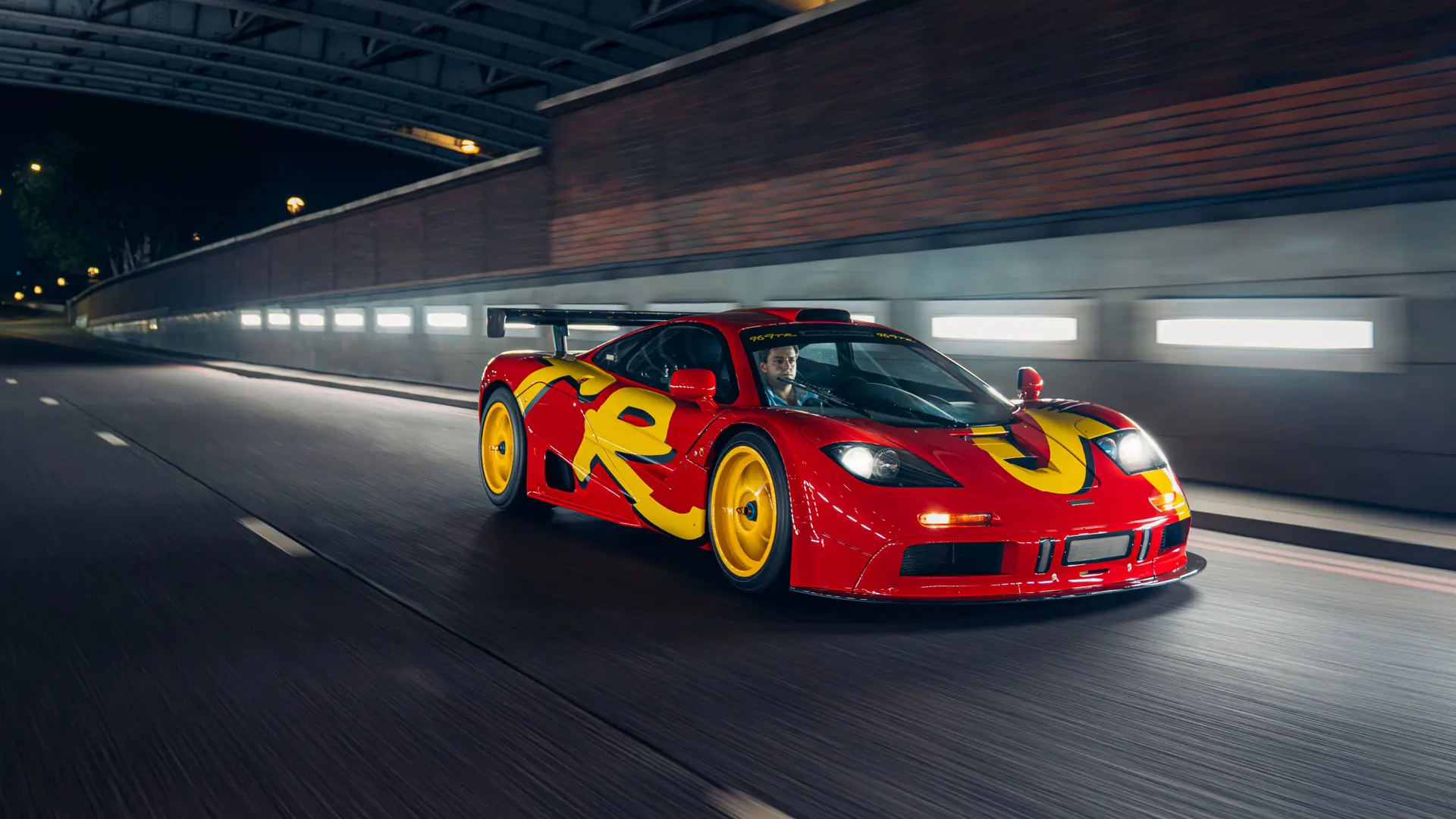
RM Sotheby’s will offer the 1996 McLaren F1 GTR chassis 10R at its 2026 Monterey sale with a stated value in excess of $35 million. The obvious hooks are all present: McLaren F1, Pink Floyd drummer Nick Mason, one private owner, a road conversion and a livery that can be recognized from across a paddock.
But celebrity and color are not the real story. This Nick Mason McLaren F1 GTR is compelling because it occupies a place in McLaren history that cannot be reproduced. Chassis 10R was the factory’s bridge between the 1995 Le Mans-winning GTR and the more developed 1996 competition car. Its collectibility rests on that development role, strengthened by long-term ownership and unusually visible use.
The prototype matters more than the résumé
The F1 was not conceived as a racing car, yet customer pressure led McLaren to develop the GTR for the BPR Global GT Series. The result was one of endurance racing’s great upsets: chassis 01R won the 24 Hours of Le Mans outright in 1995 on the model’s first attempt.
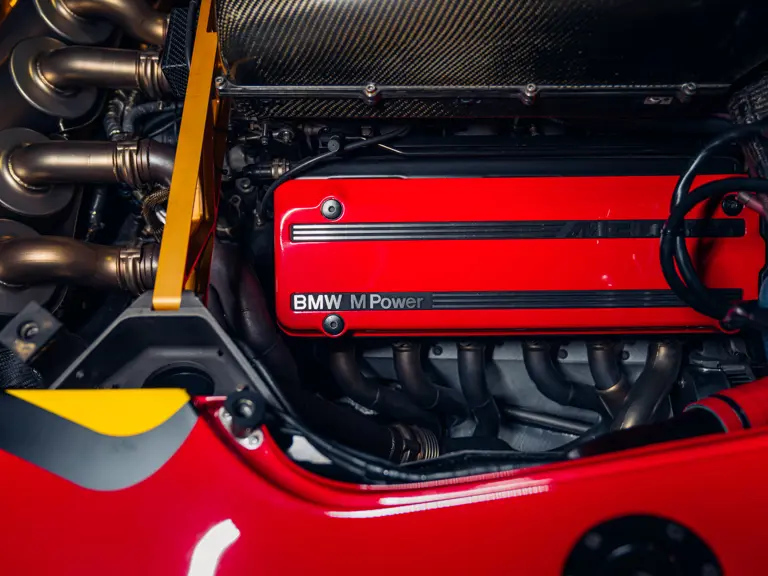
That victory immediately created a new problem. Purpose-built rivals, most notably the Porsche 911 GT1, raised the competitive standard for 1996. McLaren responded with longer front and rear bodywork, a more assertive splitter, a magnesium gearbox casing and strengthened transmission internals. According to the auction catalog, the changes removed 38 kilograms and produced the fastest F1 GTR variant, even compared with the more visually extreme 1997 Longtail.
Chassis 10R was the first of nine cars built to that 1996 specification and one of only two short-tail GTR prototypes, the other being Le Mans winner 01R. Completed in December 1995, it remained with McLaren for development and promotional work. The catalog records winter testing at Magny-Cours and associates the car with works drivers including 1995 Le Mans winner JJ Lehto.
Its period competition record is brief but meaningful. David Brabham drove 10R at the 1996 Le Mans Pre-Qualifying session for Kokusai Kaihatsu Racing, where it placed eighth in class and 20th overall. Chassis 11R ultimately contested the race. For some buyers, the absence of a race start or major victory will cap 10R’s standing below a proven winner. For others, its factory development status will be the more important distinction.
Nick Mason’s ownership adds continuity, not merely celebrity
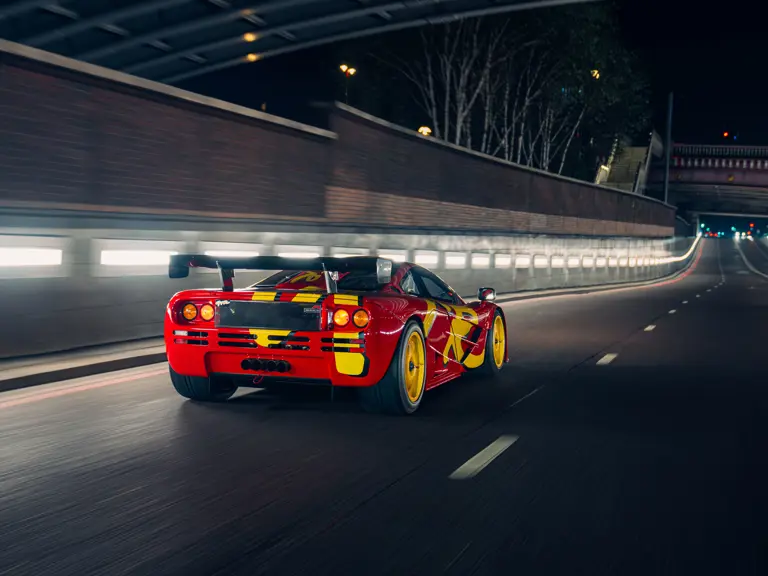
McLaren retained 10R until 1999, when it sold the car directly to Nick Mason. The factory converted it for road use, after which it was registered in the United Kingdom as “K40 MCL.” Lanzante—whose founder Paul Lanzante ran the 1995 Le Mans-winning Kokusai Kaihatsu effort—has maintained and developed the car during Mason’s ownership.
Mason’s name will broaden the audience, but celebrity ownership alone rarely sustains eight-figure value. What matters is continuity. One private custodian for more than a quarter-century, backed by specialist attention from the organization most closely associated with the F1 GTR’s greatest victory, is a provenance chain a buyer can understand.
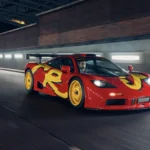
The scarlet-and-yellow “96 GTR” graphics add another layer. RM Sotheby’s describes 10R as the only F1 GTR to wear a factory livery of this kind. The design is unmistakably of its decade, and its connection to a founding member of Pink Floyd gives the car cultural reach without requiring an invented story. The livery is valuable because it is factory history; Mason’s ownership makes that history easier to remember.
Restoration history belongs at the center of the diligence
Chassis 10R is not an untouched preservation car, and serious bidders should not treat it as one. After an off-road incident during a 2009 road test, it received what the auction house calls a no-expense-spared restoration by Dean Lanzante and his team. A second restoration followed Mason’s 2017 accident during a Goodwood Members’ Meeting demonstration.
That history does not automatically diminish a competition-derived McLaren that has continued to be driven. It does, however, make documentation central to value. A buyer should examine the carbon monocoque, the extent and method of each repair, the originality and identity of major components, McLaren and Lanzante invoices, current service status, road-registration paperwork and any spares included in the sale. RM says a recent Lanzante inspection is on file.
Collectors often talk about originality as if it were binary. On a used racing machine, it is better understood as a documented continuum. The quality, authorship and transparency of the work can matter as much as the fact that work was performed.
What a $35 million-plus valuation would test
RM Sotheby’s language is “value in excess of $35,000,000,” not a conventional published estimate. The distinction matters. Asking figures, private transactions and auction results are different evidence, particularly at a level where each chassis carries its own hierarchy.
The public market has nevertheless been moving upward. A road-going 1994 McLaren F1 sold for more than $25 million in Abu Dhabi in late 2025, as Modern Car Collector reported. A road-converted 1997 F1 GTR Longtail was separately offered at $20 million. Neither is a direct comparable for 10R, but together they show the market’s willingness to treat the best F1s as peers to established blue-chip competition cars rather than merely modern supercars.
If 10R sells around or above the stated valuation, it would join the upper tier of publicly traded collector cars and force a sharper comparison with the results on our list of the most expensive cars ever sold at auction. It would also establish a rare public benchmark for an F1 GTR, a category too thinly traded for conventional price guides to be especially useful.
The risk is that the market may not reward every part of the story equally. Chassis 10R did not win Le Mans, or even start the race. It has twice been restored after incidents. Its valuation therefore depends on bidders assigning exceptional weight to prototype status, factory livery, one-owner provenance and the practical appeal of a road conversion.
Why 10R is genuinely significant
The best collector cars are rarely defined by a single superlative. They become important when engineering, history, provenance and identity reinforce one another. Chassis 10R is the first 1996-specification F1 GTR, a McLaren development car, a Le Mans test participant, a factory-converted road car and a machine preserved under one of Britain’s most serious competition-car custodians.
Collectors at this level do not simply buy rarity; they buy irreplaceability. Another F1 GTR may come to market. Another cannot become the prototype that translated McLaren’s 1995 upset into its 1996 evolution, then spent the next quarter-century with Nick Mason. That is the case for 10R—and it remains persuasive even if the price disappears from the headline.
Source: RM Sotheby’s auction catalog. Images courtesy of RM Sotheby’s.
The collector car market, every weekday morning.
Auction results, price moves and what’s crossing the block, read in four minutes. Free, from Modern Car Collector.
No spam, unsubscribe in one click. Or read more about the Brief.
Related Posts:
- McLaren Senna in Fina Colours: A Rare Commission…
- Record Ferraris, Rare Icons and 15,000 RPM: The Week…

- Monterey Car Week 2026 Results: Why a Record Week…
- Black 1996 Dodge Viper RT/10 Roadster With a Dyno…
- The Porsche Carrera GT Doubled in 2026. The $6.7…
- McLaren F1 GTR Prototype 10R Heads to Monterey With…
 John Lloyd
  Kyle Matthews