

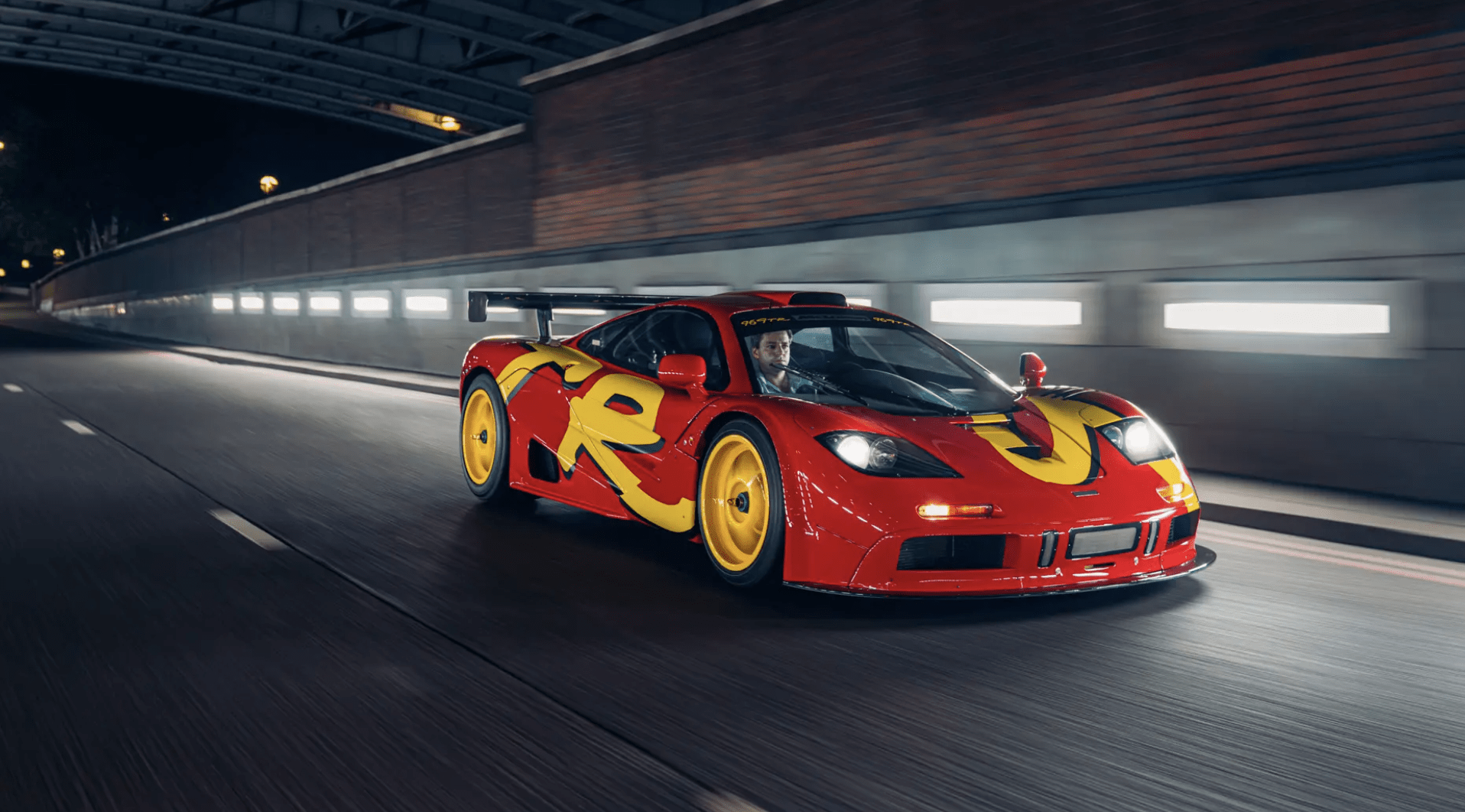
Nick Mason is selling the loudest McLaren F1 ever painted, and the number attached to it is the largest ever asked for a car from Woking.
RM Sotheby’s has consigned chassis 10R to its Monterey sale, running 13–15 August 2026 at the Monterey Conference Center, with a published guide of “Value In Excess Of $35,000,000.” No high estimate, no low estimate. That phrasing is auction-house shorthand for a car with no meaningful comparable sales, which is accurate here, and also a way of setting a floor in the public imagination without committing to a ceiling.
What actually makes 10R different
Strip away the rock-star provenance for a moment and look at the engineering, because that’s where the money is.
The 1995 F1 GTR that won Le Mans was, mechanically, a road car on a diet. It kept the production gearbox. It kept most of the road car’s architecture. It won anyway, which remains one of the great embarrassments in modern endurance racing history for everyone who showed up with a purpose-built prototype.
Related Articles
- Win a 1965 Pontiac GTO Convertible — Dream Giveaway’s Latest Charity Sweepstakes
- The New Electric Lexus LFA Isn’t the Story. The Original Still Is.
For 1996, McLaren had to respond to genuine silhouette racers — the Porsche 911 GT1 chief among them — and the GTR got serious. RM’s catalogue describes extended bodywork front and rear, a more aggressive splitter for downforce, and, critically, a magnesium gearbox casing paired with heavy-duty internals. Net result: 38 kilograms out of the car.
That gearbox detail deserves more attention than it usually gets. Magnesium is roughly a third lighter than aluminum by volume, and it’s mounted at the extreme rear of a mid-engined car, so removing mass there does more for polar moment than the raw number suggests. It’s also the reason these cars are a nightmare to own casually. Magnesium castings from the mid-’90s corrode aggressively when exposed to moisture and dissimilar-metal contact, and a cracked or pitted GTR case is not something you order from a parts counter. Anyone budgeting for a car like this is budgeting for a specialist who has physically handled one before.
Chassis 10R left Woking in December 1995 as the first of only nine 1996-spec cars, and McLaren kept it. That matters more than the paint. Factory development cars — the “XP” prototypes in McLaren shorthand — are the chassis the engineering actually happened on, and there are exactly two short-tail GTR prototypes in existence: 10R and 01R, the Le Mans winner.
The Le Mans claim needs a footnote
RM’s bullet points say the car was “Driven at the 1996 24 Hours of Le Mans during testing.” The catalogue text is more precise, and worth reading closely: 10R ran pre-qualifying under the Kokusai Kaihatsu Racing banner with David Brabham driving, finishing eighth in class and 20th overall. Sister car 11R contested the actual race.
So: real Le Mans mileage, real Le Mans timing sheets, no Le Mans race entry. That distinction is worth real money in the classic racing market, where eligibility for events like the Le Mans Classic and Peter Auto grids often hinges on documented period participation. Pre-qualifying counts as period competition history at most organizers, but a buyer planning to campaign this car should get that confirmed in writing before bidding, not after.
Related Articles
- Ends 7/21: 5X More Entries for Readers — Patriotic Corvette Duo Could Be Yours Through the Dream Giveaway
- The “Felon Daytona” Didn’t Sell for $355,000. Here’s Why That’s the Real Story.
One other oddity: the catalogue places the car at the “73rd Goodwood Members’ Meeting” in 2012. The Members’ Meeting was revived in 2014. Catalogue copy on eight-figure cars is written fast and reviewed by consignors, not historians, and small dating errors survive the process more often than you’d think. It’s a reminder that the auction description is marketing, not a warranty — RM’s own Conditions of Business say every lot is sold as-is, with the house explicitly disclaiming any obligation to verify statements about provenance or history.
The road conversion, and why a US title changes things
McLaren converted 10R for the road itself and registered it as K40 MCL in 1999, with subsequent work by Paul Lanzante — the man who ran the winning Kokusai Kaihatsu operation in 1995 — and later his son Dean. RM puts the number of GTRs converted for road use at roughly 16, and 10R was among the earliest.
The lot listing shows the registration as a US title, and the car’s location as Monterey, California. That’s a meaningful change for a car that spent its life on UK plates.
A 1996 vehicle is now past both the 25-year NHTSA exemption for federal safety standards and the EPA’s exemption window for original-configuration vehicles over 21 years old, so importing it as a permanent resident vehicle is procedurally straightforward — the paperwork problem that makes a 2005 European car nearly impossible to federalize simply doesn’t apply to a car this old. Registering it for street use in California is a separate question. A racing-derived car with no catalytic converters and no smog history is not a routine DMV visit, and the buyer’s realistic options run through direct-import and collector-vehicle registration paths rather than a normal title transfer.
The arithmetic nobody prints in the headline
RM’s published buyer’s premium for Monterey is 12 percent on the first $250,000 of hammer and 10 percent above it. At a $35 million hammer, that’s $3,505,000 on top — call it $38.5 million before a dollar of sales tax, transport, or insurance. Payment is due by 5 p.m. the next business day. The car must be off the property by 5 p.m. on 17 August or storage fees start.
Insurance is the buyer’s problem from the drop of the hammer, and there is no functional market for a $38 million single-vehicle agreed-value policy that you arrange the following Monday. Anyone bidding at this level has that conversation with an underwriter weeks in advance.
Does the number hold up?
The benchmark to beat is $20,465,000, the price a 242-mile road-going F1 brought at Gooding’s Pebble Beach sale in 2021 — then a world record for the model. Asking “in excess of $35 million” is a demand for roughly a 70 percent premium over that, on a car that has been raced, road-converted, crashed at Goodwood in 2017, and restored twice.
Related Articles
- This 1970 Plymouth Cuda Convertible Is More Than One of 132
- Ends 7/21: 5X More Entries for Readers as Dream Giveaway Puts a 670-HP 2026 Corvette Z06 on the Line
The case for it is that a factory prototype with two owners total, continuous specialist maintenance from the outfit that won Le Mans with the sister chassis, and a livery no other example wears is not competing with road cars at all. RM notes Mason ran an “open checkbook” maintenance policy and returned the car to Lanzante after significant use, with a recent inspection report on file. For a car with this history, that inspection document is arguably worth more to a serious bidder than any of the paint.
The case against is simpler: the F1 GTR market has never actually been tested in public at this altitude. Most of these cars trade privately. On 13 August, we find out whether $35 million was a floor or a wish.
Images Via: RM Sothebys
The collector car market, every weekday morning.
Auction results, price moves and what’s crossing the block, read in four minutes. Free, from Modern Car Collector.
No spam, unsubscribe in one click. Or read more about the Brief.
Related Posts:
- Nick Mason’s McLaren F1 GTR Is the Factory Prototype…

- McLaren Senna in Fina Colours: A Rare Commission…

- Record Ferraris, Rare Icons and 15,000 RPM: The Week…

- Monterey Car Week 2026 Results: Why a Record Week…
- The Collector Car Market Paid Up for Certainty This…

- The Porsche Carrera GT Doubled in 2026. The $6.7…

 Kyle Matthews