

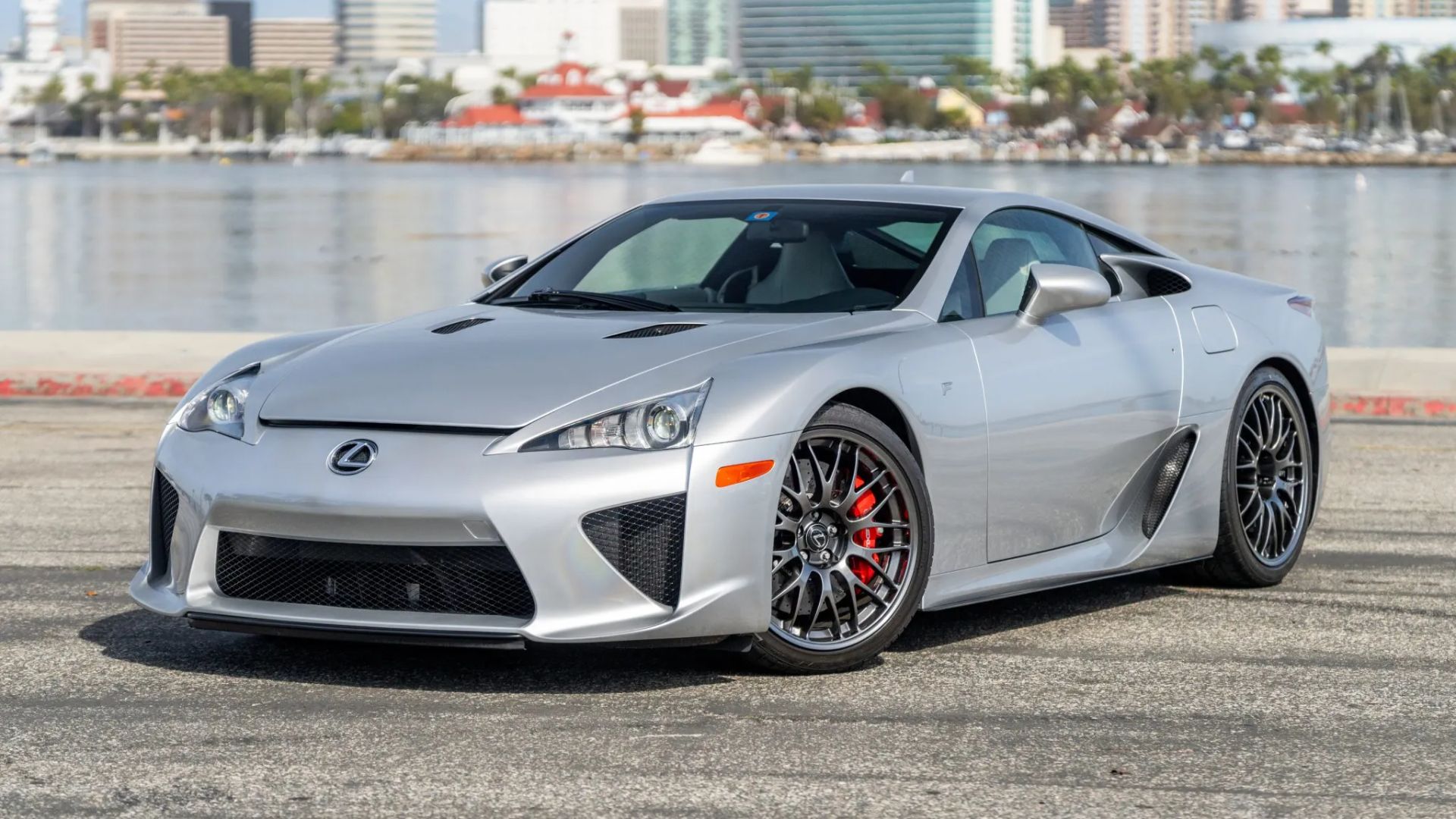
On Thursday afternoon at the Goodwood Festival of Speed, a camouflaged Lexus made a slow, deliberate run up the hill, sandwiched between a screaming V-8 road car and its V-8 racing sibling. The electric LFA concept made barely a sound. That was, in its own way, the entire point.
This was not really an unveiling. Lexus first showed the front-engined concept at Monterey Car Week last August without confirming what it was, waited four months to attach the LFA name to it, and has now waited seven more months to let it move under its own power in public. Toyota ran an almost identical playbook with the GR GT and GR GT3 last year, camouflaging both cars at this same event before formally introducing them the following December, on the very night the electric LFA concept debuted. If that pattern holds, Thursday’s hill climb is less a standalone news item than a marker on a production timeline collectors should already be watching, as we noted when Toyota first signaled a dual supercar strategy.
The strategic split matters more than the spectacle. The combustion GR GT is being positioned as a standalone GR-branded halo car, sold in the United States through Lexus showrooms rather than conventional Toyota dealers. The electric machine gets to carry the LFA name. Toyota, in other words, has decided that internal combustion and battery power will not compete for the same badge. One nameplate does gasoline. One does not. That is a deliberate, expensive decision by a company that does not make such choices casually, and it tells us something about how seriously Toyota still regards the LFA as intellectual property rather than simply an old model number to recycle.
To understand why that decision carries weight, it helps to remember what the original LFA actually was. Toyota built almost exactly 500 examples between 2010 and 2012, each with a carbon-fiber monocoque assembled largely by hand in a low-volume facility, powered by a 4.8-liter V-10 co-developed with Yamaha that revved to 9,000 rpm and used a digital tachometer because a standard needle physically could not keep pace with the engine. Toyota reportedly lost money on every car it sold. A run of 50 Nurburgring Package cars, lighter and more powerful, closed out production and today anchors the top of the model’s market. None of that was about volume or profit. It was Toyota proving, once, that it could build a hand-assembled exotic to rival Ferrari and Lamborghini on pure engineering terms, then largely walking away from the exercise.
That is the real story behind Thursday’s hill climb, and it has little to do with horsepower figures Lexus has not yet released. The original LFA’s collector value was never built on rarity alone; plenty of limited-production cars are rare and unloved. It was built on the fact that Toyota only did this once, did it at a financial loss, and then stopped. Scarcity by itself doesn’t create a blue-chip collector car. Scarcity combined with a story collectors can’t stop repeating does. By resurrecting the name on an electric flagship rather than folding it into the GR lineup, Toyota is choosing to protect that story rather than dilute it, at least for now.
Manufacturers testing electrified halo cars at Goodwood has become its own small trend worth watching, and not every approach carries the same risk. Zenvo brought its V-12 Aurora hypercar to the same hillclimb, a new nameplate with no combustion legacy to protect. Mercedes-AMG has taken a similar approach with its own electric supercar program, building on a concept rather than retiring a nameplate collectors already prize. Reviving a specific, revered badge on a fundamentally different powertrain is a harder needle to thread, and it is one Porsche has so far avoided doing with the 911 name. Whether Toyota threads it will depend entirely on what the production LFA becomes, and whether it earns comparisons to the original on its own terms rather than borrowed ones.
There is also a demographic story here that matters more than most manufacturer announcements. The original LFA already sits near the top of the modern Japanese collector hierarchy for buyers who came of age idolizing it in video games and magazine spreads rather than showroom brochures, a buying group we’ve tracked as it reshapes the broader collector market. An electric flagship carrying the same badge is aimed squarely at that same audience a decade further into their earning years, not at the traditional matching-numbers crowd counting date-correct build sheets.
None of this means the electric LFA will be a good car, or that it deserves to wear the badge at all; that verdict waits for an actual reveal, real specifications, and eventually real seat time. But the hill climb at Goodwood already told collectors something the marketing department did not say out loud: Toyota still believes the LFA name is worth protecting rather than spending. Collectors rarely pay a premium for a nameplate alone. They pay for a story a manufacturer refuses to tell the same way twice, and for now, Toyota seems to agree.
The collector car market, every weekday morning.
Auction results, price moves and what’s crossing the block, read in four minutes. Free, from Modern Car Collector.
No spam, unsubscribe in one click. Or read more about the Brief.
Related Posts:
- Record Ferraris, Rare Icons and 15,000 RPM: The Week…
- Everything Modern Car Collector Covered Last Week
- Lightning McQueen Joins the 2026 Goodwood Festival of Speed

- Goodwood Road Racing Club Comes to America: What…

- A 72-Mile Lexus LFA Nürburgring Package Shows How…
- Ferrari F50 Value Nearly Tripled in Two Years.…
 Eve Nowell
  John Lloyd