

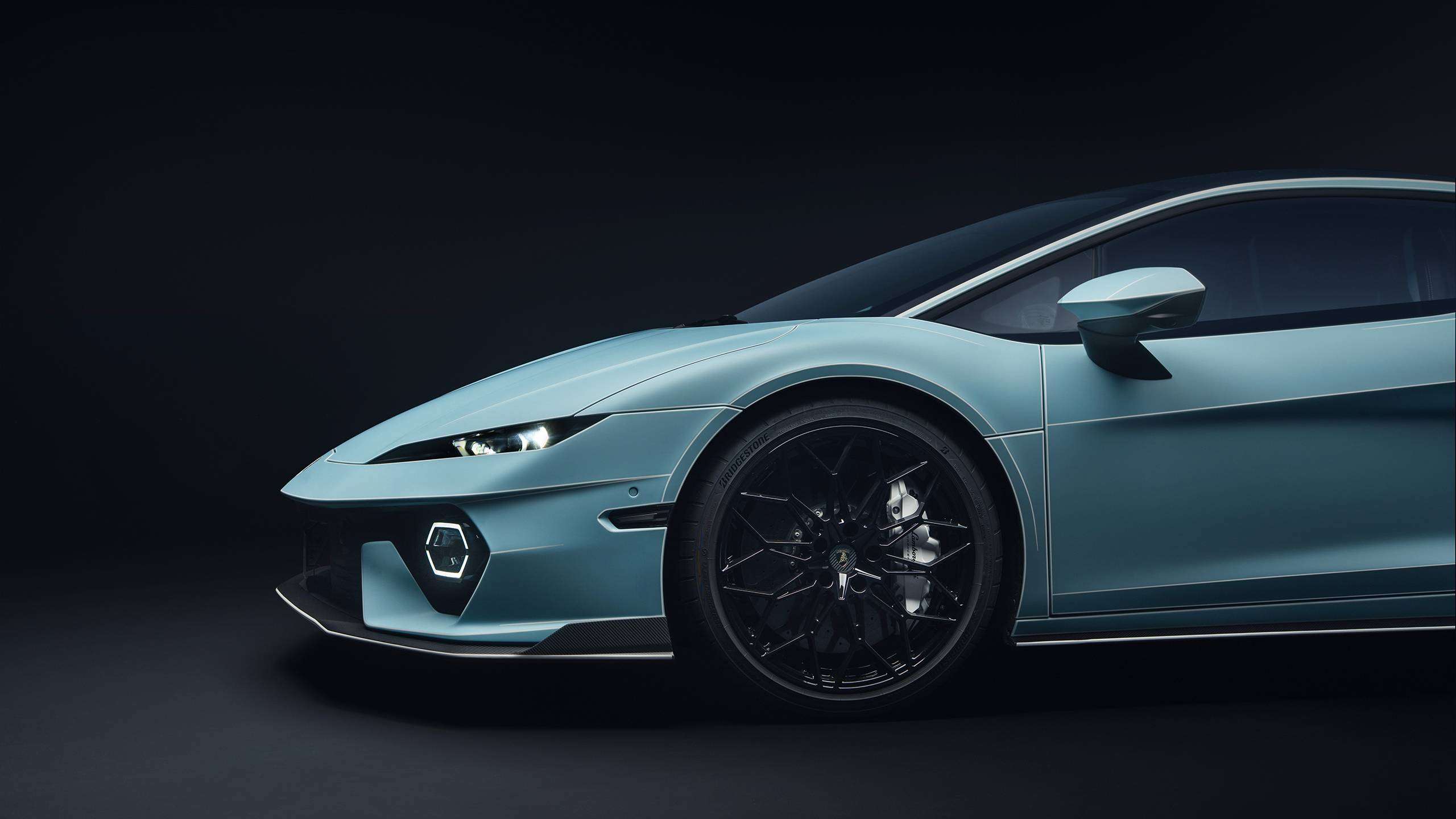
Lamborghini has put wool in a supercar, and unlike most Goodwood show-car theater, this one comes with actual ownership consequences.
Two one-off Temerarios built by the Ad Personam department made their public debut at this year’s Festival of Speed, both riffing on the same idea: a super sports car dressed by a Milanese tailor. Fine graphic lines run across the bodywork, meant to look like the construction marks a designer scratches onto a sketch before the surfaces exist. One car is Grigio Crater Matt with Grigio Artis contrast graphics. The other is Celeste Fedra with Bianco Phanes accents and the matt Alleggerita package.
The interior is where the actual news is, and where the press release does something clever that’s worth catching.
The wool car and the not-wool car
Lamborghini says this is the first time a production car from Sant’Agata gets “Gessato” pinstripe inserts — virgin wool, black base, silver stripe, worked into the door panels, rear wall and headliner. The pattern is deliberately broken up rather than running clean, which is a reasonable design call: a rigid pinstripe on a curved door card would fight every crease line in the panel.
But read further and the Alleggerita car doesn’t get wool at all. On that build, the material switches to Corsa Tex by Dinamica, the microfiber suede Lamborghini already uses across the range, printed to mimic the same discontinuous stripe. So “first wool in a production Lamborghini” applies to exactly one of the two cars shown.
Related Articles
- The BMW M10 Doesn’t Need a Chassis to Be Collectible
- This 543-Mile 2017 Dodge Viper GTC Shows How Final-Year Rarity Really Works
That’s not a gotcha — it’s an engineering decision. Dinamica is measurably lighter than a woven wool with backing, and the Alleggerita package exists to shave grams. It also handles perspiration and body-contact abrasion better on a bolstered track seat.
What wool actually means to own
Natural fiber in an automotive cabin is a real material choice with real maintenance implications, and nobody in the luxury business talks about them.
Wool is hygroscopic — it absorbs and releases moisture from the air. That’s the reason it feels good to sit on and doesn’t turn clammy the way vinyl does, and it’s also the reason a car parked in a humid garage with wool trim behaves differently from one trimmed in leather. Wool is naturally flame-resistant, which is a genuine advantage for meeting flammability standards without a heavy chemical treatment. It’s also more UV-stable than most synthetics in terms of fiber strength, though dyed wool absolutely fades.
The downsides are the ones you’d expect from a suit. Wool abrades under repeated friction, which is why the placement matters here: door panels, rear wall and roof liner are surfaces you brush rather than grind against, and Lamborghini kept it off the seats. It attracts clothes moths and carpet beetles, which nobody thinks about until they store a car for a winter with a snack crumb in the door pocket. And it can’t be cleaned the way an interior detailer cleans leather. Aggressive alkaline cleaners will destroy the fiber’s protein structure. If you buy one of these, the correct answer to a spill is a pH-neutral wool product and a lot of patience, not the all-purpose cleaner in the shop’s spray bottle.
Anyone insuring one should also understand that a trim panel finished in a bespoke virgin wool woven for two cars is not a parts-counter item. Agreed-value coverage with a specified restoration provision is a different conversation than a standard exotic policy.
The paint bill nobody mentions
Both cars wear contrast liveries as painted graphics rather than vinyl, and one of them is a matt finish. Matt paint is a maintenance category unto itself: you cannot machine-polish it, because polishing works by leveling clear coat and leveling a matt clear makes it glossy in patches. A scratch that a detailer would buff out of a gloss car in ten minutes means a repaint of the affected panel on a matt one.
Now add a multi-line graphic that crosses panel seams. Repairing a door on a car like this isn’t a door repair — it’s a blend across adjacent panels to make the lines register. That’s the sort of thing that turns a parking-lot scuff into a five-figure body shop estimate, and it’s worth confirming with an underwriter before a claim rather than after.
Under the tailoring
Mechanically, these are standard Temerarios, which is to say not standard at all. The launch specifications list a 4.0-liter hot-V twin-turbo V8 making 800 CV between 9,000 and 9,750 rpm, with a flat-plane crank, titanium connecting rods, and DLC-coated finger followers rated to 11,000 rpm. Three axial-flux electric motors — one sandwiched between the engine and the eight-speed dual-clutch, two on the front axle — bring the system total to 920 CV. Zero to 100 km/h in 2.7 seconds, 343 km/h flat out.
The dry weight is 1,690 kg, which is the number that tells you what hybridization costs. The 3.8 kWh pouch-cell battery lives in the center tunnel; the front e-axle assembly weighs 73 kg on its own.
Related Articles
- Record Ferraris, Rare Icons and 15,000 RPM: The Week in Collector Cars
- Four Collector-Vehicle Auctions to Watch This Saturday, July 18
The Alleggerita package on the Celeste Fedra car is not a badge. Lamborghini quantifies it: 12.65 kg out through body components alone, more than 25 kg once the lightweight interior parts, carbon wheels and titanium muffler are counted, and a 67 percent bump in aerodynamic load. The rear bonnet alone accounts for 9.2 kg of that. It also brings polycarbonate fixed side windows and a lightweight rear screen.
Polycarbonate is the detail worth flagging. It’s roughly half the weight of glass and vastly tougher against impact, but it scratches from ordinary washing, and once it’s hazed you’re replacing the panel rather than polishing it. Anyone who has owned a car with plastic rear glazing knows the routine: no automatic car wash, ever, and a dedicated plastic-safe cleaner.
Why Lamborghini is doing this
The commercial logic is straightforward. Ad Personam is high-margin work that costs Lamborghini relatively little in engineering hours, and personalization revenue doesn’t carry the homologation burden that a new variant does. A wool insert requires no crash testing, no emissions recertification, no WLTP resubmission — the Temerario’s numbers stay where the official figures put them, at 24 MPGe combined and 16 mpg on gasoline alone for US cars.
For buyers, the practical takeaway is unglamorous but useful: bespoke materials and painted liveries dramatically raise the cost and difficulty of every future repair, and they don’t reliably return that money at resale unless the car has a story attached. Two Goodwood show cars have a story. The Ad Personam order you place at your dealer next month probably doesn’t.
Images Via: Lamborghini
The collector car market, every weekday morning.
Auction results, price moves and what’s crossing the block, read in four minutes. Free, from Modern Car Collector.
No spam, unsubscribe in one click. Or read more about the Brief.
Related Posts:
- The Complete Guide to the Yenko Camaro
- Lamborghini's Temerario Tricolore Isn't Rare. It's…

- Goodwood Road Racing Club Comes to America: What…

- No Reserve: Tailor Made 2026 Ferrari Purosangue For…

- Lightning McQueen Joins the 2026 Goodwood Festival of Speed

- Record Ferraris, Rare Icons and 15,000 RPM: The Week…

 Kyle Matthews