
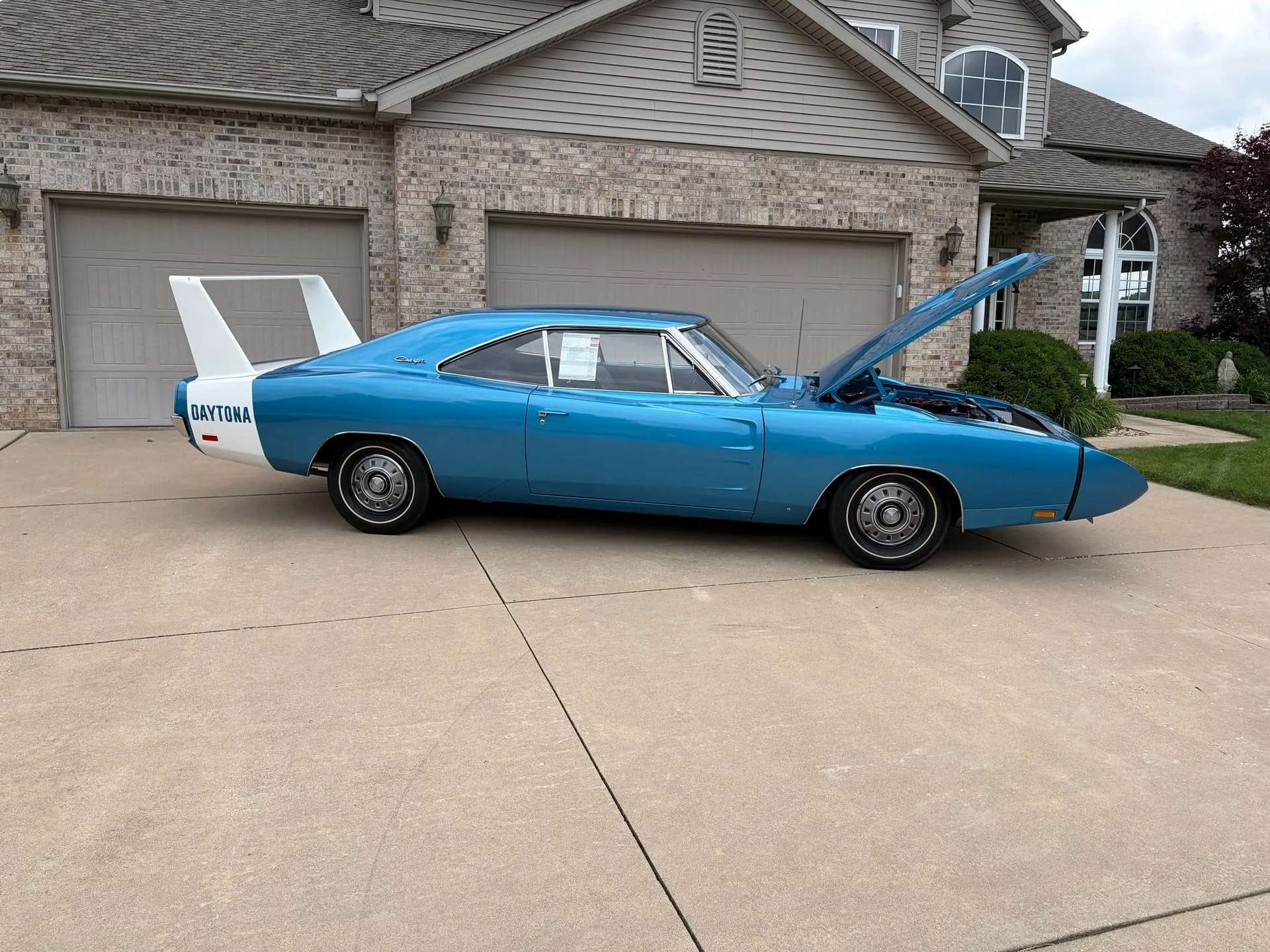
On July 18, a meticulously documented, Concours-certified 1969 Dodge Charger Daytona crossed the digital block on Bring a Trailer and stopped at $355,000, short of its reserve. No sale. In a market conditioned to chase record numbers, a no-sale rarely makes headlines. But this particular Daytona, a car that spent nearly a decade rotting in a Kansas City salvage yard as evidence in a title-fraud case, has more to teach serious collectors than most cars that do sell. The real story here isn’t the bid. It’s what that bid, and the reserve it couldn’t clear, tells us about where the market actually draws the line between a great story and a great engine.
The Daytona was never meant to be a collector car. Dodge built exactly 503 of them for the 1969 model year, and every one existed to satisfy NASCAR’s homologation rule requiring a minimum production run before a body style could race. The elongated nose cone and the 23.5-inch rear wing weren’t styling exercises; they were aerodynamic tools built to keep stock cars stable at speed on NASCAR’s fastest ovals, and the actual metalwork was handled off-site by Creative Industries, the Detroit-area coachbuilder Chrysler leaned on for low-volume, high-complexity conversions it couldn’t run through a normal assembly line. That distinction matters. A Daytona isn’t a Charger with an appearance package. It is a homologation special, and its value has always been tied to that motorsport purpose rather than to straight-line horsepower alone.
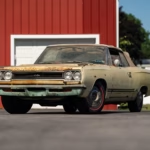
This example, the 110th of the 503 built, began its life in a way that had nothing to do with racing. It was special-ordered through Zeck Motor Co. in Leavenworth, Kansas, by the dealer-owner’s son, then sold into used-car circulation within a few years. By 1973 it had landed with a Kansas City used-car dealer who was later jailed on charges tied to fraudulent titles, and the Daytona, along with roughly fifty other vehicles including a second, red 1969 Daytona, was impounded. The two winged Chargers sat outside at a salvage yard in Kansas City for the better part of a decade while their legal status remained unresolved, which is how this car earned the nickname it still carries today: the Felon Daytona.
A subsequent owner bought both impounded Daytonas in 1982 for $5,500 and trailered them to Indiana, beginning a slow process of sourcing the parts that a decade outdoors had claimed. The car wasn’t returned to the road until around 2009 and 2010, when Troy Angelly Restorations in Eldorado, Illinois, completed a rotisserie refurbishment that included rebuilding the numbers-matching 440ci Magnum V8, factory-rated at 375 horsepower and 480 lb-ft, and refinishing the body in its original Bright Blue Metallic. The work held up to scrutiny: the car earned a Gold Certificate in the OE-Certification Class at the Mopar Nationals and a Concours Gold Certificate at the Muscle Car & Corvette Nationals, both in 2010, and it later spent two years on display at the Gilmore Car Museum in Michigan.
What separates this Daytona from thousands of other well-restored Mopars is the paper trail that survived alongside it. Its fender tag decodes cleanly against its broadcast sheet, itself a rare survivor since broadcast sheets were routinely discarded on the assembly line and rarely reach a 55-year-old car in usable condition. A second, partial broadcast sheet backs up the first, and the order number, sequence number, and June 9, 1969 build date all correspond. The car has appeared in print twice, once in the May 2011 issue of Mopar Collector’s Guide and again in Hot Rod’s 2018 feature on its improbable rescue, and ten binders of restoration photos accompany the sale. For a car with a title history this messy, that documentation isn’t decoration. It is the entire reason this Daytona is worth discussing at all rather than being remembered as an unrecoverable parts car. It is the same lesson Modern Car Collector drew from a Boss 429 restoration debate earlier this year: the real story wasn’t the make, it was provenance versus craftsmanship, and the more compromised a car’s history, the more its paperwork has to do.
So why didn’t $355,000 clear the reserve? Because a 440 Magnum Daytona, no matter how honest its restoration or how compelling its salvage-yard backstory, is still a 440 Magnum Daytona. Of the 503 built, only a small fraction left the factory with the 426 Hemi, and the market has drawn a hard line between the two ever since collector interest in aero cars accelerated in the 1990s. Modern Car Collector covered that gap directly when Bobby Allison’s NASCAR-raced Hemi Daytona headed to Mecum’s Monterey sale this past summer, a car whose motorsport pedigree and Hemi drivetrain put it in territory this Felon Daytona will never reach, regardless of how many binders come with it. A reserve-not-met result like this one is a data point, not a failure: it tells us that buyers are willing to pay well into six figures for honest documentation and a good story, but the seven-figure threshold on 1969 Daytonas still belongs almost exclusively to Hemi cars. Our recent ranking of the ten most valuable American muscle cars makes the same point from the other direction: engine codes, not nostalgia, still set the ceiling.
For collectors evaluating a car like this one, the lesson isn’t that documentation doesn’t matter. It’s that documentation and drivetrain answer two different questions. Paperwork proves a car is what it claims to be, and it rebuilt this Daytona’s legitimacy after a decade in legal limbo the same way it does for Yenko Camaros and other low-production homologation specials, where the factory build sheet is often the only thing separating a genuine car from a clone. But paperwork doesn’t change what’s under the hood, and buyers shopping in this segment should treat a numbers-matching 440 and a numbers-matching Hemi as two different asset classes entirely, priced by two different groups of collectors. The Felon Daytona is a genuinely important survivor, rescued twice, once from a junkyard and once from obscurity, and it will likely find a buyer close to this bid the next time it comes to market. But its unsold result this July is worth filing away. A great story earns a car respect. Only the drivetrain decides its ceiling. See it here.
The collector car market, every weekday morning.
Auction results, price moves and what’s crossing the block, read in four minutes. Free, from Modern Car Collector.
No spam, unsubscribe in one click. Or read more about the Brief.



 John Lloyd
  Kyle Matthews