

Barrett-Jackson’s inaugural Columbus sale, held June 25–27 at the Ohio Expo Center & State Fairgrounds, produced a leaderboard that looks like a rivalry. It isn’t. Look past the bowtie-versus-blue-oval framing and the results reveal something more useful to collectors: two entirely different value systems competing for the same room, and only one of them had a ceiling above $1 million.
Every new Barrett-Jackson stop gets measured the same way — total volume, top hammer price, a headline number. That framing misses what actually happened in Columbus. Ford’s top ten and Chevrolet’s top ten weren’t competing on the same terms. One list was built on documented history, brand-controlled continuation production, and licensed nostalgia. The other was built almost entirely on craftsmanship. Once you separate those two things, the gap between a $1.1 million top lot and a $275,000 top lot stops being a surprise and starts being a lesson.
Ford’s Ceiling Had Three Different Sources — and None of Them Was Luck
The top sale of the weekend, at $1,100,000, was a 2021 Ford GT finished in ’66 Heritage Edition livery, a nod to Ford’s 1966 Le Mans-winning GT40. Modern Ford GT production across its 2017–2022 run was capped by the factory at roughly 1,350 cars, allocated through an application process rather than sold off a showroom floor. That kind of controlled scarcity is not the same as an old car simply surviving in small numbers — it’s manufactured scarcity with a paper trail, and collectors have learned to trust it. Two more GTs, a 2022 example and a Studio Collection Series car, sold for $913,000 and $863,500, respectively. Three cars from the same limited production run, three separate seven-figure-adjacent results. That’s not a fluke; that’s a market that has already decided what this car is.
Right behind it, at $1,045,000, sat the weekend’s most historically serious car: a 1969 Boss 429 Mustang. The Boss 429 exists for one reason — Ford needed to homologate its semi-hemi 429 for NASCAR, and the engine was so wide it wouldn’t fit a stock Mustang’s shock towers without Kar Kraft hand-modifying every chassis that received one. Total production across 1969 and 1970 was roughly 1,350 cars. This is the rare case where “rare” actually means something: the rarity is a byproduct of a genuine engineering constraint, not a marketing decision, and the car’s motorsport pedigree is inseparable from why it exists at all.
Then there’s the category that doesn’t fit either bucket cleanly: three separate “Eleanor” tribute Mustangs, licensed 25th-anniversary and widebody editions, selling for $550,000, $357,500, and $327,800. None of these are numbers-matching survivors of anything. They’re professionally built, officially licensed continuations of a movie car. A decade ago, most serious collectors would have waved these off as novelty builds. In Columbus, one of them outsold every Chevrolet in the room by a factor of two. That’s worth sitting with: licensed nostalgia, done properly and backed by legal continuity to the source material, has quietly become its own investment category — bounded, but real.
Chevrolet Brought Craftsmanship. It Didn’t Bring Paper.
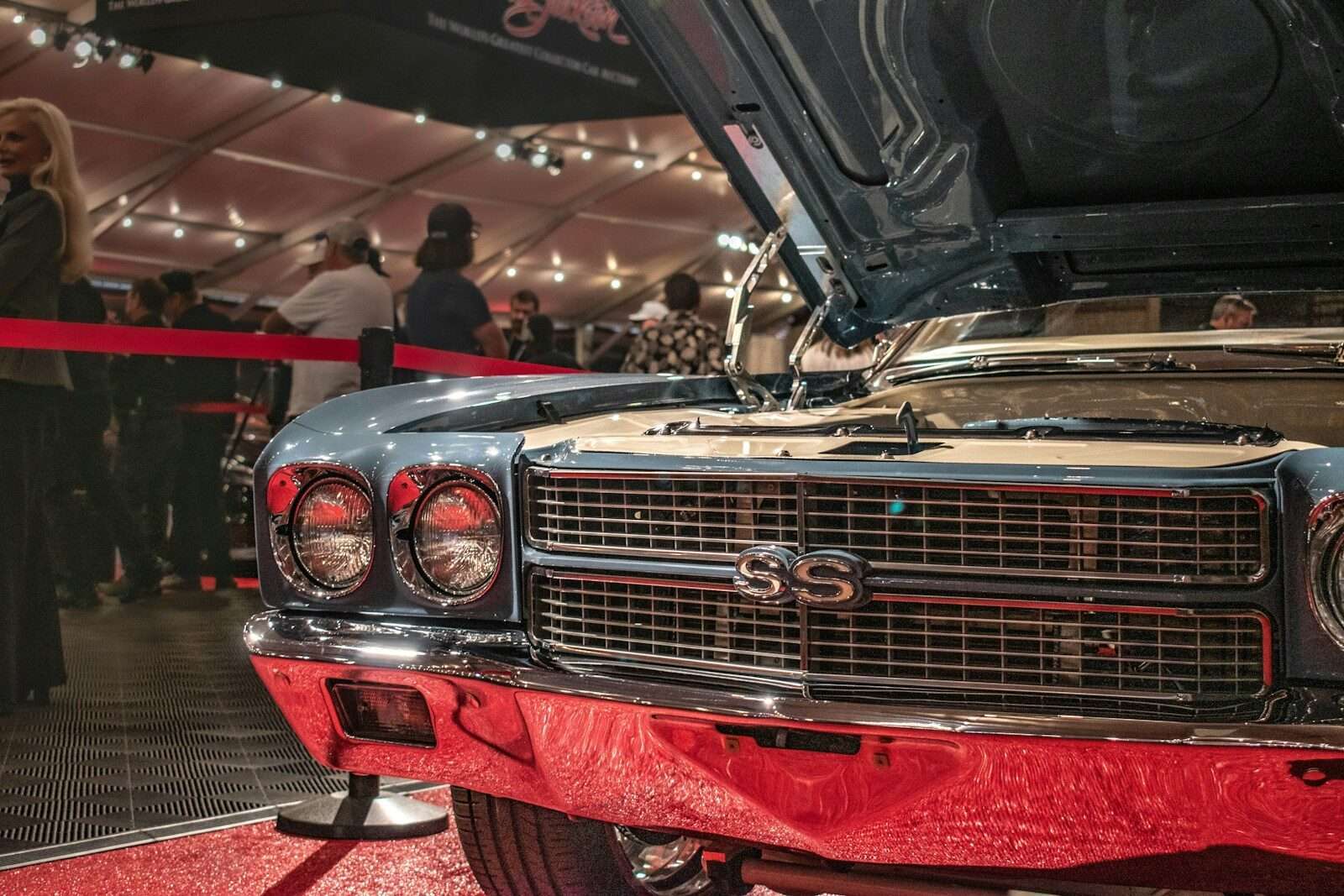
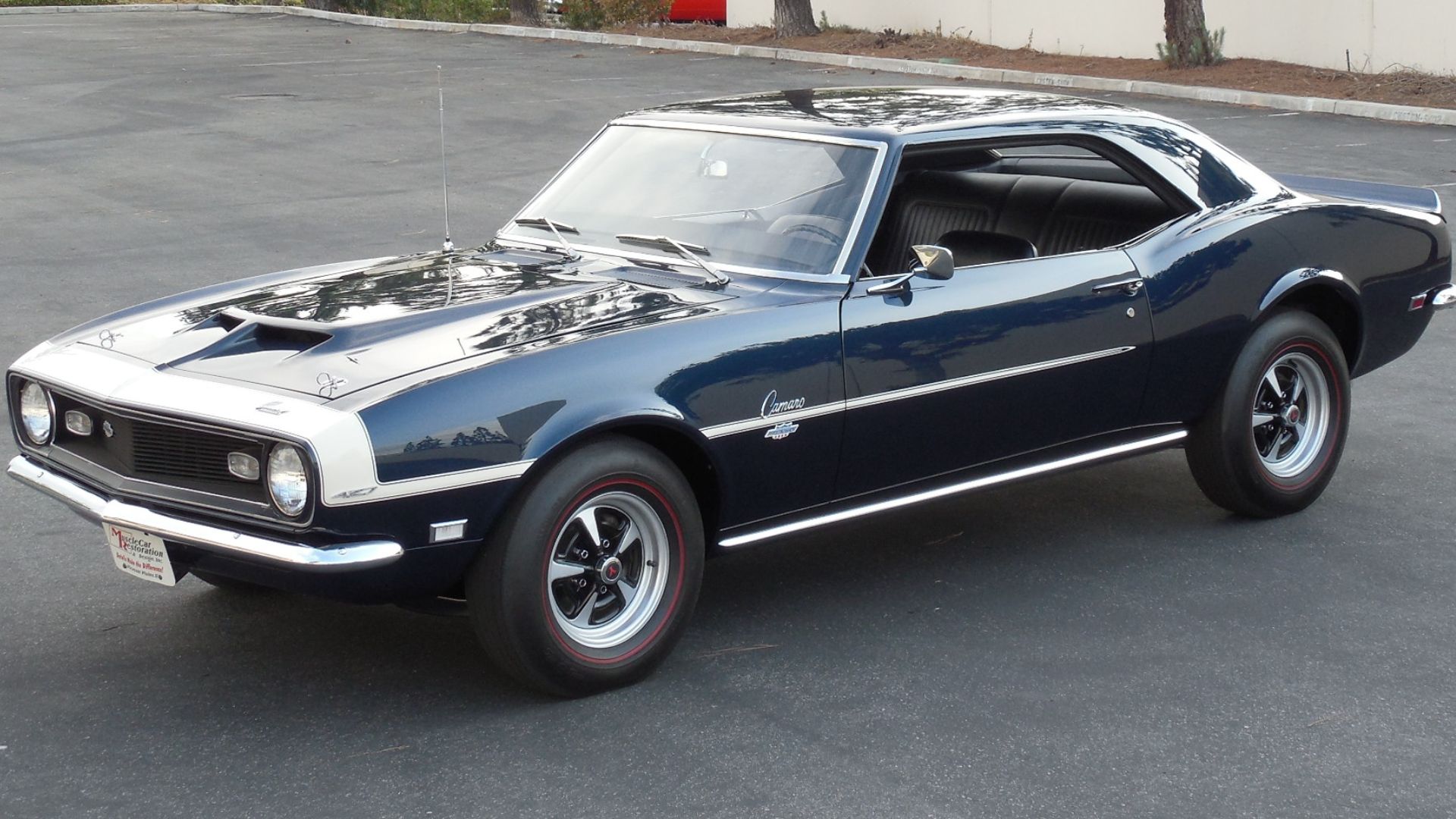
Chevrolet’s top seller, a 1970 Camaro Z/28 finished as a custom coupe, brought $275,000. Behind it came a 1950 3100 pickup, a 1967 Chevelle, and a run of Camaros and Corvettes labeled, almost without exception, “Custom.” That word is the entire story. These are restomods — beautifully executed, no doubt, but built around a donor car rather than a factory build sheet. There is nothing wrong with that; the restomod market is enormous and has its own devoted following. But a custom build’s value lives in the quality of the work performed by whoever built it, not in a chain of documentation stretching back to the factory floor. It doesn’t compound the way originality does, because there’s no original configuration to be original to.
That’s why Chevrolet’s ceiling in Columbus stopped at $275,000 while Ford’s went past $1.1 million four separate times. It isn’t a brand-loyalty story. It’s a story about what each list of cars actually was.
The Charity Trucks Are Their Own Thing — and Worth Watching
Two modern trucks sold for causes rather than collector merit: a 2022 Ford Bronco built with RealTruck and NFL quarterback Joe Burrow brought $90,000 for the Joe Burrow Foundation, and a 2025 Chevrolet Silverado 1500 in a custom Anduril livery raised $150,000 for the Call of Duty Endowment. Neither belongs on a collectibility list, and Barrett-Jackson doesn’t pretend otherwise — but these celebrity- and brand-collaboration charity builds have become a reliable fixture of every major sale now, a separate lane entirely from investment-grade collecting. Worth noting, not worth confusing with the rest of the leaderboard.
What This Means for Collectors
Originality still sets the ceiling, even at a brand-new sale location with no sales history of its own. A car with a genuine, factory-documented reason to be rare — like the Boss 429’s homologation story — will out-price a beautifully executed custom nine times out of ten. Licensed continuation and tribute vehicles, done right, have earned real standing in the market; treat them as their own asset class rather than dismissing them as novelties or assuming they behave like numbers-matching originals. And restomods should be bought and priced as craftsmanship purchases — pay for the build quality you can see, not for an appreciation curve that assumes a documented past the car doesn’t have.
Collectors rarely pay a premium for horsepower alone. In Columbus, they paid a premium for a paper trail — whether that trail led back to a NASCAR homologation requirement, a factory allocation letter, or a film studio’s license agreement. The cars without one, however well built, hit a ceiling that the cars with one simply didn’t.
The collector car market, every weekday morning.
Auction results, price moves and what’s crossing the block, read in four minutes. Free, from Modern Car Collector.
No spam, unsubscribe in one click. Or read more about the Brief.




 Elizabeth Puckett
  John Lloyd
  Kyle Matthews