

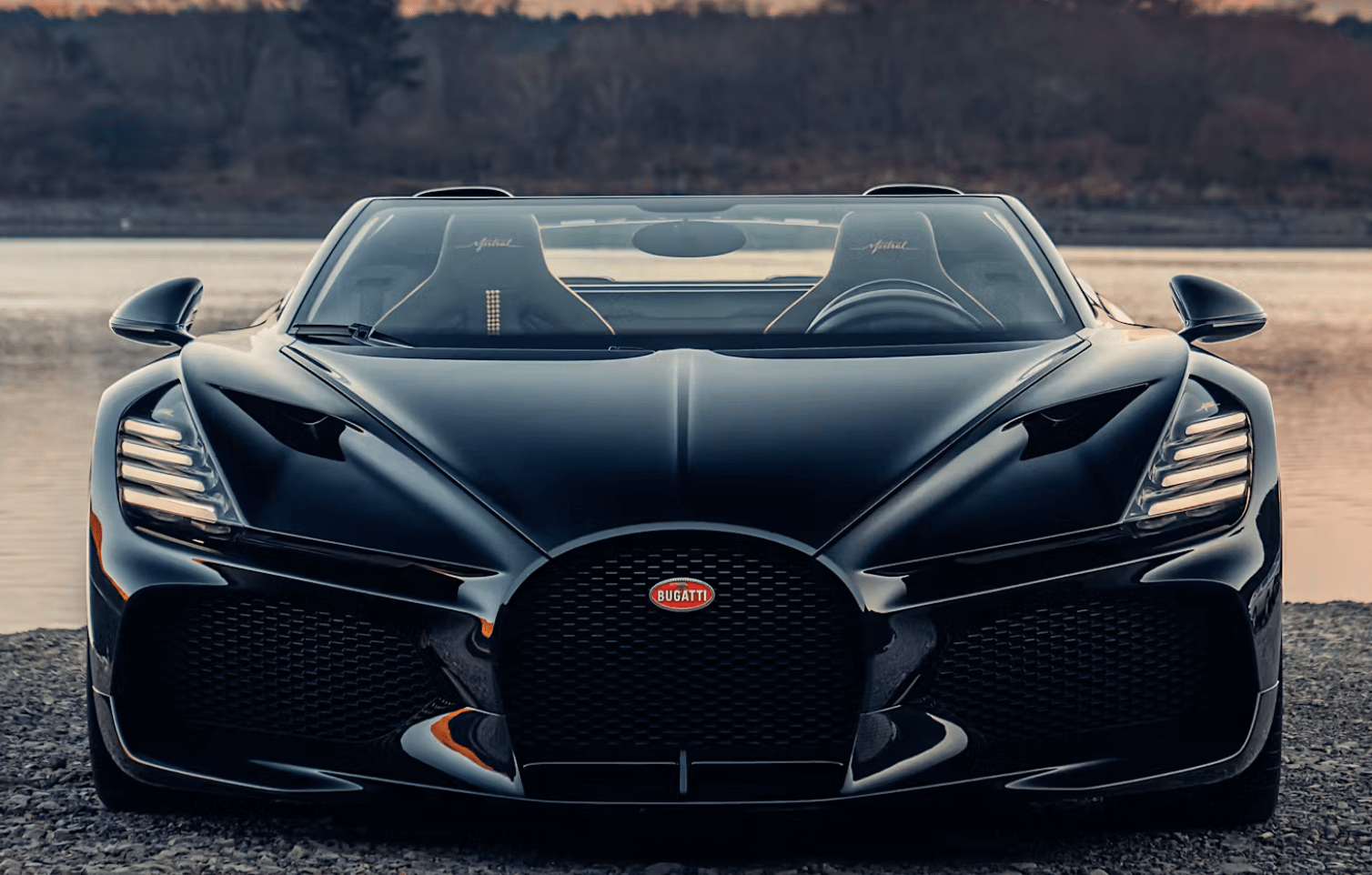
Bugatti keeps announcing funerals for the W16 and then declining to attend them. Three weeks ago the company said goodbye to the engine in the most formal way it knows how, wheeling the 99th and final W16 Mistral out of the Molsheim Atelier under the name “The last of its kind.” Now the brand’s official social channels are teasing a third Programme Solitaire commission, and the imagery leans on the W16’s engine plaque. Read that as confirmation: the quad-turbo eight-liter has one more appearance booked.
Why the engine isn’t actually dead
This isn’t Bugatti contradicting itself. It’s the difference between series production and coachbuilding, and the distinction is written into the program’s founding press release. Solitaire commissions use “existing Bugatti powertrains and chassis,” with the money going into bespoke bodywork and interiors instead.
That sentence carries more engineering and regulatory weight than it looks. A one-off built on a certified Chiron-family carbon monocoque and an already-homologated powertrain inherits the existing type approval. Design a genuinely new structure or a new engine calibration and you’re back in the certification queue with crash tests, emissions cycles, and lighting regulations to satisfy — a multi-year, multi-million-euro exercise for a car that will be built exactly once. Ferrari, Rolls-Royce, and Pagani all play the same game for the same reason. Solitaire is coachbuilding in the pre-war sense precisely because that’s the only version of coachbuilding that’s still legal at scale.
Related Articles
- Jerry Seinfeld’s Porsche 907 Langheck Is Headed to Pebble Beach. Gooding Won’t Say Whose It Is.
- Iconic Bentley and Mercedes-Benz Offerings are in the Spotlight at this year’s Pebble Beach Auctions
So the practical constraint on Solitaire cars isn’t Bugatti’s willingness. It’s how many W16 engines, transmissions, and chassis remain in inventory. Nobody outside Molsheim knows that number, and Bugatti isn’t saying.
What the hardware almost certainly is
Both previous Solitaire cars used the 1,600 PS (1,578 hp) version of the W16, and there’s no reason to expect a third to be different. That specification debuted in the Chiron Super Sport and, per Bugatti’s own F.K.P. Hommage release, involves larger turbochargers, upgraded intercoolers, revised cooling, and a strengthened dual-clutch gearbox to survive the extra torque. It is not a software flash. It is a different engine build.
The same release contains the best packaging stat in modern hypercars: by staggering the cylinders across narrow-angle banks, Bugatti’s engineers squeezed sixteen cylinders into 645 millimeters of length. A conventional sixteen would run close to a meter. That compression is the entire reason the Veyron could use a 2,700 mm wheelbase and still swallow a mid-mounted 8.0-liter with four turbos, all-wheel drive, and the radiator count of a small district heating plant.
What owning one actually involves
Anyone shopping W16 hardware — Solitaire commission or used Chiron — should understand what the architecture demands. The cooling system is the hard part. Ten heat exchangers, a dedicated intercooler circuit, and coolant volume measured in dozens of liters mean thermal management is the dominant service item, not the engine internals. Fluids, hoses, and seals age on the calendar rather than the odometer, which is exactly the wrong failure mode for cars that cover 500 miles a year.
Tires deserve the same attention. The Hommage runs 20-inch fronts and 21-inch rears on current Michelin compounds; the surrounding W16 family uses speed-rated rubber built specifically for this platform and available from essentially one supplier. Age-out replacement is a five-figure line item, and there is no aftermarket alternative that’s rated for the job.
Related Articles
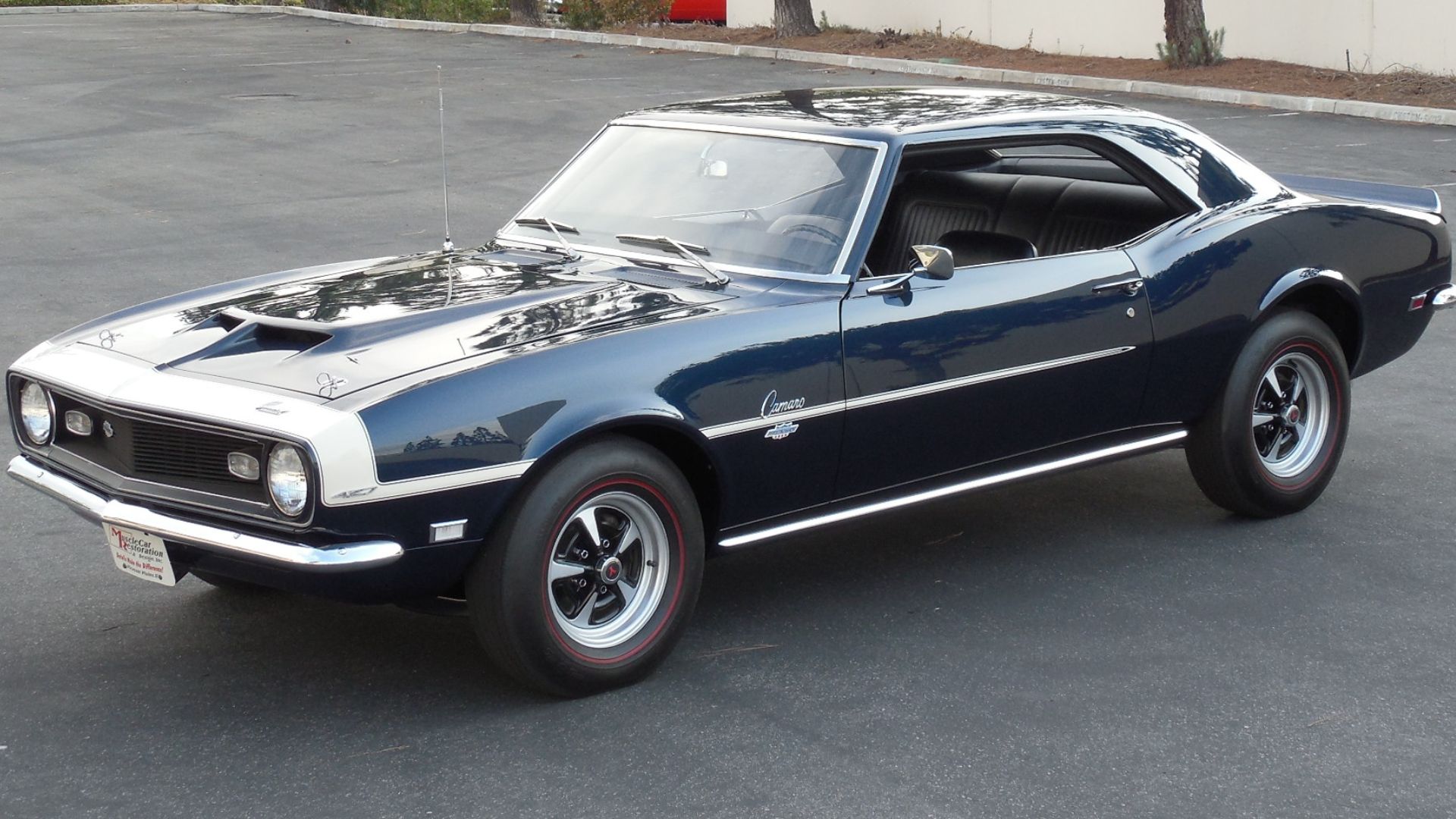
- Modern Car Collector Readers Get More Entries to Win a 1969 Camaro Z/28 and 1970 Chevelle SS454 — Super Chevy Dream Giveaway Ends 8/4
- Sweepstakes Puts Two Corvettes on the Line, Including a 2026 ZR1
The bodywork is where a one-off gets genuinely awkward. Every exterior panel on a Solitaire car exists in a production run of one. There is no parts bin, no shelf stock, and no independent shop with the tooling. A stone chip is a conversation with Molsheim. Insurers price this accordingly: these cars are written on agreed-value collector policies with named-driver restrictions and mileage caps, because a standard actual-cash-value settlement is meaningless on a vehicle with no comparable sales.
The efficiency math nobody advertises
Bugatti’s own WLTP figures put the W16 Mistral at 21.8 l/100 km combined and 495 g/km of CO2 — roughly 10.8 mpg, in the worst efficiency class the European scale offers. The Chiron is thirstier still at 25.2 l/100 km and 572 g/km. In the United States, that math translates directly into gas-guzzler tax exposure and CAFE penalties that Bugatti simply absorbs as a cost of doing business at these volumes. It’s a reminder that the W16’s retirement was never purely sentimental.
The ownership plot twist behind all this
There’s a wrinkle worth appreciating. The W16 is a Volkswagen-era artifact, conceived by Ferdinand Piëch and developed on VW Group money. As of April, that connection is severed: Porsche agreed to sell its 45 percent stake in Bugatti Rimac and its 20.6 percent Rimac Group holding to a consortium led by New York’s HOF Capital, with BlueFive Capital as the largest investor. Completion is expected before the end of 2026, after which Rimac Group takes control. Every remaining W16 Solitaire commission will be delivered by a company with no Volkswagen ownership, selling the last of a Volkswagen engine.
Meanwhile the successor is arriving on schedule but not yet on the road. Bugatti inaugurated La Manufacture on July 2, a 3,245-square-meter atelier built to lift capacity toward 200 cars a year, and stated at the time that the building was being tooled for the Tourbillon’s start of production. The Tourbillon’s own specification sheet lists 1,800 hp combined from a naturally aspirated 8.3-liter V16 spinning to 9,000 rpm plus three electric motors, an 800-volt architecture, and over 60 km of electric-only range.
Where it shows up
Bugatti hasn’t named a venue or a date. But the Brouillard made its public debut at The Quail last August, this year’s 23rd running falls on Friday, August 14, and the event’s organizers promise more than a dozen manufacturer debuts. Draw your own conclusion.
For buyers, the practical read is straightforward. Bugatti caps Solitaire at two cars annually, W16 inventory is finite and shrinking, and the supply of new quad-turbo sixteens is now strictly zero. Every remaining commission is a claim on a component set that cannot be replenished. Whether that translates into appreciation depends on a collector market that has never had to price a modern coachbuilt one-off at resale — because none of them have been sold twice yet.
Images Via: Bugatti
The collector car market, every weekday morning.
Auction results, price moves and what’s crossing the block, read in four minutes. Free, from Modern Car Collector.
No spam, unsubscribe in one click. Or read more about the Brief.



 Kyle Matthews
  EL Puckett