

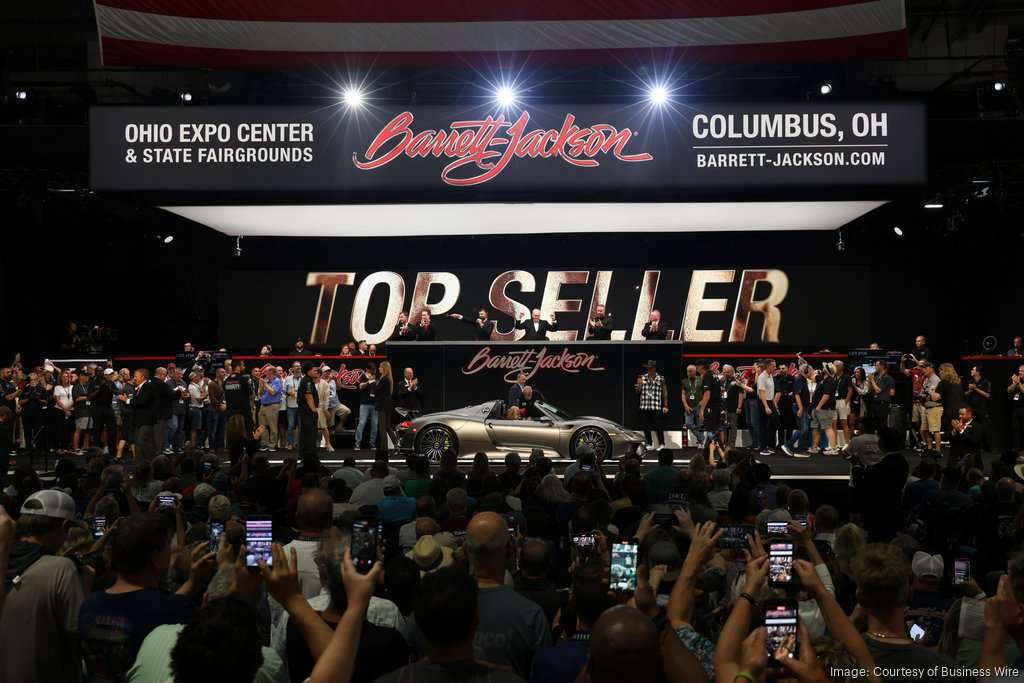
At Barrett-Jackson’s first-ever Columbus sale, held June 25–27 at the Ohio Expo Center & State Fairgrounds, the 550-car docket produced exactly three seven-figure results, and it sold through completely. Two of those million-dollar cars wore a Blue Oval and generated the expected headlines: a 2021 Ford GT ’66 Heritage Edition at $1,100,000, and a numbers-matching 1969 Boss 429 that set a new world auction record for the model at $1,045,000. The third car, and the most expensive of the entire weekend, wore neither a Ford badge nor a big-block V8. It was a 2015 Porsche 918 Spyder, and it sold for $2,695,000 — nearly two and a half times the Boss 429’s record price. That result, not the venue and not the gross, is the real story out of Columbus.
The Trinity Nobody Was Sure About
When the 918 Spyder went on sale in 2013, it arrived alongside the McLaren P1 and Ferrari LaFerrari as part of what the industry nicknamed the Holy Trinity: three flagship hypercars from three rival manufacturers, each pairing a combustion engine with electric motors and a battery pack at a performance level no hybrid had reached before. Purists were skeptical. To a generation raised on the Enzo, the Carrera GT, and the McLaren F1, a hybrid halo car looked like an admission that pure combustion engineering had hit a ceiling. There were practical doubts too, about how a battery pack would age, what a hybrid module would cost to service a decade on, and whether any of it would hold value the way an analog V12 always had.
Why This Particular Car, and This Particular Number
Barrett-Jackson catalogued this example as the 57th of the 918 units Porsche built, finished in Liquid Metal Silver and showing 13,091 miles. That mileage matters more than it might first appear. This is not a delivery-mile investment queen kept in a bubble; it is a well-used example that has clearly been driven the way Porsche engineered it to be driven. Porsche’s original sticker for the 918 landed just above $845,000 before options such as the track-focused Weissach package. A well-used, non-Weissach car trading at more than triple its original price a decade later is not a fluke inflated by a new venue’s opening-weekend energy. It is a market telling you exactly where it has decided this generation of car belongs.
Line up the production numbers and the result gets more interesting, not less. Porsche built 918 examples of the 918 Spyder. Ford capped its modern GT run at roughly 1,350 cars across 2017 to 2022, and NASCAR’s homologation rules limited the Boss 429 to a similar count across 1969 and 1970. All three cars are genuinely scarce by modern standards, and all three carry a documented, factory-controlled reason for that scarcity rather than an accident of survival. Yet only one of them outsold the other two combined. Rarity opened the door in Columbus, but it did not decide who walked through it first. The Porsche won because it was the scarcest car in the room and because a decade of real-world ownership has already answered the durability questions that kept cautious buyers on the sidelines when these cars were new.
The New Provenance
Buyers considering this generation of hypercar should treat documentation the way muscle car buyers treat a broadcast sheet. There is no matching-numbers designation for a 918 Spyder, but there is an equivalent hierarchy: Porsche’s own build and options records, a complete service history through Porsche-trained technicians, and, increasingly important as these cars age, documented hybrid-battery health. A 918 with a full Porsche service file and a clean battery report is simply a different asset than one with gaps in its history, even if the two cars look identical in photographs. That distinction will only sharpen as more of the 918 population crosses the decade-plus mark, and it is worth remembering that provenance decided the ceiling for nearly every significant result in Columbus, not just this one.
There is a generational component here as well. The buyers writing checks for 2013-era hypercars today largely grew up idolizing them as posters and video-game cover stars, the same dynamic that sent Countach and F40 values climbing once their original teenage admirers reached their peak earning years. That demographic shift, more than any single auction result, is why this number deserves attention well beyond the sale itself, and why the rest of the Holy Trinity is worth watching just as closely.
What This Means for Collectors
None of this diminishes what Ford and its restoration partners accomplished with the Boss 429, or what a factory-controlled allocation process has done for the modern Ford GT’s market. A numbers-matching Boss 429 setting a new world record is a legitimate result on its own merits. Down the same docket, three licensed ‘Eleanor’ Mustangs made a similar point in miniature, commanding real money on documentation and legal licensing rather than a factory chassis number. But the larger story in Columbus is that the market no longer treats hybrid hypercars as a science experiment with a depreciation curve attached. Collectors did not pay $2,695,000 for the 918 Spyder’s technology. They paid it because a decade of ownership has already answered the question that technology raised, and in this market, an answered question is worth more than a rare one.
The collector car market, every weekday morning.
Auction results, price moves and what’s crossing the block, read in four minutes. Free, from Modern Car Collector.
No spam, unsubscribe in one click. Or read more about the Brief.


 Kyle Matthews
  EL Puckett