
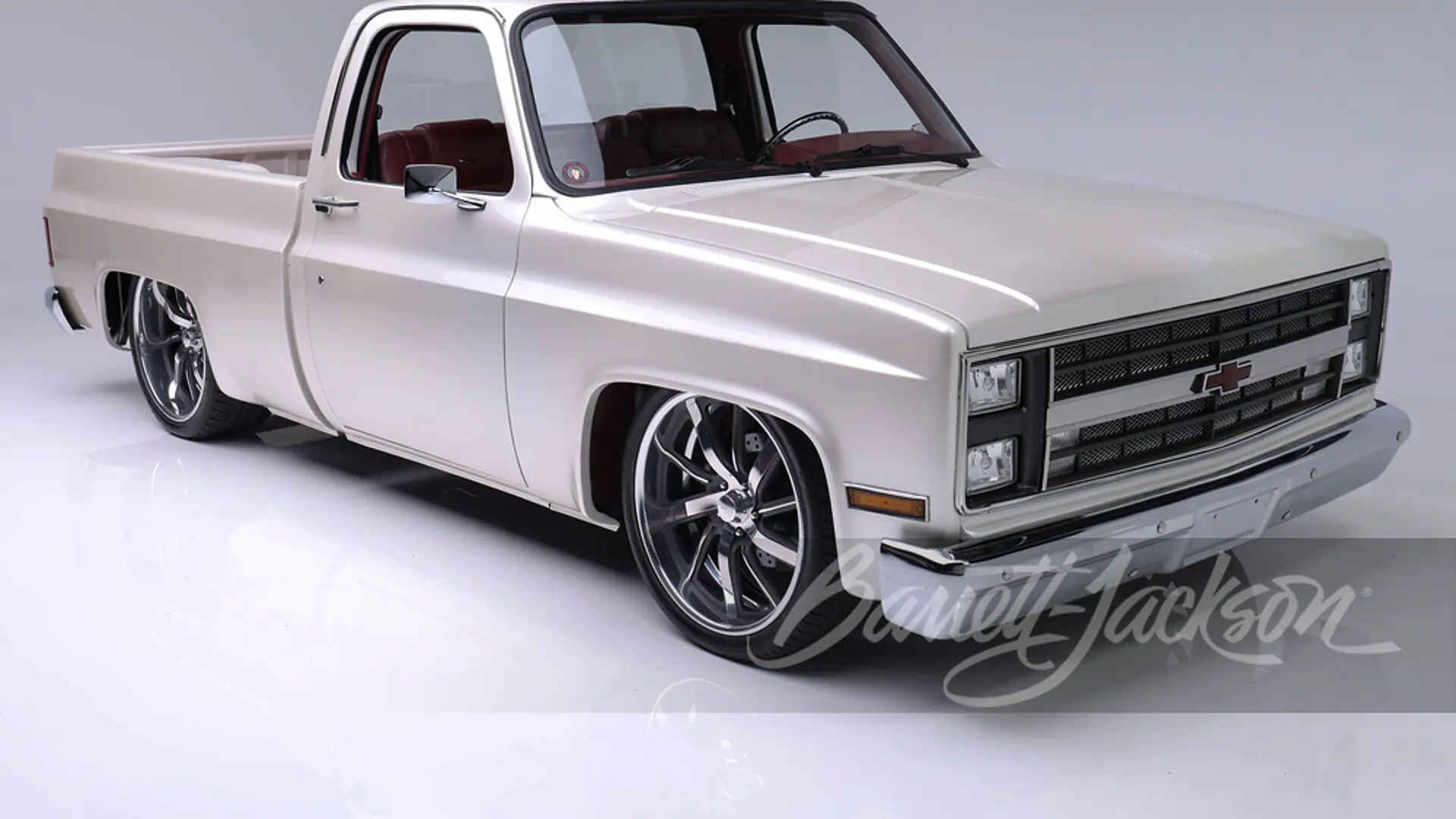
The most revealing number attached to this 1982 Chevrolet C10 isn’t the $172,700 it brought at Barrett-Jackson. It’s the $200,000 in build receipts that crossed the block with it, and the distance between the two.
Offered at no reserve as Lot 682 from the Bryan Frank Collection during Barrett-Jackson’s return to Las Vegas in September, the Pearl White pickup recovered roughly 86 cents of every dollar documented in its build. In most corners of the collector market, a 14 percent shortfall would read as a disappointment. In the custom-truck world, it is close to the best outcome a seller can reasonably expect.
That is the real story. Receipts document what a build cost. They never document what it is worth. This truck came unusually close to closing that gap, and the reasons why matter to anyone who builds, buys or consigns a modern custom.
Why a Square-Body, and Why Now
Chevrolet’s 1973–1987 C/K trucks, universally known as square-bodies, were built in enormous numbers over a fifteen-model-year run. Nothing about a standard half-ton C10 is scarce, and no serious buyer pretends otherwise. This is not a case of scarcity doing the selling.
The argument for the square-body is generational. It was the everyday truck of the late 1970s and 1980s: the one on the farm, at the job site, in the high school parking lot. The people who rode in them as kids are now in their prime buying years, and they are spending on the vehicles of their own youth, exactly as earlier generations did with Tri-Five Chevrolets and first-generation Camaros. Memory becomes demand once a generation has the means to act on it.
This example comes from the later part of the run, after Chevrolet’s 1981 restyle reworked the front sheet metal for better aerodynamics and lower weight. Its specification also carries a quiet irony. The 1982 model year was when Chevrolet first offered its 6.2-liter diesel V-8 in half-ton pickups. Forty-four years later, a 6.2-liter Chevrolet V-8 in a C10 means something entirely different.
The VIN listed in the catalog, 1GCDC14F8CJ163555, identifies a genuine 1982 Chevrolet half-ton with two-wheel drive. That matters for title and registration. Beyond that, the factory specification of this truck is nearly irrelevant to its value. Almost nothing that drove the price left the Chevrolet plant with it.
What $200,000 Bought
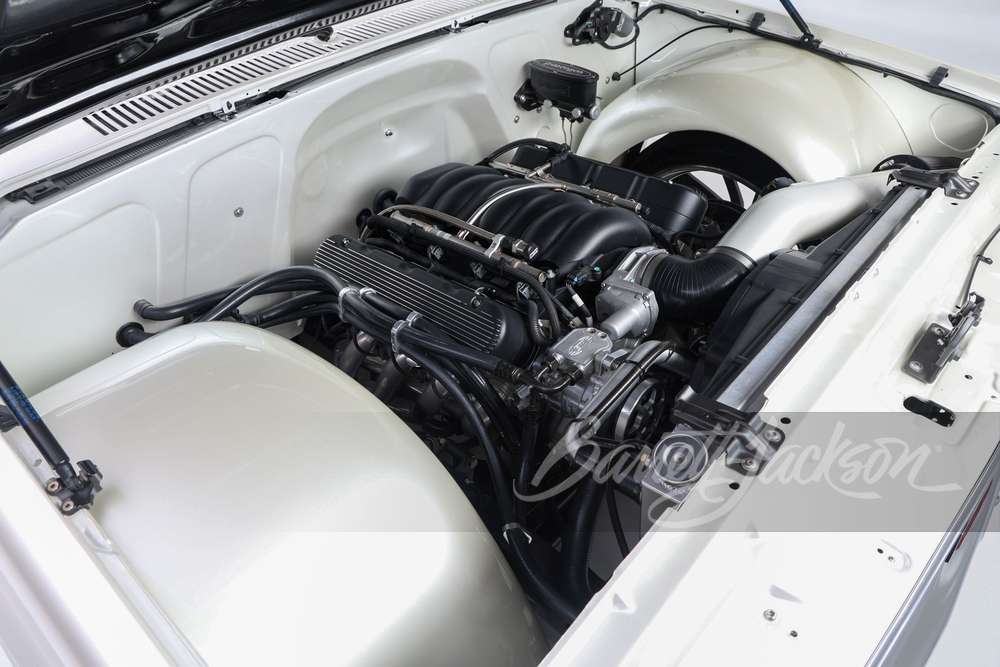
The foundation is a full custom chassis from GSI Machine and Fabrication, carrying adjustable air suspension, a four-link rear, custom front control arms, Wilwood drilled and slotted disc brakes with a Wilwood master cylinder, and a rear-mounted fuel tank. Power comes from a 6.2-liter LS V-8 crate engine paired with a 6L80E six-speed automatic, the combination that has become the default for serious builds because it is reliable, serviceable and supported nationwide.
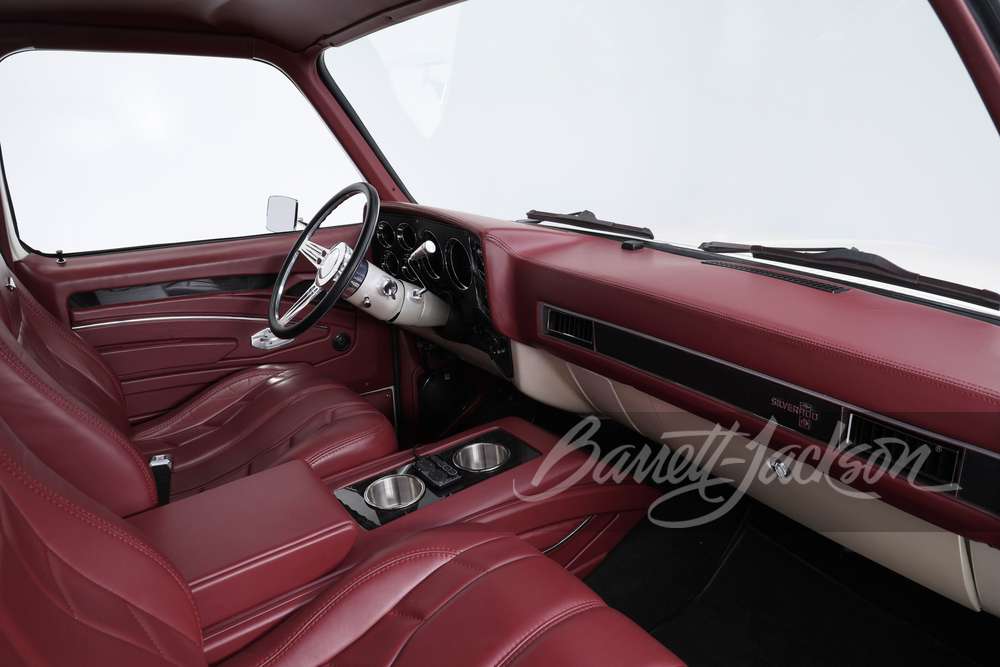
The body was professionally cut and buffed in Pearl White and fitted with mesh grille inserts, Slosh Tubz front wheelhouses, one-piece door glass and 22-inch Raceline wheels. Inside, burgundy leather covers bucket seats, custom door panels with billet releases and a custom console, joined by air conditioning, power windows, a tilt column, a billet steering wheel and a stereo with subwoofers behind the seats.
The overlooked details are the ones a listing photo barely shows. The bed floor is raised to hide the air tank. The swing-out taillamps conceal both the fuel filler and remote battery-charging lugs. Shortcut builds put the tank in plain view and leave the filler in the bedside. Concealment like this is the mark of a truck planned as a whole rather than assembled from a parts catalog, and experienced buyers notice it immediately.
Why 86 Percent Is a Strong Number
Custom vehicles lose value the day they are finished, for structural reasons. The person commissioning a build pays for labor, iteration, specialty parts at retail, corrections and taste. The next owner pays only for the result, and only for the parts of that taste they happen to share. The stereo, the wheel choice and the burgundy leather are personal decisions with a smaller audience than the chassis underneath them.
That is why custom builds routinely trade well below their documented cost, often by a wide margin. Against that backdrop, recovering most of the receipts is a vote of confidence in the work. The no-reserve format makes the number more meaningful, not less. The consignor did not protect the price. The room set it, and at least two bidders believed the truck was worth this much.
The buyer also purchased something that never appears on an invoice: time. A build of this scope typically consumes a year or more, with all the uncertainty of shop schedules and cost overruns. A finished, sorted, documented truck carries a premium over a project, and part of that premium is the price of not waiting.
Provenance, Rewritten for Custom Trucks
For a blue-chip classic, provenance means the ownership chain and the factory paperwork. For a custom, provenance is the build itself: who designed it, whose chassis it rides on, which components were used and whether the paper trail proves it. Here, $200,000 in receipts and a named chassis builder do the work that a build sheet does for a muscle car.
The collection name helps, too. Scottsbluff, Nebraska, collector Bryan Frank has been a familiar consignor at Barrett-Jackson for years, with groups of cars offered in Las Vegas in 2018 and 2023. A consignor who sends cars across the block without reserve is presenting them to sell, not to test the market, and bidders respond to that clarity.
Compare this truck with the custom 1969 Camaro Z/28 from the same sale. That car’s value rested on the factory identity its builder chose to preserve. This C10’s value rests almost entirely on what was added. Two customs, one auction, opposite sources of value, and both priced by buyers who understood the difference. The same logic runs through the Coyote-powered Bronco restomods now common at auction: the market rewards the quality of the engineering, not the novelty of the swap.
What Serious Buyers Should Verify
A strong result does not make every square-body build a sound purchase. Before bidding on a truck like this, buyers should confirm the following:
- Itemized receipts, not a total. A $200,000 figure means little without knowing how much was parts, how much was labor and which shops did the work.
- Chassis and title alignment. A full aftermarket frame should be documented, and the title should correspond to the original cab VIN as your state requires.
- Emissions and registration. California requires smog inspections for gasoline vehicles from 1976 onward, and an engine change there must be approved through the state referee program. Other states vary. Know the rules where the truck will live before you buy it.
- Air suspension health. Compressor, lines, tank and management system all deserve inspection, along with any service history.
- Drivability. Twenty-two-inch wheels and a lowered stance look right on a show truck. Confirm the alignment, ride quality and tire fitment suit how you intend to use it.
The Larger Lesson
The square-body C10 is not a blue-chip collector car in the traditional sense, and it doesn’t need to be. Its market is driven by a generation buying the truck it remembers, built the way it wishes the truck had been built. The best examples are planned, documented and executed by recognized builders, and they now command six figures at major auctions while ordinary trucks remain plentiful and affordable.
For anyone commissioning a build, the lesson is practical. Spend on what the next owner will also value: chassis engineering, finish quality and documentation. Treat personal taste as the cost of enjoyment, not as an investment.
This C10 did not make money for the person who built it. It did something more useful for the market. It showed precisely where the value in a modern custom truck lives. For the full lot description and photo gallery, see the Barrett-Jackson catalog listing.
Lead image: Barrett-Jackson
The collector car market, every weekday morning.
Auction results, price moves and what’s crossing the block, read in four minutes. Free, from Modern Car Collector.
No spam, unsubscribe in one click. Or read more about the Brief.


 Shawn Henry
  Eve Nowell