

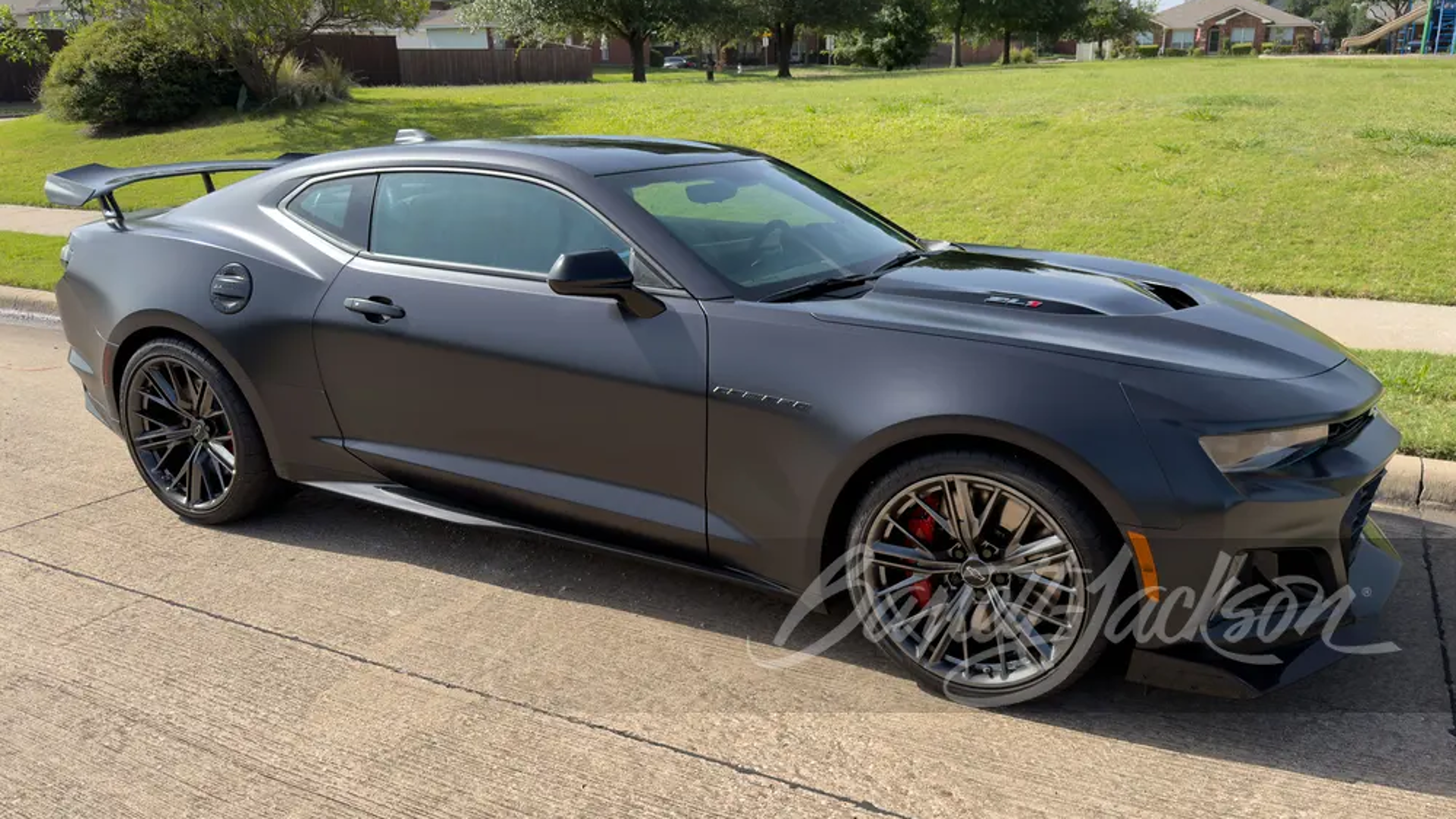
Barrett-Jackson’s Las Vegas sale wrapped up last week with a 2024 Chevrolet Camaro ZL1 Collector’s Edition crossing the block for $125,400. The car wore serial No. 23 of a 300-unit U.S. allocation, carried 125 miles, and came with the kind of documentation package collectors normally have to chase down decades after the fact: original window sticker, factory welcome kit, two commemorative posters, and a Shinola Canfield Sport watch serialized to match the car. On paper, it reads like a textbook future collector car. The question worth asking isn’t whether $125,400 was a lot of money for a two-year-old Camaro. It’s whether Chevrolet can manufacture the thing collectors have always had to wait for the market to decide on its own.
A halo built by allocation, not by accident
The ZL1 Collector’s Edition was never a mass-market trim. Chevrolet built 1,335 Collector’s Edition Camaros across the RS, SS, and ZL1 lines before Lansing Grand River closed the book on the sixth generation in January 2024, and the overwhelming majority of that total, 563 2SS coupes and convertibles alone, was never meant to be scarce in any meaningful sense. The ZL1 version is different. Chevrolet built exactly 350 ZL1 Collector’s Editions worldwide, 300 of them for the U.S. market, each wearing Panther Black Matte paint, a numbered fender badge, a serialized steering-wheel emblem, and the ZL1 1LE aerodynamics package on top of the standard car’s 650-horsepower supercharged LT4. That is a halo within a halo, and Chevrolet built it that way on purpose, tying the number 300 to a production run rather than letting scarcity emerge the way it always used to: through attrition, neglect, and the slow accident of which cars survived.
That distinction matters more than the hammer price does. The Yenko Camaro got its reputation because a Pennsylvania dealer found a loophole in GM’s engine displacement cap, not because Chevrolet marketed it as a future collectible. The same is true of the car this one is really being measured against.
Two kinds of scarcity
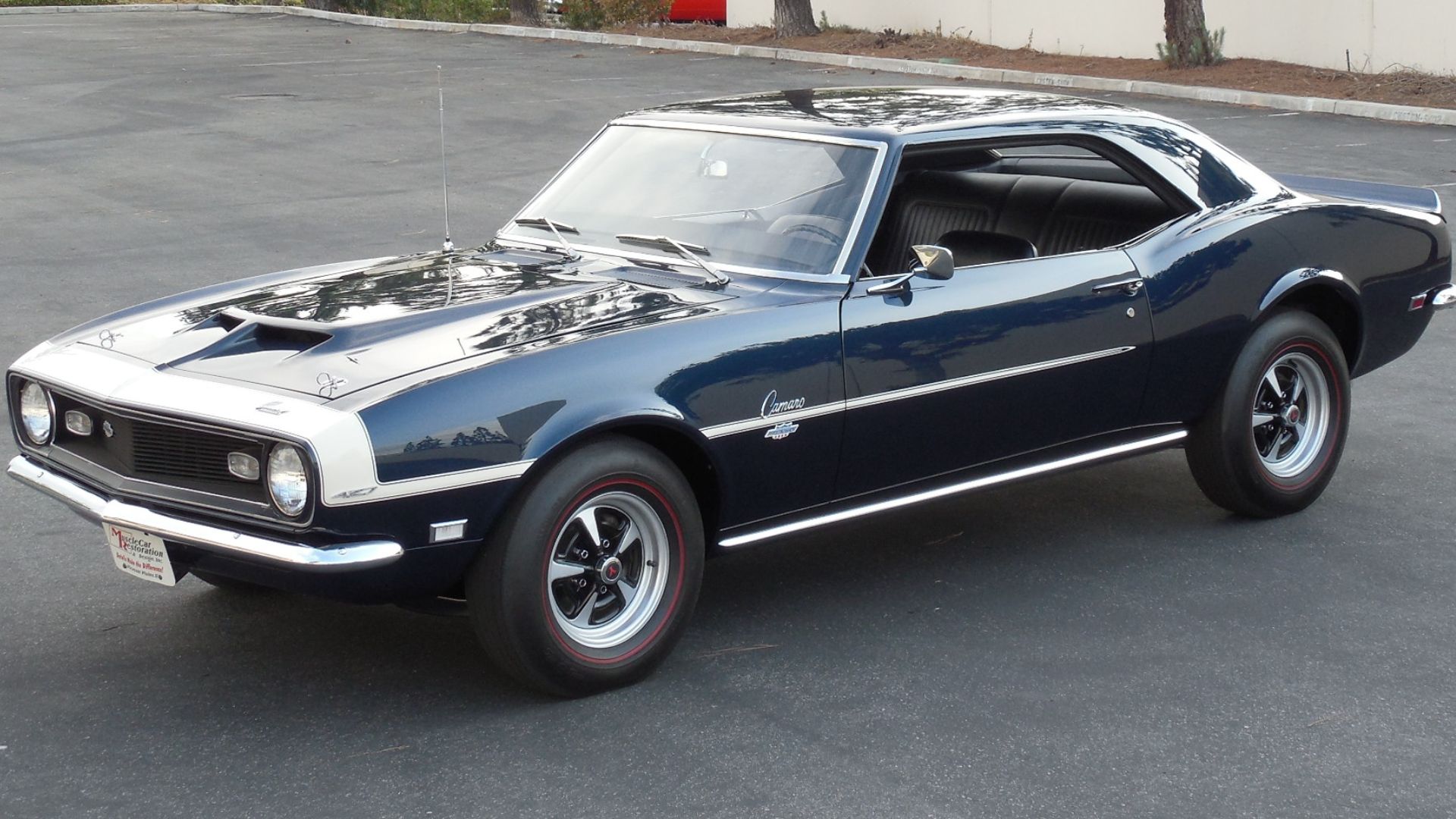
In 1969, corporate GM capped the Camaro at 400 cubic inches. Dealers and racers got around it through the Central Office Production Order system, and COPO 9560 became the vehicle for an all-aluminum, 430-horsepower 427 that Chevrolet built for one reason: to make the Camaro legal, and competitive, in NHRA Super Stock. Only 69 were built. Nobody at GM numbered a fender badge or serialized a wristwatch to go with it. The scarcity was a byproduct of a homologation requirement, not a marketing plan, and it took racers proving what the ZL1 could do on a drag strip before anyone treated it as significant. It took collectors, working from surviving Olympic Gold COPO cars with full factory documentation and painstaking COPO re-creations built to the original spec, more than fifty years to fully price that history in. A numbers-matching example sold at Barrett-Jackson’s Scottsdale auction for $1,094,500 in 2023, and the jump from its $770,000 sale five years earlier came almost entirely from the reunification of the car with its original engine block, a detail that mattered more to buyers than the paint color or the transmission.

That is earned scarcity: rarity that exists because of what a car had to be, confirmed and re-confirmed by a market that spent half a century deciding the story was real. What sold in Las Vegas last week is a different animal. Nothing about the ZL1 Collector’s Edition’s mechanical package required a 300-unit ceiling. Chevrolet chose that number, then built the entire ownership experience, the badge, the watch, the posters, the welcome kit, around the idea that owners were buying something destined to be collectible on delivery day. It is a well-executed package. It is also, at its core, a bet that Chevrolet placed on the market’s behalf before the market had any say in the matter.
Manufactured scarcity does have a track record, just not a clean one
That doesn’t mean the bet is a bad one. GM has shipped limited-run modern Camaros with real staying power before: the GMMG Phase III ZL1 built on Chevrolet’s own COPO heritage, and even a car as unlikely as the Hertz Hendrick 2020 Camaro SS, never rented and preserved as a curiosity, have both found dedicated buyers willing to pay for an unusual story attached to a low-production car. Documentation, condition, and a clean chain of ownership do compound, the same way they compounded for the Olympic Gold COPO and for Yenko Camaros that came with their original build sheets intact.
But the counterexample is sitting in Dodge showrooms right now, and it’s not encouraging for anyone assuming “final edition” is a synonym for “investment.” Dodge built 1,000 Challenger Shakedown editions as the first of its seven Last Call specials in 2023, and one recently changed hands for $63,888, roughly $5,000 under its original $69,015 sticker, with 13 miles on the odometer. A car marketed almost identically to the ZL1 Collector’s Edition, complete with commemorative badging and a “last of its kind” pitch, has already lost value new-in-wrapper. The difference isn’t sentiment. It’s math: 1,000 Shakedowns is more than triple the U.S. allocation of ZL1 Collector’s Editions, and Dodge spread similar packages across seven separate Last Call variants, diluting whatever scarcity story each one could tell on its own. Chevrolet’s restraint on the ZL1 number, whether by design or by supply constraint, is arguably the single most important decision behind why No. 23 found a buyer willing to pay 41 percent over its $88,690 window sticker.
What would actually have to happen from here
A $125,400 result on one car, from a sample of 300, is a data point, not a verdict. For the ZL1 Collector’s Edition to earn the status this sale implies rather than merely rent it, several things still need to happen. The next handful of low-mile examples need to sell at or above this level, not below it, the way early Dodge Last Call sales are currently trending against their own hype. The coupe-versus-convertible split, 274 to 76 worldwide, needs to hold a coherent value relationship instead of scrambling as more cars surface from garages and dealer floor plans. The paperwork, the watch, and the posters need to stay bundled with the cars they were issued to, because a stripped-down CE with no documentation is just a Camaro with a matte wrap and a number nobody can verify. And critically, the story needs an audience old enough to have wanted a Camaro ZL1 in period, or an entirely new generation of buyers willing to treat “last of the internal-combustion Camaro” the way an earlier generation treated “last of the big-block muscle cars.” That audience question is still open, and GM’s own comment when Chevrolet announced the end of Camaro production, that “this is not the end of Camaro’s story,” cuts both ways: a nameplate that comes back cheapens the finality this car is being sold on, while a nameplate that genuinely stays retired strengthens it.
None of that is a knock on the buyer in Las Vegas. It’s a reminder of what the industry has learned about limited editions since 1969: back then, Chevrolet built a car to solve a racing problem and let history assign the value five decades later. Today, the value proposition gets written into the press release before the car leaves the factory, and the market is asked to simply agree. Sometimes it does. Collectors don’t create value by numbering a fender badge; they create it by deciding, years or decades later, that a car actually mattered. The ZL1 Collector’s Edition has a real shot at clearing that bar. It just hasn’t cleared it yet, and neither has any other manufactured-scarcity special built in the last three years. What serious buyers should be watching isn’t this $125,400 sale. It’s the next five.
The collector car market, every weekday morning.
Auction results, price moves and what’s crossing the block, read in four minutes. Free, from Modern Car Collector.
No spam, unsubscribe in one click. Or read more about the Brief.
Related Posts:
- The Complete Guide to the Yenko Camaro
- 2,300-Mile 2023 Chevrolet Camaro ZL1 1LE Is for Sale…
- Record Ferraris, Rare Icons and 15,000 RPM: The Week…

- 1969 Chevrolet Camaro ZL1 (COPO 9560): Collector Spec Sheet
- Today in Collector Car History: The 1967 Chevrolet…
- The Collector Car Market Paid Up for Certainty This…

 Kyle Matthews
  Eve Nowell