

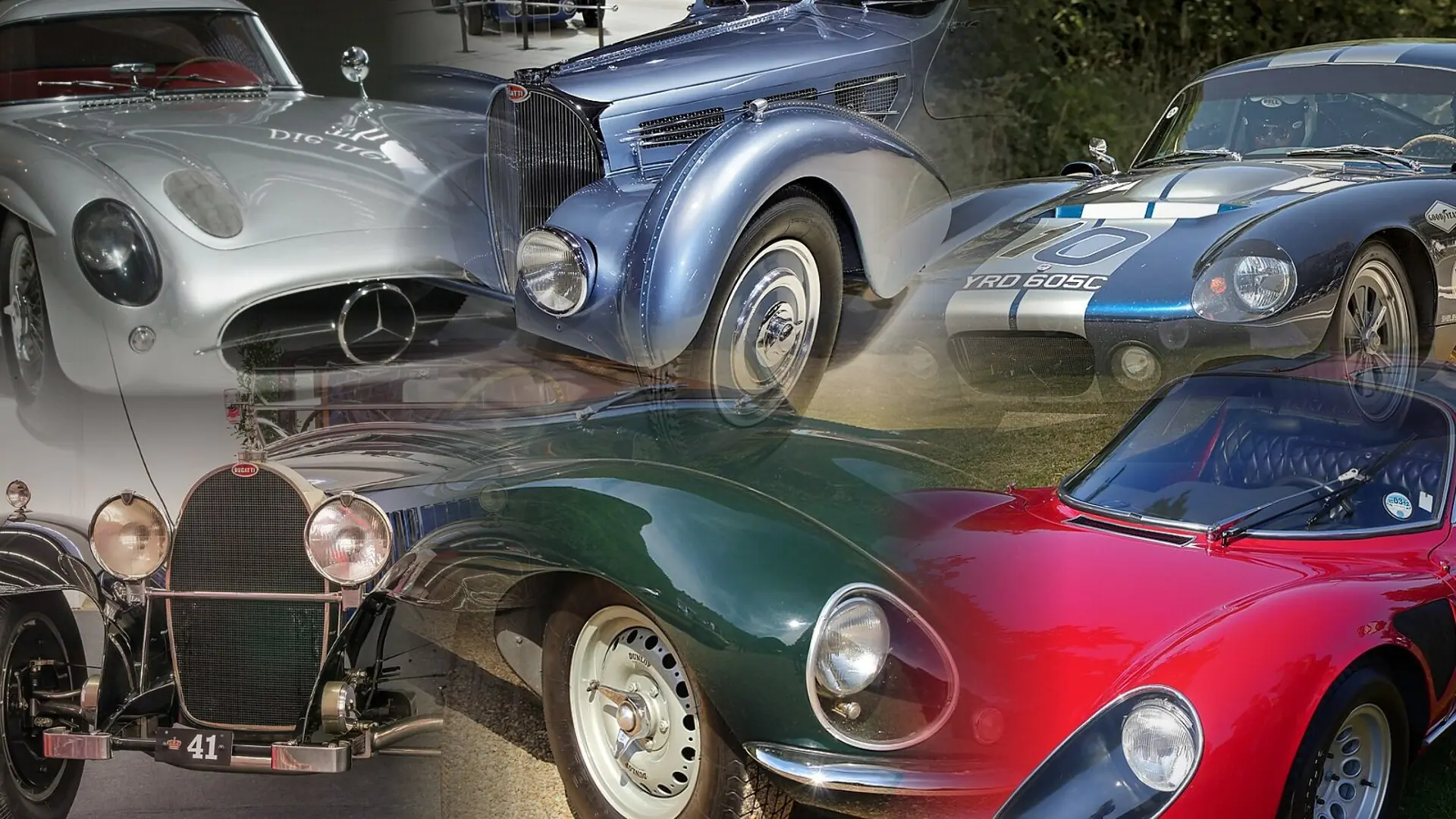
Plenty of classic cars are described as rare. These six are rare in a way that changes how the market treats them. Production ran from two cars to eighteen, most of the surviving examples live in museums or long-term private collections, and when one does change hands, the sale tends to rewrite the record books. A few of them never come up for sale at all.
The list counts down from the most-produced car to the least. Production figures are the original period builds; later continuation or recreation cars are noted where they exist but not counted. For the cars that have sold, see our running list of the 10 most expensive cars ever sold at auction.
6. Alfa Romeo 33 Stradale (1967–1969) — 18 Built

- Built: 18, between November 1967 and March 1969
- Engine: 2.0-liter V8, 230 PS (227 hp) at 8,800 rpm
- Top speed: 260 km/h (162 mph)
- Price new: US$17,000 in 1968
The 33 Stradale is what happens when a factory race team builds a road car with almost no compromises. Alfa Romeo took the chassis and the high-revving 2.0-liter V8 from its Tipo 33 sports racer, and Franco Scaglione drew a body that still turns up near the top of “most beautiful car” lists more than half a century later. It was also the first production car to use butterfly doors.
At US$17,000, the Stradale was the most expensive car on sale to the public in 1968, and very few buyers were willing to pay it. Only 18 were completed, and several of those chassis were later used as the basis for one-off concept cars from Italy’s top design houses. Alfa Romeo thought enough of the car to revive the name for a limited modern supercar in 2023, but the originals remain among the most sought-after Italian cars of the era.
5. Jaguar XKSS (1957) — 16 Built

- Built: 16 original cars (25 planned)
- Engine: 3.4-liter Jaguar XK inline-six
- Origin: Road-going conversion of the Le Mans-winning D-Type
- Famous owner: Steve McQueen
The XKSS exists because Jaguar had race cars it couldn’t sell. When the factory pulled out of racing after the 1956 season, it was left with unsold D-Types, the car that won Le Mans in 1955, 1956 and 1957. Jaguar added a passenger door, a full-width windshield, a folding top and bumpers, and sold the result as a road car, mainly aimed at North America.
Twenty-five were planned. On the evening of February 12, 1957, a fire at Jaguar’s Browns Lane factory destroyed nine cars that were still in production, and only 16 originals were ever finished. One of them went to Steve McQueen, who called his British racing green example the “Green Rat”; it now sits in the Petersen Automotive Museum in Los Angeles.
In 2016, Jaguar Classic announced it would hand-build the nine missing cars to original specification, at more than £1 million each, to finally complete the 1957 order. Those continuation cars are a story of their own (we’ve looked at how modern continuation-style builds are valued), but the 16 period cars remain the ones collectors chase.
4. Bugatti Type 41 Royale (1927–1933) — 7 Built

- Built: 7 (six survive)
- Sold to customers: 3
- Engine: 12.8-liter (12,763 cc) straight-eight, roughly 275–300 hp
- Wheelbase: 4.3 meters (169.3 in); overall length about 6.4 meters (21 ft)
Ettore Bugatti designed the Royale to be the grandest car in the world, intended for kings. The scale is still hard to believe: a 12.8-liter straight-eight, a wheelbase longer than many modern full-size pickups, and an overall length of about 21 feet. The bare chassis cost US$30,000 when it went on sale.
The timing could not have been worse. The Royale arrived on the eve of the Great Depression, and not a single king bought one. Bugatti made seven, but only three were sold to customers. The engine found a more profitable second life powering French railcars.
Six Royales survive, and each body is different. The Coupé Napoléon, Ettore’s own car, and the Park Ward limousine are in the Cité de l’Automobile in Mulhouse, France. The Weinberger cabriolet belongs to the Henry Ford Museum in Dearborn, Michigan, and Volkswagen has owned the Binder Coupé de Ville since 1999. The Kellner car set a then-record when it sold at Christie’s in 1987 for £5.5 million, or about $9.7 million.
3. Shelby Cobra Daytona Coupe (1964–1965) — 6 Built

- Built: 6
- Designer: Peter Brock
- Big win: 1965 International Championship for GT Manufacturers (GT III class)
- Coachwork: Prototype built in Venice, California; the other five by Carrozzeria Gransport in Modena, Italy
Carroll Shelby‘s open Cobra roadster was brutally fast, but it was a brick on Europe’s long straights. Peter Brock’s answer was a long, low, cut-off-tail coupe body that let the same Ford V8 run much faster at places like the Mulsanne Straight. The first car was built in Venice, California, and the remaining five were bodied in Modena, Italy.
It worked. In 1965 the Daytona Coupe won the GT class of the International Championship for GT Manufacturers, making Shelby the first American constructor to take a world title. Only six were ever built.
The prototype, CSX2287, has the most remarkable story. It set 25 land speed records at Bonneville in November 1965, was later owned by record producer Phil Spector, and then disappeared for decades before turning up in a California storage unit in 2001. After a legal fight over ownership, it went to the Simeone Foundation Automotive Museum in Philadelphia in 2009 for a reported $7.25 million. In 2014 it became the first car listed on the National Historic Vehicle Register.
2. Bugatti Type 57SC Atlantic (1936–1938) — 4 Built

- Built: 4 (three known to survive)
- Designer: Jean Bugatti
- Engine: 3.3-liter twin-cam straight-eight, about 200 hp when supercharged
- Signature detail: The riveted dorsal seam running nose to tail
If any car on this list is a work of art first and a car second, it’s the Atlantic. Jean Bugatti, Ettore’s son, based it on the Aérolithe concept, whose body was made from Elektron, a magnesium alloy that couldn’t be welded, so the panels were riveted together along a raised seam. The production cars switched to aluminum, but Bugatti kept the seam because it looked spectacular.
Four were built. Chassis 57374, the original Rothschild car, won Best of Show at Pebble Beach in 2003 and was sold in 2010 for a reported $30 million or more to the Mullin Automotive Museum collection. Chassis 57591 has belonged to Ralph Lauren since 1988 and has won Best of Show at both Pebble Beach and Villa d’Este. Chassis 57473, now in a private collection in Spain, survived a serious crash and a long restoration.
The fourth, chassis 57453, is known as “La Voiture Noire” (the Black Car). It was last documented in early 1941, amid the wartime upheaval in France, and no one has publicly seen it since. It is the most famous missing car in the world, and finding it remains the dream of car-world treasure hunters.
1. Mercedes-Benz 300 SLR Uhlenhaut Coupé (1955) — 2 Built

- Built: 2
- Engine: 3.0-liter (2,982 cc) straight-eight with direct fuel injection, 310 PS
- Top speed: close to 290 km/h (180 mph)
- Sold: €135 million (about $142 million), RM Sotheby’s private auction, May 5, 2022
The rarest car on this list is also the most valuable car ever sold. The 300 SLR was the racing sports car Mercedes-Benz used to dominate the 1955 World Sportscar Championship, with drivers including Juan Manuel Fangio and Stirling Moss. Two hardtop coupés with gullwing doors were built for the 1956 season, but Mercedes withdrew from racing after the 1955 Le Mans disaster and they never raced.
Instead, engineer Rudolf Uhlenhaut, who led the racing department, used one as his company car. With a top speed approaching 180 mph, it was the fastest road car of its era, and it carried his name from then on.
For decades, Mercedes kept both coupés and said they would never be sold. That changed on May 5, 2022, when RM Sotheby’s held a secret, invitation-only auction at the Mercedes-Benz Museum in Stuttgart. One coupé sold to a private collector for €135 million, more than double the previous record for any car, with the proceeds going to set up a Mercedes-Benz Fund for scholarships. The other remains in the museum. The 300 SLR’s story also inspired the Fangio family to build their own.
What Makes a Classic Car Truly Rare?
Low production is only part of it. Every car here combines a tiny build run with something that can’t be repeated: a racing record, a famous designer or owner, a factory fire, a world war, or a manufacturer that simply refused to sell. That’s why provenance matters so much at this level. Two cars can share a model name, but the one with a documented history is the one collectors fight over, just as a Jaguar heritage certificate can make or break a more common classic.
Some of these cars will probably never be sold again. When one does appear, it will be one of the biggest events the collector car world has seen.
Lead image: Composite of Wikimedia Commons photos by Späth Chr. (public domain), Thesupermat (CC BY-SA 3.0), Alexander Migl (CC BY-SA 4.0), Johannes Maximilian (CC BY-SA 4.0), MrWalkr (CC BY-SA 4.0) and edvvc (CC BY 2.0)
The collector car market, every weekday morning.
Auction results, price moves and what’s crossing the block, read in four minutes. Free, from Modern Car Collector.
No spam, unsubscribe in one click. Or read more about the Brief.


 Eve Nowell
  Shawn Henry