

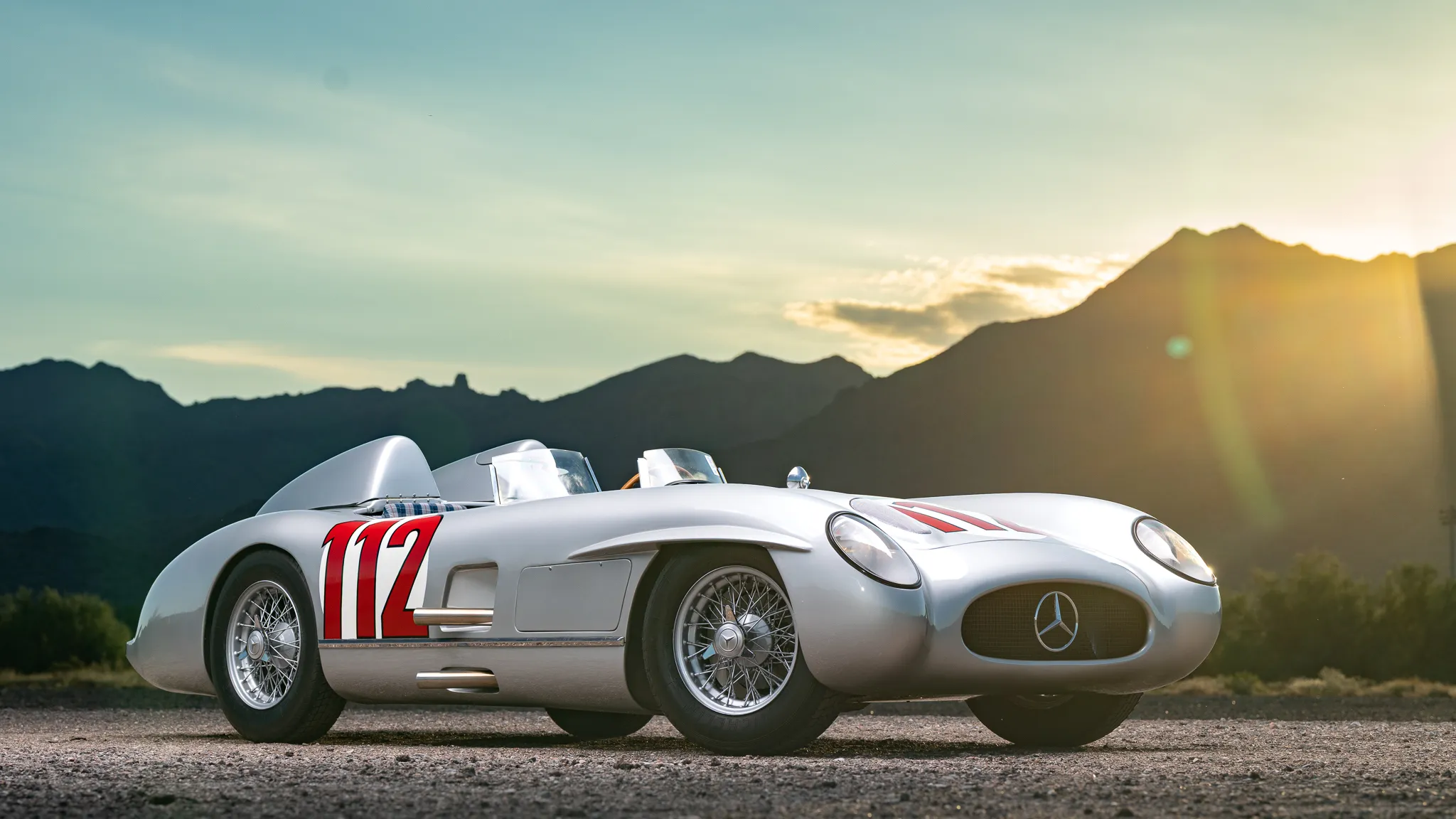
A silver two-seat racer wearing a red “112” roundel is currently bid to $110,000 on Bring a Trailer, consigned through a Scottsdale dealer with days left on the clock. Its shape belongs to the Mercedes-Benz 300 SLR, the car that delivered a record-setting Mille Miglia win in 1955 and helped Mercedes-Benz sweep that year’s World Sportscar Championship. But this isn’t a 300 SLR, and nobody involved has ever pretended otherwise. It’s a Mercedes-Benz 300 SLR replica, hand-built in Argentina and commissioned by Oscar “Cacho” Fangio, son of five-time Formula One champion Juan Manuel Fangio, in honor of the car his father raced. The reason it exists says more about the collector market’s upper reaches than any single auction result this year.
The Car That Isn’t Really for Sale
Nine 300 SLR roadsters were built for the Mercedes-Benz works team in 1955, along with two closed coupes finished afterward for engineering director Rudolf Uhlenhaut, who used one as a personal car. Stirling Moss and co-driver Denis Jenkinson drove one to victory in that year’s Mille Miglia at a record average speed that has never been challenged, because the open-road race itself was banned after 1957. Fangio, driving the sister car without a navigator for nearly a thousand miles, finished second. That same season the model also won the Targa Florio and closed out Mercedes’ sports car championship, while Fangio claimed his third Formula One title in the marque’s W196.
Almost every surviving 300 SLR remains under Mercedes-Benz’s own stewardship rather than in private collections. The one meaningful exception arrived in 2022, when the manufacturer privately sold one of its two Uhlenhaut coupes for €135 million, by its own account the highest price ever paid for a car. Mercedes-Benz has said the proceeds funded an educational and environmental scholarship program rather than a private seller’s balance sheet. It was less a market transaction than a decision to let one example go on the company’s own terms.
That is the context worth sitting with. For a private collector, no matter how well capitalized, a genuine 300 SLR is not really a car that can be bought. It is closer to a national museum piece that occasionally, and reluctantly, changes hands.
Building What the Market Won’t Sell
That scarcity is precisely what makes the Fangio family’s decision interesting. Commissioned by Cacho Fangio and completed in 2018 after a two-year build, the car was constructed by Argentine coachbuilder Javier Izurieta, who hand-formed the body from 5052-H32 aluminum using measurements and drawings taken directly from an authentic 300 SLR. The tubular spaceframe chassis follows factory blueprint dimensions, adapted to accept modern running gear.
That last point matters more than it might first appear. Rather than chase a reproduction of the original’s temperamental fuel-injected straight-eight, the builders fitted a 2.4-liter M112 V6 and six-speed manual sourced from a Mercedes-Benz W202-generation C240, along with that car’s four-wheel disc brakes and power steering. It is an honest engineering choice: a tribute meant to be driven, not a museum prop pretending to race-spec mechanicals it doesn’t have. The car wears red livery associated with the 300 SLR Fangio piloted at the 1955 Targa Florio, along with covered headlights, wheel-arch eyebrows, and Rudge-style wire wheels drawn from the original’s visual language.
What Serious Documentation Looks Like
The car changed hands again in 2024, and its new owner treated it as more than a static homage. The taillight mounts were reshaped, the seats were reupholstered in Mercedes-Benz tartan cloth, and dash-mounted Heuer rally timers and a Smiths clock joined the cockpit alongside lap harnesses. In November 2024, the car appeared on the cover of 300 StarLetter, the newsletter published by the Gull Wing Group, the principal club for Mercedes-Benz 300SL and 300SLR owners in North America. That is a meaningful endorsement in this corner of the hobby: recognition from the community that knows the original cars best.
The car also carries an FIA Historic Technical Passport, a document that certifies a vehicle’s construction and specification against period-appropriate technical rules for historic motorsport eligibility. That a tribute car has been vetted to this standard signals a build that goes well beyond fiberglass and decals. In the United States, though, it is titled as a 1957 MERZ, the designation given to assembled or replica vehicles, a reminder that buyers of any tribute car need to understand how their state treats registration, insurance, and eventual resale of a car that was never issued a factory VIN.
Why This Matters More Than the Bid
Run the sale price through the test that matters at Modern Car Collector: if the $110,000 bid disappeared entirely, would this still be worth writing about? It would. The real story isn’t what this car sells for. It’s what its existence tells us about where the money in this hobby is actually pointed.
As the most significant postwar competition cars increasingly land in manufacturer heritage collections, museums, and family offices that don’t sell, private collectors are left with two options: chase whatever does trade, at whatever price it commands, or pursue documented, honestly built tributes to the cars that no longer come to market at all. We’ve watched that same instinct play out elsewhere this year, from a Talbot-Lago Teardrop replica crossing the block at Mecum to a Porsche Carrera GT rebodied as a tribute to the Porsche 917. None of these cars are trying to deceive anyone. What separates a credible tribute from a fantasy kit car is exactly what separates any collector car’s value from its sticker price: documentation, craftsmanship, and a legitimate claim to the story it’s telling. That’s the same lesson we drew recently from a Steve McQueen motorcycle heading to Bonhams. The object rarely carries the value on its own. The paperwork behind it does.
Mercedes-Benz itself has never stopped selling the 300 SLR’s mystique. Decades later, the company built a modern hypercar with McLaren and named it the SLR McLaren, later releasing a 722 Edition and a run finished in tribute to Stirling Moss himself. The original car’s shadow is long enough that the factory still markets against it.
Collectors rarely pay a premium for horsepower alone. They pay for proximity to moments in history that money genuinely can’t buy anymore. The Fangio family didn’t commission this car because they could reproduce a 300 SLR. They built it because the alternative, for anyone outside a corporate boardroom in Stuttgart, is not owning one at all. That is worth remembering the next time a bid counter ticks past six figures for a car that was never meant to fool anyone.
The collector car market, every weekday morning.
Auction results, price moves and what’s crossing the block, read in four minutes. Free, from Modern Car Collector.
No spam, unsubscribe in one click. Or read more about the Brief.
 Kyle Matthews
  Eve Nowell