

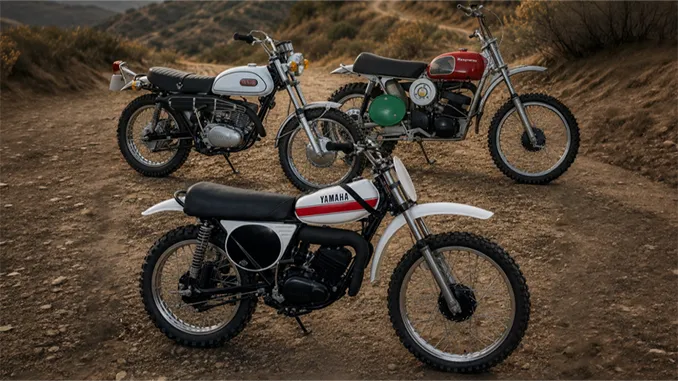
Bonhams has opened consignments for its Autumn Stafford Sale, the two-day motorcycle auction paired with the Classic MotorCycle Mechanics Show on October 10-11, and the first lot confirmed is one that needs no introduction: a 1972 Husqvarna 250cc motocrosser once owned by Steve McQueen. It carries an estimate of £30,000 to £50,000 and will sell without reserve. For readers of this publication, accustomed to McQueen’s name attaching itself to Porsches and Ferraris worth eight figures, that estimate looks almost modest. That gap between the mythology and the money is the real story here.
McQueen’s motorcycle career was not a hobby he dabbled in between films. He raced off-road seriously, competing for the United States team at the 1964 International Six Days Trial in East Germany alongside his friend and stunt double Bud Ekins, and he later produced and starred in “On Any Sunday,” the 1971 documentary that did more to popularize American motorcycle racing than any film before it. Husqvarna’s rise in the American market through the late 1960s and early 1970s owes a real debt to McQueen’s patronage; he rode the brand’s lightweight two-strokes in the desert and on the motocross track, and period dealers openly credited him with selling motorcycles in a way no advertising campaign could.
That history is exactly why the modest estimate deserves attention rather than dismissal. McQueen owned and rode a number of Husqvarnas during his competitive years, which means a single example, absent strong documentation tying it to a specific event, photograph, or period of his ownership, inherits his story but not his singularity. Compare that with Jerry Seinfeld’s rejected $25 million offer for McQueen’s Porsche 917K, a one-off hero car from a specific film, and the difference in magnitude makes sense. Rarity alone has never been what drives collector value; specificity does. Buyers considering this Husqvarna should want to see exactly what Bonhams can document: invoices, period photographs, and a continuous chain of ownership, anything that moves the bike from a Husqvarna McQueen owned toward the Husqvarna McQueen raced. That is the same standard we would expect applied to a claim like the one behind a one-of-one 1962 Mercedes-Benz 300 SL Roadster we covered earlier this year, where impeccable provenance meant documented, not merely asserted.
Selling the bike without reserve is itself a signal worth reading. A no-reserve sale removes the auction house’s safety net and lets bidders, rather than an undisclosed floor, decide what McQueen’s ownership is actually worth in today’s market. It is a genuine test rather than a choreographed result, and the outcome in October will tell us more about how deep celebrity-provenance demand runs in the motorcycle world than any pre-sale estimate can.
That test matters because the motorcycle market has been proving, lot by lot, that it can support real money. Bonhams’ Spring Stafford Sale earlier this year sold the ex-Mike Hailwood and Giacomo Agostini 1965 MV Agusta 500cc Grand Prix racer for £967,000, the second-highest price ever paid for a motorcycle at auction. Ben Walker, Bonhams’ International Department Director for Collectors’ Motorcycles, has called the October sale “another epic Bonhams motorcycle sale,” and the rest of the consignment list backs up the confidence: a barn-find 1931 Brough Superior Overhead 680, an ex-works 1926 Scott 498cc that raced the Isle of Man TT, and an ex-Isoyo Sugimoto and David Emde 1978 Yamaha TZ750 that finished second in the inaugural Suzuka 8 Hours. Every one of those lots is being sold on the same criteria that govern the car market: originality, factory racing pedigree, documented ownership, and a story that cannot be manufactured after the fact.
For collectors who live primarily in the car world, that convergence is worth noting on its own terms. Bonhams, the same house that has brought unusual and category-defining machinery like the 2006 Koenigsegg CCXR prototype to market, is applying identical connoisseurship to two wheels, and family offices and younger buyers who grew up cross-collecting are increasingly willing to follow. The wall between four-wheel and two-wheel collecting is getting thinner, and pricing at the top of the motorcycle market, a near-million-pound MV Agusta, is now closing in on entry-level classic car territory.
The other announcement bundled into this news, that James Robinson, longtime editor of The Classic MotorCycle magazine, has joined Bonhams as a consultant specialist, is not a footnote. It signals that the motorcycle market is institutionalizing the way the collector car market did decades ago. Authentication, cataloguing, and valuation performed by someone with genuine subject-matter authority is what separates a durable market from a speculative one, and recruiting one of the most respected voices in classic motorcycling to inspect and catalogue consignments tells serious buyers that Bonhams is building infrastructure for the long term, not simply chasing a famous name.
None of this means every McQueen-associated object is a wise purchase at any price. It means the opposite: that the McQueen premium, like any provenance premium, has to be earned through documentation rather than assumed from a name. Collectors rarely pay a premium for horsepower alone, and they rarely pay one for a famous name alone, either. They pay for a verifiable moment in history, and the diligence required to confirm that moment is where real judgment separates a considered purchase from an expensive one.
The Autumn Stafford Sale takes place October 10-11 at the Classic MotorCycle Mechanics Show in Stafford, England, with the full catalog to follow as remaining consignments close.
The collector car market, every weekday morning.
Auction results, price moves and what’s crossing the block, read in four minutes. Free, from Modern Car Collector.
No spam, unsubscribe in one click. Or read more about the Brief.
Related Posts:
- Record Ferraris, Rare Icons and 15,000 RPM: The Week…
- 18 Steve McQueen Cars and Motorcycles That Have Sold…
- Original-Paint 1972 Chevrolet Corvette Convertible…
- The Collector Car Market Paid Up for Certainty This…
- No-Reserve 1970 Lamborghini Miura P400S Heads to…
- This Dodge Dart Demon 340 Tribute Rolls Into…
 Shawn Henry
  Kyle Matthews