

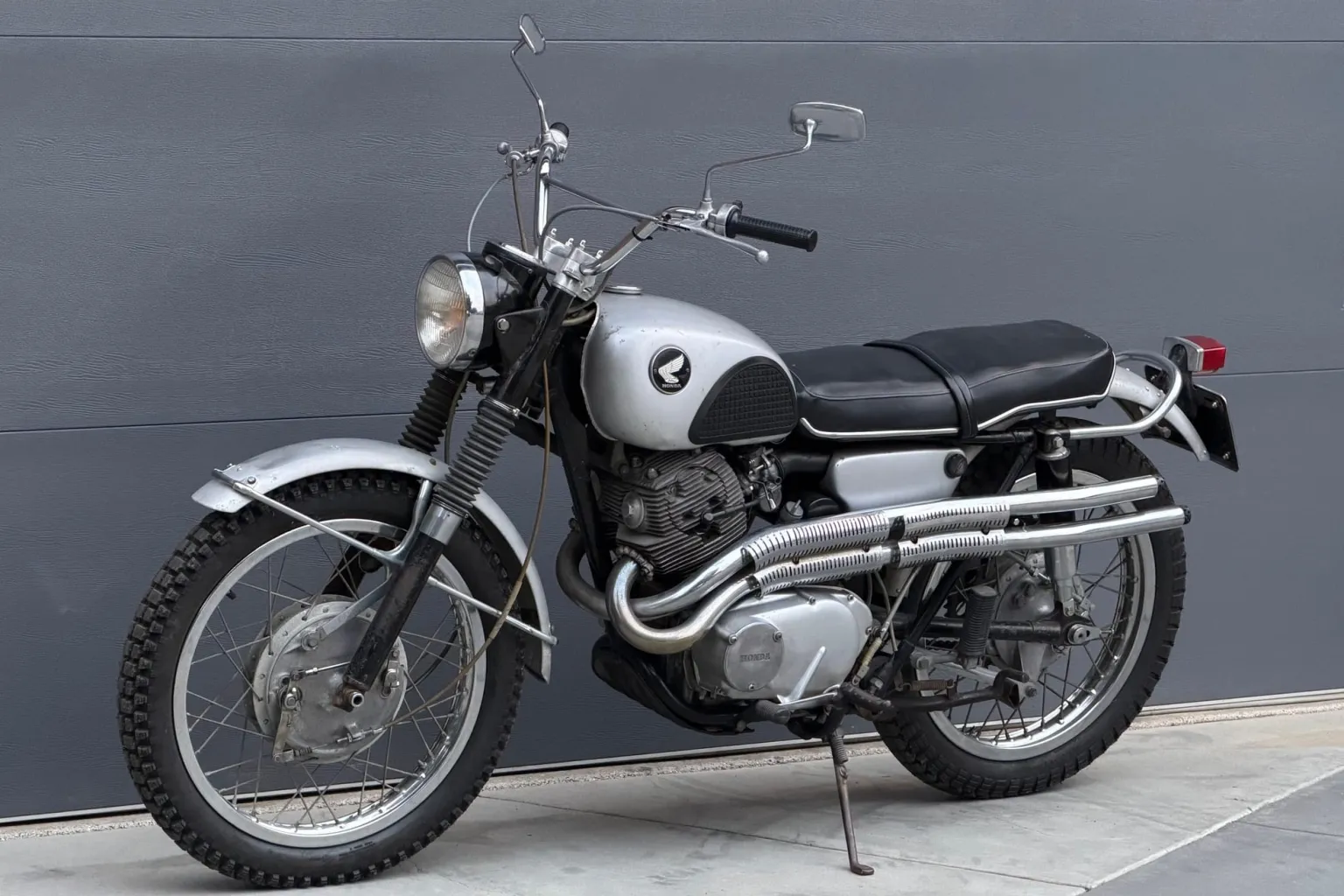
On July 28, 2026, a 1964 Honda CL72 Scrambler carrying a Paramount Pictures invoice made out to Elvis Presley closed on Bring a Trailer without a buyer. Thirty-eight bids pushed the silver twin to $14,555 before the clock ran out and the listing flipped to Reserve Not Met. By the arithmetic that usually drives auction coverage, that’s a non-story. By the standard we hold ourselves to at Modern Car Collector, it’s the more instructive result of the two.
This is not an article about a motorcycle that failed to sell. It is an article about the difference between a name on an invoice and a name on a screen credit — and about what happens when a boldface celebrity attachment runs into the more disciplined instincts of the small group of people actually willing to wire money.
A Small Honda With a Big Name Attached
The CL72 Scrambler was never meant to be a collector’s item. Derived from Honda’s CB72 Hawk, the 247cc SOHC parallel-twin was built for the booming early-1960s American market for lightweight, dual-purpose motorcycles — the same market Honda was courting with its famous You Meet the Nicest People on a Honda campaign, an effort to convince a mainstream, non-outlaw American public that motorcycling could be respectable, even aspirational. Bikes like this one were sold as disposable transportation, not heirlooms. Few survive with paperwork intact.
This one does. The consignment included a duplicate factory invoice, dated September 23, 1964, documenting delivery to Elvis Presley in care of Paramount Pictures Studios in Los Angeles. That single sheet of paper is the entire premise of the listing — and, properly understood, it is genuinely rare. Small-bore Japanese motorcycles from this era were not inventoried, insured as collectibles, or kept alongside their sales paperwork for six decades. The invoice is the artifact. The motorcycle is its supporting evidence.
The Difference Between “Delivered To” and “Seen With”
1964 was also the year Presley co-starred with Barbara Stanwyck in Roustabout, a picture built around carnival life and motorcycles, in which Presley rode a Honda on screen. That coincidence did a lot of work in the comment section beneath this listing, where longtime bidders debated whether this CL72 was connected to the film. It likely wasn’t. Several close readers of the listing pointed out that the screen-used Honda in Roustabout was a different, larger model — which means this Scrambler’s significance rests entirely on the invoice’s claim of personal delivery, not on any documented appearance in Presley’s films or public life.
That distinction matters more than it might seem. Collectors have learned, often expensively, that “delivered to” and “seen with” are not interchangeable categories of provenance. A factory shipping record proves a transaction. It does not prove attachment, use, sentiment, or duration of ownership — and serious buyers increasingly price that gap rather than ignore it. Our earlier coverage of Steve McQueen’s Husqvarna Motocrosser made a similar point about a different icon and a different bike: the market pays a real premium for documented use, and a smaller, more cautious premium for documented delivery alone.
Attention Without Conviction: Reading the Bid Sheet
On paper, the numbers around this sale look like a hit. Over fifteen thousand page views, more than a thousand watchers, eighty-two comments, and thirty-eight competitive bids from a genuine cross-section of bidders — not a single party running the number up alone. That is real engagement, not a fluke. But engagement measures curiosity. It does not measure conviction, and the two are frequently confused in celebrity-adjacent lots.
The seller, posting under the handle Niteroi, put it plainly once the auction closed: “we were far apart this time.” Thirty-eight bids is not a thin market — it is a crowd that showed up, looked closely, and stopped short of the number the consignor needed. That is a healthy market functioning correctly, not a failed one. It is close to what we described in our look at a reserve-not-met Lamborghini Countach 25th Anniversary earlier this year: an unsold lot is not evidence the market has cooled. It is often evidence the market is pricing condition and documentation more precisely than the surrounding hype suggests it should.
The Salvage Brand No One Could Bid Away
Buried near the bottom of the listing, past the invoice and the mechanical work, sat the detail that likely did the most damage to the final number: the California title carries a Salvaged brand. A branded title follows a vehicle permanently, regardless of how clean the current bodywork looks or how compelling the backstory attached to it is. It signals that, at some point in this motorcycle’s sixty-two years, an insurer or state authority determined it had been a total or constructive loss. That history is now part of the CL72’s permanent record, and it will suppress value at every future sale, not just this one.
Add to that an odometer showing just fifteen miles — about five of them ridden under the current owner, who acquired the bike in 2025 — with total lifetime mileage explicitly listed as unknown, and a non-operational original speedometer removed and included as a separate, unattached piece. None of this is disqualifying on its own. Together, it describes a motorcycle whose paper trail proves where it went in 1964 but goes nearly silent on where it went for the next sixty years. That silence, more than the Presley name, is what kept serious money from reaching the reserve.
What Serious Collectors Should Take From This
The lesson here isn’t that celebrity provenance doesn’t matter. It’s that celebrity provenance is not a single category — it’s a spectrum, and buyers who treat every boldface name attachment as equally strong will eventually overpay for the wrong end of it. A factory delivery record to a star is meaningfully different from a documented ownership history, which is meaningfully different from verified screen use, which is meaningfully different from photographic evidence of the star actually riding the specific machine in question. This CL72 sits at the weakest end of that spectrum, and thirty-eight bidders priced it accordingly.
It’s also a reminder that title branding and mileage gaps are not cosmetic footnotes to be waved away by a good story. They are structural facts that follow a vehicle into every future transaction, the same way originality and matching numbers do on the four-wheeled side of this hobby — a principle we’ve returned to often, including in our look at a 1960 Porsche 356B Sunroof Coupe Abarth Tribute that drew its strength from an unbroken, honestly documented history rather than a famous name. Honda’s own collector market, from Scramblers like this one to modern icons like the Honda S2000, rewards exactly that kind of discipline.
A famous name can fill a comment section. It takes a clean title and an accountable odometer to fill a reserve. The thirty-eight people who bid on this Honda weren’t dismissing Elvis Presley — they were correctly pricing a Scrambler whose most compelling evidence sits on an invoice, not in the ownership history that followed it. In today’s collector market, that is very often the whole story hiding behind the headline.
The collector car market, every weekday morning.
Auction results, price moves and what’s crossing the block, read in four minutes. Free, from Modern Car Collector.
No spam, unsubscribe in one click. Or read more about the Brief.

 Kyle Matthews
  Shawn Henry