

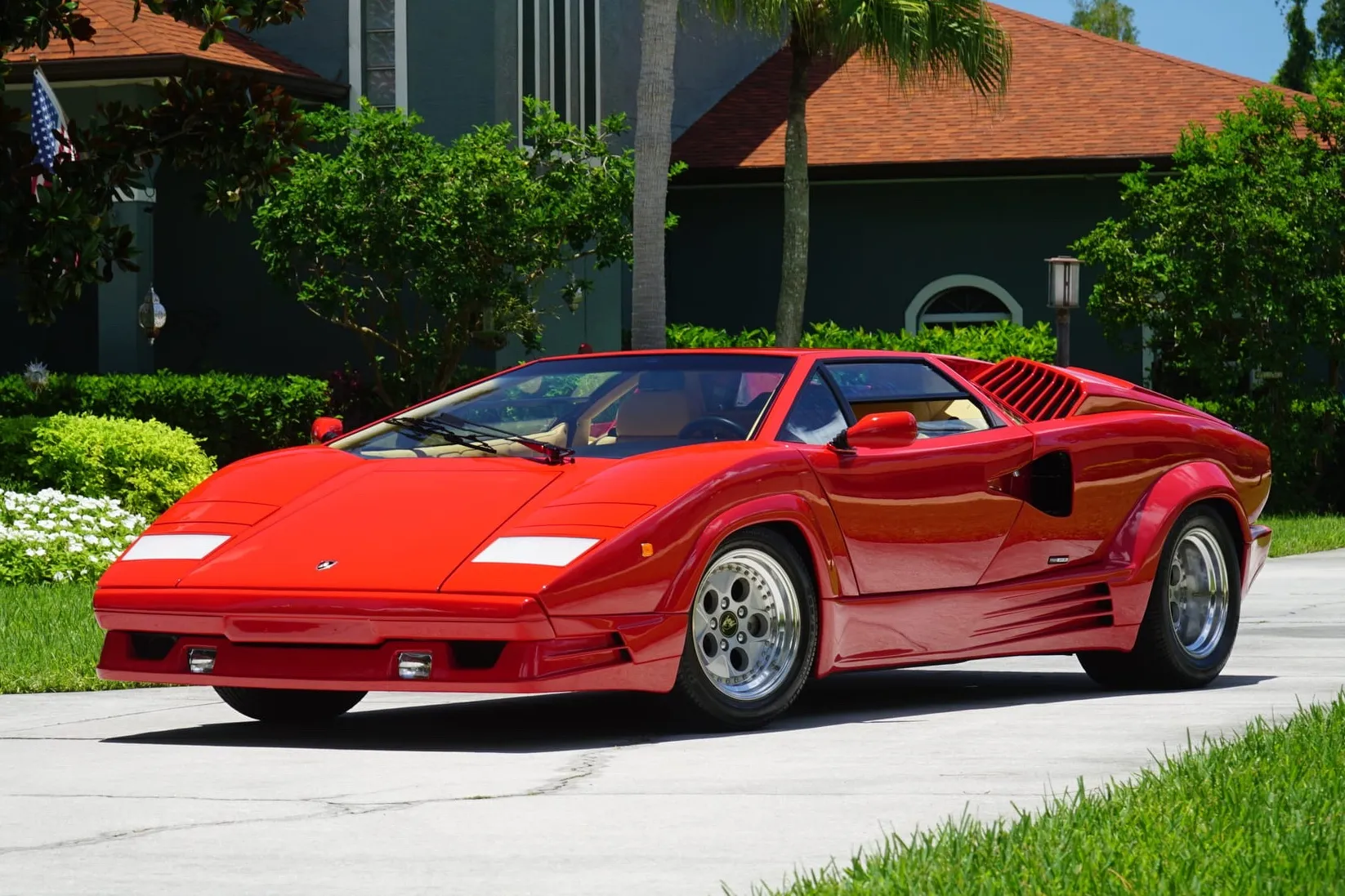
Every generation of Lamborghini enthusiast has an opinion about the Countach 25th Anniversary, and for thirty-five years that opinion has mostly been unkind. Purists tend to blame the car for ruining Marcello Gandini’s original wedge, pointing to its bloated fenders, slab-sided decklid, and fussier face grafted onto one of the cleanest shapes in automotive history. A newly consigned example, chassis KLA12072, offered on Bring a Trailer with just 379 kilometers on its odometer, is worth examining not because it will settle that argument, but because it finally lets collectors judge the car Lamborghini actually built, rather than the car that thirty-six years of use, modification, and hardened opinion have turned it into.
Lamborghini commissioned the redesign in 1988 to mark a quarter-century since the marque’s founding, and handed the project not to Gandini but to a young composites specialist named Horacio Pagani, then working inside Lamborghini’s experimental department years before he founded his own hypercar company. Pagani’s brief was narrow: freshen a fifteen-year-old shape without touching its wheelbase or greenhouse. His solution added carbon-fiber and Kevlar body panels, restyled sills, a revised front fascia, and intake ducts canted forward with fine horizontal fins, changes that modernized the silhouette but also thickened it, trading the Countach’s razor-edged proportions for something heavier and more sculptural. Lamborghini built roughly 658 examples between 1988 and 1990, making the 25th Anniversary the most numerous Countach variant ever produced, and, when the last one left Sant’Agata, the final expression of the model that had defined the marque since 1974.
Production volume alone would suggest the 25th Anniversary should be the least discussed Countach, not the most. It is not the rarest series; the early LP400 periscopio cars, numbering roughly 150, hold that distinction. For years the 25th Anniversary actually traded at a discount to earlier, purer-looking Countaches, precisely because collectors treated Pagani’s redesign as a compromise rather than a culmination. That discount has been narrowing. A generation of buyers who never experienced the Countach as a new car is now shopping by different criteria than their predecessors, favoring the version that is the most powerful, the most usable, and the most visually dramatic in the metal, criteria the wide-body 25th Anniversary satisfies better than any Countach that preceded it.
Specification matters as much as styling here. American-market 25th Anniversary Countaches were fitted with Bosch fuel injection to satisfy U.S. emissions law, along with additional bumper hardware to meet crash standards. Euro-market cars like KLA12072 kept the Countach’s original induction system: six Weber 44 DCNF downdraft carburetors feeding a 5.2-liter, four-valve V12 descended from Giotto Bizzarrini’s 1963 architecture, factory-rated at 448 horsepower. For collectors, that distinction is not a footnote. A carbureted Countach sits mechanically closer to the car Lamborghini intended, with the induction noise, throttle response, and tuning idiosyncrasies that defined the V12 era, rather than a smoothed-over emissions compromise. It is also, increasingly, what buyers are asking for by name, a preference visible even in the enthusiast commentary trailing this listing.
KLA12072’s ownership history reinforces geographic patterns that have shaped the global supercar market for decades. The car was delivered new to a first owner in Saudi Arabia, part of a wave of low-mileage exotics that entered Gulf collections in period and were driven sparingly, if at all. It surfaced in Europe in 2018, when a second owner brought it to Monaco, one of the world’s densest concentrations of seven and eight-figure cars, before it was sold again and exported to the United States in 2023. Each leg of that journey helps explain the odometer reading: this is a car that spent nearly its entire life in markets where a Countach was bought to be owned rather than driven, and where high-value exotics are stored, insured, and maintained rather than used as intended. A clean title history since 2024 and a documented service this year suggest the current dealer-owner has kept the car mechanically sorted rather than simply parked.
For serious buyers, the number that matters most is not the current bid but the odometer. A Countach that has covered 379 kilometers in thirty-six years has not been restored, because there has been nothing to restore. It has not been re-trimmed, because the Champagne leather has never worn through. Its carburetors have not been swapped for injection, its bumpers have not been Americanized, and its geometry has not been altered by decades of bushings, panel gaps, and paintwork accumulating small deviations from factory specification. In a model where so many surviving examples have been modified, converted, or simply used hard through the 1990s and 2000s, an unmolested Euro 25th Anniversary is a rarer thing than its production number of 658 would suggest. Rarity, in this case, is not about how many were built. It is about how few remain in the condition Lamborghini delivered them.
Bidding on KLA12072 currently stands at $800,000 with more than a week remaining, already well above the retail range 25th Anniversary Countaches commanded five years ago. That trajectory says less about a single auction than about a broader recalibration underway across the Countach market, one echoed by Lamborghini’s decision to revive the nameplate with the limited-production Countach LPI 800-4, a modern hypercar built explicitly to trade on the original’s silhouette and mystique. Whether or not that reissue directly influenced demand for the original cars, it has undeniably reintroduced the Countach name to a younger, wealthier buying audience, many of whom are now discovering that the analog original, particularly in its final and most dramatic form, remains the more significant car.
That the 25th Anniversary also happened to be the last Countach built before the Diablo arrived in 1990 sharpens its significance further. Every final-example argument in the collector market deserves scrutiny, since plenty of send-off editions are marketing exercises rather than meaningful conclusions, as Lamborghini’s own last-of-the-breed Diablo GT later demonstrated when it closed out the V12 raging-bull era with considerably more mechanical drama than sentiment. But the Countach’s ending was different: it was the car that had defined Lamborghini’s identity for a decade and a half, reaching the end of its development in a form purists still argue was a step in the wrong direction. Whether that argument holds up is beside the point. What matters is that KLA12072 preserves the ending Lamborghini actually built, not a reinterpretation of it.
Collectors evaluating cars like this should resist two easy conclusions. The first is that low mileage alone creates value; plenty of unused cars are unremarkable, while plenty of well-driven, well-documented examples with matching numbers and honest histories are worth more than showroom queens with unclear pasts. The second is that scarcity alone explains desirability, an assumption worth challenging given how often production numbers turn out to say little about why a given car actually commands a premium. Recent single-owner consignments crossing the block have tested how much a name or a story is really worth, and the lesson has been consistent: provenance matters only when it is verifiable and when it changes how a car should be understood. What makes KLA12072 different is that its low use and its geography reinforce each other. A Gulf-delivered, Monaco-kept, carbureted Euro car with 379 kilometers on the clock is not a curiosity. It is closer to a factory specification sample than a used automobile.
None of this means $800,000 is the right number, or that bidding will or won’t climb further before the auction closes on July 31. That is a question for the bidders currently chasing this car, not for the rest of the market. The more durable takeaway is this: the Countach 25th Anniversary spent three decades being treated as the version serious collectors were supposed to overlook. A car like this one argues that collectors were judging the wrong thing. They were judging thirty-six years of wear, modification, and compromise layered onto a controversial design. What they should have been judging is the design itself, as Lamborghini actually built it, and that is precisely what 379 kilometers preserves.
The collector car market, every weekday morning.
Auction results, price moves and what’s crossing the block, read in four minutes. Free, from Modern Car Collector.
No spam, unsubscribe in one click. Or read more about the Brief.



 John Lloyd
  Shawn Henry
  Eve Nowell