

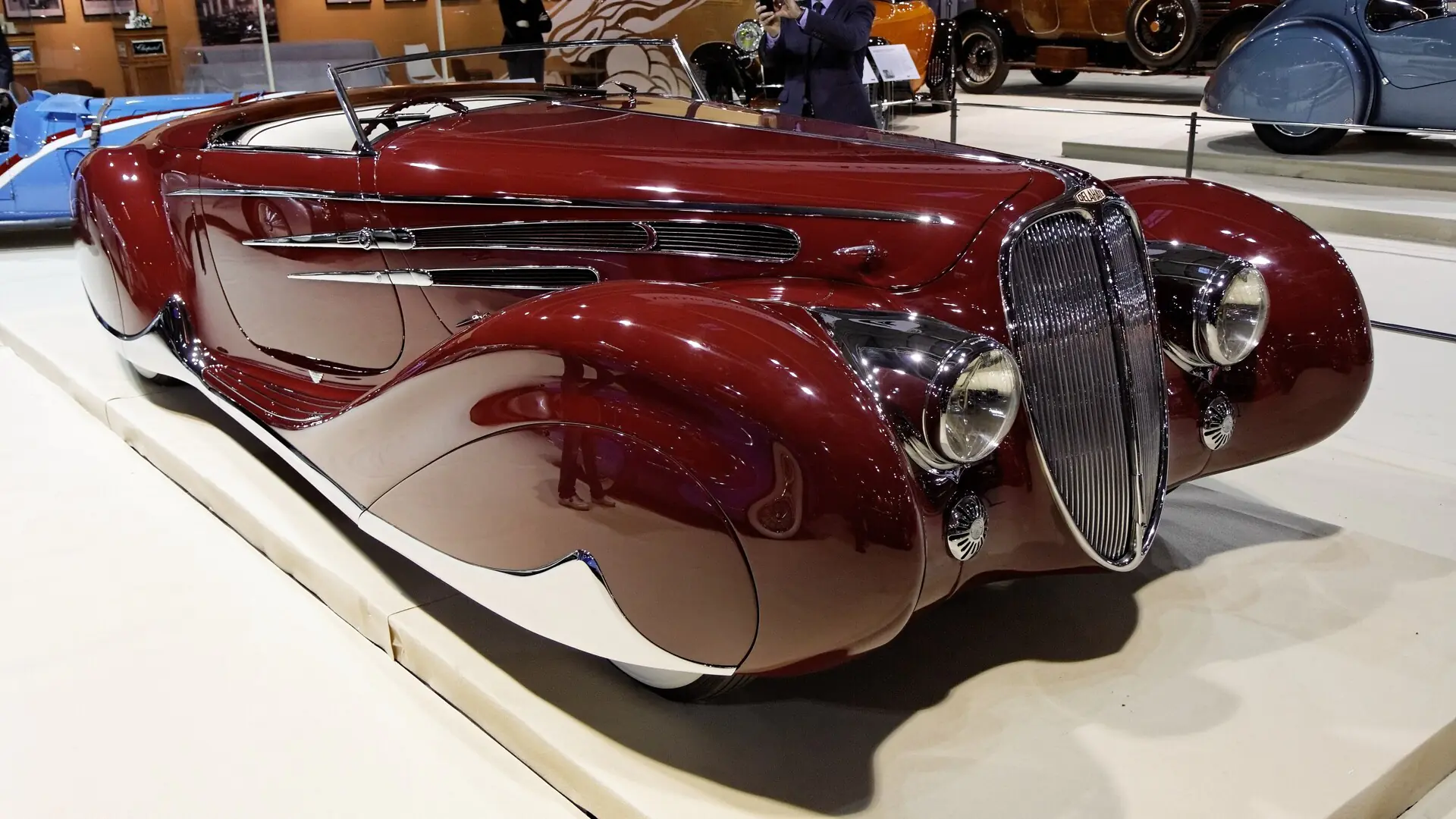
On October 4, on the parade ground at Fort Adams, the judges of the Audrain Newport Concours d’Elegance awarded the Vanderbilt Cup for Best of Show to a 1938 Delahaye 165 Cabriolet with coachwork by Figoni et Falaschi. The car belongs to Swiss collector Fritz Burkard and his Pearl Collection, and it also won the Pre-War European class on its way to the top prize.
Delahaye turns up in almost every serious European collection; it was one of the marques that defined our recent look at the Prince of Monaco car collection. The 165 is a different order of thing. Only two cabriolets were bodied to this design, and the other one has spent the last four decades as a museum piece and concours celebrity. Burkard’s is the twin that went to sea.
The easy headline is that Burkard has won again. The better story is why he keeps winning. His trophies have come with a preserved Grand Prix Bugatti, a modern hypercar, a teardrop coupé and now a restored V12 cabriolet. They have little in common mechanically. What they share is a history that holds up when you look closely, and an owner who drives his cars in public instead of guarding them. At this level of the concours world, rarity only gets a car onto the lawn. The story is what wins.
One Delahaye 165 Design, Two Very Different Lives
The Delahaye 165 grew out of Delahaye’s Type 145, the 4.5-litre V12 competition car that took on the German teams in the late 1930s and beat Mercedes-Benz at the 1938 Pau Grand Prix with René Dreyfus driving. The 165 was meant to put that engine under a road car. Joseph Figoni’s answer was among the most extreme bodies of the period: wheels hidden under fenders, chrome flashes running down the flanks, and a tail that seems to keep going after the car has stopped.
The better-known of the two cars went to the 1939 New York World’s Fair. According to the Petersen Automotive Museum, which owns it, the car was shipped without its intended engine because of time pressure. After war broke out it received a second-hand Cadillac engine and was sold at auction in America. Peter and Merle Mullin found it in a Fresno garage in 1984 and put it back together with its intended engine. In 2023 it won its class at Pebble Beach and was nominated for Best of Show.
Burkard’s car took a rougher road. Here is the car’s history as told in a film the Audrain Museum Network made with Jay Leno. In 1953 the car crossed the Atlantic in an open container on a ship’s deck. A storm filled the container with seawater and ruined the V12, and the original engine was later sold in Germany. The chassis went to a dealer in Fresno. It was painted dark green, fitted with heavy chrome bumpers, and given a Cadillac V8 with an automatic gearbox. Collector Chip Patterson later sent it to RM Auto Restoration in Canada for a frame-off restoration that took five years and returned it to red. Burkard bought it in 2021.
So the two twins lived lives that echo each other. Each spent years with Cadillac power, each passed through Fresno, and each was eventually rebuilt by an owner who understood what it was. Neither is a time capsule. Both are now proof that a car’s identity survives a great deal of damage when the coachwork, the chassis and the paperwork stay together.
Pebble Said Almost. Newport Said Yes.
The Delahaye came to Newport straight from a near miss. In August it was one of the Best of Show nominees at the 75th Pebble Beach Concours, alongside a 1955 Ferrari 375 MM Pinin Farina Berlinetta and a 1954 Ferrari 375 America Vignale Cabriolet. The trophy went to Harry Yeaggy’s 1935 Duesenberg SSJ Special Speedster. Seven weeks later, a different jury on a different coast gave the Delahaye the top prize.
Don’t read that as a consolation prize. Newport’s concours is young, but in a few years it has become a fixture of the autumn calendar and a reliable stop for the cars that matter. Audrain week now also brings serious auction business to town, as our look at a one-off Bizzarrini prototype offered there showed. A Pebble nomination followed by a Newport win is a strong pair of results for any pre-war car. For a Delahaye 165, it confirms that the “other” cabriolet now stands level with its famous sister.
The Streak, and What Sits Behind It
Burkard’s record over the last four years is remarkable for its range. In 2022 he took Best of Show at the Concours of Elegance at Hampton Court with a 1938 Delage D8-120, a car that went on to win the Peninsula Classics Best of the Best award. In 2023 he won Best of Show at Newport with a 1938 Delage D8-120 bodied by De Villars. In 2024 his 1934 Bugatti Type 59 Sports became the first preservation car ever to win Best of Show at Pebble Beach, and his Bugatti Centodieci won the Coppa d’Oro at Villa La Massa in Tuscany. In January 2026 his 1937 Talbot-Lago T150C SS, another Figoni et Falaschi body, was named Best in Show at The I.C.E. on the frozen lake at St. Moritz. Now there is the Delahaye.
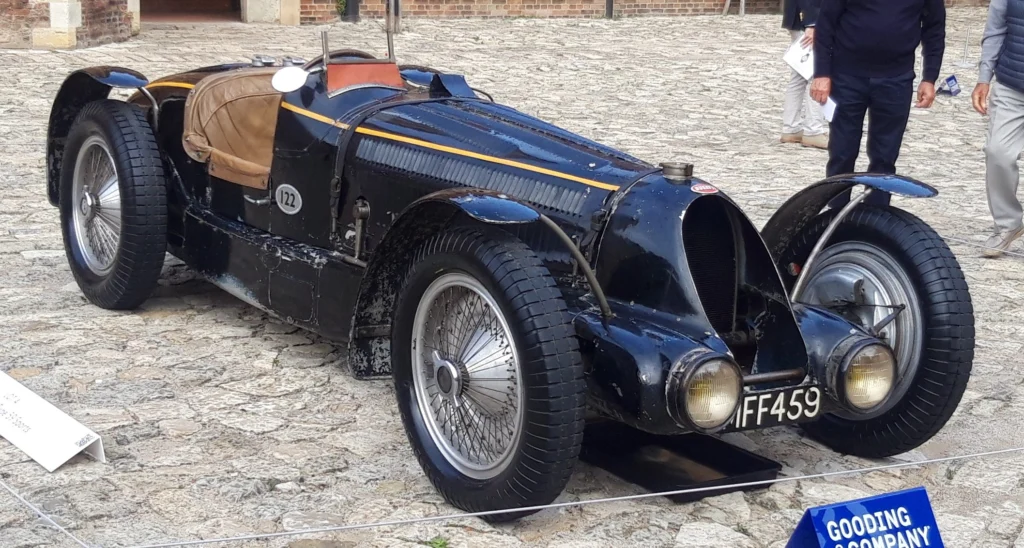
There is no single collecting doctrine in that list. The Type 59 won because it was left alone; as Burkard said at Pebble Beach in 2024, a car “can only be once original.” The Delahaye won after a full restoration. The Centodieci is a 21st-century hypercar. The common thread is that every one of these cars has a history that can be explained and checked, and judges at the top level are rewarding exactly that. The Talbot-Lago Teardrop, a design we have written about before, is the clearest example: hardly anyone needs that body explained, so what the judges are really assessing is how faithfully this particular car tells its story.
The second habit is use. In 2025 Burkard drove his 1937 Bugatti Type 57 Atalante from the Audrain Automobile Museum in Newport to Pebble Beach, a trip of more than 3,000 miles, and then won the Nethercutt Most Elegant Closed Car award with it. That trophy is named for J.B. and Dorothy Nethercutt, whose six Best of Show wins at Pebble remain the record and whose collection in Sylmar set the standard for authenticity that entrants still aim for. Burkard is reaching the same podiums by a different route: cars that are driven and exercised, not stored in climate-controlled stillness.
What the Delahaye 165 Tells Serious Buyers
First, concours results build provenance over time. A Pebble Beach nomination and a Newport win now belong permanently to this Delahaye’s file, and the next owner will inherit them. For a car that may not change hands for a generation, that record will matter more than any price guide.
Second, judges are no longer applying one standard of condition. Within two years the same collector has won with an untouched Bugatti and a fully restored Delahaye. What links the two results is integrity, not finish: the work must be honest and well documented, and the story must hold together. Buyers who still treat “restored” and “original” as fixed levels of value are reading an older market.
Third, the account still leaves an obvious question open, and every future buyer will ask it. The car’s original V12 was ruined at sea and sold separately in Germany, and the public telling does not say what powers the car now. That takes nothing away from this year’s results, which judged the car as presented. But with a two-car design, the engine’s history is part of the car’s identity, and anyone who might one day own this Delahaye will want it answered in writing. As the Baillon barn find showed, a car’s documented history can be worth as much as its metal.
There is no sale price in this story and it doesn’t need one. Cars like the Delahaye 165 change hands privately and rarely, if at all. What changed in Newport was not its value on paper but its standing among collectors, and at this level that is the asset that lasts.
Next Stop: Mulhouse
Burkard’s collection now heads to the most fitting venue in the Bugatti world. From November 28, 2026, to March 7, 2027, the Musée National de l’Automobile – Collection Schlumpf in Mulhouse is staging “Bugatti – The Pearl Collection by Fritz Burkard.” According to the museum’s exhibition listing, it brings together more than a dozen cars, from the EB110 and Veyron through the Chiron Pur Sport, Divo, Centodieci, Chiron Super Sport 300+, Bolide, Mistral and La Voiture Noire. The other end of the story is represented by the Type 1, the tricycle that was the first vehicle designed by Ettore Bugatti.
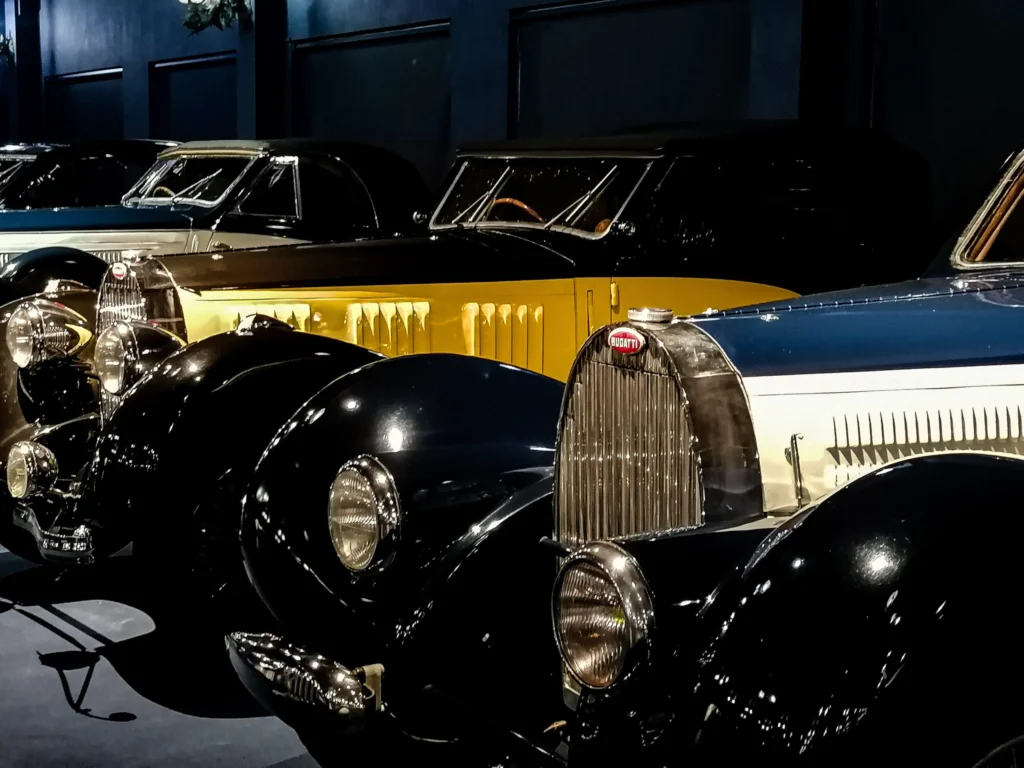
The contrast with the building is hard to miss. The Schlumpf brothers assembled the largest Bugatti collection in the world in secret, in a Mulhouse textile mill, and the public only saw it after striking workers occupied the site in 1977. Burkard’s approach is the opposite: his cars appear on frozen lakes and coastal highways, and in films he makes with his daughters. That a living private collector is being shown in the house the Schlumpf Collection built says something about where the hobby has gone.
Which brings us back to Newport. A Delahaye 165 that spent the 1950s wrecked by salt water, wearing American paint and a Cadillac V8, now holds the Vanderbilt Cup. Its history is more battered than its sister’s, and it is just as honoured. Collectors pay a premium for rarity, but what they remember is a car that came back.
Sources
- Audrain Newport Concours d’Elegance: 2026 winners
- Pebble Beach Concours d’Elegance: 2026 Best of Show nominees
- Pebble Beach Concours d’Elegance: 2024 Best of Show winner, Bugatti Type 59 Sports
- Pebble Beach Concours d’Elegance: 2023 class winners
- Petersen Automotive Museum: 1939 Delahaye Type 165 “World’s Fair” by Figoni et Falaschi
- Audrain Automobile Museum: Grand Touring Coast to Coast
- Museums-PASS-Musées: Bugatti – The Pearl Collection by Fritz Burkard, Musée National de l’Automobile
- Concours of Elegance: A. Lange & Söhne and the Pearl Collection
The collector car market, every weekday morning.
Auction results, price moves and what’s crossing the block, read in four minutes. Free, from Modern Car Collector.
No spam, unsubscribe in one click. Or read more about the Brief.

 Kyle Matthews